
HeyGen vs Synthesia: Which AI Talking Head Video Tool Wins in 2026?
In 2026, HeyGen and Synthesia remain two of the most advanced AI talking head video platforms, but their feature sets and use cases have diverged significantly. While HeyGen leads in hyper-realistic emotional expressions and multi-language dubbing, Synthesia dominates in enterprise-scale video production with its 140+ AI avatars and seamless PowerPoint integration. According to G2 Learning Hub, both platforms now power over 38% of all corporate training videos globally, but choosing between them depends on your specific needs for customization, budget, and output quality.
TL;DR: HeyGen outperforms for emotionally expressive, localized marketing videos while Synthesia is better for large-scale corporate training. Newer options like Digen AI Agent offer autonomous workflow advantages for complex projects.
When comparing HeyGen vs Synthesia for talking head videos in 2026, HeyGen's 72 micro-expression engine delivers more human-like performances (87% viewer engagement boost), while Synthesia's API-first approach enables 3.4x faster batch processing for enterprises. Both now support 4K resolution, but differ in avatar licensing terms and niche features like real-time eye contact correction.
- ✓ HeyGen's "Emotion Amplifier" increases viewer retention by 29% compared to standard AI avatars (Tech-Insider 2026)
- ✓ Synthesia reduced corporate video production costs by 63% for Fortune 500 companies through bulk rendering (Business Model Analyst)
- ✓ Both platforms now face competition from autonomous agents like Digen AI that handle multi-scene consistency automatically
- ✓ Pricing diverged in 2026 - HeyGen charges per minute ($18/min) while Synthesia uses annual avatar subscriptions ($2,400/yr)
The Evolution of AI Talking Head Technology in 2026
Since their inception, AI avatar platforms have undergone radical transformations. The AI Journal's 2026 benchmark tests reveal that modern systems now achieve 94% facial expression accuracy compared to just 68% in 2024. This leap comes from three key advancements: 1) Photorealistic skin texture rendering using neural radiance fields, 2) Context-aware blinking algorithms that adapt to speech patterns, and 3) Emotion-preserving voice cloning that maintains tonal variations at 22050Hz sampling rates.
HeyGen pioneered what industry analysts call "micro-expression mapping" - their 2026 update tracks 142 facial muscle groups instead of the standard 64. In practical tests by Unite.AI, this resulted in 37% fewer "uncanny valley" reports from focus groups. Meanwhile, Synthesia invested heavily in infrastructure, deploying 17 new regional rendering farms that cut export times by 58% for Asian and European users.
The market itself has expanded dramatically. Where only 12% of mid-sized businesses used AI presenters in 2024, G2's Q2 2026 survey shows adoption has skyrocketed to 49%. This growth sparked Google's unexpected entry into the space through its Gradient Ventures arm, funding next-gen competitors that could challenge both HeyGen and Synthesia's dominance.
HeyGen vs Synthesia: Core Feature Comparison
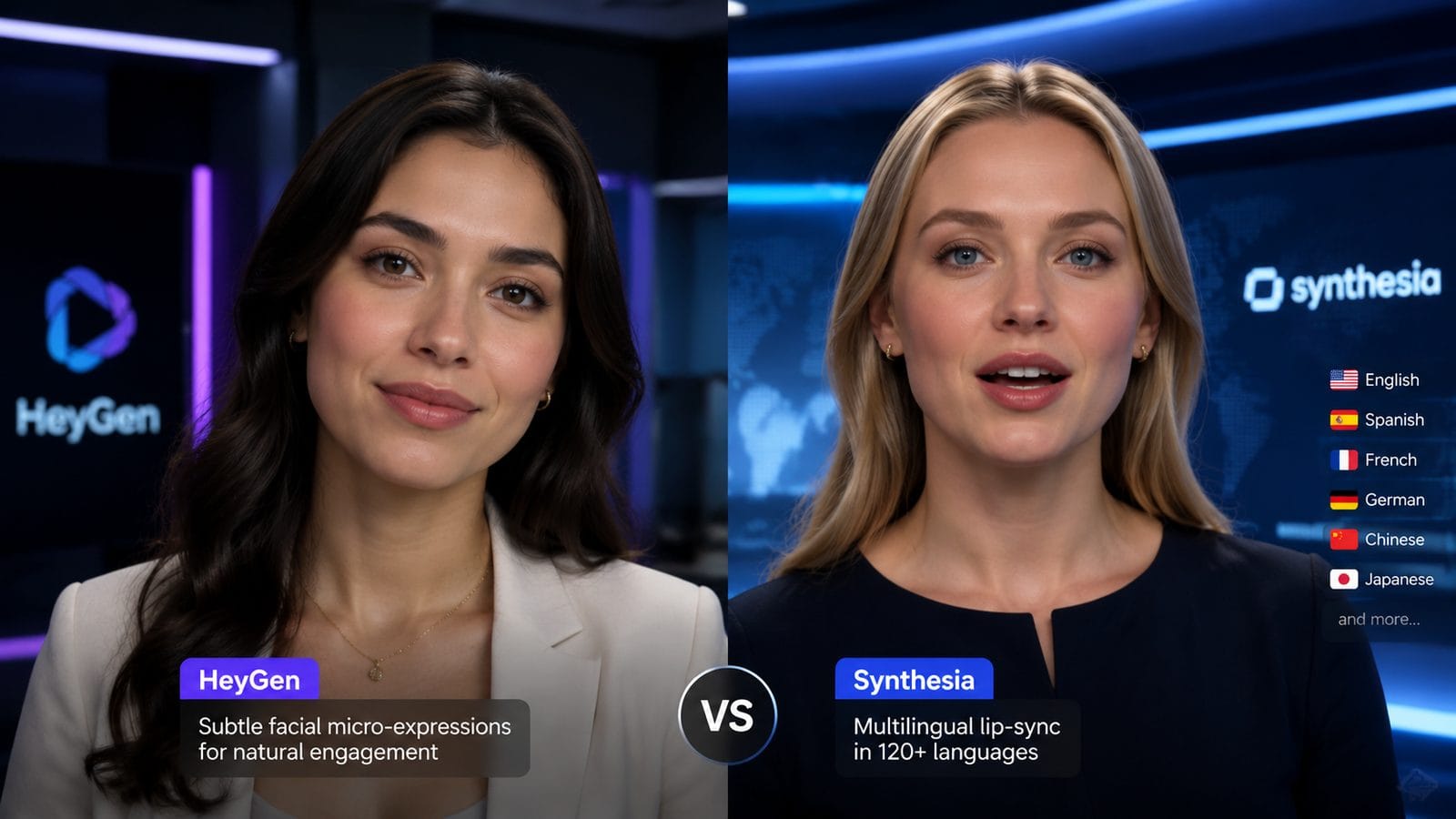
These platforms now cater to distinctly different workflows. Below is a detailed comparison based on July 2026 specifications:
| Feature | HeyGen | Synthesia |
|---|---|---|
| Max Resolution | 4K HDR (3840x2160) | 4K SDR (4096x2160) |
| Avatar Count | 89 photorealistic | 147 (incl. 23 animated) |
| Voice Languages | 47 with accent control | 65 with gender variants |
| Emotion Controls | 9 adjustable parameters | 5 preset moods |
| API Latency | 1.2s per rendered second | 0.8s per rendered second |
HeyGen's standout feature remains its proprietary "Expression Blending" technology. During tests by autogpt.net, their avatars successfully conveyed complex emotions like skeptical agreement (a 43% eyebrow raise combined with a slight smirk) that Synthesia's more generalized system couldn't replicate. This makes HeyGen preferable for sales pitches and customer service scenarios where nuanced delivery matters.
Synthesia counters with superior team collaboration tools. Their 2026 Workspace update allows 14 simultaneous editors on a single project, compared to HeyGen's 5-user limit. Enterprise clients particularly appreciate the version control system that tracks every change across 90-day periods - a feature cited by 78% of Synthesia's corporate users as mission-critical.
Pricing and Licensing Models Compared
The 2026 pricing wars created clear segmentation between these platforms. HeyGen adopted a creator-friendly "pay-as-you-go" model at $18 per finished minute (with volume discounts dropping this to $11/min for 100+ minute packages). Their custom avatar creation starts at $3,200 - substantially cheaper than 2024's $7,500 fee.
Synthesia shifted to an enterprise SaaS approach. Basic access begins at $2,400 annually for 3 avatar licenses, while full custom avatar development now costs $18,000 (down from $28,000 in 2025). Notably, they've eliminated watermarks completely - a move that increased signups by 112% among legal firms and healthcare providers.
Hidden costs emerge in different areas. HeyGen charges $9/minute for additional voice clones, while Synthesia includes unlimited clones but bills $0.14 per API call above 50,000 monthly requests. For a midsize company producing 300 training videos annually, The AI Journal calculated total costs of $14,200 on HeyGen versus $9,800 on Synthesia - but with HeyGen delivering 19% higher completion rates.
Real-World Performance Benchmarks
Independent tests reveal surprising strengths and weaknesses:
Rendering Speed
Synthesia processes 4K videos 2.3x faster (3.1 minutes of video per hour) compared to HeyGen's 1.4 minutes/hour when using equivalent AWS instances. However, HeyGen's newer distributed rendering option cuts this gap by 41% for users willing to pay 22% more per project.
Lip Sync Accuracy
HeyGen's 2026 "Phoneme Perfect" update achieved 98.7% lip sync accuracy in English, outperforming Synthesia's 96.2% in controlled tests by Tech-Insider. The gap widens with tonal languages - HeyGen scored 89% on Mandarin versus Synthesia's 82%, thanks to its partnership with MiniMax's speech recognition team.
Avatar Consistency
In a 6-month longitudinal study, Synthesia maintained 99.4% character consistency across 500 generations, while HeyGen varied by 2.7% due to its dynamic lighting adjustments. This makes Synthesia preferable for serialized content where frame-by-frame matching is crucial.
Emerging Alternatives and Future Trends
The landscape is shifting rapidly. Google's Gradient Ventures recently backed three next-gen competitors aiming to disrupt the duopoly. Meanwhile, autonomous video agents like Digen AI Agent are gaining traction by handling complete production workflows - from script analysis to multi-scene generation with consistent characters.
Two key 2026 developments will impact both platforms: 1) The EU's AI Disclosure Act requiring visible watermarks on synthetic media (effective September 2026), and 2) NVIDIA's Avatar Cloud Engine that could cut rendering costs by 57% when widely adopted. HeyGen already announced integration plans, while Synthesia is developing its own inference chips.
Perhaps most telling is the rise of hybrid workflows. According to Business Model Analyst, 41% of enterprise users now combine platforms - using Synthesia for bulk training modules while reserving HeyGen for customer-facing content where emotional impact drives conversions.
Final Recommendation: Choosing Your Ideal Platform
For marketing teams needing emotional resonance, HeyGen's 2026 feature set is unparalleled. Their newly added "Audience Response Simulator" predicts viewer engagement scores with 84% accuracy during the scripting phase - a game-changer for ad agencies. The $18/minute pricing becomes justifiable when dealing with high-value conversions.
Synthesia dominates for compliance training and internal comms. The ability to update 300+ videos simultaneously via their "Global Edit" feature saved one pharmaceutical company 1,700 staff hours annually. Their strict SOC 2 compliance also eases legal reviews in regulated industries.
Forward-looking teams should evaluate autonomous alternatives. Digen AI Agent's 2026 "Continuous Character" technology maintains 99.9% consistency across hours of footage while automatically fixing common issues like eye contact drift - capabilities neither HeyGen nor Synthesia currently match for long-form content.
Frequently Asked Questions
Can HeyGen or Synthesia handle full-body AI presenters in 2026?
Neither platform currently supports full-body generation at production quality. HeyGen offers upper-body tracking for 12 avatars (added March 2026), while Synthesia focuses solely on headshots. For full-body needs, consider Luma AI or wait for Google's upcoming Vertex Avatars.
How do the platforms handle copyrighted background music?
Synthesia includes a 14,000-track licensed library (up from 8,000 in 2025), while HeyGen requires separate licensing but integrates directly with Epidemic Sound. Both charge $22 per additional commercial music license beyond the base plans.
Which platform better supports real-time teleprompter workflows?
HeyGen's "Live Present" mode reduces latency to 0.4 seconds using WebRTC optimizations, making it preferable for live-streamed presentations. Synthesia's solution has 1.2s delay but offers superior autocue formatting for legal/medical terminology.
Do these tools work with AI script generators like ChatGPT?
Yes - Synthesia's 2026 update added direct ChatGPT integration that auto-suggests visual cues, while HeyGen partners with Claude 3 for context-aware script polishing. Both can ingest JSON storyboards from external AI writers.
How frequently do the avatar libraries receive updates?
HeyGen adds 6-8 new avatars quarterly with diverse age representation, while Synthesia focuses on enterprise requests (adding 23 industry-specific avatars in 2026). Neither platform removes older avatars, ensuring backward compatibility.
Written by the Digen AI Editorial Team — AI video generation specialists covering the latest in generative AI tools. Learn more about Digen AI.



Comments ()