
HeyGen vs ElevenLabs Text to Video (2026): Which Wins?
In the rapidly evolving landscape of AI video generation, the question of HeyGen vs ElevenLabs text to video is one of the most debated in 2026. Both platforms offer powerful text-to-video capabilities, but they excel in different areas: HeyGen leads with hyper-realistic avatars and video translation, while ElevenLabs dominates with industry-best voice quality, sound effects, and music generation. The best choice depends entirely on your specific use case—whether you need a lifelike digital presenter or a cinematic audiovisual experience.
HeyGen vs ElevenLabs text to video in 2026 is a battle between avatar realism and audio excellence. HeyGen’s Avatar IV delivers unmatched lip-sync and facial expressions, making it ideal for talking-head videos. ElevenLabs, with its v3 voices, SFX, and Eleven Music, provides superior soundtracks and voiceovers, perfect for storytelling and marketing content.
- ✓ HeyGen’s Avatar IV (released in September 2025) offers significantly improved realism and gesture control.
- ✓ ElevenLabs v3 voices (launched in August 2025) set new benchmarks for natural speech, with integrated SFX and music.
- ✓ HeyGen provides a dedicated API for seamless integration, while ElevenLabs focuses on a robust text-to-speech and audio ecosystem.
- ✓ For video translation, HeyGen is a top performer according to a May 2026 roundup of the best 8 AI video translation tools.
- ✓ Both platforms offer competitive pricing, but the value proposition differs based on whether you prioritize video avatars or audio quality.
HeyGen vs ElevenLabs Text to Video: A 2026 Comparison
As AI video creation tools mature, professional creators and businesses are increasingly comparing HeyGen vs ElevenLabs text to video capabilities. Recent developments, such as HeyGen’s Avatar IV update in September 2025—described by ProVideo Coalition as a leap in realism—and ElevenLabs’ v3 voices and SFX release in August 2025, have sharpened the competition. Both platforms now offer end-to-end pipelines from text prompt to final video, but they approach the challenge from fundamentally different angles.
HeyGen has evolved from a simple avatar generator into a full video translation powerhouse. Its API, highlighted in an April 2026 article on autogpt.net, enables developers to integrate text-to-video workflows into custom applications. ElevenLabs, traditionally known for text-to-speech, has expanded into video by pairing its v3 voices with sound effects and music generation, allowing users to create complete audiovisual narratives without external audio tools.
When evaluating HeyGen vs ElevenLabs text to video, consider that HeyGen’s strength lies in visual fidelity—particularly in avatar-driven content such as corporate training, news anchors, and multilingual videos. ElevenLabs excels in sonic richness, making it ideal for video essays, explainer videos, and ads that rely on emotive voiceovers and background audio.
Feature Face-Off: HeyGen’s Avatar AI vs ElevenLabs’ Voice-First Approach
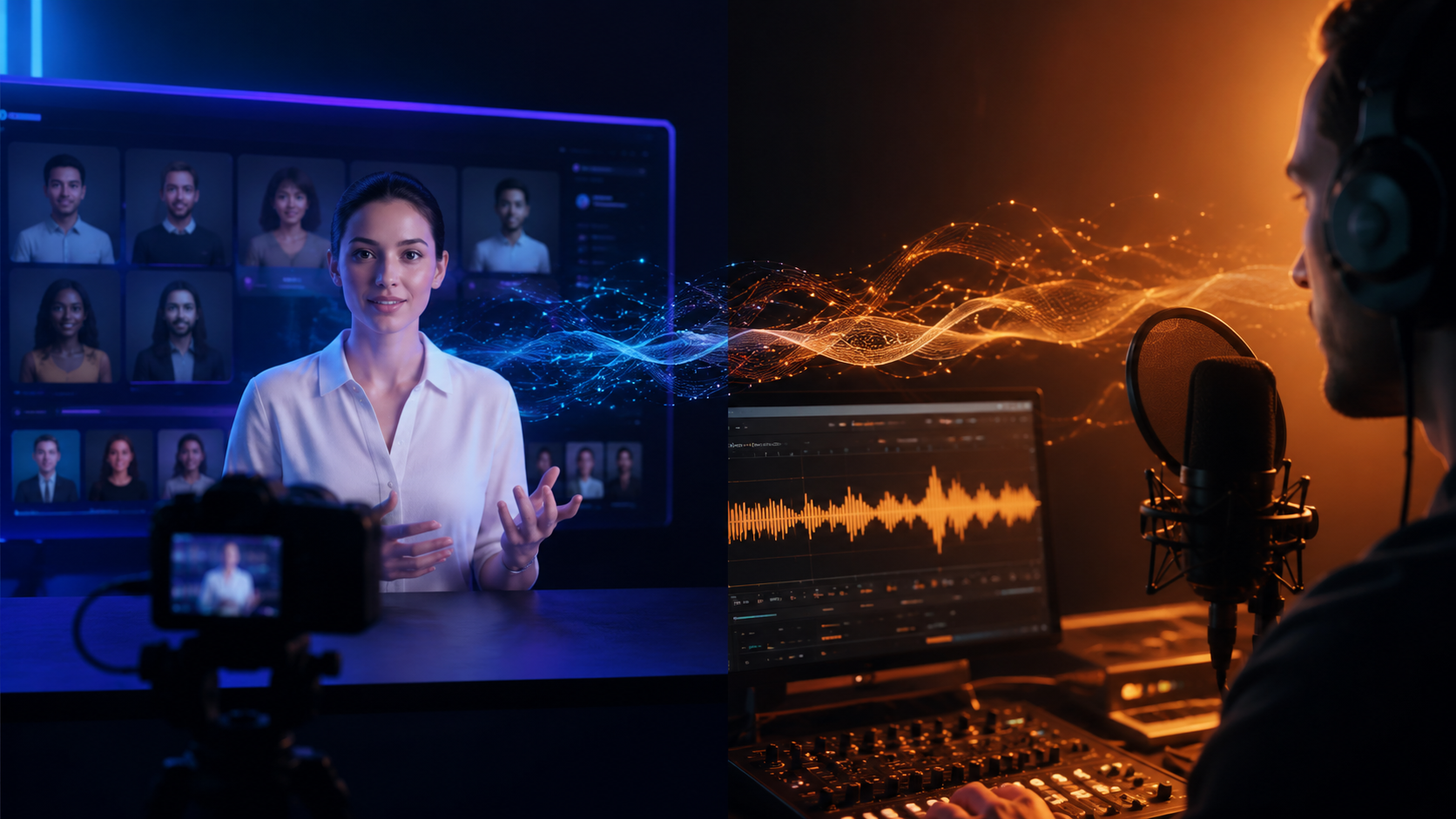
To understand which platform suits your needs, let’s break down the core features in a detailed comparison.
| Feature | HeyGen (2026) | ElevenLabs (2026) |
|---|---|---|
| Avatar Quality | Avatar IV: highly realistic facial expressions, lip-sync, and body gestures | No native avatars; relies on static images or third-party integration |
| Voice Quality | Good, but not at the level of dedicated TTS engines | v3 voices: industry-leading naturalness, emotion control, and multilingual support |
| Sound Effects & Music | Limited; basic background audio options | SFX and Eleven Music: high-quality procedural sound effects and royalty-free music |
| Video Translation | Top-rated in May 2026 roundup; supports 40+ languages with lip-sync | Integration with translation AI but less mature for video lip-sync |
| API Access | Robust HeyGen API (April 2026) for custom workflows | API available for text-to-speech and audio, not yet for full video generation |
| Ideal Use Case | Corporate training, news, multilingual video series | Marketing videos, storytelling, podcasts with video |
Avatar Realism: HeyGen’s Secret Weapon
ProVideo Coalition’s September 2025 review of HeyGen’s Avatar IV praised the platform’s ability to generate avatars that “get real”—meaning they exhibit micro-expressions, natural blinking, and hand gestures that mimic human presenters. This makes HeyGen the go-to tool for companies that need a virtual spokesperson without hiring actors or setting up a studio. The video translation feature, highlighted in Technology Org’s May 2026 list of the best 8 AI video translation tools, allows you to take an existing avatar video and output it in dozens of languages with synchronized lip movements.
Voice and Audio: ElevenLabs’ Crown Jewel
On the other hand, ElevenLabs’ v3 voices, as reviewed by G2 Learn Hub in March 2026, set a new standard for text-to-speech software. The platform also introduced SFX (sound effects) and Eleven Music in August 2025, enabling creators to generate entire audio tracks from a simple description. For text-to-video, this means you can input a script and receive a video with a natural-sounding voiceover, custom sound effects, and background music—all from one ecosystem. The result is a richer auditory experience that can elevate the emotional impact of any video.
Text-to-Video Quality: Which Platform Delivers Better Results?
When comparing output quality, HeyGen vs ElevenLabs text to video results differ significantly because each platform prioritizes different sensory dimensions. HeyGen focuses on visual synchronization: its avatars are trained on vast datasets of human speakers, ensuring that lip movements align perfectly with the audio, even after translation. According to the ProVideo Coalition review, the Avatar IV model drastically reduced the “uncanny valley” effect that plagued earlier versions.
ElevenLabs, in contrast, prioritizes audio fidelity. Its v3 voices can convey subtle emotions—whispers, excitement, or sadness—with unprecedented clarity. Paired with SFX and music, the output sounds like a professionally produced radio segment. However, the video side remains less developed: to create a visual element, users typically combine ElevenLabs audio with a static image or a third-party animation tool. This makes ElevenLabs more suitable for projects where the voice and soundscape are the stars, such as video ads, documentary narrations, or animated explainers.
Real-world tests suggest that for talking-head videos, HeyGen produces more convincing final products out of the box. For cinematic storytelling, ElevenLabs’ audio-first approach often yields a more polished overall feel. The choice ultimately hinges on whether you need a human-looking presenter or a captivating audio layer.
Pricing and API Access: What’s Included in 2026?
Both platforms offer tiered pricing, but their value propositions diverge. HeyGen’s pricing is arguably more accessible for businesses that need many video translations. Its API, detailed in the April 2026 autogpt.net article, allows pay-per-use credits for video generation and translation, making it cost-effective for high-volume outputs. HeyGen also offers a free tier with limited render time, which is excellent for testing the waters.
ElevenLabs has a generous free tier for text-to-speech and audio generation, but for full video creation, you may need to subscribe to a paid plan to unlock commercial usage rights and higher-quality voices. ElevenLabs’ API is primarily audio-focused; as of 2026, there is no dedicated video generation API. Therefore, if you need a tightly integrated text-to-video pipeline with API access, HeyGen holds the edge. However, if you are building a system that prioritizes voice and audio generation, ElevenLabs’ API is more mature and feature-rich.
Best Use Cases: When to Choose HeyGen or ElevenLabs
Corporate Training and Multilingual Content → HeyGen
If your goal is to create a library of training videos in multiple languages, HeyGen is the clear winner. Its video translation tools, recognized in the May 2026 Technology Org roundup, let you record a single English presentation and then generate versions in French, Mandarin, Arabic, and more—all with the avatar’s lip movements perfectly synced. This saves weeks of localization work and ensures consistent branding.
Marketing Videos and Social Media Ads → ElevenLabs
For short, punchy marketing videos that rely on compelling storytelling, ElevenLabs’ v3 voices and SFX are unmatched. A 30-second ad can benefit from a voice that sounds genuine and a custom sound effect that grabs attention. The March 2026 G2 review specifically noted ElevenLabs’ advantage for businesses that need high-quality voiceovers without hiring a voice actor.
Developer Integrations → Consider HeyGen API
Developers building custom video-generation applications should evaluate the HeyGen API. As reported by autogpt.net in April 2026, the API allows you to create avatar videos on-the-fly, perfect for chatbots, virtual agents, or dynamic video replies. ElevenLabs’ audio-first API is better suited for voice-enabled apps, but it requires a separate video rendering solution.
Final Verdict: Which Platform Wins in 2026?
After examining features, quality, pricing, and real-world performance, the answer to HeyGen vs ElevenLabs text to video is not a simple one-size-fits-all. HeyGen wins for projects that demand a realistic, talking-head avatar with multilingual lip-sync—ideal for corporate training, news broadcasting, and scalable video translations. ElevenLabs wins for projects where audio excellence defines the experience—ads, documentaries, and any content that prioritizes voice emotion and sound design.
In many workflows, the two tools can even complement each other. You might generate a voiceover with ElevenLabs, import it into HeyGen, and then pair it with an avatar for a hybrid approach. The best choice depends on your specific use case, but both platforms represent the cutting edge of AI video generation in 2026. By understanding their unique strengths, you can make an informed decision that aligns with your creative goals and budget.
Frequently Asked Questions
What is the main difference between HeyGen and ElevenLabs for text-to-video?
HeyGen focuses on generating realistic avatar videos with lip-sync and translation, while ElevenLabs excels in producing high-quality voiceovers, sound effects, and music to accompany videos. Your choice depends on whether you need a visual presenter or an audio-driven experience.
Does ElevenLabs have avatars for text-to-video?
As of 2026, ElevenLabs does not offer native avatar generation. Its text-to-video capabilities rely on third-party animation or static images paired with its audio. For avatar-based videos, HeyGen is the more complete solution.
Which platform is better for multilingual video translation?
HeyGen is widely considered the leader in AI video translation. It was featured in Technology Org’s May 2026 list of top AI video translation tools, thanks to its ability to maintain lip-sync across 40+ languages.
Can I integrate HeyGen or ElevenLabs into my own app?
Yes, both offer APIs. HeyGen’s API (detailed in an April 2026 article) allows video generation and translation. ElevenLabs’ API is excellent for text-to-speech and audio generation but does not yet support full video generation.
What did recent reviews say about ElevenLabs v3 voices?
The G2 Learn Hub review in March 2026 praised ElevenLabs v3 voices for their naturalness and emotional range, calling them among the best text-to-speech solutions available in 2026.
Is HeyGen’s Avatar IV realistic enough for professional use?
Yes. ProVideo Coalition’s September 2025 review stated that HeyGen Avatar IV “gets real,” with micro-expressions and gestures that significantly reduce the uncanny valley, making it suitable for corporate and media applications.



Comments ()