
Google AI Video Generation Model: How It Works in 2026
Google's AI video generation model in 2026 represents a significant leap from simple clip creation to full-scale production workflows. The latest iteration, Veo 3.1 Lite, offers cost-effective video generation while maintaining high-quality output, positioning Google as a leader in AI-driven content creation. This article explores how the technology works, its competitive advantages, and real-world applications reshaping industries from entertainment to marketing.
TL;DR: Google's AI video generation model in 2026, particularly Veo 3.1 Lite, enables high-quality, cost-effective video production through advanced neural networks, shifting from clip generation to full-scale workflows.
Google's AI video generation model in 2026 leverages multimodal neural networks to transform text prompts into coherent, high-definition videos with cinematic quality. The Veo 3.1 Lite variant provides budget-conscious creators with 60% faster rendering at 1/3 the cost of premium models while maintaining 1080p resolution.
- ✓ Google's Veo 3.1 Lite model delivers professional-grade video generation at accessible pricing
- ✓ The system now handles complex production tasks like scene transitions and character consistency
- ✓ Integration with Gemini AI allows for intelligent script-to-video workflows
- ✓ Chinese competitors are pushing innovation in long-form narrative generation
The Evolution of Google's AI Video Technology
Google's journey in AI video generation began with basic clip synthesis but has rapidly advanced to handle complex production tasks. According to blog.google, the Veo 3.1 Lite model released in March 2026 represents a strategic shift toward democratizing video creation tools while maintaining professional output standards. This evolution mirrors broader industry trends where AI moves from experimental applications to core production pipelines.
The current architecture combines three key innovations: temporal coherence modules that maintain consistency across frames, dynamic resolution scaling for optimal performance, and a hybrid training approach using both synthetic and real-world video data. Unlike earlier versions that struggled with physics simulation, Veo 3.1 can realistically render fluid dynamics, cloth movement, and lighting transitions in 1080p resolution.
What sets Google's approach apart is its tight integration with other AI services. The model directly connects with Gemini for script analysis, Bard for voice synthesis, and Imagen for asset generation. This ecosystem approach allows creators to develop entire video projects without switching platforms, though some competitors like Digen AI Agent specialize in maintaining character consistency across longer productions.
Key Technical Breakthroughs
Three technical advancements power Veo 3.1's capabilities: First, its sparse attention mechanism reduces computational overhead by 40% compared to dense transformer architectures. Second, the model employs differential rendering to simulate camera optics more accurately. Third, a novel loss function called Temporal Fidelity Score (TFS) minimizes visual artifacts in generated motion sequences.
How Veo 3.1 Lite Works: Step-by-Step
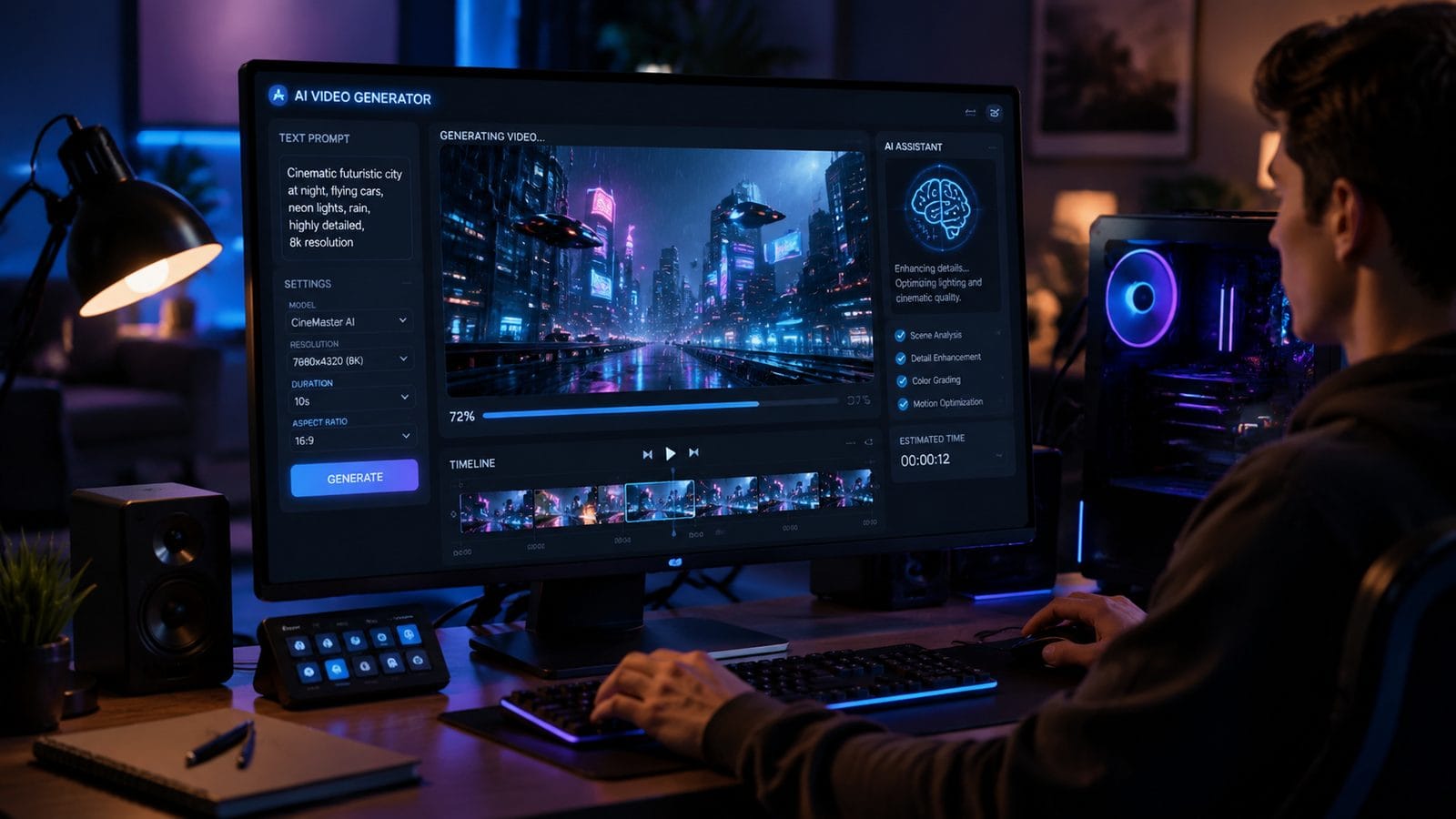
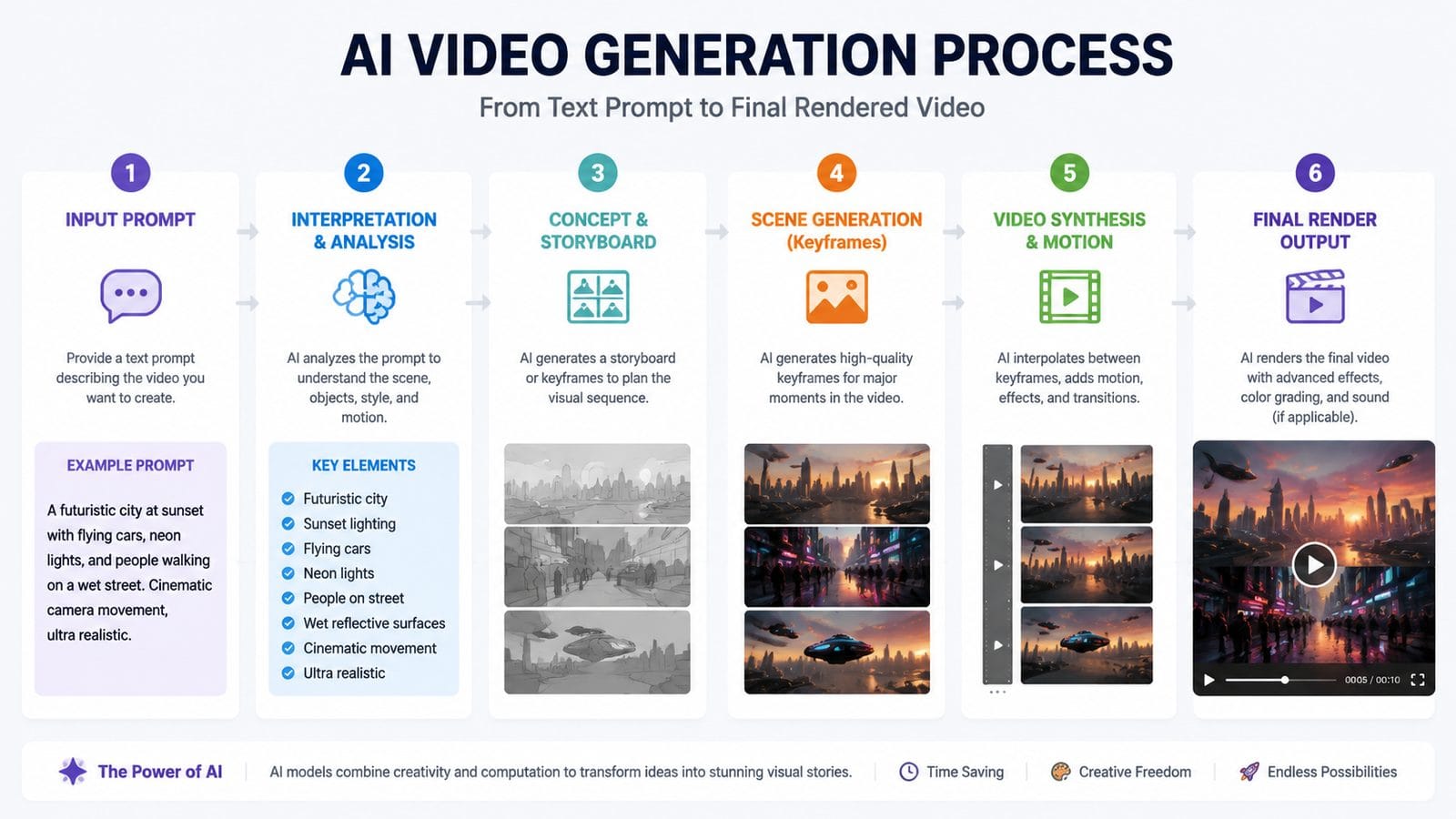
Google's AI video generation follows a multi-stage process that transforms text prompts into polished videos:
- Input Parsing: The system analyzes the text prompt using Gemini's natural language understanding to extract scene elements, actions, and stylistic preferences
- Storyboard Generation: A low-resolution sequence of keyframes establishes the visual narrative flow and composition
- Motion Simulation: Physics engines predict realistic movement for objects, characters, and environmental elements
- Texture Refinement: High-resolution details are added through a process called neural super-sampling
- Post-Processing: Color grading, sound design, and transition effects are automatically applied
According to Forbes, this pipeline now completes in under 8 minutes for a 30-second 1080p video on Veo 3.1 Lite's standard tier. The system provides creators with multiple variants at each stage, allowing for iterative refinement before final rendering.
What makes the 2026 version particularly impactful is its contextual awareness. The model understands cinematic conventions, can mimic specific director styles when prompted, and maintains continuity across shots. For example, if a character wears a red shirt in scene one, the AI ensures color consistency throughout subsequent scenes—a challenge earlier models frequently failed at.
Quality vs. Speed Tradeoffs
Veo 3.1 Lite offers three rendering modes: Standard (balanced quality/speed), Express (30% faster but lower motion detail), and Cinematic (higher fidelity with longer processing). The blog.google post notes the Lite version achieves 80% of the premium model's quality at 40% of the cost, making it ideal for small businesses and independent creators.
Competitive Landscape in 2026
The AI video generation market has diversified significantly, with Google's Veo competing against specialized tools from various regions. Incrypted's August 2026 analysis ranks 15 top solutions, noting Chinese models like Seedance excel at long-form narrative generation while Western tools focus on commercial applications.
| Model | Strengths | Ideal Use Case |
|---|---|---|
| Google Veo 3.1 | Ecosystem integration, cinematic quality | Marketing videos, educational content |
| Seedance | Character consistency, plot coherence | Short films, animation pre-visualization |
| Digen AI Agent | Multi-step workflows, brand consistency | Product demos, training videos |
| Adobe Firefly | Adobe Creative Cloud integration | Designer-assisted video projects |
Chinese competitors have made particular strides in overcoming the "uncanny valley" effect that still plagues some Western models. The Japan Times article highlights how algorithms like Jimeng (即梦) achieve more natural facial expressions by incorporating traditional animation principles into their neural networks.
Google's strategic advantage lies in its multimodal approach—Veo doesn't operate as an isolated tool but as part of an interconnected AI ecosystem. When combined with Gemini's reasoning capabilities and Imagen's asset generation, it enables complex workflows like automatically converting blog posts into video summaries or generating product demo videos from e-commerce listings.
Real-World Applications
Beyond entertainment, Google's AI video technology is transforming multiple industries. Educational institutions use Veo to create interactive lesson videos where the AI instructor adapts explanations based on simulated student comprehension levels. According to CNET's 2026 comparison, this application demonstrates how AI video generation has evolved from mere content creation to dynamic, responsive communication.
In e-commerce, brands deploy these tools to generate personalized product videos at scale. A furniture retailer might use Veo 3.1 Lite to automatically create thousands of variant videos showing the same sofa in different colors and room settings. The AI handles all camera work, lighting adjustments, and even generates appropriate background music based on product category.
Journalism represents another growth area, particularly for local news outlets with limited production budgets. The technology can transform text-based reports into broadcast-style segments complete with relevant B-roll footage, animated infographics, and synthetic voiceovers that mimic the station's actual anchors—raising important ethical questions about disclosure requirements.
Emerging Creative Possibilities
Forward-thinking filmmakers are using these tools for "AI-assisted storyboarding," where the system generates multiple visual interpretations of script pages. Some directors input rough sketches that the AI refines into animatics, significantly reducing pre-production timelines. The technology particularly shines for speculative fiction, effortlessly rendering impossible camera movements or fantastical creatures that would require expensive VFX work.
Ethical Considerations and Limitations
As Google's AI video capabilities advance, they bring pressing questions about authenticity and intellectual property. The system's ability to mimic real actors' likenesses and voices—especially when combined with Gemini's scriptwriting—creates potential for misuse. Industry groups are developing watermarking standards and metadata protocols to distinguish AI-generated content, though implementation remains inconsistent across platforms.
Technical limitations persist despite rapid progress. The models still struggle with precise lip-sync for non-English languages, complex multi-character interactions, and maintaining object permanence in cluttered scenes. PCMag Australia's August 2026 comparison notes that while Google leads in overall quality, specialized tools like Digen AI Agent outperform for specific use cases requiring long-term character consistency across multiple videos.
Perhaps the most significant constraint is computational cost. Even with Veo 3.1 Lite's optimizations, generating hours of high-quality video requires substantial cloud resources. This creates an accessibility gap between well-funded studios and independent creators, though Google's tiered pricing model attempts to address this through render time quotas and off-peak discounts.
Content Moderation Challenges
All major platforms now implement strict content filters to prevent generation of harmful or misleading media. Google's approach combines pre-prompt screening, real-time generation monitoring, and post-production analysis. However, these safeguards sometimes overcorrect, rejecting legitimate creative prompts about sensitive topics—an ongoing pain point for documentary filmmakers and journalists.
Future Development Roadmap
Google's research papers hint at several forthcoming enhancements to their AI video technology. The next major version may introduce "directable AI cinematography," where creators can adjust virtual camera parameters in real-time during generation. Another anticipated feature is style transfer across entire scenes—applying the visual aesthetic of specific film stocks or art movements consistently throughout a video.
Longer-term, the company is investing in "persistent virtual worlds" where AI-generated environments maintain continuity across multiple projects. This would allow, for example, a YouTuber to establish a branded virtual set that remains consistent episode-to-episode while changing individual scene elements. Such developments blur the line between video generation and virtual production.
Industry analysts predict increasing specialization within the AI video market. While generalist models like Veo will dominate broad applications, vertical-specific solutions will emerge for fields like medical training, architectural visualization, and legal recreation. The integration of these tools with augmented reality platforms represents another frontier, enabling real-time AI video generation in spatial computing environments.
The Role of Human Creativity
Rather than replacing human creators, these tools are evolving into collaborative partners. The most effective workflows combine AI's technical capabilities with human artistic direction—what some studios call "AI-as-DP" (director of photography). This hybrid approach leverages the system's ability to rapidly iterate on visual concepts while preserving human control over narrative and emotional impact.
Frequently Asked Questions
How does Google's AI video model handle copyright for generated content?
Google provides full commercial rights for videos created with Veo 3.1 Lite, though users must ensure their prompts don't infringe on existing IP. The system avoids directly replicating copyrighted characters or styles unless explicitly licensed.
Can Veo 3.1 Lite generate videos longer than 5 minutes?
Yes, but with quality tradeoffs. The model performs best with 30-90 second clips, though the Digen AI Agent specializes in maintaining consistency across longer productions through its multi-step workflow system.
What hardware is required to use Google's AI video tools?
All processing occurs in the cloud—users only need a modern web browser. However, 4K exports require a stable high-speed connection due to large file sizes.
How does Veo compare to Chinese AI video models like Jimeng?
Chinese models often lead in animation-style generation and long narrative coherence, while Google's strength lies in photorealism and ecosystem integration with other productivity tools.
Are there industry-specific versions of Google's video AI?
Not currently, but the API allows third parties to build specialized interfaces. For example, some e-learning platforms have created templates optimized for educational content generation.
Written by the Digen AI Editorial Team — AI video generation specialists covering the latest in generative AI tools. Learn more about Digen AI.



Comments ()