
Generative AI for Animation Workflows: 2026 Trends & Tools
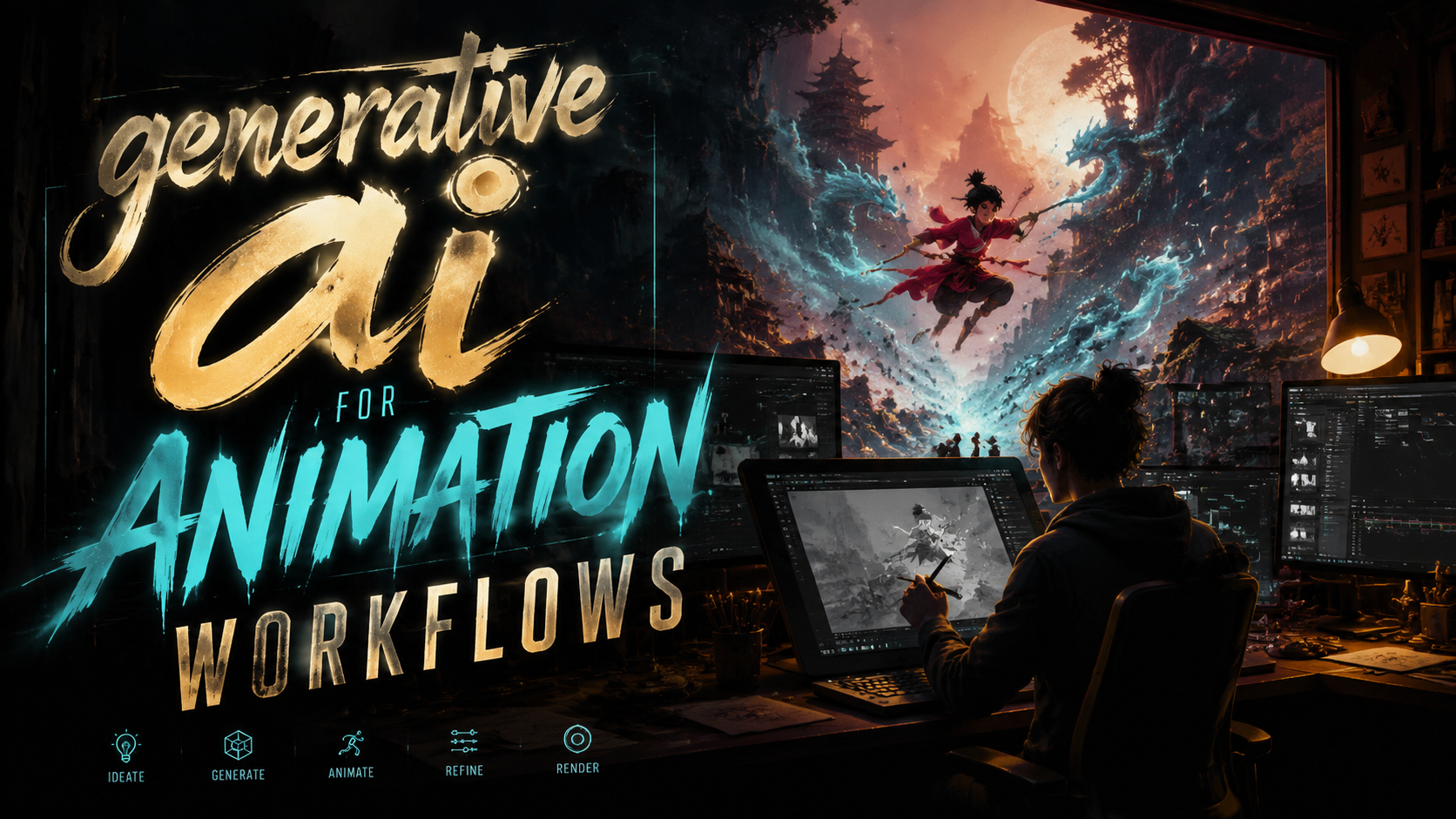
Generative AI for animation workflows is transforming how studios create content, offering unprecedented speed and creative flexibility. By 2026, hybrid AI-human pipelines dominate the industry, with tools like Netflix's INKubator studio demonstrating how generative models can streamline production while preserving artistic vision. The market is projected to reach $31.37 billion by 2035 as studios integrate AI for tasks ranging from character design to in-betweening.
TL;DR: Generative AI is revolutionizing animation workflows in 2026 through hybrid human-AI pipelines, with Netflix's INKubator leading the charge and market projections showing explosive growth to $31.37 billion by 2035.
Generative AI for animation workflows is the integration of artificial intelligence tools that automate or enhance various stages of animation production, from concept art generation to motion interpolation, enabling faster iteration and reduced production costs while maintaining creative control.
- ✓ Hybrid AI-human workflows now dominate professional animation production
- ✓ Netflix's INKubator studio showcases AI-native animation at scale
- ✓ Market projected to grow to $31.37 billion by 2035 (Precedence Research)
- ✓ Universities like UTS are partnering with studios to push AI animation boundaries
- ✓ AI excels at automating repetitive tasks while artists focus on creative direction
The State of Generative AI in Animation (2026)
The animation industry has reached an inflection point in 2026, with generative AI tools becoming standard in professional workflows. According to No Film School, the Tribeca Film Festival featured multiple shorts created using hybrid AI-animation pipelines, demonstrating the technology's artistic viability. Studios are no longer debating whether to adopt AI, but rather how to implement it most effectively across their production cycles.
Market research confirms this shift: According to Precedence Research, the generative AI in animation market will hit $31.37 billion by 2035, growing at a compound annual rate of 28.7%. This growth stems from AI's ability to automate labor-intensive tasks like in-betweening, background generation, and lip-syncing, which traditionally accounted for 60-70% of animation production time.
The most significant development comes from streaming platforms, with Netflix making bold moves in AI-driven animation. Their INKubator studio, as reported by Cartoon Brew, represents the first major "GenAI-native" production house, focusing initially on short-form content with plans to expand into features. This validates generative AI as not just a supplemental tool, but a foundational technology for next-generation animation studios.
Key Tools Powering AI Animation Workflows
The 2026 generative AI animation toolkit has matured beyond experimental plugins to enterprise-grade solutions. Leading studios now deploy AI across three core workflow stages: pre-production (concept art, storyboarding), production (character animation, effects), and post-production (rendering optimization, style transfer). These tools integrate seamlessly with traditional software like Maya and Blender through dedicated plugins.
Concept Generation Suites
AI-powered concept art generators have evolved to understand cinematic language, allowing directors to input mood boards or script excerpts and receive style-consistent character designs and environments. The VANDAL-UTS partnership reported by LBBOnline has produced tools that maintain artistic coherence across hundreds of generated assets, solving early AI's inconsistency issues.
Motion Interpolation Engines
New neural networks specialize in converting rough keyframes into smooth animation while preserving animator intent. These systems learn from studio-specific animation styles, enabling the automation of in-between frames without the "floaty" motion that plagued early AI animation attempts. Production tests show 40-50% reductions in manual tweaking time.
Procedural Worldbuilding
Background generation AI can now extrapolate fully realized environments from sparse art direction notes, automatically maintaining perspective consistency and lighting coherence across shots. This proves particularly valuable for TV animation where hundreds of background variations are needed per episode.
Netflix's INKubator: A Case Study in AI-Native Production
Netflix's INKubator studio represents the most ambitious application of generative AI for animation workflows to date. As detailed by quasa.io, the studio operates with a "AI-first" philosophy, where traditional roles are reimagined around generative tools. Their pipeline begins with AI-assisted script breakdowns that automatically identify animation opportunities and potential production challenges.
The INKubator workflow demonstrates how AI can enhance rather than replace human creativity. Directors work with AI "co-pilots" that suggest visual metaphors and pacing options based on emotional beats in the script. Animators then refine these suggestions, focusing their expertise on key storytelling moments while AI handles repetitive sequences. Early results show a 3-4x increase in output speed compared to traditional methods.
Looking ahead, INKubator plans to tackle feature-length productions by late 2027. Their success has prompted other studios to establish similar AI-native divisions, creating a new category of animation professional: the AI workflow director, who specializes in optimizing human-AI collaboration throughout the production pipeline.
Emerging Trends in AI-Assisted Animation
As generative AI for animation workflows matures, several key trends are shaping industry adoption. The most significant is the move toward "explainable AI" tools that provide artists with clear rationales for their suggestions, building trust in automated systems. Studios now demand transparency in how training data was sourced and how the AI makes creative decisions.
Another trend is the rise of studio-specific AI models. Rather than using generic generative tools, major animation houses are training proprietary systems on their back catalogs. This allows for consistent house styles while avoiding the legal uncertainties of public AI models. The approach mirrors how Pixar developed its proprietary animation software in the 1990s.
Real-time collaboration between distributed teams has also improved dramatically. Cloud-based AI animation platforms now allow artists in different time zones to work on the same scene simultaneously, with AI handling version control and style reconciliation. This proved crucial for the hybrid workflow behind the Tribeca short film mentioned by No Film School, where team members across three continents contributed seamlessly.
Ethical Considerations and Industry Response
The rapid adoption of generative AI for animation workflows has sparked important ethical discussions. Leading studios have established clear guidelines around AI usage, particularly regarding training data provenance and artist compensation. Most now require that AI tools be trained either on fully licensed content or a studio's own intellectual property.
Labor organizations have negotiated new contract provisions addressing AI's role in production. These typically stipulate that AI cannot be used to replace credited creative positions, but may assist with time-intensive technical tasks. The industry is moving toward a model where AI augments rather than replaces human artists, similar to how CGI tools changed (but didn't eliminate) traditional animation roles.
Academic institutions are playing a crucial mediating role. Partnerships like VANDAL and UTS (reported by LBBOnline) focus on developing ethical AI frameworks alongside technical innovations. Their work helps ensure the technology develops in ways that benefit both studios and creative professionals, preserving animation as a vibrant art form while embracing productivity gains.
Future Outlook: 2027 and Beyond
The generative AI animation market shows no signs of slowing, with Market Research Future projecting continued 25%+ annual growth through 2030. Several developments will shape the coming years, including the integration of physics-aware AI that understands material properties and natural motion at a fundamental level.
Personalized animation represents another frontier. AI tools will soon enable real-time style adaptation, allowing viewers to select preferred visual treatments (e.g., shifting between anime-inspired and hyper-realistic rendering) without additional production work. This could revolutionize content localization and accessibility.
Perhaps most significantly, we'll see the first fully AI-assisted feature films by 2028. These won't be "AI-generated movies," but rather traditionally structured productions where generative tools handle 60-70% of the technical workload, allowing human creatives to focus entirely on storytelling and emotional impact. The success of Netflix's INKubator suggests this transition may occur faster than many industry observers predicted.
How does generative AI actually help animators?
Generative AI assists animators by automating repetitive tasks like in-betweening and lip-syncing, suggesting creative options during pre-production, and optimizing rendering processes. This allows artists to focus on high-value creative decisions rather than technical execution.
Are animation jobs at risk due to AI?
Current trends show AI creating new roles (like AI workflow directors) while changing existing ones. Studios report increased hiring for creative positions as AI handles technical work, similar to how CGI tools expanded rather than contracted the animation job market.
What's the learning curve for AI animation tools?
Most 2026 tools are designed to integrate with existing software like Maya and Blender, with studios reporting 2-4 weeks for experienced animators to achieve proficiency. Many tools use natural language interfaces to reduce technical barriers.
How do studios ensure AI-generated content is original?
Leading studios now use proprietary AI models trained exclusively on their own IP or fully licensed content. Legal departments carefully vet all training data sources to avoid copyright issues in generated outputs.
Can small studios compete with AI-powered giants like Netflix?
Yes—cloud-based AI animation platforms are democratizing access to advanced tools. Many providers offer subscription models that allow smaller studios to leverage the same core technologies as major players, just at smaller scales.
Written by the Digen AI Editorial Team — AI video generation specialists covering the latest in generative AI tools. Learn more about Digen AI.
Comments ()