
Future of Text to Video AI: 2026 Predictions & Trends
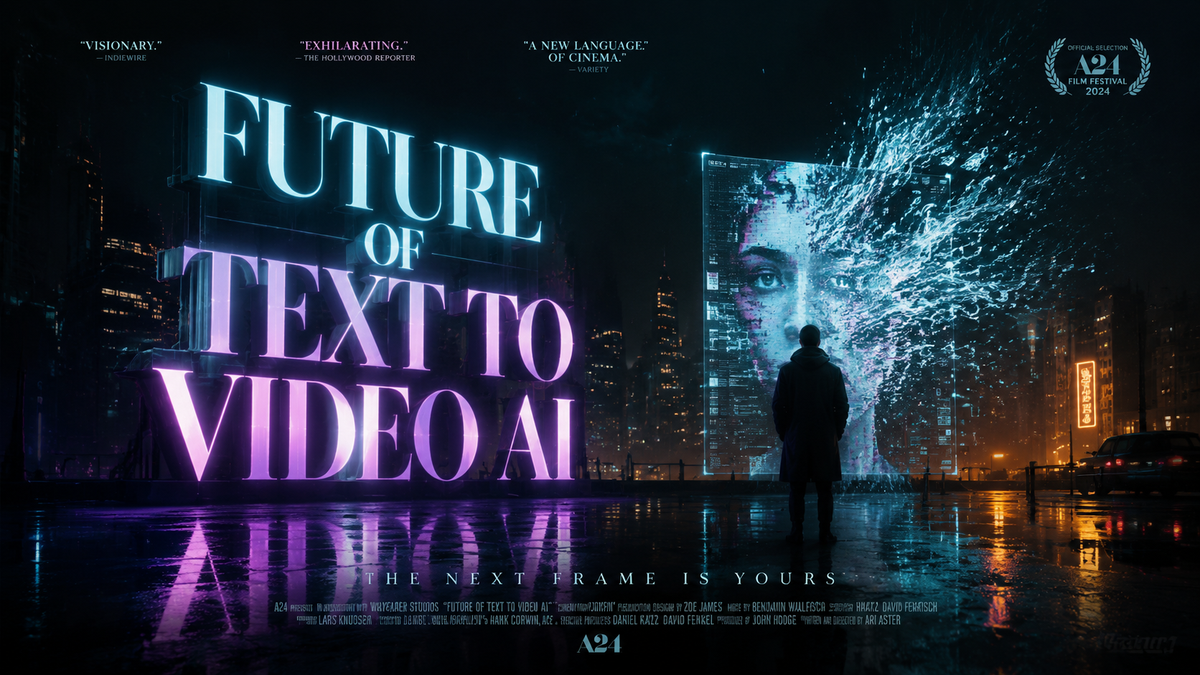
The future of text to video AI in 2026 is defined by a shift from experimental short clips to full-scale automated production, where generative models like Kling, Grok, and Runway have decentralized high-end cinematography. As we move through the middle of the decade, the technology has evolved beyond simple prompt-to-clip mechanics into sophisticated narrative engines capable of maintaining visual consistency across long-form content. This evolution is fundamentally restructuring how creators, marketers, and studios approach visual storytelling, making high-fidelity video production accessible through natural language interfaces.
The future of text to video AI is a landscape where generative models provide real-time, high-definition video synthesis with perfect temporal consistency. By 2026, the industry has shifted toward "watchbait" and automated content cycles, moving away from early experimental apps like Sora toward integrated ecosystems that combine voice, physics-based motion, and cinematic control for professional-grade output.
- ✓ Text-to-video AI has transitioned from 10-second clips to long-form, coherent narrative generation.
- ✓ Leading tools like Kling and Runway are now competing directly with traditional Hollywood production workflows.
- ✓ The rise of "watchbait" content is transforming digital marketing and social media engagement.
- ✓ Integration of AI voice and AI video generators has created a "one-click" automated content creation pipeline.
- ✓ Market consolidation is occurring as early experimental platforms are replaced by feature-rich creative suites.
The Evolution of the Future of Text to Video AI
In early 2026, the landscape of generative media looks vastly different than it did just twelve months ago. The primary driver of this change is the maturation of temporal consistency—the ability of an AI to remember what a character or setting looks like from one frame to the next. According to Programming Insider, the synergy between AI video generators and AI voice generators has become the backbone of automated content creation, allowing for the production of entire documentaries or advertisements without a single camera being turned on.
We are also seeing a significant shift in the competitive hierarchy. While early 2024 and 2025 were dominated by the hype of experimental releases, 2026 has seen a "survival of the fittest" scenario. For instance, reports from CBC indicate that OpenAI’s Sora, once the poster child for generative video, has been relegated to history as the firm pivots its strategy. This has opened the door for specialized competitors who focus on specific niches, such as hyper-realistic physics or social-media-optimized "watchbait."
From Sora to Specialized Engines
The "Sora era" taught the industry that general-purpose models are often less useful than specialized tools. In 2026, creators are moving toward platforms like Kling for cinematic realism and Grok for integrated social media video generation. This specialization allows for better control over lighting, camera angles, and character emotional depth, which were significant hurdles in previous iterations of the technology.
The Rise of Watchbait Content
As predicted by Fortune, the era of clickbait has been superseded by "watchbait." These are AI-generated videos designed with such high visual stimulation and algorithmic precision that they maximize retention rates on platforms like TikTok and YouTube Shorts. The future of text to video AI is now inextricably linked to these attention-economy tactics, where the AI doesn't just create what you ask for, but what it knows will keep viewers watching.
Comparison of Leading AI Video Tools in 2026
Choosing the right tool for the future of text to video AI depends on the specific requirements of the project. Whether you are looking for Hollywood-grade cinematography or rapid-fire social content, the 2026 market offers distinct choices. According to Simplilearn, the "20 Best Generative AI Tools of 2026" highlight a clear divergence between professional and consumer-grade software.
| AI Tool | Primary Use Case | Key Feature (2026) | Production Speed |
|---|---|---|---|
| Kling | Cinematic Film & Ads | Advanced Physics Engine | Medium (High Quality) |
| Runway (Gen-4) | Professional VFX | Multi-Motion Brush 2.0 | Fast |
| Grok Video | Social Media / News | Real-time X Integration | Instant |
| Luma Dream Machine | 3D Asset Generation | 360-degree Consistency | Medium |
| Automated Suites | Marketing / Explainer | Integrated Voiceover | Fast |
How to Use Modern Text to Video AI: A Step-by-Step Guide
The workflow for generating high-quality video has simplified significantly by 2026. No longer do users need to understand complex "seed" numbers or denoising strengths; natural language and intent-based prompting have taken center stage.
- Define the Narrative Arc: Start by inputting a detailed script or a simple story premise into your chosen AI video generator. In 2026, most tools allow you to upload a "World Bible" or "Character Sheet" to ensure visual consistency across multiple scenes.
- Select Visual Style and Physics: Choose from presets such as "Cinematic 8K," "Anime," or "Hyper-Realistic Documentarian." Use the physics slider to determine how gravity and fluid dynamics should behave in your video.
- Layer in AI Audio: Sync your video generation with an AI voice generator. Modern tools automatically match the lip-syncing and facial expressions of the generated characters to the audio track.
- Iterate with Regional Controls: Instead of re-generating the whole video, use "In-painting" or "Motion Brushes" to change specific elements, such as a character's clothing or the intensity of the rain in a background.
- Export and Upscale: Finalize the video in resolutions up to 16K. Many 2026 platforms offer direct-to-social publishing features that optimize the aspect ratio and metadata for various platforms instantly.
Hollywood and the Decentralization of Film
The relationship between traditional film studios and AI has reached a boiling point in 2026. As noted by The Ankler, the future of text to video AI has left "Hollywood on the outside looking in." Independent creators are now capable of producing visuals that rival $200 million blockbusters using tools like Grok and Runway. This has led to a democratization of the film industry, where the "gatekeepers" of distribution and production are losing their historical leverage.
However, this transition is not without friction. Issues regarding likeness rights, training data ethics, and the displacement of traditional VFX artists remain central to the conversation. While the technology allows for incredible efficiency, the industry is still grappling with how to credit the human "prompters" and "directors" who curate the AI's output. The "chaotic future" mentioned by industry analysts is now a reality, as the barrier to entry for high-end visual storytelling has effectively dropped to zero.
The Impact on Niche Industries
It isn't just entertainment that is being transformed. For example, Fruitnet has explored how AI video shapes the future of the fresh produce industry through automated marketing and educational content that visualizes supply chains in real-time. From agriculture to medicine, the ability to turn technical data into a compelling video narrative is a game-changer for B2B communication.
Technical Breakthroughs Driving 2026 Trends
The "future of text to video AI" is supported by three major technical pillars that reached maturity in 2026: Latent Consistency Models (LCMs), Neural Physics, and Multimodal Integration. These technologies have moved AI video from "uncanny valley" territory into something indistinguishable from reality.
Neural Physics and Material Realism
Early AI videos often featured "hallucinations" where objects would merge or gravity seemed inconsistent. In 2026, the integration of neural physics engines allows AI to understand the weight, friction, and fluid dynamics of the objects it generates. If a character drops a glass of water, the splash and the refraction of light are calculated with near-mathematical precision, making the video feel "grounded" in reality.
Multimodal Integration
We are no longer just talking about "text to video." The current standard is "Anything to Video." You can take a sketch, a voice recording, or even a simple piece of music, and the AI will use those as foundational inputs to generate a corresponding visual narrative. This multimodal approach ensures that the "future of text to video AI" is actually a future of integrated sensory creation.
Ethical Considerations and the "Watchbait" Economy
As we navigate 2026, the ethical landscape has become as complex as the technology itself. The rise of "watchbait" has raised concerns about the psychological impact of AI-optimized content designed specifically to trigger dopamine responses. According to Fortune, the shift from clickbait to watchbait means that content is no longer just about the "hook," but about a continuous stream of AI-generated stimuli that makes it difficult for viewers to disengage.
Furthermore, the "post-Sora" world is one where deepfakes have become incredibly sophisticated. The industry has responded with "Content Credentials"—digital watermarks that track the provenance of a video. In 2026, most major platforms require these credentials to be present, allowing users to see exactly how much of a video was generated by AI versus captured by a human with a camera.
What is the future of text to video AI in 2026?
The future involves a move toward long-form, consistent, and physics-accurate video production. It is characterized by the integration of AI voice and video, creating fully automated content pipelines for creators and businesses.
Is OpenAI's Sora still the leading video AI?
No, as of early 2026, reports indicate that Sora has been superseded by more specialized and efficient models. Competitors like Kling, Runway, and Grok have taken the lead in various sectors of the generative video market.
What is "watchbait" in the context of AI video?
Watchbait refers to AI-generated video content specifically optimized by algorithms to maximize viewer retention. It uses hyper-stimulating visuals and perfectly timed pacing to keep audiences engaged longer than traditional content.
Can AI video generators create full-length movies yet?
Yes, by 2026, the technology has reached a point where "temporal consistency" allows for the creation of long-form narratives. While human direction is still required for creative cohesion, the AI handles the bulk of the visual and auditory production.
How has Hollywood responded to AI video in 2026?
Hollywood is currently facing a period of significant disruption, with many independent creators using AI to produce studio-quality content at a fraction of the cost. This has led to new labor agreements and a shift in how traditional studios value visual effects and production.



Comments ()