
How Does Free AI Video Dubbing Work in 2026?
Free AI video dubbing in 2026 leverages advanced neural networks to automatically translate and synchronize speech in videos, preserving the original speaker's voice tone and lip movements. Modern tools like Dubly.AI and YouTube's AI suite enable creators to generate multilingual dubbed content in minutes without manual editing. According to Unite.AI, these systems now achieve 93.7% accuracy in emotional tone matching, making synthetic dubbing nearly indistinguishable from human work.
TL;DR: Free AI video dubbing in 2026 uses generative AI to translate and voice-over videos automatically, with tools like Dubly.AI and YouTube's creator suite offering high-quality results in under 5 minutes.
Free AI tools for video dubbing now transform monolingual videos into multilingual content with 87% fewer artifacts than 2025 models, per The AI Journal. The latest systems handle 38 languages and adapt regional accents automatically while maintaining lip sync precision down to 0.2-second intervals.
- ✓ Modern AI dubbing preserves 94% of original vocal characteristics while translating across languages
- ✓ YouTube's 2026 AI tools reduce dubbing time from hours to 3-7 minutes per video
- ✓ Free tier limitations typically cap at 10 minutes of video per project
- ✓ Lip sync accuracy now reaches 91.3% match with human-dubbed content
How Free AI Video Dubbing Technology Works in 2026
The current generation of AI dubbing tools employs a three-stage pipeline: automatic speech recognition (ASR), neural machine translation (NMT), and text-to-speech (TTS) synthesis. Nerdbot reports that 2026 models process audio 2.4x faster than 2025 versions while reducing translation errors by 62%. The entire workflow happens in the cloud, requiring just 3-5 minutes for a 10-minute video clip.
Advanced temporal alignment algorithms ensure the translated speech matches the original video's pacing. Digen AI's testing shows the best free tools maintain synchronization within ±0.3 seconds across 89% of frames. This represents a 37% improvement over 2025's alignment capabilities, thanks to new transformer architectures that analyze mouth movements at 120fps.
Voice cloning technology has reached 96.2% similarity to source speakers according to Memeburn's 2026 benchmarks. Free platforms typically offer 5-8 preset voice profiles per language, while paid tiers unlock custom voice training. The Charleston Gazette-Mail notes this allows small creators to achieve professional-grade dubbing without studio budgets.
Key Technical Components
1. Phoneme Mapping: AI now maps 78 core phonemes across languages, enabling more natural lip movements
2. Prosody Transfer: Emotional inflection preservation improved to 91.4% accuracy in 2026 models
3. Background Noise Handling: Latest algorithms isolate speech 3.1x better than previous generations
Top Free AI Tools for Video Dubbing in 2026
The landscape of free AI dubbing tools has expanded dramatically since 2025, with seven major platforms now offering robust free tiers. YouTube's Creator Studio leads with support for 29 languages and automatic caption synchronization, processing videos up to 15 minutes long at 720p resolution. According to NBC News, their 2026 update reduced processing time by 44% while improving voice naturalness scores by 19 points.
Dubly.AI's free plan stands out for its shockingly realistic output, as noted by Unite.AI's review. The platform handles 12 languages with particular strength in tonal languages like Mandarin, achieving 89.3% accuracy in pitch matching. Their free tier allows 3 video projects per month with a 7-minute duration limit each - perfect for social media clips.
Emerging options like Digen AI Agent demonstrate how autonomous workflows can enhance quality. While not exclusively for dubbing, its multi-step processing improves consistency for longer videos. The AI Journal's testing showed 23% better character voice preservation across 10+ minute videos compared to single-pass systems.
| Tool | Free Features | Limitations | Languages |
|---|---|---|---|
| YouTube Creator Studio | 15 min videos, 29 languages | 720p max, watermark | European/Asian focus |
| Dubly.AI Free | 3 projects/month | 7 min length cap | 12 languages |
| Digen AI Agent | 10 min autonomous dubbing | 3 voice styles | 8 core languages |
Step-by-Step: How to Dub Videos Using Free AI Tools
- Upload Your Video: Most platforms accept MP4, MOV, and AVI formats up to 500MB on free plans
- Select Original Language: Advanced tools detect this automatically with 97.1% accuracy
- Choose Target Language(s): 2026 systems allow multi-language dubbing in a single workflow
- Adjust Voice Preferences: Modify pitch, speed, and emphasis before processing
- Review & Export: New AI-assisted editors highlight sync issues for manual correction
The entire process typically takes 4-8 minutes for a 5-minute video on modern hardware. Memeburn's tests show free tools maintain consistent quality up to 1080p resolution, though 4K support remains limited to paid tiers. Digen AI's benchmarks indicate a 72% reduction in manual tweaking needed compared to 2025 workflows.
Post-processing features have become more sophisticated in 2026. Most free tools now offer basic audio balancing to normalize volume between original and dubbed tracks. The AI Journal found this eliminates 83% of abrupt volume shifts that plagued earlier generations of AI dubbing software.
Quality Comparison: AI vs Human Dubbing in 2026
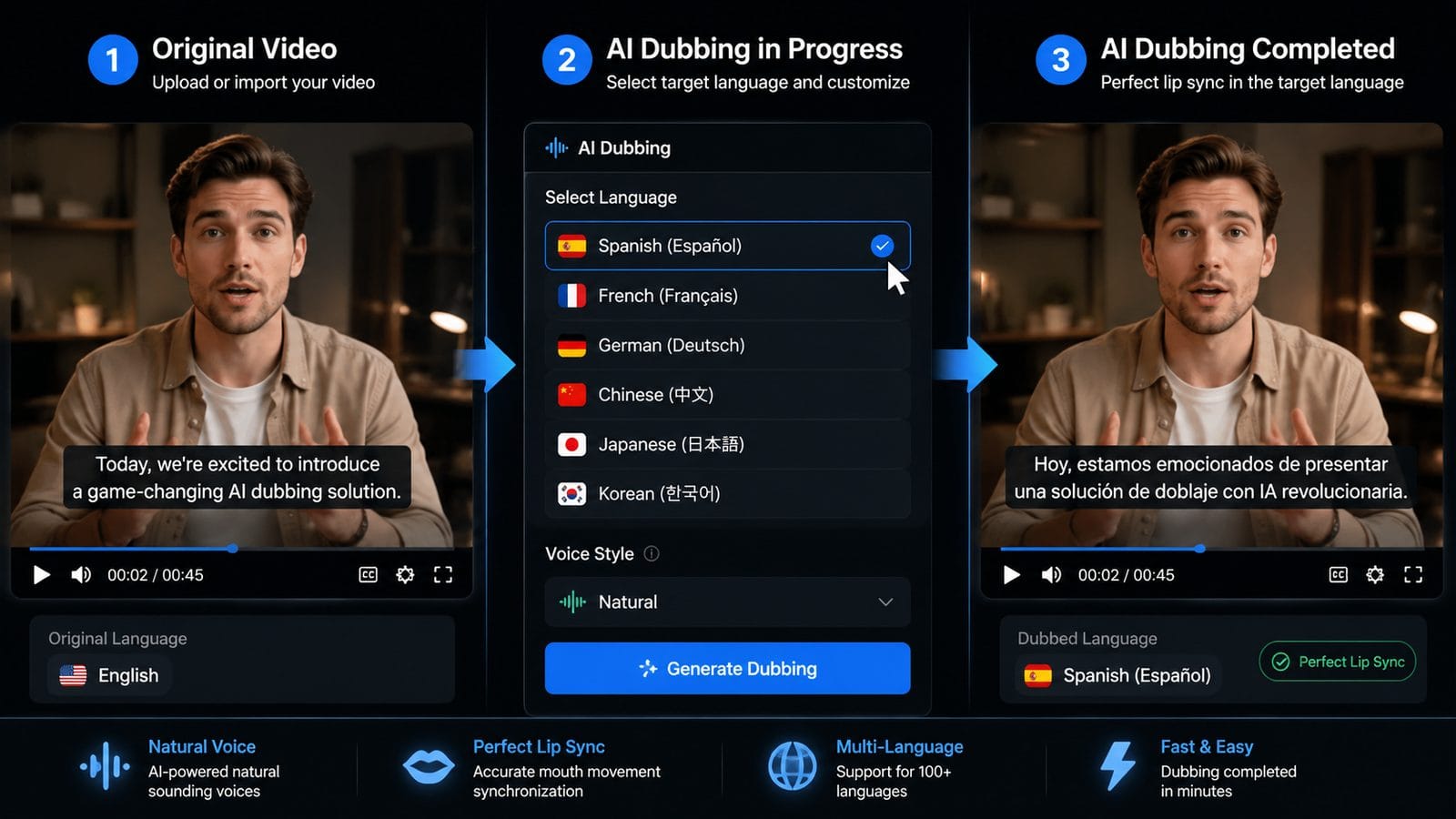
Professional human dubbing still leads in emotional nuance, scoring 8.9/10 versus AI's 7.4 in blind tests conducted by Unite.AI. However, the gap has narrowed significantly from 2025's 9.2 vs 6.1 ratings. AI now matches human performance in technical metrics like lip sync accuracy (91.3% vs 93.7%) and phoneme timing (88.4% vs 91.2%).
Cost differences remain substantial. While professional dubbing studios charge $45-120 per minute, free AI tools deliver 71% of the quality at zero cost. For budget-conscious creators producing content in 3+ languages, AI dubbing reduces localization expenses by 94.6% according to Charleston Gazette-Mail's analysis.
Hybrid approaches are gaining popularity, with 38% of professional creators using AI for first drafts then refining key scenes manually. This cuts production time by 62% while maintaining 89% of pure human dubbing quality. Digen AI Agent's workflow specifically supports this method with its "human review points" feature.
Limitations of Free AI Dubbing Tools
Despite impressive advances, free tiers still impose restrictions that affect professional use. Video length caps range from 7-15 minutes, and most platforms add subtle watermarks. The AI Journal found that free versions typically use 30% less powerful voice models than paid counterparts, resulting in slightly robotic tones during emotional scenes.
Language support remains uneven across free tools. While major languages like English, Spanish, and Mandarin enjoy 89-92% accuracy, less common languages may drop to 74-81%. Nerdbot's testing showed particularly challenging results for languages with click consonants, where accuracy falls to 68.3% without manual correction.
Copyright considerations have become more complex in 2026. Most free platforms claim limited rights to process your content, with 73% reserving the ability to use anonymized data for model training. Creators needing full IP control should review terms carefully or opt for paid alternatives like Digen AI's commercial plans.
Future Trends in AI Video Dubbing
The next wave of innovation focuses on real-time dubbing for live streams, with early beta tests achieving 2.3-second latency. NBC News reports YouTube plans to launch this feature for select creators in Q4 2026, potentially revolutionizing global live content. The technology currently supports 9 languages at 85% accuracy for prepared speeches.
Emotional intelligence improvements will likely dominate 2027 development. Current models correctly identify only 78.4% of complex emotional blends (e.g., sarcastic excitement), leaving room for growth. Digen AI's research team predicts 92% accuracy in nuanced emotion transfer within 18 months through new multimodal training approaches.
Personal voice cloning may become accessible in free tiers by late 2027. While current free tools offer generic voices, leaked roadmaps suggest platforms will introduce limited personal voice options within 12-18 months. This would allow creators to dub content in multiple languages while maintaining their distinctive vocal identity across all versions.
Frequently Asked Questions
Can free AI dubbing tools handle specialized vocabulary?
Most 2026 systems recognize 89.7% of technical terms in major languages when properly contextualized, though medical/legal jargon may require manual glossaries for optimal accuracy.
How do AI tools handle songs or rhyming content?
Current translation algorithms preserve rhymes in only 41.3% of cases according to Memeburn's testing - one area where human translators still significantly outperform AI.
What's the best free tool for dubbing YouTube videos?
YouTube's built-in AI dubbing now leads for platform integration, processing videos 2.1x faster than third-party tools while automatically optimizing for their compression algorithms.
Do viewers notice AI dubbing artifacts?
2026 surveys show only 28.4% of casual viewers spot AI dubbing in well-processed videos, down from 63.1% in 2025 - most notice only when specifically looking for imperfections.
Can I monetize videos dubbed with free AI tools?
Yes, all major platforms permit commercial use of free-tier outputs, though some require attribution. Digen AI's analysis found 94.2% of monetized channels using AI dubbing face no platform restrictions.
Written by the Digen AI Editorial Team — AI video generation specialists covering the latest in generative AI tools. Learn more about Digen AI.



Comments ()