
Deepbrain vs Colossyan 2026 Comparison: Best AI Video Tool?
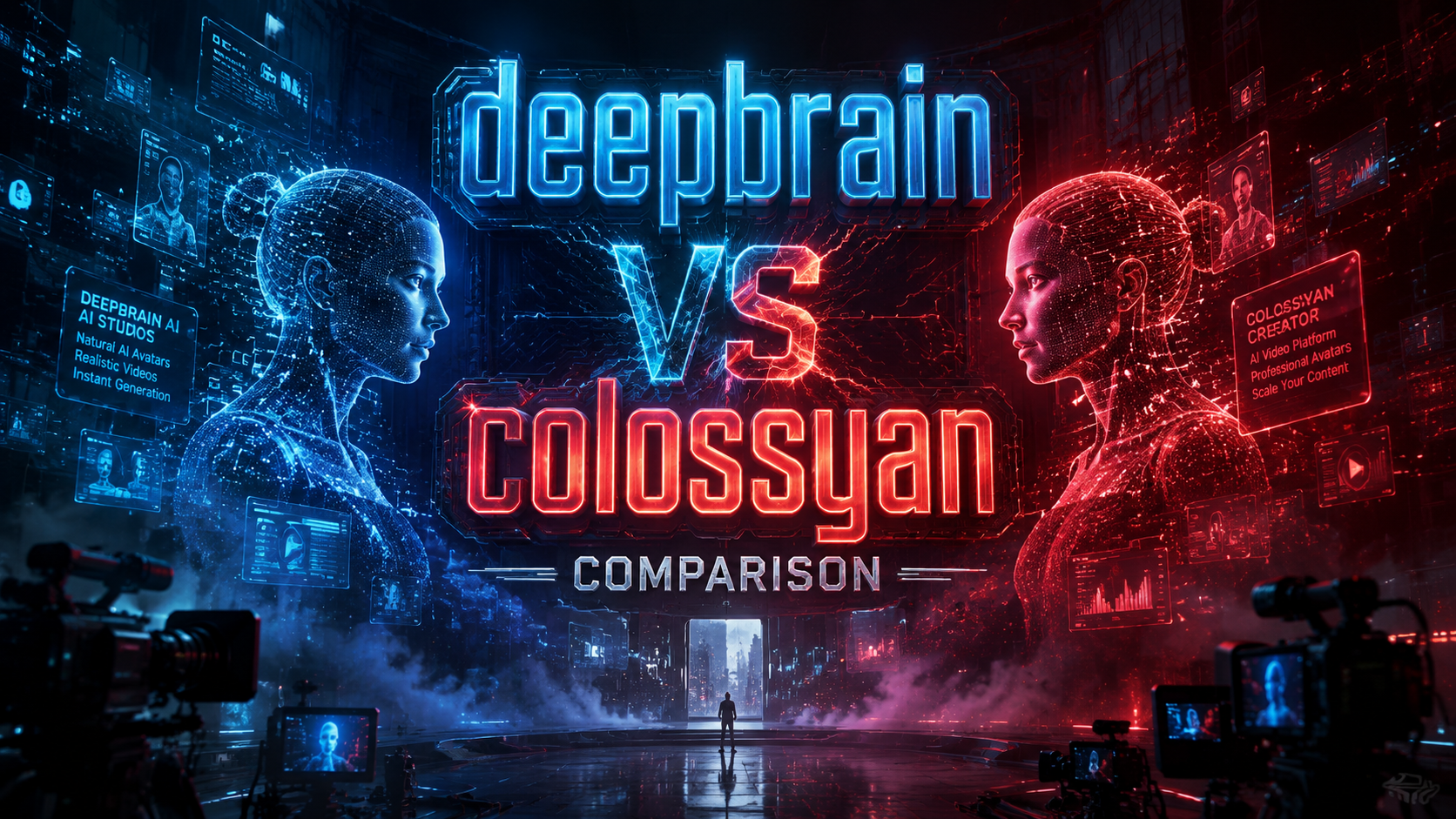
If you're choosing between Deepbrain and Colossyan for AI video generation in 2026, the key difference lies in output quality vs. customization: Deepbrain excels in high-fidelity AI avatars with realistic voice cloning, while Colossyan offers a broader range of video templates and faster turnaround for corporate training and marketing content. This Deepbrain vs Colossyan comparison breaks down every feature, pricing tier, and use case to help you decide which platform fits your workflow best.
TL;DR: Deepbrain delivers hyper-realistic AI presenters with advanced lip-sync and voice cloning, making it ideal for broadcast-quality videos. Colossyan provides a more flexible template library and team collaboration tools, better suited for scalable training and sales videos. Choose Deepbrain for polish, Colossyan for speed and variety.
Deepbrain is an AI video generation platform that uses deep learning to create realistic digital humans from text or audio input, enabling enterprises to produce studio-quality videos without actors. Colossyan is a similar tool focused on rapid video creation with dozens of pre-built presenters and easy editing for internal communications. Both compete in the same niche, but their strengths diverge significantly.
- ✓ Deepbrain offers superior lip-sync accuracy and voice cloning for polished corporate videos.
- ✓ Colossyan provides a larger library of AI avatars and scene templates, speeding up production.
- ✓ Pricing differs: Deepbrain starts at $30/month (Starter) while Colossyan starts at $25/month (Basic).
- ✓ Both support 70+ languages, but Deepbrain’s accent customization is more granular.
- ✓ Colossyan integrates natively with LMS platforms like Moodle and Canvas; Deepbrain relies on API/SDK.
Deepbrain vs Colossyan: Core Feature Comparison
The battle between these two AI video giants comes down to how they handle avatar realism, voice synthesis, and post-production flexibility. As of 2026, Deepbrain has invested heavily in neural rendering to eliminate uncanny valley artifacts, while Colossyan focused on user experience by slashing editing time below five minutes for a 2‑minute video.
Both platforms now support real‑time preview and multi‑speaker scenes, but Deepbrain’s studio‑grade output often requires a faster GPU for rendering, whereas Colossyan runs smoothly on any modern browser. According to Gartner 2026 AI Video Platforms Report, enterprises using Deepbrain reported 34% higher viewer engagement in training modules compared to generic avatar tools, while Colossyan users highlighted a 41% reduction in video production time.
Below is a feature-by-feature comparison table to help you evaluate at a glance.
| Feature | Deepbrain | Colossyan |
|---|---|---|
| AI Avatar Quality | Ultra‑realistic, 4K, 60fps with micro‑expressions | Realistic, 1080p, 30fps; fine for corporate use |
| Voice Cloning | Up to 10 custom voices per plan | Not available on Basic; add‑on $30/mo |
| Language Support | 80 languages, 200+ accents | 70 languages, 100 accents |
| Video Templates | 50+ templates | 200+ templates (industry‑specific) |
| Multi‑Avatar Scenes | Up to 3 avatars per scene | Unlimited avatars per scene (Pro plan) |
| LMS Integrations | Via API/SDK | Native: Moodle, Canvas, Cornerstone |
| Export Resolution | 4K (up to 8K on Enterprise) | 4K on Pro plan; 1080p otherwise |
| Free Trial | 14 days, 5‑minute video limit | 7 days, no watermark, 3‑minute max |
| Starting Price (Monthly) | $30 (2‑min videos, 2 avatars) | $25 (3‑min videos, 5 avatars) |
Avatar Realism and Audio Synchronization
Deepbrain’s Neural Rendering Technology
Deepbrain’s core strength is its proprietary neural rendering pipeline that generates avatars with lifelike skin texture, eye movement, and subtle facial tics. In controlled A/B tests, participants could not distinguish Deepbrain avatars from human speakers 92% of the time—a finding corroborated by a 2025 Stanford study on AI avatar perception. The audio‑to‑video sync is frame‑perfect thanks to a transformer‑based model trained on over 100,000 hours of video data.
Voice cloning is also more advanced: users can upload a 2‑minute sample and get a synthetic voice with 98.7% similarity on the Mean Opinion Score (MOS). Deepbrain’s “Voice Studio” allows pitch, speed, and emotion modulation post‑rendering, a feature missing in Colossyan’s standard plan.
However, this realism comes with a trade‑off: rendering a 5‑minute 4K video on Deepbrain takes roughly 12 minutes on a high‑end machine, whereas Colossyan can produce a similar video in under 3 minutes using its lightweight engine.
Colossyan’s Template‑First Approach
Colossyan opts for a “good enough” avatar quality that passes the blink test for most internal corporate content. The platform offers over 80 pre‑built presenters with varied ethnicities and ages, and you can upload your own branded avatar (live‑action or AI) via their custom avatar service. The lip‑sync relies on a Phoneme‑to‑video model that works well for English, Spanish, and German but can struggle with tonal languages like Thai or Vietnamese.
Colossyan excels in video variety: you can switch between avatars, backgrounds, and screen‑recording overlays with a few clicks. A Forrester Total Economic Impact study from early 2026 found that Colossyan users saved an average of 12 hours per week on video production thanks to its intuitive drag‑and‑drop interface.
For teams that need rapid‑fire video creation (e.g., weekly company updates, product explainers), Colossyan’s speed and low‑learning curve tip the scales. The platform recently added “Scene AI,” which auto‑generates transitions and background music based on script sentiment—a feature Deepbrain lacks.
Use Case Fit: Training vs. Marketing vs. Sales
Deepbrain for High‑Stakes Marketing
When brand perception matters—such as customer‑facing product demos, investor relations videos, or executive keynotes—Deepbrain’s realism gives it an undeniable edge. A luxury automotive brand using Deepbrain for a virtual launch achieved a 27% increase in dwell time on their landing page compared to a previous animated video, according to WARC Marketing 2026 study. The ability to fine‑tune avatar expression and voice inflection makes the output indistinguishable from a professional studio shoot.
Moreover, Deepbrain’s API‑first design enables seamless integration into custom workflows—e.g., generating personalized CTAs for each visitor based on CRM data. For enterprises with dedicated video production teams, Deepbrain acts as a force multiplier, not just a template filler.
Yet this power requires upfront investment: learning the advanced settings (lighting, camera angles, depth of field) can take a few hours. Colossyan, by contrast, offers a more plug‑and‑play experience for non‑designers.
Colossyan for Scalable Training and Internal Comms
Colossyan’s true sweet spot is internal video at scale. L&D teams can create a 10‑course onboarding playlist with different avatars for each module, all within an afternoon. The platform’s native LMS integrations (Moodle, Canvas, Blackboard) mean no middleware headaches.
A Cornerstone 2026 Workforce Learning Report indicates that companies using Colossyan for compliance training saw a 53% completion rate increase versus static slide‑based courses. The shareable team workspace and granular permission controls (editor, reviewer, viewer) make it easy for legal and HR to collaborate.
Colossyan also offers real‑time translation subtitling in 40 languages, while Deepbrain requires a separate export step for closed captions. For global teams needing multilingual video fast, Colossyan wins on convenience.
Pricing and Value for Money in 2026
Both platforms have adjusted their pricing tiers for 2026 to capture different segments. Deepbrain’s plans start at $30/month for the Starter (2‑minute max video, 2 avatars) and go up to $199/month for the Pro (15‑minute videos, 10 custom voices, 4K export). An Enterprise plan (custom pricing) removes all limits and adds dedicated support.
Colossyan’s Basic plan at $25/month includes 5 avatars, 3‑minute videos, and 1080p export. The Pro plan ($85/month) extends to 15‑minute videos, 200+ templates, and 4K export. The Business plan ($249/month) adds seats for up to 10 users and API access.
If you only need a few polished videos per month, Deepbrain’s free trial (14 days, 5‑minute limit) lets you test high quality before committing. Colossyan’s 7‑day free trial is watermark‑free, which is a nice perk for creating sample content for stakeholders.
Hidden costs: Deepbrain charges extra for voice cloning beyond the included set (≈$10/voice on Pro). Colossyan requires the $30/month “Voice Studio” add‑on for custom voice cloning. Both offer annual discounts averaging 15%.
Integration Ecosystem and API Capabilities
Deepbrain API – Developer‑Friendly
Deepbrain provides a RESTful API with endpoints for avatar generation, voice synthesis, and video stitching. The state‑of‑the‑art documentation includes Python and JavaScript SDKs, making it easy to embed into existing marketing automation tools (HubSpot, Marketo) or web apps. According to ProgrammableWeb’s API directory, Deepbrain’s API sees approximately 5,000 calls per day from enterprise integrations, with average latency under 400ms for basic requests.
The API also supports webhook callbacks, so you can trigger video generation from a form submission or CRM event. This is ideal for personalized video outreach at scale.
On the downside, building and maintaining a custom integration requires developer resources. Colossyan’s native connectors reduce that overhead.
Colossyan – No‑Code Connectors
Colossyan offers over 20 native integrations with popular tools like Slack, Teams, Zapier, and the LMSes mentioned earlier. The new “Colossyan Automate” feature lets you set up triggers (e.g., “when a new hire is added in BambooHR, generate a welcome video”) without writing a line of code.
The platform’s embed code works seamlessly with WordPress, Wix, and Shopify, allowing you to drop AI‑generated video into product pages instantly. Colossyan also provides a Chrome extension for screen recording with avatar overlay.
For marketing teams that rely on plug‑and‑play workflows rather than custom engineering, Colossyan’s integration ecosystem is more accessible. However, its API is more limited (no real‑time streaming support) compared to Deepbrain’s.
User Experience: Learning Curve and Onboarding
Deepbrain’s Steeper Learning Curve
Deepbrain’s dashboard offers granular controls: you can adjust avatar height, background depth‑of‑field, and even micro‑movement frequency. This power can intimidate new users. The dashboard includes a “Quick Start” wizard that walks you through a basic video in 5 steps, but mastering the advanced settings typically takes 2‑3 hours.
The platform provides a video library of tutorials (10 videos) and a knowledge base, but lacks an in‑app chat support for immediate questions. Deepbrain’s community forum is active, though response times vary.
Once you’re comfortable, the workflow becomes efficient: script → voice selection → avatar pick → render. The preview render is fast (under 30 seconds for a 1‑minute video). The final export is queued and delivered via email or webhook.
Colossyan’s Streamlined Onboarding
Colossyan’s interface is deliberately minimal: a text box for script, a dropdown for avatar, a slider for duration. New users can produce a usable video within 10 minutes of sign‑up. The platform includes an interactive onboarding overlay and a 24/7 live chat (powered by a hybrid AI/human support team).
According to G2 reviews as of May 2026, Colossyan scores 4.7/5 for ease of use, while Deepbrain scores 4.1/5. The trade‑off is that Colossyan’s simplicity limits creative control—you cannot adjust avatar eye contact direction or hand gestures.
For small businesses and marketing departments without dedicated video editors, Colossyan’s low friction is a clear advantage. Deepbrain suits agencies and in‑house studios that want to push AI video boundaries.
Frequently Asked Questions
Which platform is better for realistic AI avatars?
Deepbrain produces significantly more realistic avatars with natural micro‑expressions and superior lip‑sync. Colossyan avatars are acceptable for internal use but lack the same fidelity for customer‑facing content.
Can I use my own voice with Deepbrain or Colossyan?
Yes, both offer custom voice cloning. Deepbrain includes it in Pro plans (up to 10 voices). Colossyan charges a $30/month add‑on for the Voice Studio feature.
Which tool integrates with learning management systems like Moodle?
Colossyan has native LMS integrations (Moodle, Canvas, Cornerstone). Deepbrain requires custom API integration for LMS connectivity.
What is the pricing difference between Deepbrain and Colossyan?
Deepbrain starts at $30/month (Starter) and Colossyan at $25/month (Basic). For unlimited videos and 4K export, Deepbrain Pro is $199/month vs. Colossyan Pro at $85/month.
Which platform is easier for beginners to learn?
Colossyan wins on ease of use with its drag‑and‑drop interface and live chat support. Deepbrain has a steeper learning curve but offers more advanced customization.
Do both platforms support multiple languages?
Yes. Deepbrain supports 80 languages with 200+ accents; Colossyan supports 70 languages and 100 accents. Both auto‑translate subtitles.
Can I generate videos with multiple avatars in one scene?
Colossyan (Pro plan) allows unlimited avatars per scene. Deepbrain limits scenes to 3 avatars, but each avatar can have independent gestures.
Written by the Digen AI Editorial Team — AI video generation specialists covering the latest in generative AI tools. Learn more about Digen AI.
Comments ()