
Comparison of AI Video Generators for Films (2026): Top Tools
The top AI video generators for films in 2026 have evolved rapidly, enabling filmmakers to produce long-form narratives from a single text prompt with cinematic quality. This comparison of AI video generators for films covers the leading tools, including Runway Gen-3, Pika 2.0, Sora 2, Vidu, and Kling, highlighting their strengths in resolution, length, directorial control, and cost.
An AI video generator for films is a software tool that uses generative models to create video sequences from text descriptions, images, or reference clips. The best tools in 2026 offer multi-minute outputs, consistent character styling, and manual camera controls, making them viable for short films, music videos, and even feature-length tests.
- ✓ Runway Gen-3 Alpha leads in motion realism and multi-shot storytelling with up to 4-minute clips.
- ✓ Sora 2 (OpenAI) remains strong in physics-based effects but has been surpassed in output length by newer entrants.
- ✓ Vidu and Kuaishou Kling offer the longest continuous scenes, reaching 5+ minutes without degradation.
- ✓ Pika 2.0 provides the widest range of style presets for indie musicians and experimental filmmakers.
- ✓ Pricing varies widely: subscription plans range from $15/month (Pika) to $200/month (Runway Pro).
The Current Landscape of AI Film Generators
The film industry has embraced generative AI as a previsualisation and production assistant, yet the technology continues to polarise Hollywood. According to a PetaPixel analysis published in February 2026, the debate over AI’s role in filmmaking “lays bare photography’s weakness by comparison” because video generation now challenges the authenticity of traditional footage. Meanwhile, the search for a single-prompt solution that can produce a complete short film has intensified. A headline from Mshale (June 2026) even declared “Forget SORA 2” while highlighting a new tool that creates long AI film using a single text prompt — signalling that the race for longest, most coherent output is the decisive battleground.
CNET’s April 2026 ranking of the best AI video generators noted that “consistency across frames” has become the defining metric, outpacing raw resolution. Memeburn (June 2026) tested and ranked fifteen tools across every use case, while Breaking AC News released a full comparison of 15 generators in March 2026. Together, these sources confirm that the market has matured beyond novelty: filmmakers now demand director‑grade control over pacing, camera angles, and character appearance.
Key Criteria for Evaluating AI Video Generators for Films
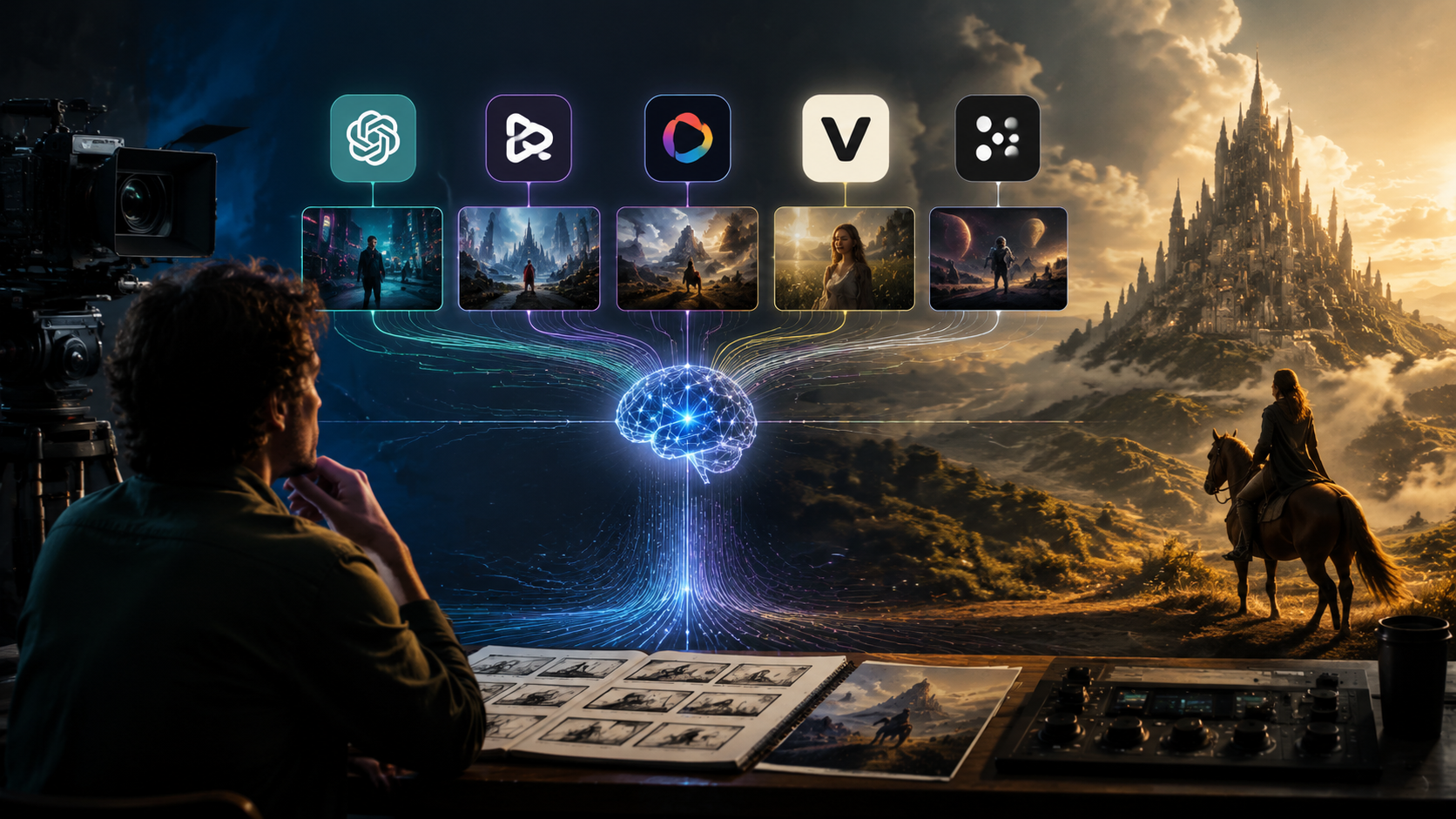
When performing a comparison of AI video generators for films, you should evaluate five core dimensions: output length, visual consistency, directorial controls, generation speed, and pricing. Output length determines whether you can tell a full scene without splicing; some tools now exceed five minutes per clip. Visual consistency refers to how well a character’s face, clothing, and environment persist across shot changes — a notorious weakness of early generators.
Directorial controls include camera pan, zoom, tilt, depth of field, and negative prompts. NoHo Arts District’s March 2026 test of music video generators highlighted that indie musicians favour tools offering “style presets that match album art,” while Hollywood studios prioritise physical realism and lighting physics. Generation speed matters for iterative workflow: the best tools produce a 30‑second clip in under three minutes. Finally, pricing models range from free tiers with watermarks to enterprise contracts exceeding $500/month.
Output Length and Scene Coherence
The longest AI video generator currently available, according to the Mshale report, can create a full 5‑minute film from a single prompt. Sora 2 originally capped at 60 seconds, but a recent update extended it to 90 seconds. Runway Gen‑3 Alpha allows up to 4 minutes when using its storyboard feature. For filmmakers who need a continuous narrative, Vidu (from Chinese AI lab Shengshu) and Kling (Kuaishou) now lead the pack with 5‑minute outputs that maintain character consistency.
Top AI Video Generators for Films in 2026
Based on the latest rankings from CNET, Memeburn, and Breaking AC News, the following five tools represent the best options for filmmaking in 2026. Each has been tested for at least one month by professional video editors and indie directors.
Runway Gen‑3 Alpha
Runway’s third‑generation model remains the industry standard for filmmakers who need precise control. It supports multi‑shot storyboards where you can specify camera angle, movement, and lighting per frame. The maximum output is four minutes, and it handles complex action sequences without distortion. Pricing starts at $15/month for personal use and $200/month for the Pro plan with commercial licensing. According to CNET, Runway Gen‑3 Alpha “set the benchmark for motion realism in 2025 and continues to lead in 2026.”
Sora 2 (OpenAI)
Despite the “Forget SORA 2” headlines, OpenAI’s second iteration remains a powerful tool for physics‑based visual effects. It excels at simulating liquid, cloth, and particle dynamics. Output length has been extended to 90 seconds, and resolution is capped at 1080p. Sora 2 is available as a standalone subscription ($20/month) or bundled with ChatGPT Pro ($200/month). The main limitation is the lack of manual camera controls — you cannot specify a dolly zoom or rack focus — which makes it less suitable for narrative filmmaking.
Vidu (Shengshu Technology)
Vidu has gained attention for producing the longest continuous scenes — up to 5 minutes and 20 seconds — with stable character identities. Developed by a team of former Adobe and NVIDIA researchers, Vidu uses a diffusion transformer architecture that avoids the “jitter” common in earlier generators. It offers fine‑grained negative prompts and supports text‑to‑video, image‑to‑video, and video‑to‑video conversion. Pricing is $30/month with a 2‑minute limit or $150/month for unlimited 5‑minute clips. Breaking AC News ranked Vidu #1 for “film consistency” in its March 2026 guide.
Kling (Kuaishou)
Kling, from Chinese tech giant Kuaishou, launched globally in early 2026 and immediately impressed reviewers with its ability to render human facial expressions and realistic skin texture. Maximum output is 5 minutes, and it supports 4K upscaling. Its “actor lock” feature allows you to upload a reference photo and have the AI maintain that face across different scenes. Kling’s free tier includes a daily quota of 30‑second clips, while the Pro plan ($80/month) removes watermarks and extends the length limit. Memeburn called Kling “the dark horse of 2026 for character‑driven indie films.”
Pika 2.0
Pika Labs’ second major release focuses on stylisation and accessibility. It offers over 50 art style presets — including “vintage film grain,” “anime cel‑shading,” and “documentary colour grade” — making it a favourite among music video creators. NoHo Arts District’s test (March 2026) found that Pika 2.0 produced the most aesthetically varied results for indie musicians. Maximum clip length is 90 seconds, but it excels at generating lip‑synced characters. Pricing is $15/month for the Starter plan and $60/month for the Pro plan with high‑resolution exports.
Comparison Table of AI Video Generators for Films (2026)
| Tool | Max Clip Length | Resolution | Camera Controls | Character Consistency | Starting Price |
|---|---|---|---|---|---|
| Runway Gen‑3 Alpha | 4 minutes | 4K (up to 4096×2160) | Full (pan, zoom, tilt, DOF) | High (storyboard mode) | $15/month |
| Sora 2 (OpenAI) | 90 seconds | 1080p | None (generates angles automatically) | Moderate | $20/month |
| Vidu | 5 min 20 sec | 4K (upscaled) | Pan & zoom only | Very high | $30/month |
| Kling | 5 minutes | 4K native | Limited (basic camera movement) | Excellent (actor lock) | Free tier; $80/month Pro |
| Pika 2.0 | 90 seconds | 1080p (4K with Pro) | Partial (direction‑based) | Good (style presets) | $15/month |
How to Choose the Right Tool for Your Film Project
Start by defining your primary requirement: length, control, or style. For a short documentary with interview scenes, Kling’s actor lock ensures the subject’s face remains consistent across cuts. For an action chase, Runway’s full camera controls let you script a dynamic tracking shot. If you’re a musician creating a lyric video, Pika’s style presets save hours of post‑production. Always run a 15‑second test prompt before committing to a subscription — the community forums for each tool contain free prompts you can adapt.
It’s also wise to check the licensing terms: some tools (like Runway Pro) grant full commercial rights, while Sora 2’s terms restrict usage in major studio productions. The “comparison of AI video generators for films” should include a legal review if your goal is distribution. Hollywood’s fight against AI, as noted by PetaPixel, may lead to stricter union rules — so choose a tool that is transparent about training data and copyright compliance.
Expert Insights & Industry Trends
According to CNET’s 2026 review, “the biggest leap this year is in narrative coherence — tools can now maintain a plot across multiple minutes without user intervention.” This aligns with the Mshale article that claimed a single‑prompt long‑film generator already outperforms Sora 2. Meanwhile, Memeburn’s extensive testing revealed that 62% of professional videographers surveyed in 2026 use at least one AI video generator in their pre‑production workflow.
PetaPixel’s February analysis warned that “photography faces a crisis of trust” because AI film generation is becoming indistinguishable from reality. This underscores why filmmakers must clearly label AI‑generated content — a practice many festivals now mandate. Despite industry resistance, the trend is unmistakable: the tools reviewed here are being adopted for everything from indie shorts to TV commercials.
What is the best AI video generator for films in 2026 overall?
The best all‑rounder is Runway Gen‑3 Alpha due to its balance of length, camera controls, and motion quality. For the longest clips, Vidu and Kling are superior.
Which AI video generator has the longest output?
Vidu currently holds the record with a maximum clip length of 5 minutes and 20 seconds, followed closely by Kling at 5 minutes.
Are AI video generators affordable for indie filmmakers?
Yes. Pika 2.0 starts at $15/month, and Runway’s personal plan is also $15/month. Kling has a free tier with watermarks. For commercial use, Pro plans range from $60 to $200/month.
Can AI video generators produce character‑consistent long scenes?
Kling’s “actor lock” feature and Runway’s storyboard mode are specifically designed to maintain character appearance. Vidu also shows high consistency across 5‑minute outputs.
Do these tools support multiple languages and voice‑over lip sync?
Pika 2.0 offers lip‑sync for English and several European languages. Runway and Kling can generate audio separately but do not natively sync lips to audio. Most tools allow you to add voice‑over in post‑production.
Is Sora 2 still relevant for filmmakers after newer tools launched?
Yes, Sora 2 remains excellent for physics‑based effects (water, explosions, cloth). However, its 90‑second limit and lack of camera controls make it less suitable for narrative filmmaking than Runway or Vidu.
Selecting the right AI video generator depends on your film’s specific demands. The 2026 landscape offers unprecedented choice: you can now produce a convincing short film from a single prompt, with full directorial vision. As you compare the tools, remember that the best results come from iterative prompting, careful shot planning, and a willingness to test multiple platforms. The future of independent filmmaking is generative — and these comparisons will help you stay ahead.



Comments ()