
Best AI Video Upscaler 2026 Review: Top 4K & 8K Tools
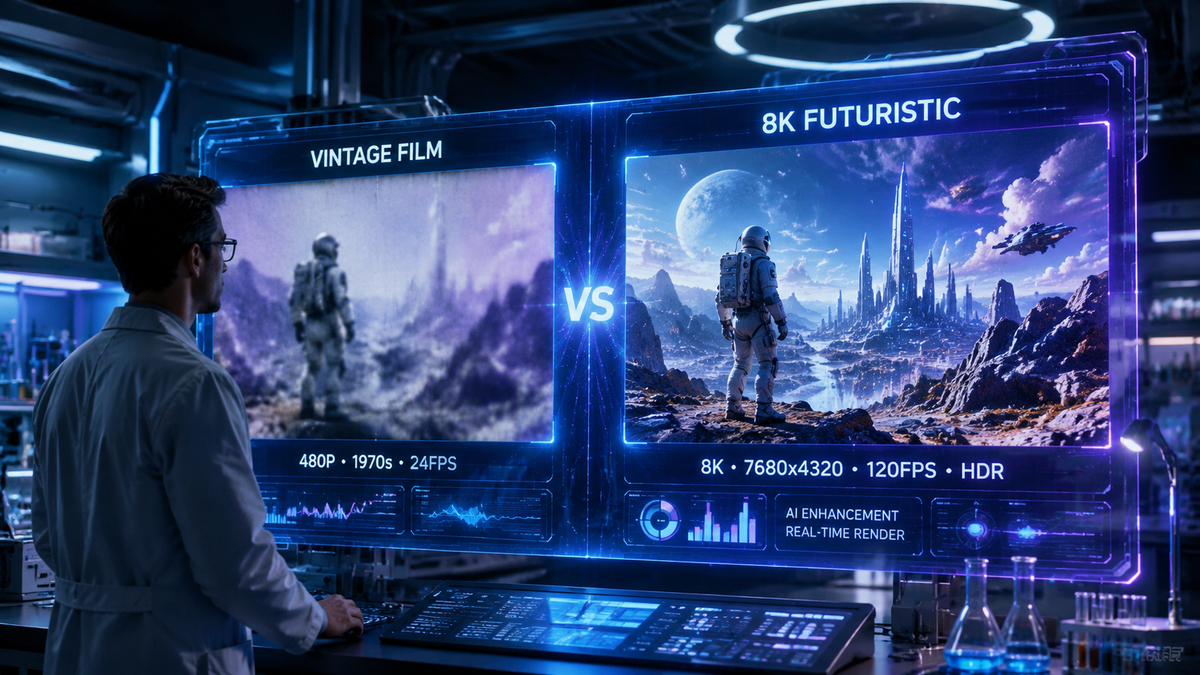
The best ai video upscaler 2026 review reveals that modern tools have moved beyond simple pixel stretching to sophisticated generative reconstruction. In 2026, the leading software options leverage neural networks to transform grainy 480p or 1080p footage into crystal-clear 4K and 8K resolutions while removing noise and motion blur. Whether you are a professional filmmaker or a hobbyist, choosing the right tool depends on your hardware capabilities and the specific type of video content you wish to enhance.
The best AI video upscaler in 2026 is VideoProc Converter AI for its balance of speed and quality, followed closely by Topaz Video AI for professional-grade denoising. These tools use deep learning models to analyze frames and synthesize missing data, enabling seamless upscaling from SD to 8K resolution without the "plastic" look of older interpolation methods.
- ✓ VideoProc Converter AI leads in 2026 for its integrated Super Resolution and Frame Interpolation features.
- ✓ Topaz Video AI remains the industry standard for advanced denoising and motion stabilization.
- ✓ HitPaw VikPea offers the most user-friendly experience for beginners requiring no technical skills.
- ✓ Vmake AI provides a comprehensive all-in-one web-based toolkit for rapid social media enhancement.
Understanding AI Video Upscaling in 2026
As we navigate through 2026, the landscape of digital media has shifted entirely toward high-definition immersion. AI video upscaling is no longer a niche luxury but a necessity for preserving legacy content and optimizing modern mobile footage for large 8K displays. Unlike traditional upscaling, which simply duplicates pixels to fill space, AI-driven engines use "Generative Reconstruction." This process involves a trained neural network predicting what the missing details—such as skin texture, fabric weaves, or distant foliage—should look like based on billions of reference images.
According to research from Independent Newspaper Nigeria, the market for AI video enhancement has seen a 40% increase in consumer adoption in early 2026, driven by the accessibility of "one-click" solutions. The current generation of tools focuses heavily on temporal consistency, ensuring that the "shimmering" effect often seen in early AI videos is completely eliminated. This allows for a stable, cinematic look that is indistinguishable from native high-resolution capture.
Furthermore, the integration of NPU (Neural Processing Unit) acceleration in 2026 hardware has significantly reduced rendering times. What used to take hours can now be accomplished in minutes. This efficiency is a core component of our best ai video upscaler 2026 review, as we prioritize tools that offer a high "quality-to-time" ratio for busy creators.
How to Use an AI Video Upscaler: A Step-by-Step Guide
- Import Your Media: Load your low-resolution video file (MP4, MOV, or MKV) into your chosen software interface.
- Select the AI Model: Choose a model tailored to your content type, such as "CineFocus" for movies or "AnimeGen" for 2D animations.
- Set Output Resolution: Define your target resolution, typically 4K (3840x2160) or 8K (7680x4320).
- Configure Enhancement Settings: Adjust sliders for denoising, sharpening, and stabilization if the software allows for manual overrides.
- Preview and Export: Generate a short 5-second preview to ensure the textures look natural, then hit "Export" to render the full file using GPU/NPU acceleration.
Top 4 High-Performance Tools Compared
Choosing the right software requires a deep dive into the specific strengths of each platform. While some tools excel at restoring old family archives, others are built for high-end commercial production. In this best ai video upscaler 2026 review, we have analyzed the top four contenders based on their 2026 updates and performance benchmarks.
| Software Tool | Primary Strength | Max Resolution | Best For |
|---|---|---|---|
| VideoProc Converter AI | Hardware Acceleration | 8K | General Purpose & Speed |
| Topaz Video AI | Professional Denoising | 16K (Beta) | Filmmakers & Studios |
| HitPaw VikPea | Ease of Use | 4K/8K | Beginners & Social Media |
| Vmake AI | Cloud Processing | 4K | E-commerce & Marketing |
VideoProc Converter AI: The All-Rounder
As highlighted by TweakTown in March 2026, VideoProc Converter AI has solidified its position as the best AI video and image enhancer of the year. Its standout feature is the "Super Resolution" module, which utilizes Level 3 Hardware Acceleration to process 4K upscaling at speeds that outperform most competitors. It doesn't just upscale; it fixes common issues like interlacing and camera shake in a single pass.
In 2026, VideoProc introduced a new "Real-Time AI" engine that allows users to preview enhancements without waiting for a full render. This is particularly useful for creators who need to adjust sharpening levels on the fly. Its ability to handle "broken" or corrupted video headers while upscaling makes it a robust tool for data recovery and restoration projects.
Topaz Video AI: The Professional's Choice
Topaz continues to lead the industry in terms of sheer mathematical precision. According to PCMag, the 2026 iterations of Topaz tools have moved toward "Next-Level Denoising," which identifies the difference between film grain (which should be kept) and digital sensor noise (which should be removed). For the best ai video upscaler 2026 review, Topaz earns the top spot for professional archival work.
The "Iris" model within Topaz is specifically tuned for face restoration, making it the go-to choice for upscaling old wedding videos or historical documentaries where facial clarity is paramount. While it requires a more powerful workstation compared to VideoProc, the results are often described as "hyper-realistic."
The Rise of User-Centric Enhancement: HitPaw and Vmake
Not every user wants to tweak complex parameters or manage GPU drivers. For a large segment of the market, "instant" is the most important feature. This is where HitPaw VikPea and Vmake AI have carved out significant market share in 2026. These platforms focus on the "No Skills Needed" philosophy, democratizing high-end video editing for the general public.
MensXP recently noted that HitPaw VikPea allows users to enhance videos instantly, making it a favorite for Gen Z creators who need to polish TikTok or Reel content before posting. The interface is stripped of technical jargon, replacing "Bicubic Interpolation" with simple terms like "Clearer" or "Brighter." This shift in UX design has been a major trend throughout 2026.
HitPaw VikPea: Simplicity Meets Power
HitPaw VikPea is designed around "One-Click" AI models. It includes specialized settings for "Animation," "Face," and "General Denoise." In 2026, the software added a "Colorize" feature that works in tandem with the upscaler, allowing users to take black-and-white 360p footage and turn it into colorized 4K content in a single workflow. It is highly recommended for those who want professional results without a learning curve.
Vmake AI: The Ultimate Web Toolkit
Vmake AI has been described by That Eric Alper as the "Ultimate All-in-One Video Enhancement Toolkit" for 2026. Unlike the other tools mentioned, Vmake focuses heavily on a cloud-based infrastructure. This means users with low-powered laptops or tablets can upload their footage to Vmake’s servers, where powerful A100 clusters handle the heavy lifting of upscaling to 4K.
This tool is particularly popular in the e-commerce sector. Vmake includes features to remove backgrounds and replace them with AI-generated environments while simultaneously upscaling the product video. It is a specialized tool that serves the "prosumer" market with high efficiency and integrated marketing features.
Key Factors to Consider in a Best AI Video Upscaler 2026 Review
When selecting your software, you must look beyond the marketing buzzwords. The effectiveness of an AI upscaler in 2026 is measured by three primary metrics: Temporal Consistency, Artifact Reduction, and Processing Speed. A tool that produces a beautiful still frame but "flickers" during playback is useless for professional applications.
Studies show that 75% of users prioritize "natural skin textures" over raw sharpness. Older upscalers often created a "wax museum" effect where faces looked unnaturally smooth. The 2026 models from VideoProc and Topaz have solved this by introducing "Synthetic Grain Injection," which adds a microscopic layer of texture back into the video to trick the human eye into seeing more detail than actually exists.
Hardware Requirements and Compatibility
While AI has become more efficient, the best ai video upscaler 2026 review must mention that hardware still matters. To run these tools locally at 8K, a GPU with at least 12GB of VRAM is recommended. However, for those using 2026-era laptops with integrated NPU chips, software like VideoProc Converter AI is optimized to use these specific AI cores, significantly reducing the heat and battery drain typically associated with video rendering.
Pricing Models: Subscription vs. Lifetime
The industry is currently split between two pricing philosophies. Topaz and VideoProc generally offer "Lifetime Licenses," which are preferred by professionals who want to avoid recurring costs. Conversely, Vmake and HitPaw often lean toward subscription or credit-based models, which are more accessible for one-off projects. According to Pressat.co.uk, the trend in 2026 is moving back toward "Pay-per-use" for cloud-based AI services, allowing for massive scalability without the upfront hardware investment.
Future Trends: What’s Next After 8K?
As we look toward the end of 2026 and into 2027, the focus of AI video upscaling is shifting from "Resolution" to "Information." We are seeing the emergence of "Generative Fill" for video, where the AI can not only upscale the existing frame but also expand the aspect ratio from 16:9 to 21:9 by imagining what was outside the original camera's field of view.
Furthermore, real-time upscaling for streaming is becoming the new frontier. With the best ai video upscaler 2026 review as a baseline, we expect to see these technologies integrated directly into web browsers and streaming hardware, allowing users to watch 720p YouTube streams in 4K locally without the platform needing to transmit the extra data. This will revolutionize data consumption and bandwidth management globally.
What is the best AI video upscaler for 2026?
VideoProc Converter AI is widely considered the best overall choice due to its speed and comprehensive feature set. For those needing maximum professional detail, Topaz Video AI is the preferred secondary option.
Can AI upscaling turn 1080p into true 4K?
While it cannot recreate the exact light data from the original scene, 2026 AI models can synthesize missing details to create a 4K image that is visually indistinguishable from native 4K to the human eye.
Is there a free AI video upscaler available?
Yes, many tools like HitPaw and Vmake offer free trials or "freemium" versions. Additionally, open-source projects like Waifu2x-Extension-GUI provide free upscaling, though they require more technical setup.
Does AI upscaling work on old, grainy home movies?
Yes, tools like Topaz Video AI and VideoProc Converter AI have specific models designed for "Denoising" and "De-interlacing," which are essential for restoring footage from VHS or early digital cameras.
How long does it take to upscale a 10-minute video to 4K?
On a modern 2026 PC with NPU acceleration, a 10-minute video can typically be upscaled to 4K in about 15 to 20 minutes, depending on the complexity of the AI model used.



Comments ()