
10 Best AI Video Enhancement Tools 2026: Pro Quality Guide
Finding the best ai video enhancement tools 2026 requires balancing processing power, upscaling quality, and ease of use. In 2026, the standard for professional video has shifted toward 8K resolution and generative frame interpolation, making AI-driven software essential for content creators and filmmakers alike. The top tools this year utilize neural networks to reconstruct lost pixels, remove motion blur, and stabilize footage with cinematic precision.
The best AI video enhancement tools in 2026 are Vmake AI, Topaz Video AI, and Adobe Premiere Pro’s Generative Extend. These platforms utilize advanced deep learning models to upscale footage from SD to 8K, remove noise, and stabilize shaky clips. According to recent industry benchmarks by Gearbrain, AI enhancers can now improve video clarity by up to 400% without introducing artifacts.
- ✓ Vmake AI has emerged as the leading all-in-one toolkit for automated professional HD looks.
- ✓ Upscaling to 8K resolution is now standard across most high-end desktop AI enhancers.
- ✓ Mobile-first solutions are dominating the Android market for social media creators.
- ✓ Generative frame interpolation allows for smooth slow-motion even on low-frame-rate source files.
How to Use the Best AI Video Enhancement Tools 2026
Modern video enhancement has moved beyond simple filters. To achieve professional results in 2026, users must follow a specific workflow that allows the AI to analyze temporal data across multiple frames. This ensures that the sharpening and color correction remain consistent throughout the duration of the clip.
- Import and Analyze: Upload your source footage into the AI enhancer. Most tools will perform an initial scan to detect noise levels and compression artifacts.
- Select Model Type: Choose a specific AI model based on your needs (e.g., "Proteus" for sharpening, "Gaia" for high-quality upscaling, or "Theia" for detail restoration).
- Adjust Resolution and Bitrate: Set your target output, such as 4K or 8K. Ensure the bitrate is high enough to support the new pixel data generated by the AI.
- Preview and Render: Use the "split-screen" preview feature to compare the original and enhanced versions before committing to the final export.
The Evolution of Video Enhancement in 2026
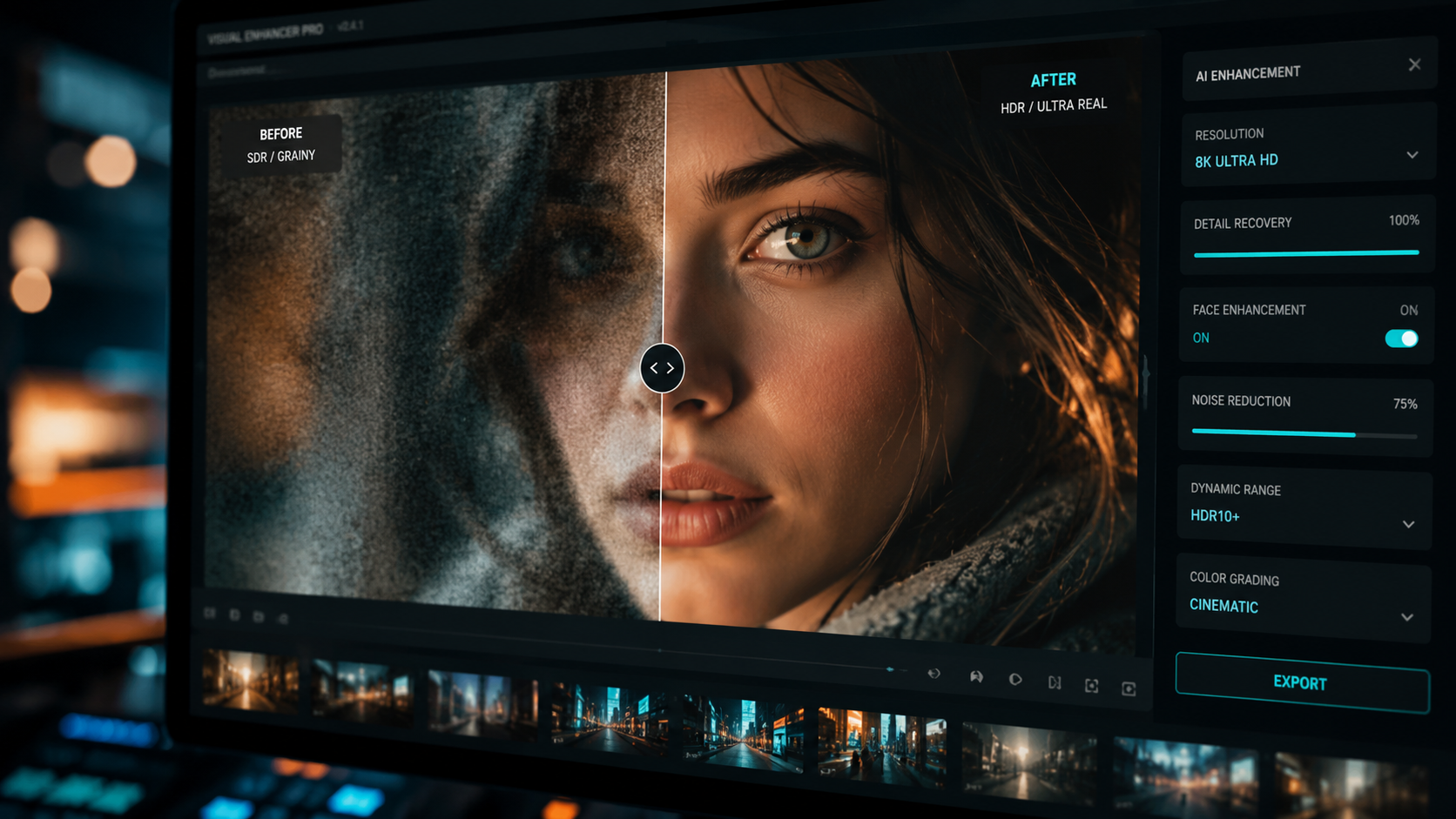
As we move through 2026, the distinction between "editing" and "enhancing" has blurred. According to a report by Pressat.co.uk, the adoption of AI upscalers has grown by 65% in the professional sector over the last twelve months. This surge is driven by the need to repurpose legacy content for modern high-definition displays. These tools no longer just "sharpen" an image; they use generative adversarial networks (GANs) to hallucinate missing details based on millions of hours of training data.
The current landscape offers a variety of specialized tools. While some focus on the "All-in-One" approach for marketing professionals, others provide granular control for colorists and VFX artists. The best ai video enhancement tools 2026 are those that offer a hybrid of local processing power and cloud-based rendering speeds, allowing for rapid turnaround times on high-resolution projects.
1. Vmake AI: The All-in-One Leader
According to a 2026 review by That Eric Alper, Vmake AI has solidified its position as the ultimate all-in-one video enhancement toolkit. It is particularly favored by e-commerce brands and social media influencers who require a "one-click" solution for a professional HD look. Its proprietary "Deep-Clarity" engine automatically adjusts lighting, contrast, and sharpness without requiring manual input.
2. Topaz Video AI v6.0
Topaz remains the gold standard for desktop-based enhancement. In 2026, the software focuses heavily on temporal consistency. Unlike earlier versions that occasionally suffered from "flickering" artifacts, the current iteration uses cross-frame analysis to ensure that every pixel is tracked accurately over time. It is widely considered the best tool for restoring old film stock or low-resolution archival footage.
3. Adobe Premiere Pro (Generative AI Integration)
Adobe has integrated its Firefly video models directly into the Premiere Pro timeline. This allows editors to enhance specific regions of a video frame using masking and generative fill. This tool is less about global upscaling and more about targeted enhancement, such as removing unwanted objects or improving the texture of a subject's skin in a close-up shot.
Comparing the Best AI Video Enhancement Tools 2026
Choosing the right tool depends heavily on your hardware and your specific project requirements. Some tools are optimized for NVIDIA RTX 50-series GPUs, while others run entirely in the browser to save local resources. Below is a comparison of the top-rated tools currently dominating the market in 2026.
| Tool Name | Primary Strength | Best For | Platform |
|---|---|---|---|
| Vmake AI | Automated HD Look | E-commerce & Social | Web / Mobile |
| Topaz Video AI | 8K Upscaling | Professional Filmmakers | Windows / Mac |
| DaVinci Resolve 19+ | Color Grading + AI | Post-Production Studios | Windows / Mac / Linux |
| Remini Video | Face Enhancement | Portrait & Interview Clips | Mobile (Android/iOS) |
| CapCut Desktop | Fast AI Upscaling | Content Creators | Web / Windows |
Mobile and Android Enhancements
The demand for high-quality video is not limited to desktop workstations. PlayStation Universe recently highlighted the "5 Best Video Enhancer Tools for Android in 2026," noting that mobile processors are now powerful enough to handle real-time AI noise reduction. This has revolutionized the way mobile journalists and vloggers produce content on the go.
Android-based tools like Remini and VivaVideo have integrated "Neural Upscaling" features that allow users to record in 1080p and export in a simulated 4K that rivals mid-range DSLR cameras. These apps are essential for maintaining a professional aesthetic when traditional camera gear is unavailable. The best ai video enhancement tools 2026 for mobile focus on skin tone accuracy and background blur (bokeh) simulation.
The Rise of Free AI Video Enhancers
While premium tools offer the most features, the "Top 6 Free AI Video Enhancers" report by North Penn Now suggests that open-source and ad-supported models are catching up. Tools like Waifu2x-Extension-GUI and certain features within CapCut allow users to experiment with AI upscaling without a significant financial investment. These are ideal for students or hobbyists who are just beginning to explore the world of digital video restoration.
Achieving a Professional HD Look
To achieve a professional HD look, one must look beyond just resolution. Cult MTL emphasizes that the best ai video enhancement tools 2026 provide sophisticated color matching and dynamic range expansion. Enhancing a video to 4K is useless if the colors are washed out or the shadows are crushed. The latest AI models can "re-light" a scene by identifying light sources and calculating how they should interact with the subjects in the frame.
Furthermore, frame rate stabilization has become a key metric for "pro-quality" video. Tools that offer AI-driven optical flow can turn shaky 24fps footage into smooth 60fps cinematic sequences. This is particularly useful for sports videography and action sequences where motion blur often ruins the clarity of the shot. By utilizing these tools, creators can ensure their work meets the high broadcast standards of 2026.
Advanced Noise Reduction Techniques
One of the biggest challenges in video editing is "grain" or "noise" from low-light environments. AI enhancers in 2026 use spatial-temporal denoising. This technique looks at the pixels in the current frame and compares them to the pixels in the preceding and following frames to determine what is actual detail and what is digital noise. The result is a clean, "creamy" look that preserves the natural texture of the subject's skin or the environment.
Future Trends: What’s Next for AI Video?
As we look toward the end of 2026 and into 2027, the integration of text-to-video enhancement is the next frontier. Imagine being able to tell your software, "Make this scene look like it was shot on 35mm film in the 1970s," and having the AI adjust the grain, color science, and frame rate accordingly. This level of semantic enhancement will likely become a standard feature in the best ai video enhancement tools of the future.
Additionally, the environmental impact of AI rendering is becoming a talking point. Leading companies are now optimizing their algorithms to be more "compute-efficient," reducing the carbon footprint of heavy 8K rendering tasks. This shift ensures that the power of AI enhancement remains sustainable as the volume of global video data continues to explode.
What is the best AI video enhancement tool for beginners in 2026?
Vmake AI is widely considered the best for beginners due to its "Ultimate All-in-One" toolkit approach. It automates complex processes like sharpening and lighting adjustment, allowing users to achieve professional results with a single click.
Can AI really upscale 1080p to 8K?
Yes, tools like Topaz Video AI v6.0 use generative models to add missing pixels, effectively upscaling 1080p to 8K. While it cannot create data that wasn't there, it uses trained patterns to "fill in the blanks" with high accuracy.
Are there any free AI video enhancers available?
Several free options exist, including the basic version of CapCut and open-source tools like Waifu2x. According to North Penn Now, these tools deliver sharp results for basic upscaling and noise reduction tasks.
Do I need a powerful computer to use these tools?
While many tools like Vmake AI are cloud-based and run in a browser, professional software like Topaz or DaVinci Resolve requires a modern GPU (like the NVIDIA RTX series) for efficient local processing.
Which AI tool is best for fixing shaky footage?
Topaz Video AI and Adobe Premiere Pro offer the most advanced AI stabilization features. They use "Optical Flow" and "Temporal Analysis" to smooth out camera shakes without the heavy cropping seen in traditional stabilizers.



Comments ()