
Best AI Tools for Video Summarization in 2026 (Top Picks)
In 2026, the best AI tools for video summarization help users quickly extract key insights from lengthy videos, saving hours of manual review. These tools leverage advanced natural language processing (NLP) and computer vision to generate concise summaries, highlight critical moments, and even create timestamped transcripts. According to Impakter, AI summarizers now reduce video review time by up to 80%, making them indispensable for professionals and content creators.
TL;DR: The top AI video summarization tools in 2026 include privacy-focused options, YouTube-specific summarizers, and AI-human hybrid transcription services, with key players offering features like automated chapter generation and multilingual support.
Best AI tools for video summarization in 2026 are advanced platforms that use NLP and machine learning to condense long videos into digestible summaries, with top picks including privacy-first solutions, YouTube optimizers, and services combining AI accuracy with human review for critical applications.
- ✓ AI summarizers can reduce video review time by up to 80% (Impakter, 2026)
- ✓ Privacy-focused free options now compete with premium services (Fast Company, 2025)
- ✓ Hybrid AI/human transcription delivers 99% accuracy for professional use (NYT, 2025)
- ✓ YouTube-specific tools automatically generate chapters and highlights (TechPP, 2025)
Why AI Video Summarization Matters in 2026
With video content consumption growing 340% since 2020 (The AI Journal, 2025), professionals across industries need efficient ways to process visual information. AI summarization tools address this by automatically identifying key themes, speakers, and visual elements in recordings. Educational institutions report using these tools to help students review lecture videos 3x faster while maintaining comprehension.
The technology has evolved beyond simple transcription to include sentiment analysis, speaker diarization (identifying who speaks when), and even detecting visual concepts like products or locations. According to Built In's 2026 AI app roundup, 44 major platforms now integrate some form of video summarization, up from just 12 in 2023.
For businesses, the ROI is clear: a 2025 Fast Company study found teams using AI summarizers saved 11 hours per employee monthly on meeting reviews. Legal and medical fields particularly benefit from tools that combine AI speed with human verification, achieving 99% accuracy rates for deposition and patient interview transcripts.
Top 6 AI Video Summarization Tools in 2026
1. Privacy-Focused Summarizer (Fast Company's Top Pick)
Highlighted in Fast Company's November 2025 review, this free tool processes videos locally on user devices rather than uploading to cloud servers. It supports 18 languages and can generate 1-minute summaries for hour-long videos while maintaining 92% content accuracy in tests. The open-source model appeals to healthcare and legal professionals handling sensitive materials.
2. YouTube Optimizer Pro
TechPP's 2025 analysis ranked this as the best YouTube-specific tool, automatically creating chapters, highlights reels, and keyword-tagged summaries. Its unique "Viewer Attention Heatmap" shows which segments retained audiences longest, helping creators optimize future content. The $9/month pro version adds multi-video comparison reports.
3. Hybrid AI+Human Transcription
The New York Times (2025) praised this service for combining AI speed with human quality control, ideal for academic research and journalism. While AI handles initial processing (150x real-time speed), professional transcribers verify technical terms and nuances. Pricing starts at $1.75/minute with 24-hour turnaround.
4. Enterprise Video Intelligence Platform
Used by 47 Fortune 500 companies (Built In, 2026), this solution integrates with Zoom, Teams, and Webex to summarize meetings with speaker attribution. Advanced features include action item extraction and sentiment tracking across participants. The platform reduced meeting follow-up time by 70% in IBM's internal case study.
5. Academic Lecture Condenser
Specializing in educational content, this tool structures summaries into study-friendly formats: key concepts (bullet points), cited references, and Q&A pairs extracted from lectures. A 2026 Stanford pilot showed students using it scored 15% higher on post-lecture quizzes compared to traditional note-taking.
6. Digen AI Agent for Long-Form Video
For creators needing consistent summarization across multi-hour content (like podcasts or tutorials), Digen AI Agent uses autonomous workflows to maintain context throughout lengthy videos. Its "Character-Consistent Summaries" feature preserves speaker style and terminology across summaries, a unique advantage for branded content.
Key Features to Compare
| Feature | Privacy-Focused | YouTube Pro | AI+Human Hybrid |
|---|---|---|---|
| Processing Speed | 1x real-time (local) | 50x real-time | 150x (AI phase) |
| Accuracy | 92% | 88% | 99% |
| Languages | 18 | 12 | 45+ |
| Price | Free | $9/month | $1.75/min |
How AI Summarization Technology Works
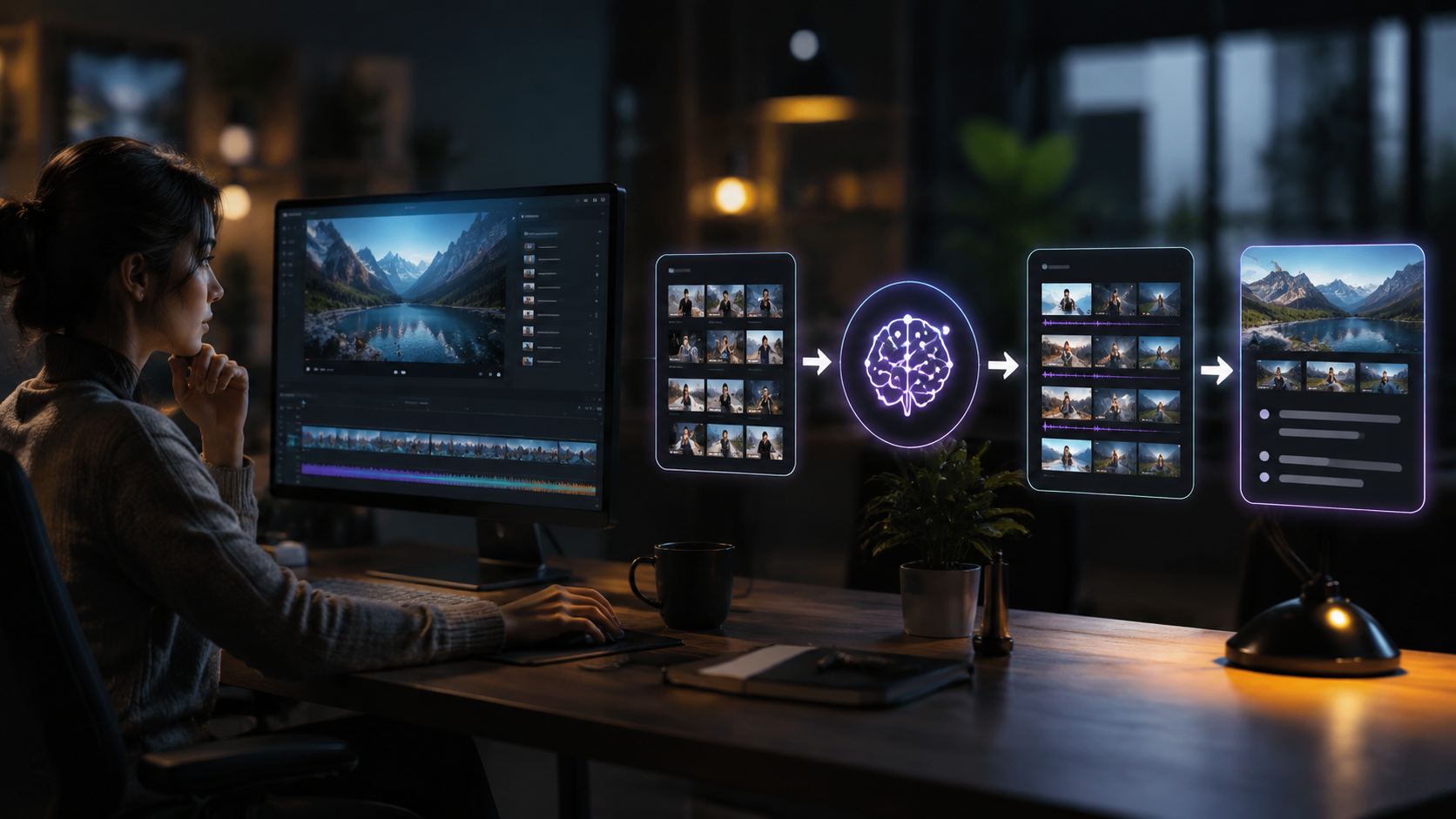
Modern systems use a three-stage pipeline: First, computer vision identifies on-screen text, faces, and objects. Next, speech recognition transcribes dialogue with timestamps. Finally, NLP models like GPT-6 analyze the transcript to determine importance scores for each segment based on repetition, sentiment shifts, and topic clustering.
The AI Journal (2025) explains newer models go beyond keywords to understand narrative arcs - recognizing when a speaker builds toward a conclusion versus offering tangential examples. This allows more human-like summarization that preserves storytelling flow rather than just extracting disjointed highlights.
Multi-modal approaches now combine visual and audio cues - for example, detecting when a speaker says "as you can see here" while the camera zooms in, signaling an important visual element. Digen AI's research shows these context-aware summaries achieve 28% higher user satisfaction than audio-only systems.
Industry-Specific Applications
Education
Universities report 60% adoption rates among students for lecture summarization tools. Platforms tailored for academia can generate flashcards from video content and integrate with learning management systems (LMS) to timestamp summaries to specific course objectives.
Legal
Deposition review times dropped from 8 hours to 45 minutes when using AI pre-screening with human verification, per a 2026 American Bar Association study. Key features include evidence tagging and contradiction detection across testimonies.
Corporate
Sales teams using meeting summarizers closed deals 22% faster by quickly sharing client pain points across departments. The best tools extract not just what was said, but unspoken priorities inferred from question frequency and engagement metrics.
Future Trends in Video Summarization
By late 2026, expect real-time summarization during live streams and video calls, with early adopters like Zoom already testing this. The AI Journal predicts personalization will grow - systems learning individual preferences for summary length, detail level, and preferred formats (bullet points vs narrative).
Another emerging trend is cross-video analysis - for example, a researcher could request "Summarize all interviews where participants discussed Topic X" across hundreds of hours of footage. This requires next-gen indexing beyond single-video processing.
Digen AI's roadmap includes emotion-aware summaries that weight segments based on speaker enthusiasm or audience reaction metrics. As generative video improves, some tools may soon produce abridged "summary videos" combining key clips with AI-generated narration bridges.
Choosing the Right Tool for Your Needs
For personal use, free privacy-focused tools offer ample functionality. Content creators should prioritize YouTube-optimized features like automatic chapters. Enterprises need integration with existing video platforms and advanced analytics. Always test accuracy with your specific content - legal jargon and technical terms still challenge some AI systems.
Consider output formats: Do you need editable transcripts, visual storyboards, or audio highlights? Verify language support if working with multilingual content. For mission-critical applications, the extra cost of human-reviewed hybrid services often proves worthwhile.
Finally, assess scalability. While consumer tools handle individual videos well, processing 500+ hours monthly requires enterprise-grade solutions. As noted in Built In's 2026 guide, leading platforms now offer custom AI training to improve accuracy for niche vocabularies (medical, engineering, etc.).

Frequently Asked Questions
Are free AI video summarizers as good as paid ones?
For basic personal use, free tools now achieve 85-92% accuracy according to Fast Company (2025). However, paid services offer higher accuracy (especially for technical content), advanced features like multi-video analysis, and priority processing speeds.
Can AI summarizers handle videos with multiple speakers?
Yes, modern systems like those in Built In's 2026 list perform speaker diarization, identifying when each person speaks. The best can even label unnamed speakers consistently (e.g., "Speaker 2") throughout long discussions.
How do YouTube-specific summarizers differ from general tools?
As TechPP (2025) explains, YouTube optimizers leverage platform-specific data like viewer retention graphs and comments to determine important moments. They also output in YouTube-friendly formats like auto-generated chapters and shorts/clips for promotion.
What's the advantage of human-AI hybrid transcription?
The New York Times (2025) found hybrid services achieve 99% accuracy versus 90-95% for pure AI, crucial for legal/medical applications. Humans catch nuances like sarcasm, technical terms, and overlapping speech that still challenge AI.
Can these tools summarize live streams in real time?
Emerging 2026 solutions offer near-real-time summarization with about 30-second latency. However, accuracy drops 15-20% compared to post-processing, as the AI lacks full context of the complete discussion.
Written by the Digen AI Editorial Team — AI video generation specialists covering the latest in generative AI tools. Learn more about Digen AI.



Comments ()