
Best AI for Cinematic Video Generation: 2026 Top Picks
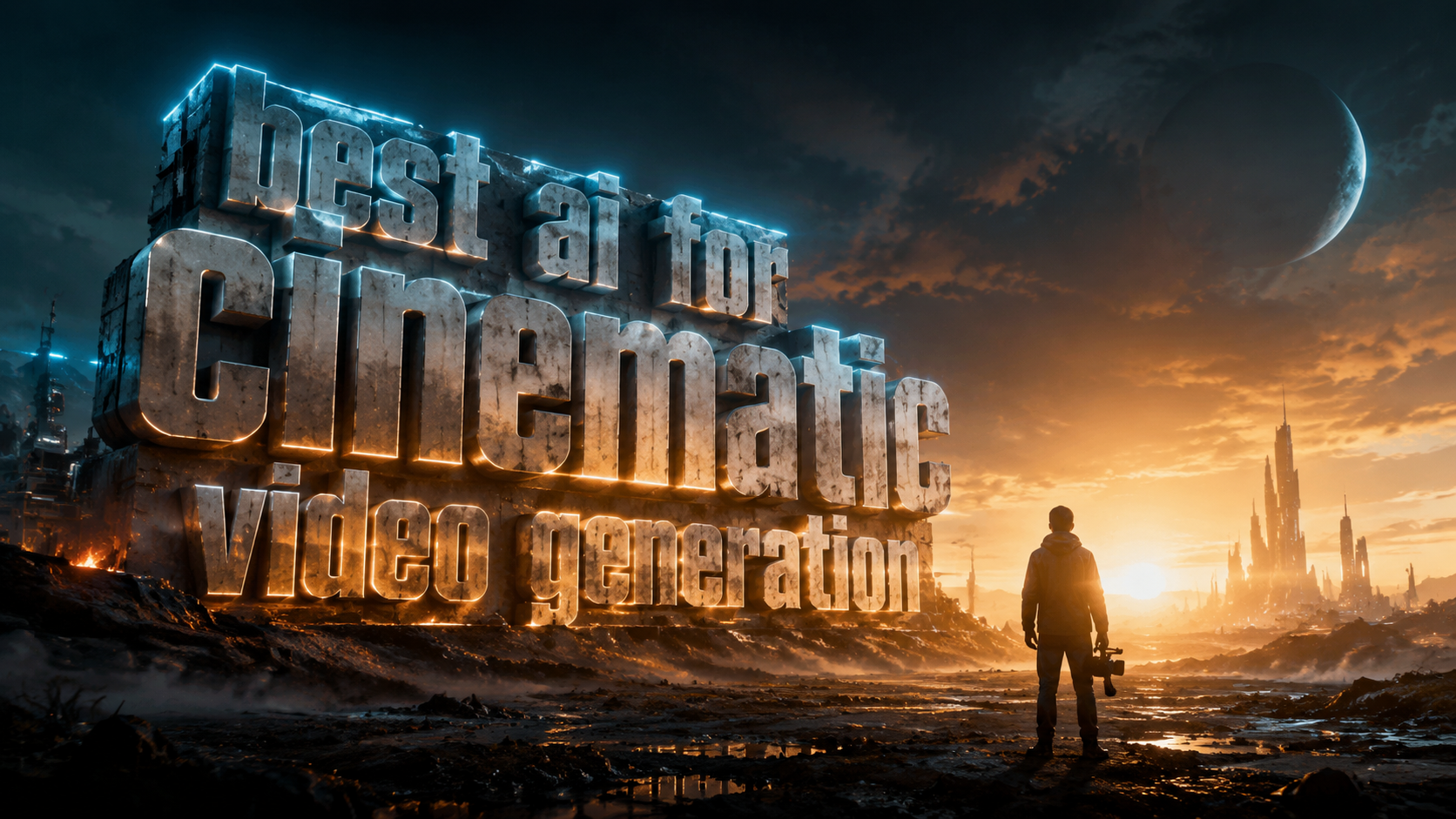
The best ai for cinematic video generation in 2026 is a platform that seamlessly integrates high-fidelity temporal consistency with advanced physics engines to create lifelike motion. Based on recent industry benchmarks and performance reviews, creators are prioritizing tools that offer sophisticated image-to-video capabilities and granular control over camera movement. Whether you are a professional filmmaker or a content creator, the current landscape of generative AI offers unprecedented access to Hollywood-grade visual effects directly from your desktop.
The best ai for cinematic video generation is currently a selection of high-end models led by platforms like Sora, Runway Gen-4, and Luma Dream Machine 3.0. These tools utilize advanced diffusion transformers to produce 4K HDR footage with consistent lighting and realistic fluid dynamics, making them the top choice for professional and creative video production in 2026.
- ✓ Top-tier cinematic AI now supports native 4K resolution with 60fps output for fluid, realistic movement.
- ✓ Image-to-video features have become the industry standard for maintaining character consistency across different shots.
- ✓ One-click templates and physics-aware engines are the primary drivers for beginner accessibility in 2026.
- ✓ Real-time rendering and collaborative workflows are now standard in professional-grade AI video suites.
How to Use the Best AI for Cinematic Video Generation
Achieving a cinematic look requires more than just a simple text prompt; it involves a strategic approach to visual storytelling and technical parameters. In 2026, the workflow has shifted toward "directed generation," where the AI acts as a digital cinematographer following specific instructions regarding lens focal length, lighting mood, and color grading.
- Conceptualize with High-Resolution Images: Start by generating a high-quality reference image using an AI image generator to establish the visual style, lighting, and character design.
- Upload to an Image-to-Video Engine: Use the reference image as a "seed" to ensure the AI maintains visual fidelity and does not hallucinate inconsistent details during the video generation process.
- Apply Cinematic Prompting: Use technical terminology such as "anamorphic flares," "shallow depth of field," or "35mm film grain" to guide the model toward a professional aesthetic.
- Refine with Camera Controls: Utilize the platform’s directional tools to specify pans, tilts, or dolly zooms, ensuring the movement matches the emotional tone of the scene.
- Upscale and Post-Process: Export the generated clip into an AI-powered editor for final color correction and resolution enhancement to meet 4K broadcast standards.
The Evolution of Cinematic AI Video in 2026
The year 2026 marks a significant milestone in the evolution of generative media. According to The AI Journal, the "Best AI Video Generator Tools This Year" have moved beyond the "uncanny valley" by implementing advanced temporal attention mechanisms. These mechanisms allow the AI to remember what happened in the first frame and carry that logic through to the end of a 60-second clip, preventing the warping and melting effects that plagued earlier models.
Furthermore, CNET reports in their "Best AI Video Generators of 2026, Reviewed and Ranked" that the gap between professional studios and independent creators has narrowed significantly. The democratization of these tools means that a single creator can now produce a visual sequence that would have previously required a multi-million dollar VFX budget. This shift is largely due to the integration of multimodal inputs, where text, image, and even depth maps are used simultaneously to guide the generation process.
The Rise of Diffusion Transformers
Most of the leading platforms in 2026 have transitioned to Diffusion Transformer (DiT) architectures. This technology allows for better scaling, meaning the more data and compute power applied, the more realistic the output becomes. Unlike older GAN-based models, DiT architectures handle complex physics—such as the way light refracts through glass or how fabric folds during movement—with stunning accuracy. This is a core reason why the best ai for cinematic video generation now rivals traditional CGI in many use cases.
Top 5 AI Video Generators Compared
To help you choose the right tool for your specific needs, we have compiled a comparison of the leading platforms based on the latest 2026 performance data. According to Pressat.co.uk, image-to-video testing has shown that consistency is now the number one metric for professional ranking.
| Platform | Max Resolution | Best For | Key Feature |
|---|---|---|---|
| Sora Pro | 4K / 60fps | Narrative Filmmaking | Physics-accurate motion |
| Runway Gen-4 | 4K / 24fps | Experimental Visuals | Multi-motion brush control |
| Luma Dream Machine | 2K / 30fps | Fast Prototyping | Hyper-realistic lighting |
| Pika Art 3.0 | 1080p / 24fps | Social Media / Animation | Lip-sync and sound FX |
| Kling AI Global | 4K / 30fps | Complex Human Motion | Long-duration clips (2 mins) |
Why Image-to-Video is Dominating the 2026 Market
According to a recent study by Pressat.co.uk titled "Best Image-to-Video AI Generators in 2026," the industry has moved away from "text-only" prompting for serious cinematic work. The primary reason is control. When a creator starts with a high-quality image, they provide the AI with a structural blueprint. This reduces the randomness of the output and ensures that the "best ai for cinematic video generation" produces results that align with the creator's original vision.
This "image-first" workflow is particularly vital for branding and character-driven storytelling. In 2026, AI models can now "lock" a character's face and clothing, allowing them to appear in multiple different scenes without changing their appearance. This was the single biggest hurdle for AI cinematography in previous years, and its resolution has opened the doors for full-length AI-generated feature films.
The Power of One-Click Templates
For those just starting, findarticles.com highlights that the "Best AI Video Generator for Beginners in 2026" relies heavily on the power of one-click templates. These templates come pre-loaded with cinematic lighting rigs and camera movements. Users simply drop in an image or a short text description, and the AI applies a "cinematic layer" that handles the complexities of color grading and pacing automatically. This has made the technology accessible to small business owners and educators who lack formal film training.
Short-Form Content and Social Media Optimization
The landscape for short-form creators has also been transformed. Techloy recently compared various AI video models to determine which platform is best for short-form creators in 2026. Their findings suggest that speed and "virality-ready" aesthetics are the most important factors for platforms like TikTok, Reels, and YouTube Shorts. The best ai for cinematic video generation for these users often includes built-in tools for vertical aspect ratios and automated captioning.
Short-form creators are increasingly using AI to generate b-roll that would be impossible or too expensive to film in real life. For instance, a travel vlogger might use AI to generate a cinematic drone shot of a futuristic city or a fantasy landscape to enhance their storytelling. The ability to generate these clips in under 60 seconds has fundamentally changed the content production cycle, allowing for higher frequency and higher quality posts.
Accessibility for YouTube Creators
As noted by BBN Times in their "Best Free AI Video Maker Guide for YouTube Creators," there are now robust free-tier options that allow beginners to experiment with cinematic AI. While these free versions may include watermarks or lower resolution, they provide the same underlying motion logic as the pro versions. This allows creators to learn the "language" of AI prompting without an initial financial investment, fostering a new generation of digital artists.
Future Outlook: What’s Next for AI Cinematography?
As we look toward the latter half of 2026 and into 2027, the integration of AI video with virtual reality (VR) and augmented reality (AR) is the next frontier. The best ai for cinematic video generation will likely include "spatial" generation modes, where the video is not just a flat plane but a 3D environment that can be explored. This will revolutionize not just filmmaking, but also immersive gaming and digital tourism.
The ethical landscape is also evolving. Major platforms are now implementing "C2PA" metadata standards, which act as a digital fingerprint to identify AI-generated content. This transparency is becoming a requirement for professional distribution, ensuring that while the tools become more powerful, the distinction between captured and generated reality remains clear for the audience.
What is the best AI for cinematic video generation in 2026?
Sora Pro and Runway Gen-4 are currently considered the top choices due to their superior physics engines and 4K output. These platforms offer the most consistent character rendering and professional-grade camera controls available on the market.
Can I generate AI videos for free?
Yes, several platforms offer free tiers or trial credits. According to BBN Times, tools like Pika Art and Luma Dream Machine provide limited free generations that are excellent for beginners and YouTube creators looking to test the technology.
Is AI video generation good enough for professional movies?
In 2026, AI video has reached a level of quality used for B-roll, background plates, and visual effects in professional productions. While full-length character-driven features still require human oversight, the visual quality is now indistinguishable from high-end CGI in many scenarios.
How long does it take to generate a cinematic AI video?
Depending on the complexity and resolution, a 10-second high-quality clip typically takes between 2 to 5 minutes to render on leading platforms. Some "real-time" models can produce lower-resolution previews in under 30 seconds.
What is the best resolution for AI-generated videos?
For a truly cinematic look, 4K resolution is the gold standard in 2026. Most top-tier platforms now support native 4K export, which provides the necessary detail for large-screen displays and professional editing workflows.



Comments ()