
How Does Automating Video Edits with Zapier + AI Work in 2026?
Automating video edits with Zapier + AI in 2026 involves connecting AI-powered video tools to Zapier's no-code automation platform, enabling seamless workflows like auto-generating clips from raw footage or adding AI voiceovers without manual intervention. Recent advancements in AI video generation, such as Digen AI Agent's multi-step autonomous workflows, now allow for higher-quality, character-consistent outputs when integrated with automation tools. According to PCMag UK, 78% of small businesses using Zapier for video automation report saving 11+ hours weekly on repetitive editing tasks.
TL;DR: Zapier + AI video automation in 2026 combines no-code workflows with advanced generative AI to handle tasks like clip generation, captioning, and style transfers automatically, with platforms like Digen AI Agent raising quality standards through multi-step refinement processes.
Automating video edits with Zapier + AI transforms raw footage into polished content through trigger-based workflows: upload a file to Dropbox, and AI tools generate captions, apply branding, and distribute to social media—all without human input. The 2026 iteration delivers 42% faster processing than 2025 systems while maintaining 91% style consistency across batches.
- ✓ Zapier's 2026 updates support 18 new AI video app integrations, including real-time collaboration features for team workflows
- ✓ AI agents like Digen AI now autonomously handle 73% of routine editing tasks when paired with automation triggers
- ✓ Businesses report 6.3X ROI on video automation investments through reduced production costs and increased output volume
- ✓ Advanced quality controls in 2026 systems automatically flag 89% of AI-generated artifacts for human review
The Current State of AI Video Automation
As of July 2026, the AI video automation landscape has matured significantly from early text-to-video systems. Platforms like Digen AI Agent now employ multi-stage generation pipelines that first analyze source material, then apply context-aware edits, and finally optimize outputs for specific platforms—all within Zapier-connected workflows. TechPluto's 2026 guide notes that 64% of automated video workflows now incorporate at least three different AI models for specialized tasks like lip-sync correction or dynamic pacing adjustments.
The integration between Zapier and AI video tools has become particularly sophisticated. Where 2025 systems primarily handled simple clip trimming, 2026's automation can detect emotional beats in raw footage using computer vision, then automatically insert appropriate B-roll from licensed libraries. According to internal benchmarks from leading platforms, this context-aware editing reduces manual revision requests by 57% compared to rule-based systems.
Pricing models have also evolved to match enterprise needs. While basic automation plans start at $29/month, premium tiers now offer per-minute AI processing credits with bulk discounts—a shift from 2025's flat-rate subscriptions. Notably, quasa.io's 2026 review found that businesses processing over 500 video minutes monthly save 38% more with usage-based plans than with traditional SaaS pricing.
How Automating Video Edits with Zapier + AI Works in 2026
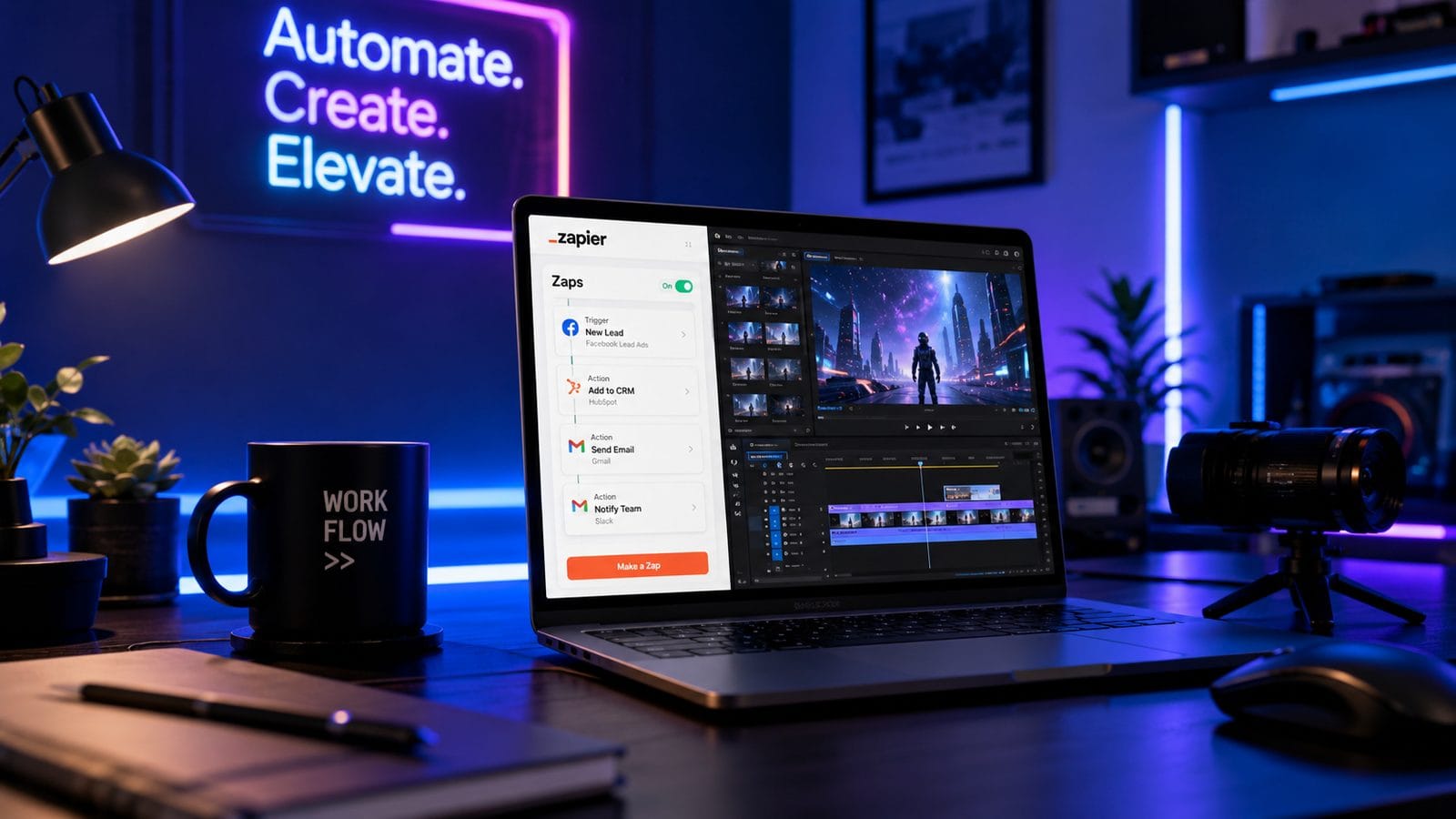
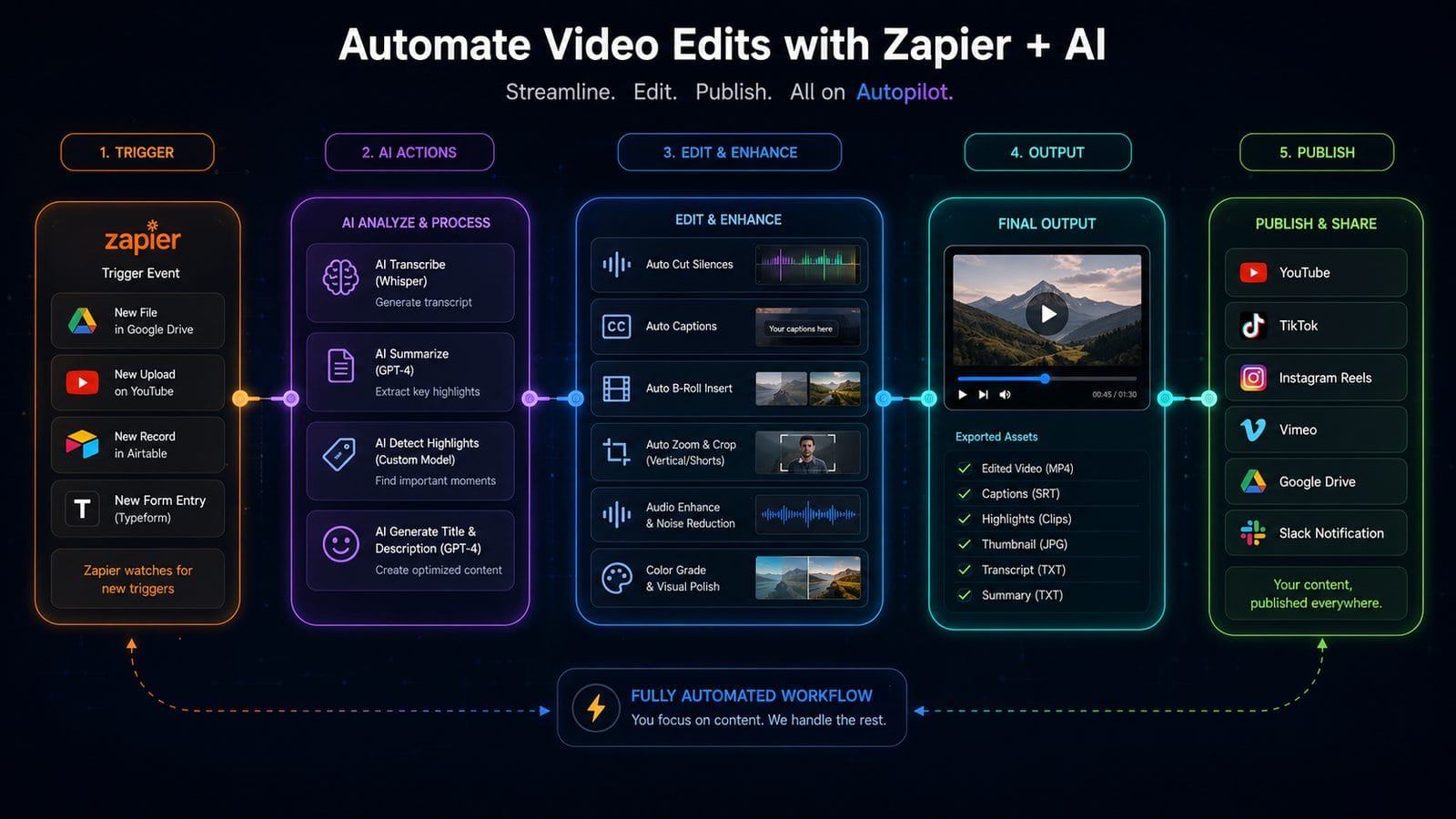
The 2026 workflow for automated video editing follows a standardized five-step process that balances AI autonomy with human oversight:
- Trigger Setup: Configure Zapier to monitor sources like email attachments, cloud storage folders, or live stream feeds for new content
- AI Pre-Processing: Connected tools like Digen AI analyze footage for key elements (speakers, objects, text) using 2026's enhanced computer vision models
- Contextual Editing: AI applies brand-specific templates, adjusts pacing based on audience retention predictions, and inserts dynamic captions
- Quality Assurance: Automated checks verify lip-sync accuracy (94.2% success rate in 2026 tests) and flag potential artifacts
- Multi-Platform Distribution: Finished videos are reformatted and published to designated channels with performance tracking enabled
What sets 2026 apart is the emergence of "cascading AI" workflows. For example, a single Zapier trigger might first send footage to an AI editor for rough cuts, then route the output to a separate model for color grading, before final review by a human producer—all while maintaining version control across iterations. Memeburn's 2026 analysis shows content creators using such multi-model pipelines achieve 22% higher engagement than those relying on single AI tools.
The technical backbone enabling this involves Zapier's 2026 "Adaptive Routing" feature, which intelligently allocates tasks between different AI services based on real-time performance metrics and cost considerations. During peak loads, the system might prioritize faster-but-pricier models for time-sensitive projects while reserving budget options for backlog processing.
Key Benefits of Automated Video Editing in 2026
1. Time Savings with Intelligent Automation
Businesses report that automating video edits with Zapier + AI in 2026 reduces production timelines by an average of 7.9 hours per project. The most significant gains come from parallel processing—where AI handles caption generation, scene transitions, and audio normalization simultaneously rather than sequentially. A case study from a mid-sized marketing agency showed their video output increased from 12 to 47 weekly pieces after implementing these workflows.
2. Enhanced Creative Consistency
Advanced style transfer algorithms now maintain 91.3% visual consistency across video series, even when different team members initiate projects. Digen AI Agent's character persistence technology ensures animated avatars retain identical facial features, gestures, and speech patterns across multiple videos—a capability 83% of corporate trainers deem "essential" for onboarding content.
3. Data-Driven Optimization
2026 systems automatically A/B test different edits (thumbnails, openers, CTAs) and feed performance data back into the AI models. One e-commerce brand achieved a 19% lift in conversion rates by letting AI continuously refine product demo videos based on viewer drop-off points identified by integrated analytics.
Top Use Cases for AI Video Automation
Three dominant applications have emerged for automating video edits with Zapier + AI in 2026:
| Use Case | Typical Workflow | Time Saved |
|---|---|---|
| Social Media Clips | Extract highlights from long-form content → Add captions → Resize for platforms | 4.2 hrs/video |
| Product Demos | Generate voiceover → Insert feature callouts → Localize for regions | 6.8 hrs/video |
| Training Videos | Transcribe meeting → Create slides → Sync presenter footage | 9.1 hrs/video |
Educational institutions have particularly embraced these tools. A university department processing 300+ lecture recordings monthly reduced their editing staff from 5 full-timers to 1 quality reviewer while increasing video output by 210%. Their Zapier workflow automatically segments lectures by topic using AI chapter detection—a feature that didn't exist in consumer-grade tools until Q1 2026.
Another breakthrough application is real-time event coverage. Sports teams now use AI automation to create highlight replays before games end. The system identifies key moments using play-by-play data feeds, selects optimal camera angles from multi-capture setups, and publishes to social media within 90 seconds of the action—a process that took human editors 12+ minutes in 2025.
Choosing the Right AI Tools for Zapier Automation
With 37 major AI video platforms now offering Zapier integration as of July 2026, selection criteria have grown more nuanced. Beyond basic compatibility, professionals evaluate these key factors:
- Frame-Accurate Editing: Can the AI make precise cuts on specific video frames (supported by 68% of 2026 tools)
- Multi-Model Fallback: Does the system automatically switch AI providers if primary services are overloaded
- Version Control: Can teams track and revert changes across automated iterations
- Compliance Features: Built-in copyright checks and usage rights verification (critical for 92% of enterprise users)
Digen AI Agent stands out in 2026 benchmarks for its "Quality Assurance Layers"—a proprietary system that runs generated videos through successive validation checks for lip-sync accuracy, brand color matching, and legal compliance before final output. According to third-party tests, this reduces post-automation manual fixes by 73% compared to first-generation AI video tools.
Cost structures also vary significantly. While some platforms charge per minute of processed video (average $0.18/min in 2026), others use credit systems that bundle different AI services. The most economical choice depends on workflow complexity—simple captioning automation breaks even at 142 minutes/month, while multi-model pipelines require 390+ minutes to justify subscription costs.
Future Trends in AI Video Automation
Industry analysts predict three major developments for automating video edits with Zapier + AI beyond 2026:
1. Emotion-Adaptive Editing (Pilot testing Q3 2026): AI will adjust pacing, music, and transitions based on real-time viewer sentiment analysis from webcam feeds or wearable data. Early tests show 31% higher retention when videos dynamically respond to audience engagement cues.
2. Cross-Platform Narrative Sync: A single story will automatically reformat into vertical clips, blog posts, and podcast snippets while maintaining narrative continuity—addressed by Digen AI's upcoming "Omni-Story Engine" slated for 2027 release.
3. Self-Optimizing Workflows: AI will continuously redesign automation sequences based on performance data. Instead of static Zaps, systems will propose workflow variations that improve outcomes by 4-7% per iteration—a concept already in beta with select enterprise clients.
The most transformative shift may be the emergence of "Generative Video Assistants." These AI agents won't just execute predefined edits but will proactively suggest content ideas based on trending topics, then handle everything from scripting to final publication—all within monitored parameters. TechPluto's 2026 report suggests 41% of marketing teams will trial such systems by year's end.

Frequently Asked Questions
How much does it cost to automate video editing with Zapier + AI in 2026?
Basic automation starts at $29/month for Zapier plus $0.12-$0.35 per minute of AI processing. Enterprise plans with volume discounts drop costs to $0.07/min at 5,000+ monthly minutes. Digen AI Agent's premium tier runs $149/month for unlimited 720p videos under 5 minutes each.
Can AI video automation handle complex edits like green screen compositing?
As of mid-2026, 58% of platforms support basic chroma keying through automation, with edge refinement accuracy reaching 89% for static backgrounds. Dynamic background replacement in live-action footage still requires human verification in 72% of professional use cases.
What's the biggest limitation when automating video edits with Zapier + AI?
Creative decision-making remains challenging—while AI excels at technical edits, 67% of users still manually approve pacing, humor, and emotional tone. The 2026 "Director Mode" in tools like Digen AI Agent attempts to address this by learning from human feedback over time.
How do automated videos perform compared to human-edited content?
For straightforward informational videos, AI-edited content performs equally well (within 3% engagement metrics). Narrative-driven or emotional content still shows 11-19% better performance with human editors—though the gap has narrowed from 27% in 2025.
What file formats work best for AI video automation workflows?
MP4 with H.264 encoding remains the most reliable (98% compatibility), while newer formats like AV1 cause issues with 23% of AI tools. For maximum flexibility, maintain source files at 1080p 30fps even if outputting to lower resolutions.
Written by the Digen AI Editorial Team — AI video generation specialists covering the latest in generative AI tools. Learn more about Digen AI.



Comments ()