
Automated AI Video Creation Workflow: 2026 Strategy Guide
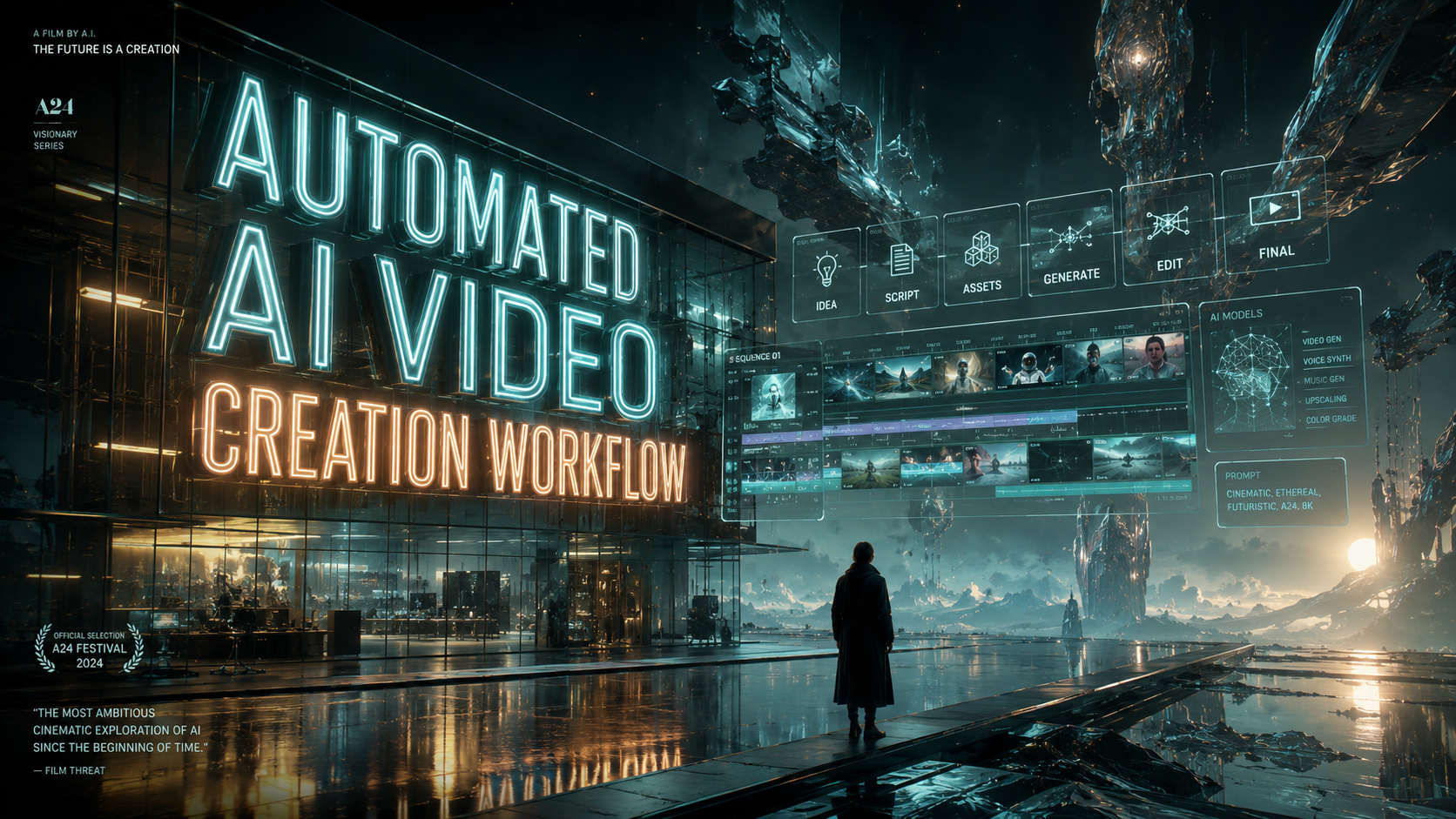
An automated ai video creation workflow is a systematic sequence of integrated artificial intelligence tools and scripts that handle every stage of video production—from scriptwriting and asset generation to editing and final publishing—without requiring manual intervention. By 2026, these workflows have shifted from simple prompt-based generators to complex, agent-led ecosystems that allow creators to scale content production infinitely while maintaining high aesthetic standards.
An automated AI video creation workflow is a self-sustaining pipeline where AI agents manage script generation, voice synthesis, visual rendering, and multi-platform distribution. This strategy leverages open-source automation platforms and cloud-based media flows to transform raw data or text prompts into polished, high-definition video content in real-time.
- ✓ Integration of open-source AI workflow tools like n8n for seamless logic handling.
- ✓ Utilization of AI-powered production platforms for enterprise-grade asset management.
- ✓ Shift toward agentic workflows where 50+ specialized AI agents handle niche production tasks.
- ✓ Automated publishing through cloud media flows for instant multi-platform reach.
The Evolution of the Automated AI Video Creation Workflow in 2026
The landscape of digital content has undergone a radical transformation over the past year. In 2026, the focus has shifted away from standalone tools toward integrated ecosystems. According to a comprehensive review by quasa.io (May 2026), n8n has emerged as a central pillar in the open-source AI workflow automation revolution. This allows creators to connect disparate AI models—such as Large Language Models (LLMs) for scripting and generative video models for visuals—into a single, cohesive engine that operates 24/7.
Furthermore, the democratization of these tools has been accelerated by new resources like the TechVideoBlog AI Video Tools Directory, launched in May 2026. This directory serves as a vital roadmap for freelancers and agencies, categorizing tools by their role within a production pipeline. The goal is no longer just to "make a video," but to build a "video factory" where the human role shifts from creator to curator and strategist.
Enterprise adoption has also reached a tipping point. As reported by Adobe for Business, the elevation of video workflows now centers on AI-powered production platforms that manage versioning, brand consistency, and collaborative editing automatically. This ensures that while the workflow is automated, the output remains professional and aligned with corporate identity standards.
Step-by-Step Guide to Building Your 2026 Workflow
- Define the Logic Layer: Use an open-source automation tool like n8n to set triggers (e.g., a new blog post, a trending topic, or a scheduled time).
- Scripting and Storyboarding: Direct an LLM agent to analyze the input and generate a scene-by-scene script, including visual prompts for each segment.
- Asset Generation: Route the prompts to specialized AI agents. According to AIMultiple (May 2026), there are now over 50+ open-source AI agents capable of handling specific tasks like 3D modeling, character consistency, and background music composition.
- Assembly and Editing: Utilize a cloud-based media flow, such as Cloudinary’s MediaFlows, to automatically stitch clips, add transitions, and overlay AI-generated voiceovers.
- Optimization and Distribution: The final step involves AI-powered publishing automation to resize, caption, and upload the video to multiple social channels simultaneously.
Core Technologies Powering Modern Video Pipelines
The backbone of a successful automated ai video creation workflow relies on the synergy between generative models and automation logic. In 2026, we see a heavy emphasis on "MediaFlows." For instance, Business Wire reported in April 2026 that Cloudinary added AI-powered video publishing automation to its MediaFlows platform, allowing for the dynamic transformation of video assets based on the end-user's device and connection speed. This ensures that the automated output is not just created, but also perfectly delivered.
Another critical component is the rise of AI Agents. Unlike traditional software, these agents can make decisions within the workflow. AIMultiple recently listed the best 50+ open-source AI agents, highlighting that these entities can now handle complex troubleshooting within a video render, such as correcting a visual artifact or adjusting the pacing of a voiceover to match the visual cues without human input.
| Feature | Legacy Workflows (Pre-2025) | 2026 AI-Automated Workflows |
|---|---|---|
| Logic Handling | Manual triggers & linear scripts | Autonomous AI Agents (n8n, Open Source) |
| Asset Creation | Stock footage & manual filming | Generative AI (Text-to-Video, Image-to-Video) |
| Editing | Human-operated NLE software | Cloud-based AI MediaFlows & Auto-Stitching |
| Scaling | Linear (More people = more video) | Exponential (One workflow = infinite video) |
| Distribution | Manual upload per platform | AI-Powered Publishing Automation |
Integrating Open-Source AI Agents for Maximum Flexibility
One of the most significant shifts in 2026 is the movement toward open-source sovereignty. By utilizing the 50+ open-source AI agents identified by AIMultiple, organizations can avoid vendor lock-in and build highly customized automated ai video creation workflow solutions. These agents can be hosted locally or in private clouds, ensuring that sensitive data used in corporate training videos or internal communications remains secure.
These agents are not just performing simple tasks; they are collaborating. One agent might be responsible for sentiment analysis of a trending topic, while another translates that sentiment into a color palette for the video's color grading. This level of granular control, once the domain of high-end post-production houses, is now accessible to any business utilizing an automated pipeline.
Advanced Scripting and Multi-Agent Orchestration
The "brain" of the 2026 workflow is the orchestration layer. By connecting tools like n8n with specialized LLMs, creators can generate scripts that are not only grammatically correct but also optimized for viewer retention. The workflow can automatically perform A/B testing on different script versions, analyzing which narrative structure performs best and then feeding those insights back into the next generation cycle.
Automated Publishing and Media Management
Creating the video is only half the battle; the other half is ensuring it reaches the right audience. The 2026 strategy involves "intelligent delivery." As Trend Hunter noted in their May 2026 report on AI video creation tools, the integration of AI into the publishing phase allows for real-time localization. A single automated workflow can produce a video in English and simultaneously generate versions in 20 other languages, complete with lip-synced avatars and culturally relevant background imagery.
Cloudinary’s recent updates to MediaFlows exemplify this trend. By automating the publishing side, businesses can ensure that their video content is responsive. According to Business Wire, this automation handles everything from bit-rate adjustment to the automatic insertion of shoppable links based on the viewer’s geographic location. This turns a simple video into a high-converting, interactive asset without any additional manual work.
Maintaining Brand Integrity in Automated Environments
A common concern with automation is the loss of "human touch" or brand consistency. However, Adobe’s AI-powered production platform has addressed this by allowing brands to bake their style guides directly into the AI’s parameters. This ensures that every video generated by the automated ai video creation workflow adheres to specific hex codes, font styles, and tonal guidelines, regardless of which AI agent is generating the visual assets.
Future-Proofing Your Video Strategy for 2027 and Beyond
As we move through 2026, the speed of innovation shows no signs of slowing. Staying ahead requires a commitment to modularity. The most successful creators are those who do not tether themselves to a single platform but instead build flexible pipelines that can swap out one AI model for a newer, more efficient one as it becomes available. The TechVideoBlog directory is an essential resource for this, providing real-time updates on the latest tools entering the market.
Finally, the ethical use of AI remains a cornerstone of the 2026 strategy. Automated workflows now frequently include "compliance agents" that check for copyright infringement and ensure that all generated content meets platform-specific safety guidelines. This layer of automated oversight is what allows large-scale agencies to deploy AI content with confidence at an unprecedented scale.
What is an automated AI video creation workflow?
It is an end-to-end system that uses AI tools and automation logic to produce videos with minimal human intervention. It covers everything from the initial idea and script to the final edit and social media posting.
Which tools are best for AI workflow automation in 2026?
n8n is currently the leading open-source platform for workflow automation, while Cloudinary’s MediaFlows and Adobe’s production platform are top choices for enterprise-level media management and publishing.
How many AI agents are typically used in a modern workflow?
While it varies, industry experts like AIMultiple suggest that there are over 50 specialized open-source agents available, with most advanced workflows utilizing 5 to 10 agents simultaneously for different production tasks.
Can automated AI videos be brand-compliant?
Yes, by using platforms like Adobe’s AI-powered production tools, companies can integrate their specific brand guidelines into the AI’s generation parameters to ensure consistent visual and tonal output.
Is it possible to automate video distribution as well?
Absolutely. Modern workflows incorporate AI-powered publishing automation that handles resizing, captioning, and multi-platform scheduling, as seen in recent updates to tools like Cloudinary MediaFlows.



Comments ()