
AI vs Traditional Video Editing 2026: The Ultimate Showdown
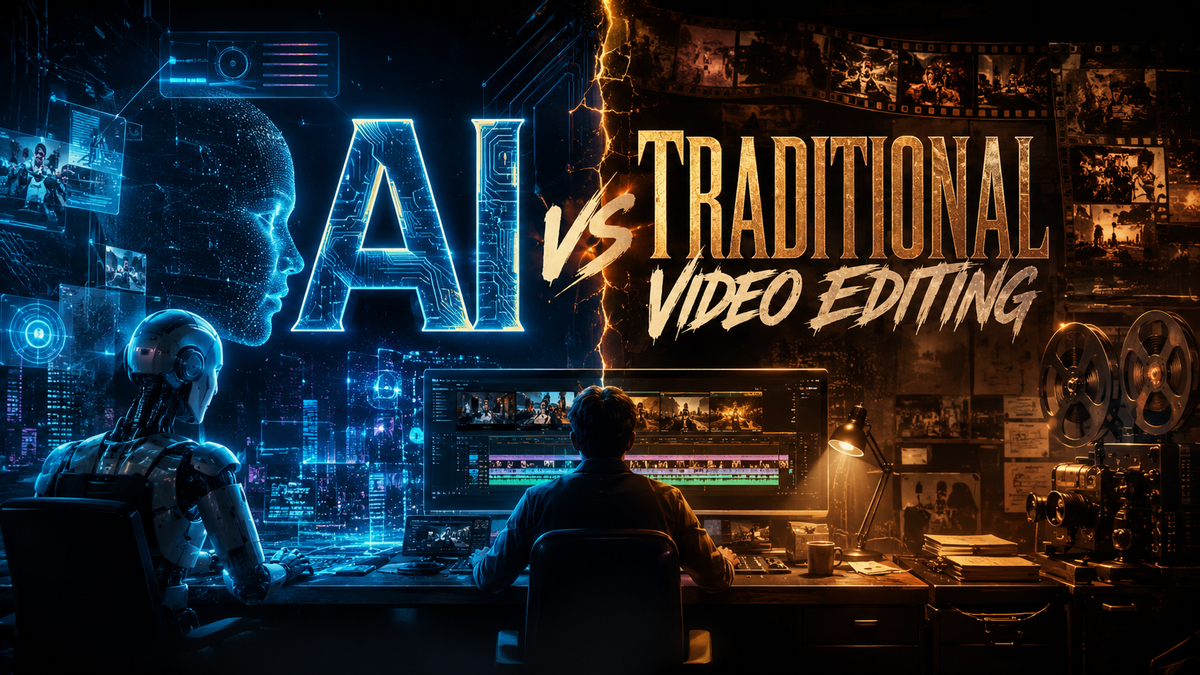
In 2026, the debate between AI-powered editing and traditional non-linear editing (NLE) workflows has shifted from a theoretical question to a practical, everyday decision for creators. The answer to whether you should invest in AI vs traditional video editing depends entirely on your project type, deadline, creative goals, and budget — and increasingly, the smartest choice is to use both.
AI vs traditional video editing in 2026 is not a winner-take-all battle but a spectrum of complementary workflows. AI tools like Pollo AI, Adobe Firefly Quick Cut, and Claude excel at automating repetitive tasks, prompt-based assembly, and intelligent object removal, while traditional NLEs remain the gold standard for granular creative control, color grading, and complex multi-track compositions.
- ✓ AI editing tools can reduce rough-cut assembly time by up to 70% compared to manual NLE workflows, according to multiple 2026 reviews.
- ✓ Traditional NLEs like Premiere Pro and DaVinci Resolve still dominate for frame-by-frame precision, audio mixing, and professional color grading.
- ✓ Hybrid workflows — using AI for the heavy lifting and manual editing for polish — are rapidly becoming the industry standard in 2026.
- ✓ Prompt-based editors such as Pollo AI and Adobe Firefly Quick Cut allow creators to generate video sequences from text descriptions, drastically lowering the barrier to entry.
- ✓ AI-assisted object removal and scene reconstruction, as covered in recent guides, now rival manual rotoscoping in quality while taking a fraction of the time.
The State of Video Editing in 2026
The video editing landscape of 2026 looks dramatically different from just two years ago. Major releases from Adobe, new entrants like Pollo AI, and the quiet automation of complex workflows via tools like Claude have reshaped what creators expect from their editing suites. According to a Vmake review published on Concept Phones (May 31, 2026), modern AI video editing tools now offer features that were once exclusive to high-end post-production houses, including intelligent scene detection, automated color matching, and one-click object removal.
At the same time, traditional NLEs have not stood still. Adobe Premiere Pro, DaVinci Resolve, and Final Cut Pro continue to receive substantial updates, integrating AI features natively while preserving the manual control that professional editors demand. The result is that ai vs traditional video editing is no longer a choice between two separate worlds — it is a continuum, and the best editors in 2026 are fluent in both.
AI Video Editing Tools Leading the Charge

The first half of 2026 has seen an explosion of capable AI video editing platforms. These tools are not novelties; they are production-ready solutions used by everyone from solo YouTubers to broadcast teams. Here are the standouts based on the latest research and reviews.
Pollo AI: Prompt-Based Editing Goes Mainstream
Coverage on Investorideas.com (April 17, 2026) highlighted the Pollo AI Video Editor as a prime example of where prompt-based editing wins over traditional NLEs. Instead of manually cutting and arranging clips, users describe the desired output in natural language — "create a 60-second highlight reel with upbeat music and transitions every 5 seconds" — and the AI assembles the sequence. A follow-up review by Scott Coop (May 8, 2026) on the Pollo AI Video Agent provided a practical look at automated video creation, noting that the agent handles scene selection, pacing, and even background score matching autonomously. For content farms, social media managers, and rapid turnaround projects, this approach can cut production time by more than half.
Adobe Firefly Quick Cut: Integrated AI from an Industry Giant
On February 25, 2026, Adobe officially launched Quick Cut, an AI video editor built into the Firefly ecosystem. The Tech Buzz reported that Quick Cut allows editors to input a text prompt and receive a fully assembled rough cut complete with transitions, music, and basic color grading. What makes Quick Cut significant is its tight integration with Premiere Pro — editors can generate a Quick Cut sequence and then open it directly in Premiere for manual refinement. This hybrid approach exemplifies how Adobe is bridging the gap between AI speed and traditional control.
Claude: Quietly Automating Complex Workflows
Geeky Gadgets (April 21, 2026) reported that Anthropic's Claude is quietly automating complex video editing workflows behind the scenes. Unlike consumer-facing editors, Claude is being used by post-production teams to automate metadata tagging, transcript generation, multi-cam syncing, and even preliminary color decisions. This is a different kind of AI — not a replacement for the NLE, but an intelligent assistant that handles the tedious preparatory work, leaving human editors to focus on creative decisions.
Vmake and Object Removal Advances
The Vmake review on Concept Phones (May 31, 2026) emphasized how AI has matured for modern creators, particularly in visual cleanup tasks. A separate step-by-step guide published on PlayStation Universe (April 15, 2026) detailed how AI helps remove objects from video in 2026. The technique now supports complex backgrounds, moving cameras, and even semi-transparent obstacles — tasks that previously required hours of frame-by-frame rotoscoping. This single capability has become a key selling point in the ai vs traditional video editing debate, as it saves enormous amounts of time without sacrificing quality.
Where Traditional NLEs Still Hold the Edge
Despite the rapid advances in AI, traditional NLEs remain irreplaceable for certain critical tasks. Understanding where each approach excels is essential to choosing the right tool for your project.
Granular Creative Control
No AI in 2026 can match the creative intuition of a skilled human editor when it comes to pacing, emotional timing, or narrative structure. Traditional NLEs offer frame-by-frame control over cuts, keyframe-level animation, and the ability to layer dozens of tracks of video, audio, and effects. For cinematic projects, documentaries, and high-end commercials, the manual touch is still the gold standard.
Professional Color Grading and Audio Mixing
DaVinci Resolve remains the industry leader for color grading, and while AI tools can apply basic color correction, they cannot yet replicate the nuanced look development that a professional colorist achieves. Similarly, audio mixing — with its complex routing, side-chaining, and spatial audio requirements — is still best handled within a traditional DAW or NLE. AI can assist with dialogue cleaning or loudness normalization, but the creative audio work remains human-led.
Complex Multi-Camera and Long-Form Projects
For multi-camera productions, long-form documentaries, or projects with hundreds of clips, traditional NLEs offer mature workflows for syncing, grouping, and managing media. While AI tools like Claude can automate syncing and tagging, the organizational backbone of a professional edit still relies on the bin structures, metadata systems, and timeline management that NLEs have perfected over decades.
AI vs Traditional Video Editing: A Side-by-Side Comparison
The table below provides a direct feature-by-feature comparison of AI video editing tools and traditional NLEs as they stand in 2026, based on current product capabilities and expert reviews.
| Feature / Capability | AI Video Editors (e.g., Pollo AI, Firefly Quick Cut) | Traditional NLEs (e.g., Premiere Pro, DaVinci Resolve) |
|---|---|---|
| Rough cut assembly speed | Minutes via prompt; up to 70% faster than manual | Hours depending on footage volume |
| Object removal & scene cleanup | One-click AI removal; handles complex backgrounds | Manual rotoscoping or mask tracking; time-intensive |
| Color grading | Basic auto-grade and look matching | Full professional color wheels, LUTs, and grading panels |
| Audio mixing & sound design | AI-assisted dialogue clean-up and loudness normalization | Full multi-track mixing, effects, and spatial audio |
| Multi-camera editing | Limited; AI can sync but lacks timeline grouping | Mature multi-cam workflows with angle switching |
| Creative control & artistic nuance | Low to medium; depends on prompt quality | Complete frame-by-frame control |
| Learning curve | Low; natural language prompts | Steep; requires software training |
| Cost (typical starting point) | Subscription $15–$50/month; some free tiers | One-time or subscription $20–$300/month |
| Best suited for | Social media, rapid turnaround, content farms, rough cuts | Cinematic, documentary, broadcast, complex projects |
Choosing the Right Workflow for Your Project
With the capabilities of both AI and traditional tools clear, the practical question becomes: which workflow should you use for your specific project? The answer in 2026 is increasingly a hybrid one. For a social media campaign requiring multiple 30-second clips, starting with Pollo AI or Adobe Firefly Quick Cut to generate rough cuts from a prompt, then polishing the best outputs in Premiere Pro, can reduce total turnaround time by more than 50%.
For a documentary or narrative film, the reverse approach often works better: edit the full project in DaVinci Resolve or Premiere Pro, then use AI tools selectively for specific tasks like removing a microphone boom in a shot, generating captions, or normalizing audio across scenes. According to the Geeky Gadgets report on Claude, many professional post-production houses now employ an "AI-first for prep, human-first for creative" model, where AI handles transcription, tagging, syncing, and rough assembly, while human editors take over for the creative cut, color, and sound design.
The key takeaway is that ai vs traditional video editing is a false dichotomy in 2026. The most efficient editors don't pick one side — they learn to leverage both, choosing the right tool for each phase of the workflow.
The Future of Video Editing Is Hybrid
Looking ahead, the trajectory is clear: AI capabilities will continue to expand, and traditional NLEs will continue to absorb those capabilities as native features. The Adobe Firefly Quick Cut launch in February 2026 is a perfect example of this convergence — an AI tool that feeds directly into a traditional NLE workflow. Pollo AI's prompt-based model and Claude's backend automation both point to a future where the line between "AI" and "traditional" editing becomes increasingly blurred.
However, this does not mean human editors become obsolete. On the contrary, the demand for skilled editors who understand narrative, pacing, color theory, and sound design is higher than ever. AI handles the labor; humans handle the art. The editors who thrive in 2026 and beyond will be those who master both the AI tools that accelerate their workflow and the traditional skills that give their work a distinctive creative voice. The ultimate winner of the ai vs traditional video editing showdown is not one technology over the other — it is the editor who knows when to use each.
Frequently Asked Questions
Is AI video editing better than traditional editing in 2026?
Neither is universally better — they excel in different areas. AI editing is superior for speed, automation of repetitive tasks, and lowering the barrier to entry, while traditional NLEs offer unmatched creative control, precision, and professional-grade color and audio tools. The best results come from combining both approaches.
Can AI completely replace a human video editor?
No. In 2026, AI tools can automate rough cuts, object removal, and transcript generation, but they cannot replicate human creative intuition, emotional timing, or narrative judgment. Professional editing still requires a human touch for projects that demand artistic quality and nuanced storytelling.
What is the best AI video editing tool available right now?
Based on recent 2026 reviews, Pollo AI leads for prompt-based assembly, Adobe Firefly Quick Cut offers the best integration with professional NLEs, and Claude excels at backend workflow automation. The best tool depends on whether you need speed, integration, or automation of repetitive tasks.
How much time can AI save in the video editing process?
According to multiple 2026 sources, AI tools can reduce rough-cut assembly time by up to 70%, and object removal tasks that previously took hours can now be completed in minutes. For a typical social media video, AI can cut total production time by 50% or more when used for the initial stages.
Are traditional NLEs like Premiere Pro and DaVinci Resolve still relevant in 2026?
Absolutely. Traditional NLEs remain essential for professional color grading, audio mixing, multi-camera editing, and any project requiring frame-by-frame control. They are also integrating AI features natively, ensuring they remain central to professional workflows even as AI tools grow more capable.
What is a hybrid workflow in video editing?
A hybrid workflow uses AI tools for the heavy lifting — rough cuts, object removal, transcription, syncing — and then switches to a traditional NLE for creative editing, color grading, and sound design. This approach combines the speed of AI with the control of manual editing, and it is becoming the standard practice in 2026.



Comments ()