
AI Video vs Human Editing in 2026: Which Wins?
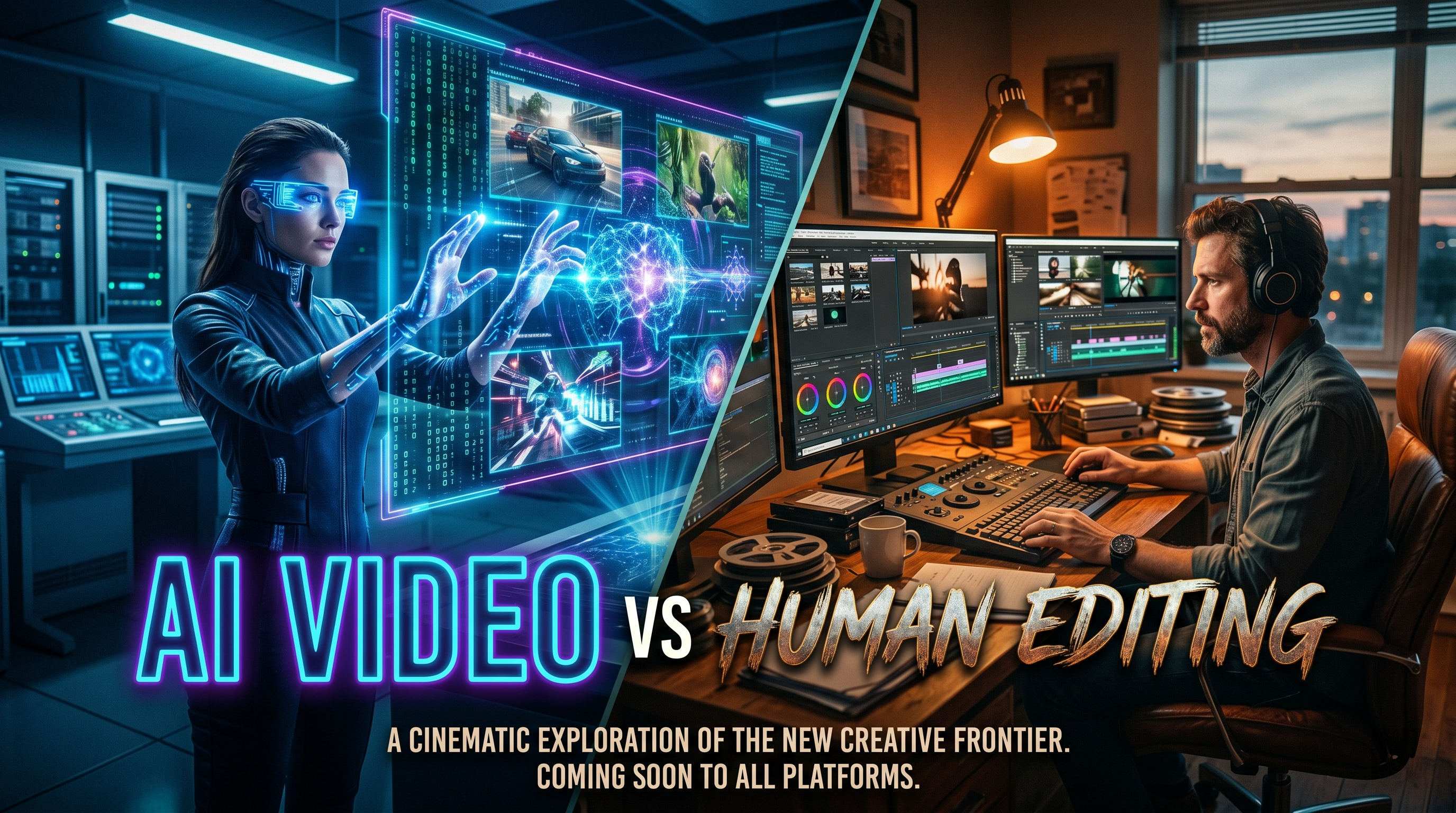
In the debate of AI video vs human editing, neither side has a definitive win in 2026 — instead, the smartest content creators are blending both approaches to achieve speed and emotional depth. AI tools now handle repetitive tasks like cutting pauses, adding captions, and generating first drafts, while human editors focus on storytelling nuance and brand consistency.
TL;DR: In 2026, the question “AI video vs human editing” no longer has a single winner. The most effective workflows combine AI’s speed and scalability with human creativity and emotional intelligence. Hybrid models, like Jellysmack’s one‑long‑video‑to‑50‑shorts system, are becoming the new industry standard.
AI video editing is the process of using machine‑learning algorithms to automate tasks such as scene detection, color correction, and audio clean‑up. Human editing remains the craft of assembling raw footage into a compelling narrative with intentional pacing, tone, and cultural context. In 2026, the best results come from a collaboration between the two.
- ✓ AI video editing tools have reduced editing time by up to 80% for routine tasks like trimming and captioning.
- ✓ Human editors are still essential for high‑impact storytelling, emotional nuance, and brand‑specific edits.
- ✓ Hybrid workflows — such as Jellysmack’s “AI + editors in minutes” — are becoming the standard for viral short‑form content.
- ✓ The job market for video editors and AI editing specialists grew by 30% year‑over‑year, according to Mediabistro.
- ✓ Adobe Firefly Quick Cut now generates AI‑driven first drafts, but final approval still rests with human creatives.
The State of AI Video Editing in 2026
2026 has been a breakout year for AI‑powered video creation. According to The AI Journal, AI tools are now capable of performing tasks that once required hours of manual work, such as scene segmentation, object tracking, and automatic sub‑clipping. Platforms like Adobe Firefly Quick Cut, launched in February 2026, can produce a “first draft” edit from raw footage in under a minute, dramatically accelerating the initial editing phase.
The Cybernews VideoGen AI review notes that while these tools are impressive, they still struggle with context‑aware decisions. For example, an AI might cut a scene too aggressively or fail to recognize subtle emotional beats that a human editor would naturally preserve. Nonetheless, the speed advantage is undeniable: tasks that used to take 30 minutes can now be done in 5.
Meanwhile, Mediabistro reports a surge in job listings for “AI Editing Specialists” and “Video Publishing” roles. The demand for hybrid editors — professionals who understand both manual editing and AI tooling — is growing rapidly. This signals that the industry is not replacing humans but rather redefining their role.
Human Editing: The Irreplaceable Craft?
Despite AI’s advances, human editors bring something machines cannot replicate: intentionality. A human editor makes conscious choices about pacing, juxtaposition, and emotional arc — decisions that are informed by cultural knowledge and empathy. In high‑stakes content like branded storytelling, documentaries, or feature films, these choices can mean the difference between a viewer feeling moved versus feeling manipulated.
Consider a recent study cited by the The Music Universe: even the best AI music video generators produce visuals that are technically correct but often lack the “human touch” — the subtle misalignments that make a video feel organic. Human editors can intentionally break rules for artistic effect, something AI is only beginning to learn.
Furthermore, brand consistency is still a distinctly human responsibility. A global brand may need specific color grades, font placements, and narrative flows that align with a complex identity. While AI can learn patterns, it cannot yet grasp the deeper strategic reasons behind those patterns without human guidance.
Head‑to‑Head Comparison: AI vs Human Editing
To understand the practical trade‑offs, here is a comparison table based on the latest tools and workflows in 2026:
| Criteria | AI Video Editing | Human Editing |
|---|---|---|
| Speed | First draft in 30–60 seconds; bulk processing in minutes | Hours to days for complex projects |
| Cost per project | Low to medium (subscription fees, e.g., $30–100/month) | High (freelance rates $50–200/hr) |
| Emotional storytelling | Basic pacing, no deep emotional intuition | Rich narrative arc, cultural sensitivity |
| Scalability | Can repurpose one long video into 50 shorts (Jellysmack model) | Limited by time and human bandwidth |
| Brand consistency | Pattern‑based, prone to odd choices | Strategic, aligned with brand guidelines |
| Error handling | May introduce artifacts or awkward cuts | Can detect and fix subtle issues |
| Best for | Social media clips, bulk repurposing, first drafts | Narrative films, commercials, high‑value content |
This table illustrates that while AI excels in speed and cost efficiency, human editors remain unmatched for creative direction and quality control. The real winner is the team that leverages both.
When AI Wins: Speed, Scale, and Short‑Form Content
AI video editing shines brightest in environments where volume and speed are paramount. The Jellysmack platform, as covered by quasa.io, can turn one long video into 50 viral shorts using a combination of AI and human editors — “in minutes.” This hybrid approach allows creators to flood social feeds with multiple variations of a single piece of content, each optimized for different platforms.
Similarly, Adobe Firefly Quick Cut, announced in February 2026, generates a rough cut based on scene changes, audio peaks, and facial expressions. According to Binance, this tool is “groundbreaking” for content creators who need to iterate quickly. News organizations and vloggers are already using it to publish breaking stories minutes after recording.
Even the music video industry has embraced AI. The Music Universe’s list of the five best AI music video generators highlights tools that can create lyric videos, animated visuals, and beat‑synchronized cuts in under five minutes. For artists who produce content frequently, AI reduces the bottleneck of manual editing, allowing them to focus on performance and promotion.
When Human Editing Wins: Storytelling, Emotion, and Brand Consistency
However, for projects that demand emotional resonance and strategic nuance, human editors are still irreplaceable. Documentaries, for instance, rely on the editor’s ability to weave a compelling narrative from hours of raw footage — choosing the right pauses, music cues, and juxtapositions that can make an audience laugh or cry. AI can assist with rough cuts but cannot replicate the instinct that tells an editor to hold on a reaction shot a moment longer.
Brand loyalty also hinges on consistent creative direction. A multinational corporation like Nike or Apple does not trust AI to fully dictate the final edit of a flagship ad. Human editors ensure that every frame aligns with the brand’s visual identity, tone of voice, and cultural context. This is especially crucial when targeting diverse, global audiences.
Moreover, the creative industry still values the human portfolio. Agencies and production houses hire editors for their unique style, problem‑solving skills, and ability to adapt to last‑minute client feedback. While AI can learn from data, it cannot negotiate with a client, interpret abstract feedback like “make it pop,” or brainstorm alternative creative approaches on the fly.
The Hybrid Future: AI + Human Collaboration
The most successful video production workflows in 2026 are hybrid models that combine AI’s brute force with human judgment. Jellysmack’s approach is a case in point: AI automatically identifies highlight moments, extracts clips, and adds captions, while human editors review, tweak, and finalize the shorts. This cuts turnaround time by 70% while maintaining quality.
Adobe Firefly Quick Cut is designed with this hybrid philosophy in mind. It generates a first draft that the human editor can then refine using traditional tools. The AI handles the tedious work — removing silences, stabilizing shaky footage, and adding basic transitions — freeing the editor to focus on storytelling. According to the Cybernews review, users report that “the AI draft is 80% perfect, but that last 20% of human polish makes all the difference.”
Even job postings on Mediabistro reflect this shift. Listings now ask for “experience with AI editing tools” alongside traditional editing skills. The role of the editor is evolving from a hands‑on technician to a creative director overseeing an AI assistant. This trend is expected to accelerate, with hybrid editing becoming the default by 2027.
Which Should You Choose?
Deciding between AI video editing and human editing ultimately depends on your goals. If you need to produce a high volume of short‑form content for social media — such as Instagram Reels, TikTok clips, or YouTube Shorts — an AI‑first workflow with human oversight is the most efficient path. Tools like those powered by Jellysmack or Adobe Firefly Quick Cut can help you go from raw footage to published content in minutes.
On the other hand, if you’re creating a brand commercial, a narrative film, or any project where emotional storytelling is critical, a human editor should lead the process. Use AI for pre‑editing tasks (transcription, rough cut, noise reduction) but retain full creative control over the final assembly. The additional time and expense will pay off in audience engagement and brand perception.
In the end, the answer to “AI video vs human editing” is not a winner — it’s a partnership. The most future‑proof editors will be those who embrace AI as a collaborator, not a competitor, and who continue to develop the creative intuition that machines cannot learn.
Frequently Asked Questions
Can AI video editing fully replace human editors in 2026?
No. While AI has become extremely capable at automating repetitive tasks, it still lacks the emotional intelligence and strategic thinking required for high‑quality storytelling. Most professionals use AI to speed up their workflow, not replace themselves.
What is the best AI video editing tool in 2026?
There is no single best tool; it depends on your needs. Adobe Firefly Quick Cut is excellent for first‑draft editing, while Jellysmack excels at repurposing long‑form video into shorts. For music videos, dedicated generators like those listed by The Music Universe are popular.
How much does AI video editing cost?
Subscription costs range from $30 to $100 per month for professional tools. Some offer free tiers with limited features. Human editing services can cost $50–200 per hour depending on complexity and location.
Will AI kill video editing jobs?
According to Mediabistro, the number of video editing jobs has actually increased in 2026, but the required skill set has shifted toward hybrid roles. Editors who learn to use AI tools will have a competitive advantage. The role is evolving, not disappearing.
What is the Jellysmack tool and how does it work?
Jellysmack uses AI to identify the most engaging moments from a long video and automatically generates multiple short clips with captions. Human editors then review and polish the clips. The entire process from one long video to 50 shorts can take “minutes.”
Is Adobe Firefly Quick Cut available now?
Yes, Adobe Firefly Quick Cut was released in February 2026. It is integrated with Adobe Premiere Pro and allows users to generate an AI‑powered first draft directly from raw footage.
Do I need both AI and human editing for my business?
For most businesses that produce regular video content, a hybrid approach offers the best balance of speed and quality. Use AI for bulk processing and first drafts, then hire a human editor for final touches and brand alignment.
Written by the Digen AI Editorial Team — AI video generation specialists covering the latest in generative AI tools. Learn more about Digen AI.



Comments ()