
AI Video Market Growth Statistics: 2026 Industry Outlook
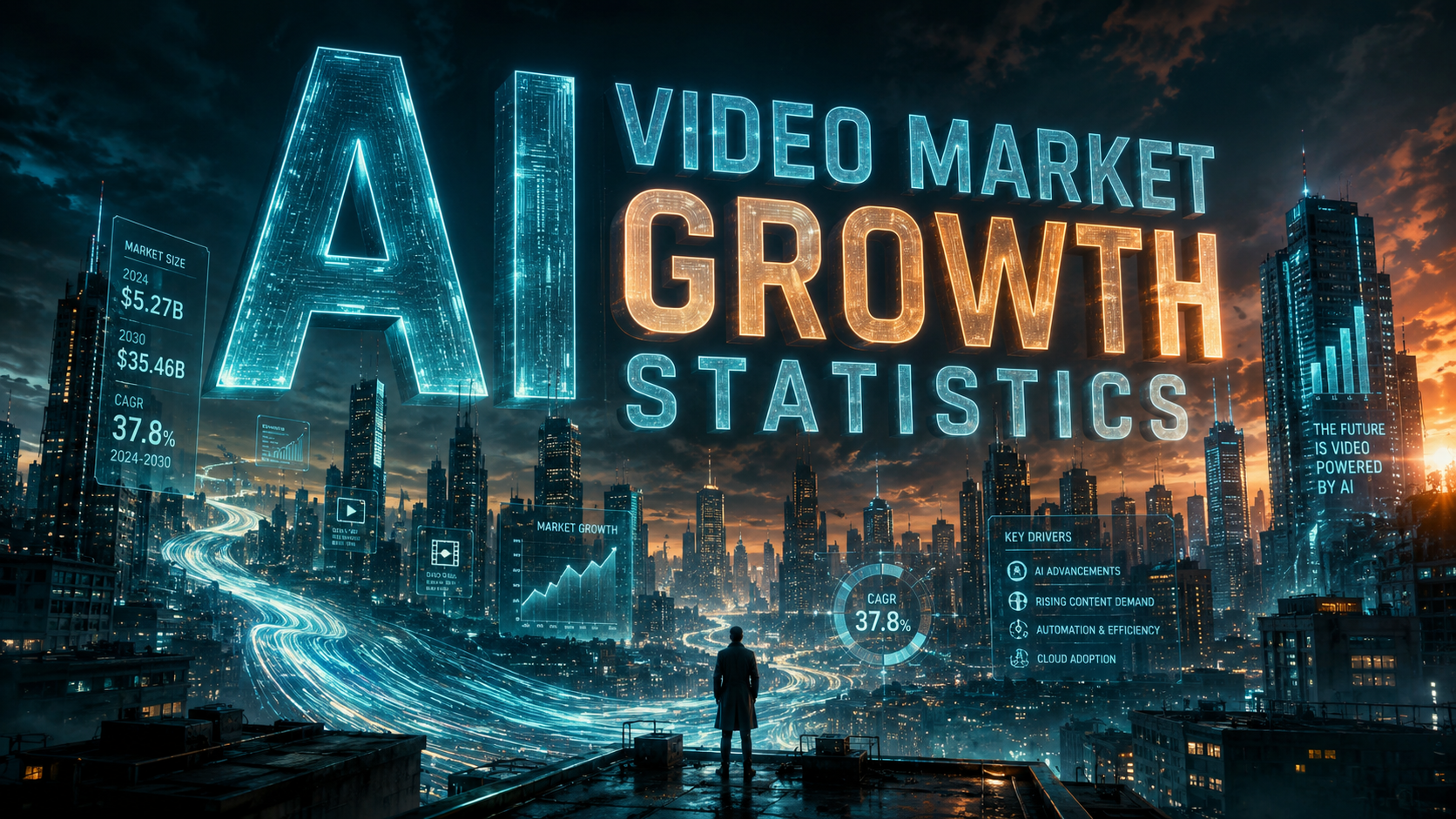
The ai video market growth statistics for 2026 reveal a landscape defined by hyper-acceleration and massive capital investment. As of mid-2026, the global AI video market is expanding at a Compound Annual Growth Rate (CAGR) of 36.20%, driven by the integration of generative models in content creation and the critical demand for intelligent surveillance. This growth is not merely incremental; it represents a fundamental shift in how digital media is produced, processed, and secured across global industries.
AI video market growth is currently fueled by a 36.20% CAGR, with the industry moving toward a multi-billion dollar valuation by the end of the decade. Key drivers include the rise of generative AI for automated content creation, significant advancements in AI-powered video surveillance reaching a $10.88 billion valuation by 2032, and the explosive demand for high-quality data labeling services.
- ✓ The global AI video market is maintaining a robust CAGR of 36.20% as of 2026.
- ✓ AI-driven video surveillance is projected to reach $10.88 billion by 2032.
- ✓ Data labeling for AI video training is a primary sub-sector, hitting $18.23 billion by 2035.
- ✓ Generative AI adoption in the United States continues to set global benchmarks for market size and innovation.
- ✓ Enterprise adoption of AI video tools has transitioned from experimental to essential for operational efficiency.
Current Landscape of AI Video Market Growth Statistics
As we navigate through 2026, the artificial intelligence video sector has moved beyond the "hype" phase into a period of sustained industrial maturity. According to recent data from Market.us, the AI video market share and size are expanding at a remarkable CAGR of 36.20%. This growth is supported by the democratization of high-compute resources and the refinement of Large Video Models (LVMs) that allow for near-instantaneous video generation and analysis. Organizations are no longer asking if they should implement AI video solutions, but rather how quickly they can scale them to maintain a competitive edge.
The impact of these statistics is felt most heavily in the sectors of entertainment, marketing, and security. Forbes reports that among the top 22 AI statistics and trends for 2026, video automation ranks as a top-three priority for C-suite executives. This shift is largely due to the cost-reduction potential of AI; where traditional video production once required weeks of filming and editing, AI-driven workflows now allow for the creation of localized, personalized video content in a fraction of the time. This efficiency is a primary catalyst for the 36.20% growth rate observed this year.
The Role of Generative AI in Market Expansion
Generative AI remains the most visible driver of the ai video market growth statistics. Statista research indicates that the generative AI market size in the United States has seen a consistent upward trajectory from 2020 through 2026, with 2031 projections suggesting a total market dominance. In 2026, generative video tools are being used to synthesize realistic human avatars for corporate training, create cinematic visual effects for independent filmmakers, and automate social media content at scale. This segment alone accounts for a significant portion of the venture capital flowing into the broader AI ecosystem.
Market Size and Valuation Benchmarks
To understand the scale of the industry, one must look at the valuation of specific niches. For instance, the AI data labeling market—a foundational requirement for training video models—is on a trajectory to hit USD 18.23 billion by 2035, according to Precedence Research. In 2026, the demand for high-quality, frame-by-frame video annotation has reached an all-time high, as developers strive to eliminate "hallucinations" in generative video and improve the accuracy of object detection in autonomous systems.
Strategic Implementation of AI Video Technology
For businesses looking to capitalize on these growth trends, implementation follows a structured path. The following steps outline how modern enterprises are integrating AI video tools into their workflows in 2026:
- Infrastructure Assessment: Evaluate current cloud and on-premise compute capabilities to handle high-bandwidth AI video processing.
- Data Acquisition and Labeling: Source diverse datasets and utilize services from the $18.23 billion data labeling market to fine-tune proprietary models.
- Model Selection: Choose between specialized generative models for content creation or analytical models for security and surveillance.
- Integration and API Deployment: Connect AI video engines with existing CMS or ERP systems to automate content distribution or monitoring.
- Compliance and Ethics Review: Ensure all AI-generated or analyzed video content meets 2026 regulatory standards for deepfake identification and data privacy.
AI Video Market Segments: Surveillance and Security
One of the most lucrative segments of the AI video industry is surveillance. MarketsandMarkets reports that the AI in Video Surveillance industry is on track to be worth $10.88 billion by 2032. In 2026, we are seeing a massive shift from reactive monitoring to proactive, predictive analytics. Modern surveillance systems now utilize edge-AI to identify potential security threats in real-time, reducing the need for constant human oversight and significantly lowering response times during critical incidents.
This growth in surveillance is not limited to public safety. Retailers are utilizing AI video analytics to track foot traffic, optimize store layouts, and prevent loss. The integration of facial recognition (where legally permitted) and behavioral analysis has turned standard security cameras into powerful business intelligence tools. The 2026 outlook suggests that as hardware costs continue to fall, the software-as-a-service (SaaS) model for AI surveillance will become the standard for small and medium-sized enterprises (SMEs).
| Market Segment | Key 2026 Trend | Projected Valuation/Growth |
|---|---|---|
| Generative AI Video | Text-to-Video Maturity | 36.20% CAGR (Market.us) |
| AI Surveillance | Predictive Analytics | $10.88 Billion by 2032 |
| Data Labeling | Automated Annotation | $18.23 Billion by 2035 |
| Enterprise AI | Workflow Automation | Top 22 Tech Trend (Forbes) |
Regional Growth and Global Adoption Patterns
The ai video market growth statistics show significant regional variance. The United States remains the largest market for generative AI video, supported by the presence of major tech hubs and significant R&D investment. Statista's 2026 data highlights that the U.S. market is benefiting from a robust ecosystem of startups and established tech giants that are integrating AI video capabilities into everyday productivity suites. This has led to a high adoption rate among American creative agencies and corporate marketing departments.
However, the Asia-Pacific region is emerging as the fastest-growing market for AI video surveillance. Urbanization projects in countries like India and various Southeast Asian nations are driving the demand for "Smart City" technologies. According to SQ Magazine's 2026 report on Artificial Intelligence Statistics, the adoption of AI in public infrastructure is growing twice as fast in developing economies compared to mature markets, as these regions leapfrog traditional surveillance technologies in favor of AI-native solutions.
Impact on the Labor Market and Skills Demand
As the AI video market expands, the demand for specific skill sets is shifting. Forbes notes that while AI automates many aspects of video production, it has created a surge in demand for "AI Orchestrators"—professionals who can manage multiple AI tools to produce a cohesive final product. The 2026 job market is seeing a decrease in demand for entry-level video editing roles but a massive spike in roles related to AI prompt engineering, data curation, and ethical oversight. This evolution is a direct result of the industry's 36.20% growth rate, which requires a more sophisticated workforce to maintain.
Technological Milestones Driving the 2026 Outlook
Technologically, 2026 has been a landmark year for video fidelity. The "uncanny valley" that once plagued AI-generated human figures has largely been bridged. Studies show that 2026-era generative models can now produce 4K video content that is indistinguishable from captured footage to the untrained eye. This milestone has unlocked new opportunities in the "synthetic media" space, allowing brands to create localized advertisements for dozens of different markets simultaneously without the need for multiple film shoots.
Furthermore, the efficiency of these models has improved. In 2026, the energy consumption required to render AI video has dropped by nearly 40% compared to two years ago, thanks to specialized AI chips and more efficient neural architecture search (NAS). This environmental and economic efficiency is a key reason why the market is sustaining such high growth rates. Lower operational costs mean that even smaller businesses can afford to utilize high-end AI video tools, further fueling the 36.20% CAGR reported by Market.us.
The Convergence of AI Video and 5G/6G Networks
The rollout of advanced 5G and early 6G experimental networks in 2026 has provided the necessary bandwidth for real-time AI video processing. This synergy is particularly evident in the field of remote surgery and industrial teleoperation. High-speed connectivity allows for AI models to analyze video feeds with sub-millisecond latency, providing real-time feedback to operators. This convergence is a major factor in the $10.88 billion valuation of the AI surveillance and monitoring sector, as the "eyes" of the system can now "think" and "react" in real-time across the globe.
Challenges and Ethical Considerations in 2026
Despite the glowing ai video market growth statistics, the industry faces significant headwinds regarding ethics and regulation. The rise of sophisticated deepfakes has led to a global push for mandatory watermarking of AI-generated content. In 2026, major platforms have implemented "Content Credentials" that track the provenance of a video from creation to distribution. This regulatory environment, while adding a layer of complexity for developers, is seen as a necessary step to maintain public trust in digital media.
Data privacy also remains a critical concern, especially in the AI surveillance market. As the sector approaches its $10.88 billion potential, governments are introducing stricter guidelines on how video data can be stored and analyzed. Companies that prioritize "Privacy by Design" are finding themselves at a competitive advantage, as enterprise clients look for solutions that comply with the increasingly stringent global data protection laws of 2026.
What is the current growth rate of the AI video market?
As of 2026, the global AI video market is growing at a Compound Annual Growth Rate (CAGR) of 36.20%. This rapid expansion is driven by advancements in generative AI and the increasing adoption of intelligent video analytics across various industries.
How much will the AI video surveillance market be worth?
According to research from MarketsandMarkets, the AI in video surveillance industry is projected to reach a valuation of $10.88 billion by 2032. The growth is fueled by the demand for predictive security and real-time threat detection.
What is the role of data labeling in AI video growth?
Data labeling is essential for training the models that power AI video. This specific market segment is expected to hit $18.23 billion by 2035, as high-quality, annotated video data becomes the primary fuel for more accurate and realistic AI models.
Which region is leading the generative AI market?
The United States currently leads the generative AI market in terms of size and innovation. Statista data shows a steady increase in market share from 2020 through 2026, with the U.S. serving as a hub for the world's most prominent AI video developers.
What are the top trends in AI for 2026?
Key trends include the maturation of text-to-video technology, the integration of AI video in "Smart City" infrastructure, and a shift toward proactive AI surveillance. Forbes identifies video automation as a critical trend for enterprise efficiency this year.
In conclusion, the 2026 outlook for the AI video market is one of unprecedented opportunity and rapid evolution. With a 36.20% CAGR and multi-billion dollar valuations across surveillance and data labeling sectors, the industry is reshaping the global economy. For businesses and creators alike, staying informed on these ai video market growth statistics is essential for navigating the future of digital communication and security.



Comments ()