
AI Video Maker vs Traditional Editing (2026 Guide)
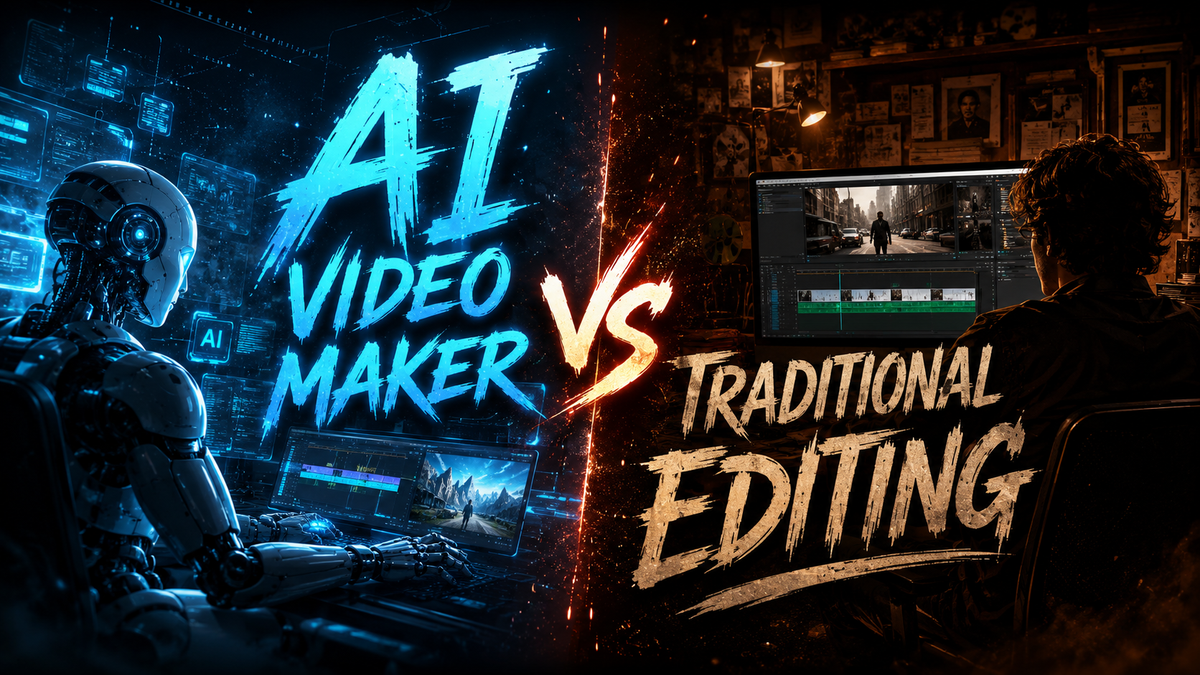
When comparing an AI video maker vs traditional editing in 2026, the choice comes down to speed versus control. AI tools like Pollo AI and Adobe Firefly's Quick Cut enable prompt-based editing that can produce a rough cut in seconds, while traditional NLEs such as VEGAS Pro offer frame‑by‑frame manual control for unmatched creative precision. Rather than one replacing the other, today’s smartest editors are learning to blend both approaches.
An AI video maker vs traditional editing comparison in 2026 reveals that AI video makers use generative algorithms and prompt‑based workflows to automate tasks like scene detection, transitions, and text‑to‑video generation, while traditional editing relies on manual timeline manipulation in software such as VEGAS Pro or Adobe Premiere Pro. Although AI tools are faster for short‑form content, traditional editors still dominate long‑form narrative and custom visual effects.
- ✓ AI video makers cut editing time by up to 80% for social‑media‑length clips, but struggle with complex narratives.
- ✓ Traditional NLEs like VEGAS Pro offer precise control over every frame, audio track, and effect layer.
- ✓ Hybrid workflows — using AI for rough assembly and manual refinements — are the fastest‑growing trend in 2026.
- ✓ Adobe Firefly Quick Cut and Pollo AI Video Agent represent the leading edge of prompt‑based editing.
- ✓ The cost gap is narrowing: AI tools often start at $15–30/month, while traditional editors require a one‑time license or subscription.
The Core Difference: Prompt‑Based vs. Manual Editing
In the ai video maker vs traditional editing debate, the fundamental divide is how you interact with the software. An AI video maker lets you type a prompt like “create a 30‑second product highlight reel with upbeat music and smooth transitions,” and the engine generates a near‑finished video. Traditional editing requires you to place clips on a timeline, trim each file, adjust audio levels, and apply effects manually.
According to a Scott Coop review of the Pollo AI Video Agent (May 2026), the tool can produce a promotional video from a single text prompt in under a minute. Meanwhile, traditional NLEs like VEGAS Pro demand experience and time — but offer the ability to tweak every pixel. The choice, then, is about urgency vs. artistic control.
Both workflows have matured in 2026. Pollo AI now supports multi‑scene prompts and lip‑sync generation, while VEGAS Pro has integrated its own AI‑assisted tools for color grading and noise reduction. The line between the two is blurring, but the philosophy remains distinct.
2026’s Leading AI Video Makers: Pollo AI, Filmora, and Adobe Firefly

The latest wave of AI video tools includes Pollo AI, Wondershare Filmora, and Adobe Firefly Quick Cut. Each takes a slightly different approach to the ai video maker vs traditional editing question.
Pollo AI Video Agent and Pollo AI Video Editor
Investorideas.com reported in April 2026 that Pollo AI’s Video Editor “wins” in prompt‑based editing when compared to traditional NLEs. The tool uses a transformer‑based model to understand natural language and generate coherent video sequences with matching audio. Pollo AI Video Agent (reviewed by Scott Coop) also automates storyboard creation and voice‑over generation.
Wondershare Filmora
In May 2026, Gadget Flow compared Wondershare Filmora vs VEGAS Pro. Filmora now includes an AI video maker mode that can analyze source footage and suggest highlight reels, as well as auto‑generate captions and transitions. It targets content creators who want AI assistance without leaving the traditional timeline interface entirely.
Adobe Firefly Quick Cut
The Tech Buzz announced in February 2026 that Adobe Firefly launched Quick Cut — a standalone AI video editor that works from text prompts and can also refine existing footage. Quick Cut integrates with Adobe’s ecosystem but requires a Creative Cloud subscription. Its strength lies in generating B‑roll and background music that aligns with the narrative.
The Cybernews list of the 16 best AI video generation tools for 2026 also highlights Runway Gen‑3 and Pika Labs, but Pollo AI and Filmora remain the most accessible for everyday editors.
Traditional Editing Software: VEGAS Pro and the NLE Standard
While AI video makers grab headlines, traditional NLEs continue to evolve. VEGAS Pro, pitted against Filmora in the Gadget Flow comparison, still leads in pro‑grade features like multi‑camera editing, precise audio waveforms, and custom color LUTs. The 2026 version of VEGAS Pro includes an AI‑powered upscaler and motion tracking, but it does not offer prompt‑to‑video generation — the editing remains manual.
Adobe Premiere Pro and DaVinci Resolve also remain popular, though the research specifically mentions VEGAS Pro and Filmora. Traditional editors are best for projects where every cut must be intentional: feature films, documentary series, and high‑end commercials. According to Perfect Corp’s “23 Best AI Video Generators for 2026” (May 2026), even the best AI generators cannot yet match the nuance of a human editor in these contexts.
Key Decision Factors in the AI Video Maker vs Traditional Editing Debate
To help you choose, here is a comparison table based on the latest 2026 data:
| Factor | AI Video Maker (e.g., Pollo AI, Filmora AI, Firefly Quick Cut) | Traditional Editor (e.g., VEGAS Pro, Premiere Pro) |
|---|---|---|
| Speed | Seconds to minutes for a rough cut | Hours to days for complex edits |
| Control | Low — you guide with prompts | High — frame‑by‑frame tweaking |
| Learning Curve | Minimal — natural language input | Steep — timeline, shortcuts, effects |
| Cost (2026) | $15–30/month (Pollo AI); $49.99/year (Filmora AI) | $19.99/month (Premiere Pro); $299 one‑time (VEGAS Pro) |
| Best For | Social media, short promos, rapid prototypes | Films, long‑form docs, advanced VFX |
| Output Quality | Good for web‑ready; can lack subtlety | Professional – broadcast quality |
| Iteration | Fast – regenerate with new prompt | Slower – manual adjustments |
This table makes the ai video maker vs traditional editing trade‑offs clear: choose AI when time is critical and creative risk is low; choose traditional when you need absolute control.
When to Choose an AI Video Maker
AI video makers excel in scenarios where speed trumps perfection. For a YouTuber who needs to post three shorts per day, Pollo AI or Filmora’s AI mode can turn raw footage into a finished product in minutes. The Investorideas.com article notes that prompt‑based editing “wins” for social media content because it eliminates repetitive tasks like cutting pauses and aligning beats.
Another sweet spot is rapid prototyping. Marketing teams use AI video makers to test multiple ad variations — changing the soundtrack, pacing, or call‑to‑action — before investing in a full manual edit. Adobe Firefly Quick Cut, launched in February 2026, is particularly strong here because it integrates with Adobe’s libraries for brand assets.
Finally, educational and training videos benefit from AI narration and scene generation. Pollo AI Video Agent can take a script and produce a complete explainer video, saving hours of recording and editing.
When to Stick with Traditional Editing
Traditional editing remains essential for projects that rely on narrative pacing, emotional beats, and visual storytelling. A feature‑length documentary or a music video with complex cuts and color grading cannot be reliably generated by AI in 2026. According to Perfect Corp, even the top‑rated AI generators struggle with “long‑form coherence” and “creative consistency across scenes.”
Additionally, if you need to work with raw, unprocessed footage (e.g., interviews, multi‑camera event coverage), traditional NLEs like VEGAS Pro offer the timeline tools to sync, trim, and layer tracks manually. The Gadget Flow comparison between Filmora and VEGAS Pro explicitly recommends VEGAS Pro for users who “demand precise control over every edit point.”
Professional video editors also value the ecosystem of plugins and custom scripts that traditional editors support — something closed AI video makers rarely offer.
The Rise of Hybrid Workflows in 2026
The most forward‑looking approach is to combine both tools: use an AI video maker for the first rough assembly, then import the timeline into a traditional NLE for fine‑tuning. This workflow is growing in popularity because it harnesses the speed of AI without sacrificing creative control.
For example, a post‑production house might use Pollo AI to generate a 30‑second promo from a script, then bring that timeline into VEGAS Pro to adjust color grading, add custom text overlays, and tweak audio transitions. The Scott Coop review mentions that Pollo AI exports standard video files compatible with most NLEs, making this seamless.
Adobe Firefly Quick Cut also offers a “Send to Premiere Pro” button for further refinement. As tools become more interoperable, the ai video maker vs traditional editing debate will likely shift to “how to best orchestrate both.”
How to Decide: AI Video Maker vs Traditional Editing in 2026
If you are still unsure, follow this decision framework:
- What is your deadline? If under one hour, use AI.
- How much creative control do you need? If every frame matters, use traditional.
- What is your budget? AI tools are cheaper for short‑form volume; traditional software is a better long‑term investment for pro users.
- Do you need to iterate? AI wins for A/B testing; traditional wins for set‑and‑polish.
- Will the video be broadcast or archived? Traditional editing produces industry‑standard files.
Ultimately, there is no single winner in the ai video maker vs traditional editing comparison — the best choice depends on your project, your skills, and your audience. Both have a place in the 2026 video production landscape.
Frequently Asked Questions
Can AI video makers completely replace traditional editors in 2026?
Not yet. While AI tools like Pollo AI and Adobe Firefly Quick Cut are impressive for short‑form content, they lack the narrative intelligence and fine‑grained control that traditional NLEs provide for long‑form, high‑stakes productions. Most professionals use a hybrid approach.
Is Pollo AI better than VEGAS Pro for professional video work?
It depends on the task. Pollo AI is better for rapid, prompt‑based creation and social media clips. VEGAS Pro is superior for multi‑camera editing, complex audio workflows, and custom visual effects. The Gadget Flow comparison in May 2026 concluded that neither is “better” — they serve different purposes.
How does Adobe Firefly Quick Cut work?
Launched in February 2026, Adobe Firefly Quick Cut is a standalone AI video editor that generates video sequences from text prompts. It can also analyze existing footage to propose edits, transitions, and background music. It integrates with Creative Cloud for advanced refining in Premiere Pro.
What is the learning curve for AI video makers vs traditional editing?
AI video makers have a very shallow learning curve — you mostly need to write descriptive prompts. Traditional editing software like VEGAS Pro or Premiere Pro requires weeks or months to master. In 2026, many beginners start with AI tools and gradually learn traditional editing for more control.
Which is more cost‑effective: AI video maker or traditional editing software?
For occasional use and short clips, AI video makers (typically $15–30/month) are cheaper. For frequent, professional‑grade editing, a traditional NLE like VEGAS Pro (one‑time $299) or Adobe Premiere Pro ($19.99/month) can be more economical in the long run. Pricing from the 2026 research shows the gap is narrowing.
Do AI video makers support 4K and high‑resolution output?
Yes, most 2026 AI video generators support up to 4K resolution. For example, Pollo AI and Adobe Firefly Quick Cut export 4K clips. However, traditional editors still offer better compression control and HDR support for cinema‑grade quality.



Comments ()