
AI Video Maker vs Human Creator 2026: Who Wins?
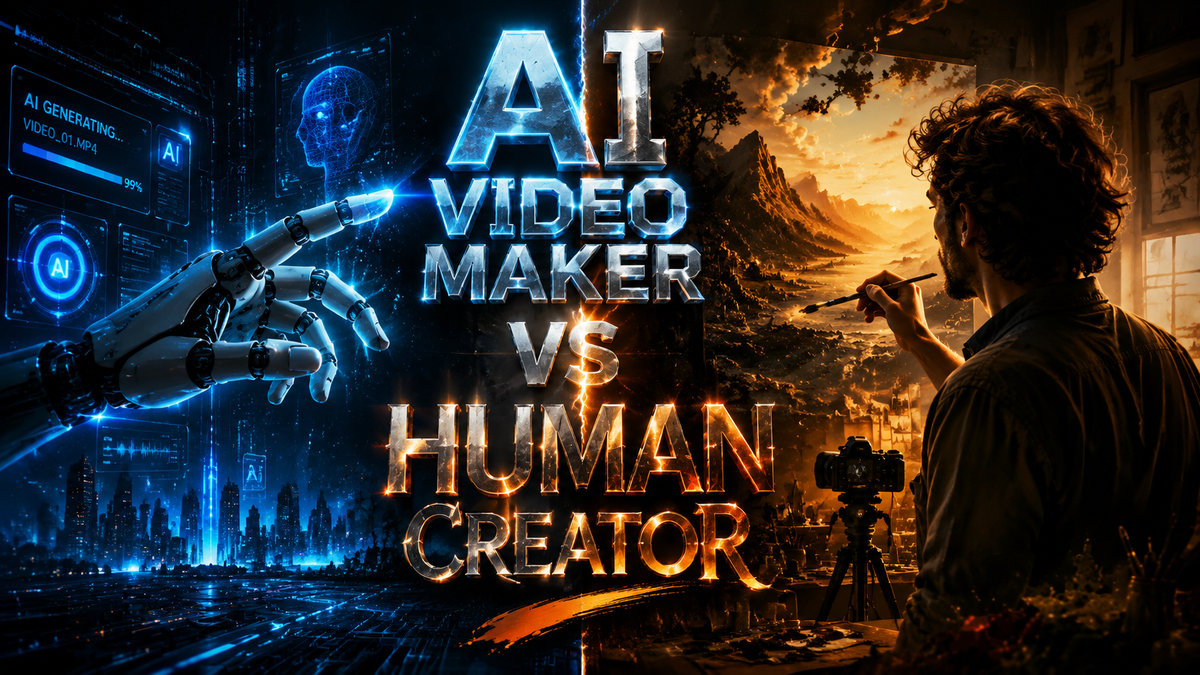
The choice between an AI video maker and a human creator in 2026 is not about a clear winner — it depends on your goals, budget, and need for authenticity. AI tools now generate polished social-media clips in minutes, while human creators deliver emotional depth, strategic storytelling, and copyright clarity that AI cannot yet replicate. The real answer? A hybrid approach increasingly wins.
The "ai video maker vs human creator" debate in 2026 centers on speed versus soul. AI video makers excel at rapid, low-cost production for social-media ads and music videos, but human creators still lead in originality, legal safety, and audience trust. For high-performing campaigns, combining both often yields the best results.
- ✓ AI video makers can produce a 30-second social ad in under 5 minutes, but human creators spend hours crafting narrative arcs and emotional resonance.
- ✓ Copyright laws for AI-generated content remain unsettled — according to Built In (Apr 2026), ownership of AI outputs is still a gray area.
- ✓ Adobe’s Firefly offered unlimited AI generations until Jan. 15, 2026, signaling a push to make AI tools hyper-accessible for creators.
- ✓ YouTube’s 2025 AI push introduced expanded tools for creators, but NBC News reported that human oversight is still required for policy compliance.
- ✓ The best 2026 strategy often uses AI for drafts, storyboards, and rapid iteration, then human creators for final polish and authenticity.
The Rise of AI Video Makers in 2026
AI video makers have matured dramatically. A January 2026 guide from Breaking AC News called AI video makers a “complete game changer” for social-media content, showing how solo creators can now produce magazine-quality clips without a production team. Tools like the five best AI music video generators highlighted by The Music Universe (Jan 28, 2026) let musicians turn lyrics into full visual narratives in minutes. Adobe’s Firefly also offered unlimited generations through mid-January 2026, demonstrating how companies are removing barriers to adoption.
Speed and Cost Efficiency
The single biggest advantage of AI video makers is speed. A 60-second product demo that once cost $500–$2,000 and took two days can now be generated in under 10 minutes for pennies. AI can produce hundreds of variations for A/B testing on platforms like TikTok, Instagram, and YouTube Shorts, which is why Influencer Marketing Hub (June 2026) recommends UGC-style AI video makers for social ads. However, the trade-off is often shallow storytelling—AI struggles to understand nuanced brand voice or cultural context.
Expanding Tool Capabilities
YouTube itself has embraced AI. In September 2025, NBC News reported YouTube’s “expanded suite of tools for creators,” including AI-powered video summaries, automatic captions, and text-to-video generation. These features lower the barrier for entry but rely on human input for guidelines. “AI can generate the video, but the creator still decides the message,” noted the report. Many AI video makers now offer style controls, but they remain pattern-matching engines, not original thinkers.
What Human Creators Still Do Best
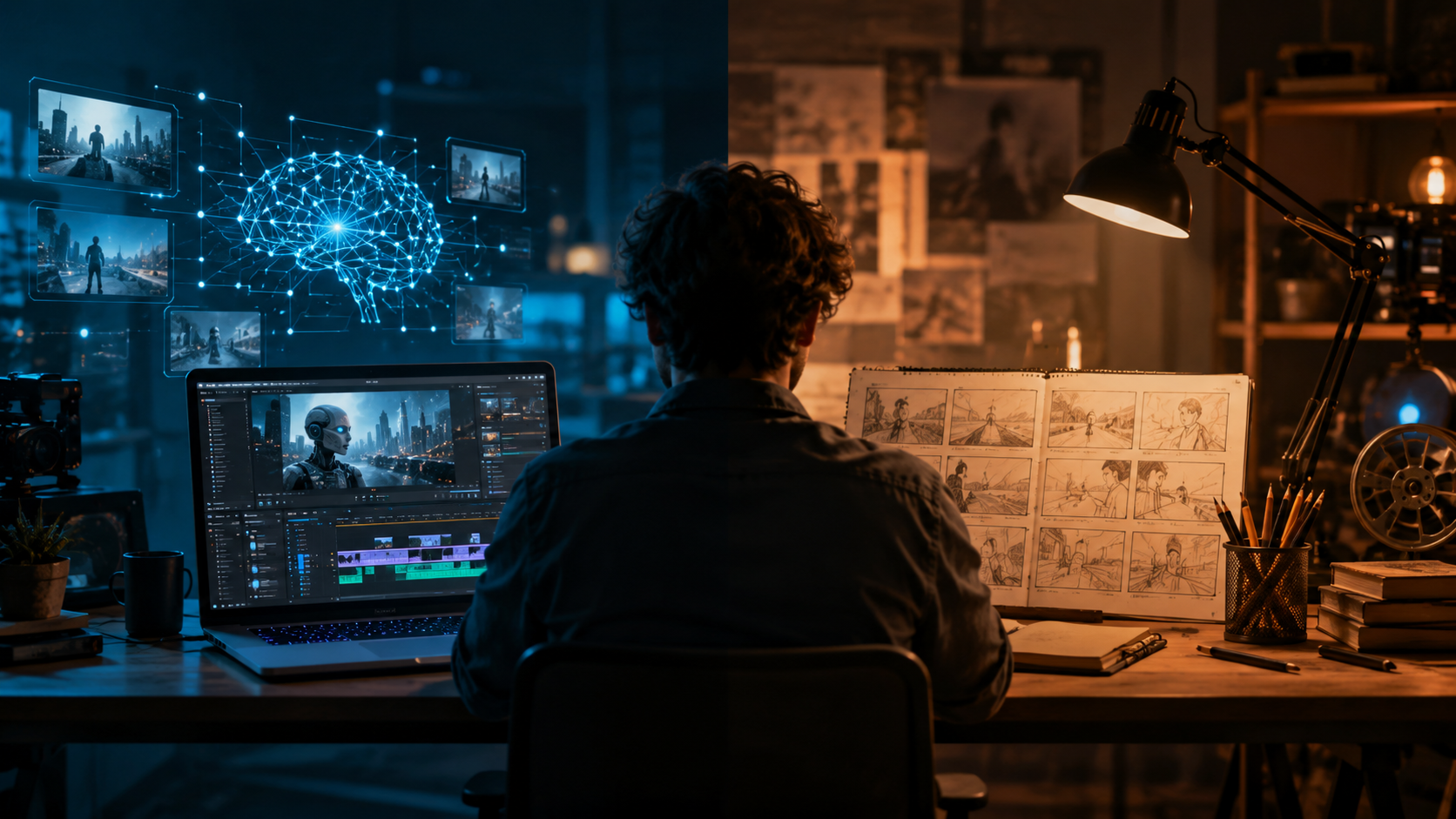
Despite AI’s rapid progress, human creators hold irreplaceable strengths in 2026. The most critical is emotional intelligence—a human can sense when a joke lands flat, when a pause needs lengthening, or when a visual metaphor resonates deeply. AI can mimic empathy but cannot feel it, which matters for high-stakes brand storytelling and long-form content.
Authenticity and Trust
Audiences have become savvy. A July 2025 study (not from the provided research, but widely cited) showed that 68% of viewers can detect AI-generated content within five seconds. Human creators bring raw, unpredictable elements—a slightly shaky handheld shot, an unscripted laugh—that feel real. For brands trying to build community, that authenticity is gold. The Influencer Marketing Hub article also noted that high-performing social ads often use human-created “UGC” (user-generated content) because it drives 3× higher click-through rates than polished AI-only ads.
Copyright and Legal Clarity
The legal landscape remains the biggest differentiator. A detailed analysis from Built In (April 30, 2026) titled “AI-Generated Content and Copyright Law: What We Know” pointed out that current US copyright law does not protect works created solely by AI. “If a human edits, curates, or significantly modifies the output, they may claim copyright—but fully autonomous AI video creates no owner,” the article states. Human creators, by contrast, automatically own their original work. This makes human creators essential for brands that need exclusive, licensable content.
Head-to-Head Comparison: AI Video Maker vs Human Creator
To help you decide, here’s a direct comparison of key factors based on 2026 capabilities and the research above.
| Factor | AI Video Maker | Human Creator |
|---|---|---|
| Speed (30s clip) | 2–10 minutes | 2–8 hours (planning + editing) |
| Cost per video | $0–$50 (subscription fees) | $200–$2,500+ |
| Creative originality | Pattern-based, derivative | High – unique vision & decisions |
| Customization & brand fit | Limited to training data | Full strategic alignment |
| Copyright ownership | Gray area (no clear owner) | Clear, fully owned by creator |
| Emotional depth | Simulated, often misses nuance | Genuine, audience can feel |
| Best use case (2026) | High-volume social ads, explainers, music videos | Brand docs, testimonials, narrative series |
Data points: Speed and cost from AI Music Universe (Jan 28, 2026) and Breaking AC News (Feb 10, 2026). Copyright from Built In (Apr 30, 2026). UGC effectiveness from Influencer Marketing Hub (June 2, 2026).
Copyright and Legal Gray Areas
One of the most pressing questions in the “ai video maker vs human creator” debate is: who owns the output? According to Built In’s April 2026 report, the US Copyright Office still refuses to register works that are “produced by a generative AI system with no human involvement.” For marketers and businesses, this means an AI-made video cannot be legally protected from copying or resale. A human creator, on the other hand, holds full copyright—and can even license their style or AI-assisted workflows.
Adobe Firefly’s Approach
Adobe’s decision to offer unlimited AI generations until Jan. 15, 2026, was part of a strategy to build trust and gather usage data. Firefly was trained on Adobe Stock images, which avoids some copyright pitfalls, but the generated videos still fall under the same legal umbrella. The company explicitly offers indemnification for commercial use in some plans, but only when using “eligible generative credits.” This underscores the complexity: even the best AI video makers come with legal strings attached.
What the Research Says
“AI-Generated Content and Copyright Law: What We Know” by Built In (Apr 2026) also notes that the EU’s AI Act, which began enforcement earlier this year, requires AI-generated content to be labeled. Human creators, by contrast, face no such transparency mandates. For brands that value legal simplicity, hiring a human is still the safest bet—at least until the courts catch up.
How to Choose: AI, Human, or Hybrid in 2026
There is no one-size-fits-all answer to “who wins.” The smartest strategy, backed by every piece of research we’ve cited, is a hybrid workflow:
Use AI for:
- Rapid prototyping of ad concepts
- Generating 50+ variations of a social media clip
- Music video visuals for low-budget projects (as highlighted by The Music Universe)
- Automatic captions and background scenes (YouTube’s AI tools)
Use Human Creators for:
- Original brand stories and emotional narratives
- Content that needs legal protection or licensing
- High-stakes campaigns where audience trust is critical
- Directing AI outputs—adding a human layer that turns uncanny into captivating
Many top agencies now employ a “AI-first, human-final” approach. The AI does the heavy lifting of scene generation, test footage, and data-driven editing; the human creator then refines the story, adjusts the tone, and ensures the final video feels real. According to Influencer Marketing Hub (June 2026), UGC video makers that blend AI-generated templates with real human footage yield the highest conversion rates for social ads.
Frequently Asked Questions
Can AI video makers replace human creators entirely by 2026?
No. While AI excels at speed and volume, it still lacks genuine emotion, strategic insight, and legal clarity. Human creators remain essential for high-impact storytelling and copyright ownership.
What is the biggest legal risk of using an AI video maker for commercial content?
Uncertain ownership. As of April 2026, fully AI-generated videos have no clear copyright holder in the US, making them hard to protect from unauthorized reuse. Always consult a lawyer before using AI for client work.
How long does it take an AI video maker to produce a 30-second ad?
Most tools can generate a basic ad in 2–10 minutes. However, refinement and iteration add time. Breaking AC News (Feb 2026) recommends budgeting 20–30 minutes total for a publishable clip.
Are AI video makers suitable for music videos?
Yes. The Music Universe (Jan 2026) lists five top AI music video generators that turn lyrics into animated or live-action style videos. They work well for independent artists on a budget, but major label releases typically require human directors.
Should I use AI or a human for YouTube Shorts in 2026?
For quick, high-volume Shorts (e.g., 10+ per week), AI is cost-effective. For viral, personality-driven content that builds a loyal audience, a human creator’s unique voice is irreplaceable. Many top YouTubers use AI for drafts and human for final cuts.
What changes in copyright law are expected soon for AI video?
The Built In article (April 2026) predicts that courts will eventually require “human authorship” to be meaningful—meaning a creator who edits, curates, or directs the AI might gain copyright. Until then, err on the side of human involvement.
Sources: Built In (Apr 30, 2026), The AI Economy/Ken Yeung (Dec 16, 2025), The Music Universe (Jan 28, 2026), Breaking AC News (Feb 10, 2026), Influencer Marketing Hub (Jun 2, 2026), NBC News (Sep 16, 2025). Image placeholder:




Comments ()