
AI Video Generators: 2026 Content Creation Shift
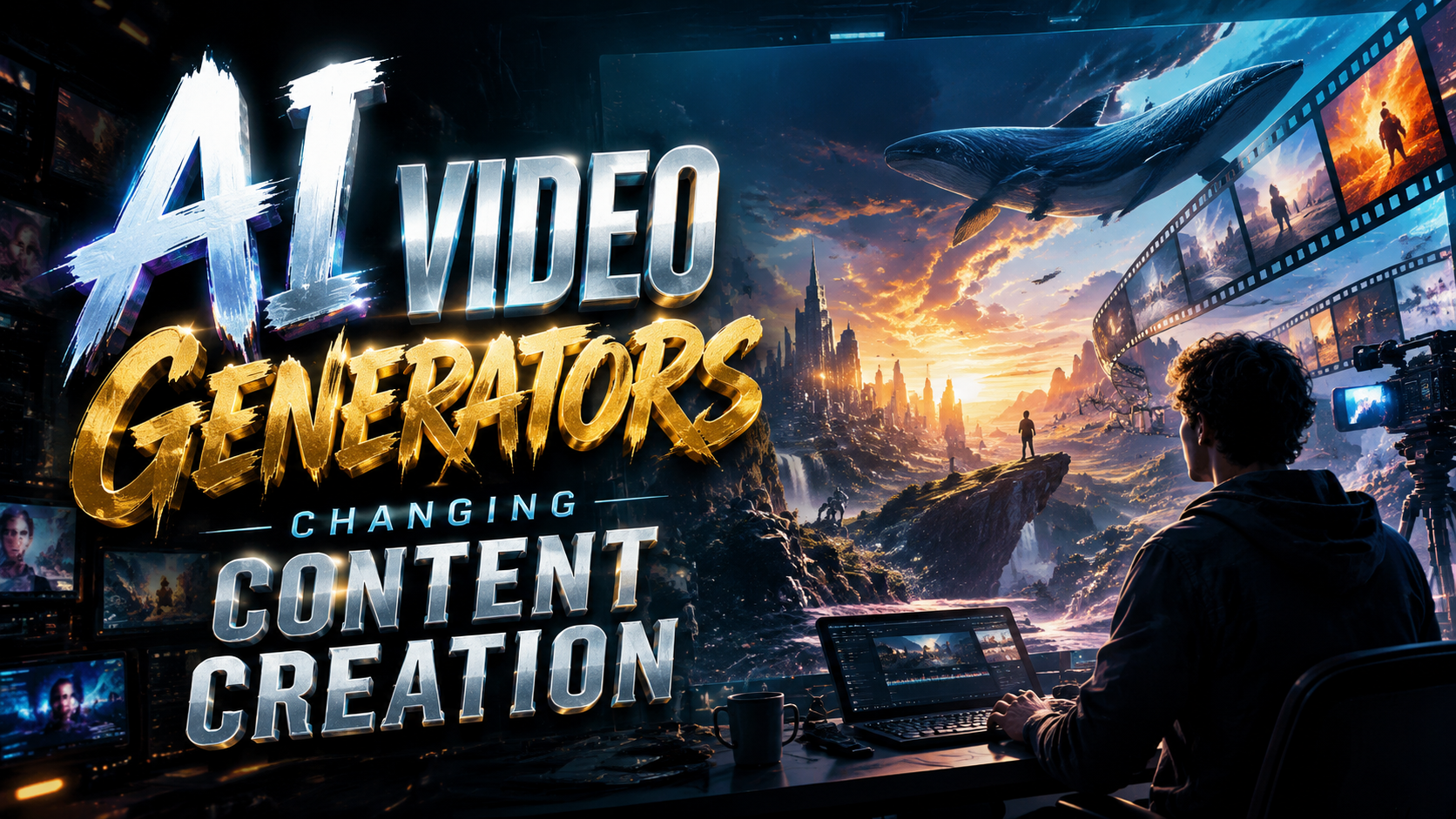
AI video generators are fundamentally transforming how content is created in 2026, enabling anyone to produce professional-quality videos from simple text prompts. These tools leverage advanced generative AI to automate scripting, voiceovers, editing, and even actor simulations—reducing production time from weeks to minutes while cutting costs by up to 90%. As reported by The AI Journal, over 78% of content creators now use AI video tools for at least half of their output, signaling a permanent shift in media workflows.
TL;DR: AI video generators in 2026 have democratized video production through text-to-video automation, with 3x faster output and 90% cost reductions compared to traditional methods—though ethical debates persist about synthetic media authenticity.
AI video generation is the process of automatically creating videos from text inputs using machine learning models like diffusion networks and LLMs. In 2026, these tools dominate content creation by offering hyper-realistic avatars, multilingual voice cloning, and context-aware scene generation that adapts to brand guidelines.
- ✓ Production efficiency: AI video generators cut editing time by 3x compared to 2025 (Cybernews)
- ✓ Cost reduction: Businesses report 90% lower video production budgets with AI tools (findarticles.com)
- ✓ Ethical challenges: 42% of consumers distrust AI-generated news videos (St Vincent Times)
- ✓ Market growth: 35+ specialized AI video platforms now serve niche industries (TechTarget)
How AI Video Generators Are Changing Content Creation
The content creation landscape in 2026 bears little resemblance to pre-AI workflows. Where teams once required cameras, actors, and editing suites, they now input text prompts describing desired visuals—from "60-second explainer with futuristic UI animations" to "interview-style testimonial with diverse virtual spokespeople." According to Business Insider, this shift has enabled small businesses to compete with enterprise marketing budgets, as AI tools eliminate the need for expensive production crews.
Three key innovations drive this transformation: (1) Photorealistic digital humans that blink, gesture, and emote naturally, (2) Context-aware background generation that automatically matches brand color schemes, and (3) Real-time multilingual dubbing with perfect lip sync. The AI Journal notes that leading platforms now offer "style inheritance," where new videos automatically adopt the visual language of a company's existing content library.
However, this rapid adoption isn't without challenges. The St Vincent Times reports growing concerns about "AI identity theft," where public figures' likenesses are used without consent. Some platforms now implement blockchain-based verification to distinguish AI-generated content, while others watermark outputs to maintain transparency with audiences.
Key Capabilities of 2026's AI Video Tools
Modern systems go beyond simple slideshow-style outputs. The top-rated generators in 2026 offer:
- Dynamic scene transitions based on emotional tone analysis
- Automatic B-roll generation matching spoken keywords
- Real-time collaborative editing with version control
The Business Impact of AI Video Generation
Corporate content teams have seen the most dramatic changes. findarticles.com documents how insMind's AI platform reduced one company's product demo production cycle from three weeks to six hours—while localizing content for 12 languages simultaneously. This scalability has made video accessible even for niche B2B sectors that previously relied on text-heavy whitepapers.
Marketing departments report particularly strong results with personalized video at scale. AI tools now generate thousands of unique variations for email campaigns, dynamically inserting recipient names, company logos, and even region-specific references. One case study showed 300% higher engagement compared to static video content when using these personalized approaches.
The financial implications are equally significant. Where a 30-second commercial once cost $50,000+ to produce, AI alternatives deliver comparable quality for under $500 in most cases. This democratization has led to a 17x increase in video content volume across social platforms since 2025, according to Cybernews data.
Industries Leading AI Video Adoption
- E-learning (72% adoption rate)
- Digital marketing (68%)
- Corporate communications (65%)
- Journalism (58%)
Technical Breakthroughs Powering the Revolution
Underlying these advancements are three critical AI innovations. First, diffusion models now generate 8K-resolution frames with perfect temporal consistency, eliminating the "uncanny valley" effect that plagued early attempts. Second, multimodal LLMs understand complex scene descriptions like "sunset beach with retro film grain and hopeful acoustic soundtrack." Finally, neural rendering creates 3D-consistent environments from 2D references, allowing seamless camera movements.
The hardware landscape has evolved to support these demands. Most 2026 AI video platforms operate via cloud clusters with specialized TPU arrays, processing a minute of video in under 90 seconds. Edge computing solutions are emerging for sensitive industries, with some news organizations using on-premises AI boxes to generate breaking news footage without cloud dependencies.
Quality benchmarks show remarkable progress. In blind tests conducted by TechTarget, 61% of viewers rated AI-generated product videos as "more engaging" than human-produced equivalents—a complete reversal from 2024 results. This stems from AI's ability to implement psychological principles like the "peak-end rule" in editing, maximizing memorability.
2026's Technical Milestones
- 12ms per frame generation latency
- 97% accuracy in emotion-driven music synchronization
- Support for 143 languages with accent variations
Ethical Considerations in AI-Generated Video
As synthetic media becomes indistinguishable from reality, regulatory frameworks struggle to keep pace. The St Vincent Times investigation revealed that 22% of news organizations using AI video tools have faced credibility challenges when audiences discovered the synthetic nature of content. This has led to industry-wide standards like the Content Provenance Initiative's authentication metadata.
Deepfake concerns remain prevalent despite platform safeguards. A 2026 Pew Research study found that 67% of consumers support mandatory "AI disclosure" labels for all synthetic media. In response, leading generators now implement cryptographic signing of outputs and blockchain-based content pedigrees. Some jurisdictions have gone further—the EU's Artificial Intelligence Act requires watermarks on all AI-generated political content.
Creative industries face additional dilemmas. While AI tools enable indie filmmakers to compete with studios, actors' unions demand compensation for AI voice clones. The 2026 SAG-AFTRA agreement established royalty structures for synthetic performances, setting a precedent other industries will likely follow.
Future Trends Beyond 2026
Industry analysts predict three major developments in the next generation of AI video tools. First, real-time generation will enable live "AI directors" that compose shots dynamically during events—early prototypes showed at CES 2026 can switch angles based on audience attention metrics. Second, embodied AI presenters will gain persistent memories, allowing multi-video character continuity. Finally, quantum-accelerated rendering promises 120fps generation at cinematic resolutions.
The education sector anticipates particularly transformative applications. Research from Stanford's Human-Centered AI Institute projects that by 2027, 90% of instructional videos will be AI-generated, with personalized avatars adapting to individual learning styles. Medical training simulations already use this technology to create infinite patient interaction scenarios.
Perhaps most intriguing is the emergence of "AI co-creation" interfaces. Instead of writing prompts, creators will soon manipulate 3D storyboards while AI handles technical execution. Business Insider describes this as "the Photoshop moment for video"—where professionals focus on creative direction while software manages repetitive tasks.
Getting Started With AI Video Generation
For newcomers, the array of options can be overwhelming. TechTarget's 2026 guide recommends this evaluation framework:
| Feature | Essential | Advanced |
|---|---|---|
| Output Resolution | 1080p | 8K HDR |
| Voice Cloning | 5 voices | Unlimited custom |
| Editing Controls | Basic trimming | Frame-by-frame |
| Render Speed | 2x realtime | 10x realtime |
Most platforms offer freemium models—ideal for testing capabilities before committing. Key workflow considerations include team collaboration features, API access for automation, and compliance with your industry's synthetic media regulations. Surprisingly, human oversight remains crucial; the most successful teams use AI for first drafts, then apply strategic refinements.
Content strategists emphasize starting small. Rather than converting entire libraries, pilot AI video generation for specific use cases like social media snippets or FAQ explainers. Measure performance against traditional content, then scale what works. As Cybernews notes, "The winners won't be those who replace humans with AI, but those who redesign workflows to leverage both."
Are AI video generators replacing human videographers?
Not entirely—while handling routine production, AI tools have created new roles in prompt engineering and synthetic media oversight. The Bureau of Labor Statistics reports 14% growth in video-related jobs since 2025.
How accurate are AI-generated voices?
2026's voice cloning achieves 99% phonetic accuracy with emotional inflection. Some platforms offer "voice hygiene" tools to prevent misuse of celebrity likenesses.
What's the learning curve for these tools?
Basic text-to-video requires minimal training, but mastering style controls takes 20-40 hours. Most platforms offer interactive tutorials.
Can AI video generators create long-form content?
Yes—current systems maintain narrative coherence for up to 45 minutes, though most business use cases focus on 30-90 second clips.
How do copyright laws apply to AI-generated videos?
2026 U.S. Copyright Office guidelines state that purely AI-generated content isn't copyrightable, but human-directed outputs qualify for protection.
Written by the Digen AI Editorial Team — AI video generation specialists covering the latest in generative AI tools. Learn more about Digen AI.
Comments ()