
AI Video Generator vs Traditional Animation in 2026: Key Differences
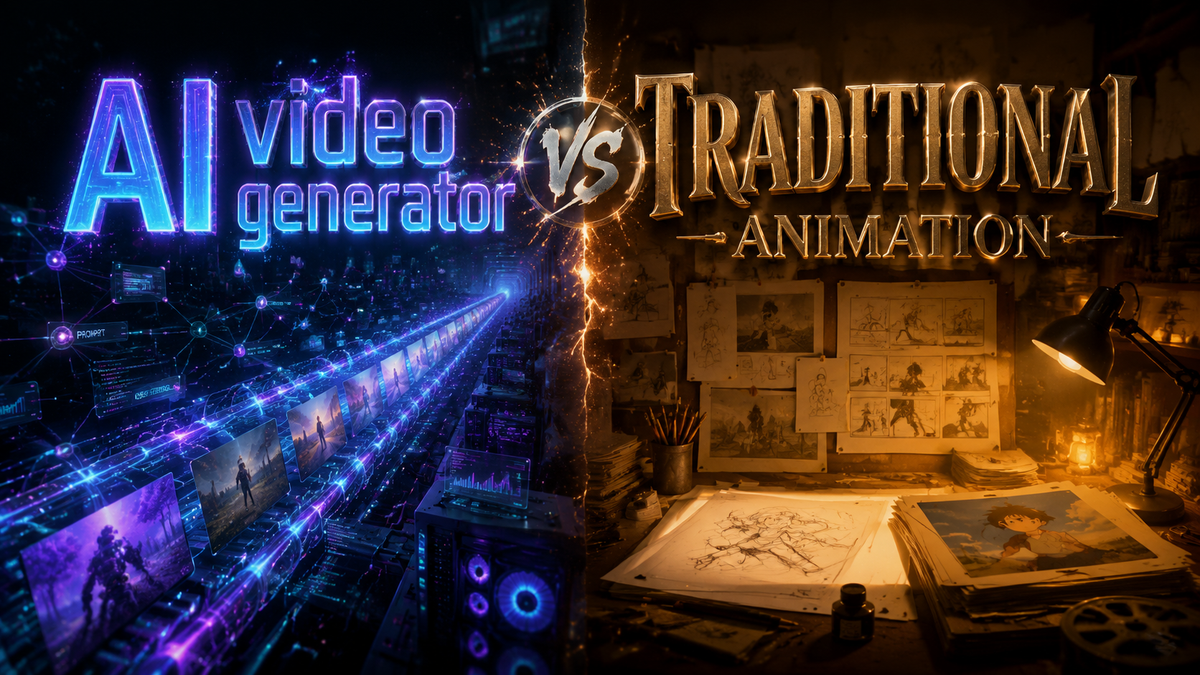
AI video generators and traditional animation serve the same ultimate purpose — creating moving visual content — but they achieve it through radically different processes. In 2026, the key difference is that AI video generators use machine learning models to transform text prompts, static images, or rough sketches into animated sequences in seconds or minutes, while traditional animation relies on frame-by-frame hand-drawing, rigged 2D puppets, or painstaking 3D modeling that can take weeks or months. The choice between them hinges on your priorities: speed and cost versus creative control and artistic authenticity.
AI video generator vs traditional animation in 2026 is a comparison of two fundamentally different production pipelines. AI tools generate motion from static inputs using neural networks trained on millions of video clips, producing results in real-time or near-real-time with minimal human intervention. Traditional animation, whether hand-drawn or digitally assisted, requires skilled artists to craft each frame, offering superior nuance and stylistic freedom but demanding far more time and budget.
- ✓ AI video generators cut production time from weeks to minutes, but traditional animation delivers unmatched artistic control.
- ✓ In 2026, AI tools like Agent Opus and Mango AI can turn static photos into dancing characters or full 2D cartoons.
- ✓ Traditional animation remains essential for high-stakes projects where brand identity, emotional depth, and unique style are paramount.
- ✓ The best approach often combines both: using AI for ideation and rough cuts, then refining with traditional techniques.
- ✓ Rising AI capabilities are lowering barriers for indie creators, while studios invest in hybrid workflows to preserve quality.
What Are AI Video Generators and Traditional Animation in 2026?
AI video generators are software platforms that leverage generative adversarial networks (GANs), diffusion models, and transformer architectures to produce video content from minimal input. According to a June 2026 report by Techloy, the latest generation of AI tools now excels at "image to video" conversion — turning a single static photo into a short, dynamic scene complete with natural motion, facial expressions, and even lip sync. Popular examples in 2026 include Agent Opus, which the Duke Digital Media Community highlighted in March 2026 for its ability to generate 2D animation directly from text and reference images, and Mango AI, which WebWire reported in January 2026 can add iconic dance moves to still photographs.
Traditional animation, by contrast, encompasses hand-drawn cel animation, cut-out puppetry, stop-motion, and computer-generated 3D animation that follows a manual or rigged workflow. Even in 2026, studios like Studio Ghibli and Pixar continue to rely on skilled animators who tweak every keyframe. The process involves storyboarding, character design, background painting, and compositing — often requiring dozens of specialists. While digital tools like Toon Boom Harmony and Blender speed up certain steps, the core human effort remains substantial.
The fundamental difference is autonomy: AI generators produce outputs with little human direction, whereas traditional animation is a craft where every movement reflects an artist's intent. This distinction drives all the practical trade-offs discussed below.
How AI Video Generators Work in 2026
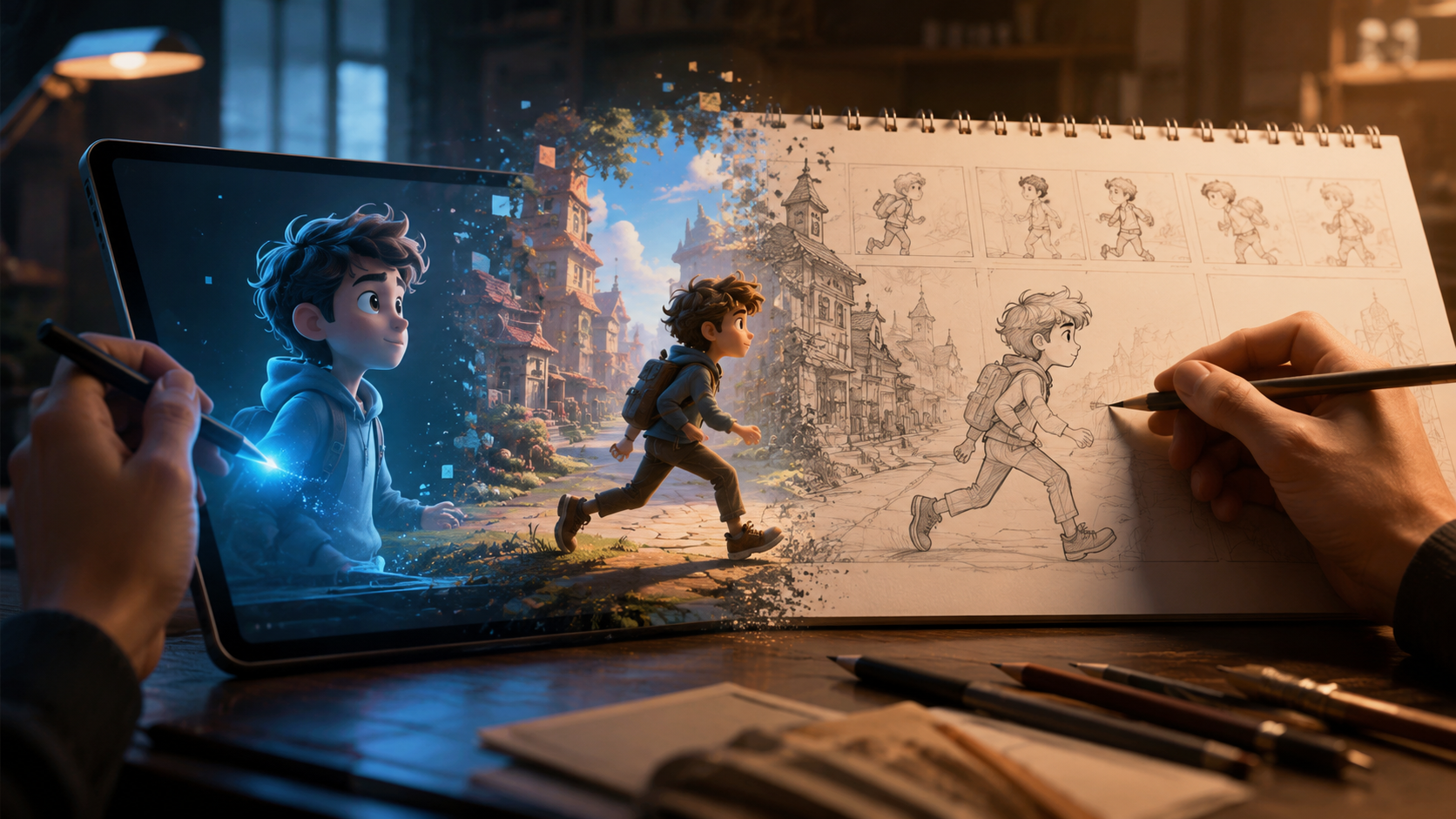
Modern AI video generators use a multi-stage pipeline. First, the user provides a prompt — text, an image, or a short video clip. The model then analyzes the semantic meaning and generates a sequence of frames that align with the input. According to Geek Vibes Nation's November 2025 tutorial, even novices can create full animated cartoons by describing scenes in plain English, with the AI handling character consistency, lighting, and motion physics. By 2026, these tools have matured to support longer outputs (up to 60 seconds in some cases), higher resolution (1080p or 4K), and coherent narratives across multiple shots.
Key Capabilities of AI Video Generators in 2026
According to Cybernews' Best AI Animation Generators 2026 in-depth review, the leading tools now offer real-time preview, style transfer (e.g., mimicking watercolor or cel-shaded aesthetics), and "talking photo" features that animate a still face with synchronized speech. PC Tech Magazine's May 2026 article spotlights free AI video generators that allow users to create professional-looking content without spending a dime, while Mango AI's dance generator demonstrates how a single image can be infused with choreographed movement. These capabilities have made AI video generation a go-to for social media content, explainer videos, and rapid prototyping.
Limitations Still Present
Despite rapid progress, AI-generated videos often suffer from artifacts: flickering textures, inconsistent character proportions across frames, and unnatural hand movements. In 2026, no AI tool can match the emotional subtleties a human animator can achieve — a raised eyebrow, a hesitant pause, a tear that lingers. The industry is actively working on these issues, but for now, AI excels at speed and volume, not nuance.
Traditional Animation Techniques Still in Use
Traditional animation in 2026 is far from obsolete. Studios and independent creators continue to employ hand-drawn animation for projects that demand a unique artistic voice. For example, the Duke Digital Media Community showcased Agent Opus as a 2D animation generation tool — but even that tool is often used as a starting point, with animators then refining results by hand. Traditional techniques include:
- Frame-by-frame hand drawing — each drawing is created separately, then photographed or scanned. This provides absolute control over every movement.
- Cut-out animation — using digital puppets with rigged joints, allowing for reuse of characters while still requiring manual keyframing.
- 3D computer animation — modeling, rigging, and animating in software like Maya or Blender, with manual adjustment of curves and physics.
- Stop-motion — physical objects are moved incrementally and photographed, a technique that remains beloved for its tactile quality.
The cost and time required are significant. A typical 30-second hand-drawn animated short can take a single artist several weeks, while a professional 3D animated scene may require a team of ten or more working for months. However, the result is often irreplaceable: a level of consistency, emotional resonance, and artistic integrity that AI struggles to replicate.
Key Differences at a Glance: AI Video Generator vs Traditional Animation
| Factor | AI Video Generator | Traditional Animation |
|---|---|---|
| Production speed | Minutes to hours for a short clip | Days to months depending on complexity |
| Cost | Low to free (many subscription plans under $30/month) | High — a single minute can cost $5,000–$50,000+ |
| Creative control | Limited to parameters and prompts; fine-tuning is difficult | Total — every frame can be adjusted by an artist |
| Output quality | Good for short clips, but artifacts and inconsistency remain | High — consistent, polished, and emotionally nuanced |
| Skill required | Minimal — typing prompts or uploading images | Extensive — years of training in drawing, animation principles, and software |
| Style variety | Limited to what the model has been trained on | Virtually unlimited — any aesthetic can be realized |
| Scalability | Easily scalable — produce hundreds of clips quickly | Hard to scale — each clip requires individualized effort |
When to Choose AI Video Generator vs Traditional Animation
The decision between AI video generator vs traditional animation depends on your project's goals, budget, and audience expectations. For social media marketing, product demos, and educational explainers, AI tools offer unmatched speed and low cost. A brand can generate a week's worth of TikTok videos in an afternoon using an AI talking photo tool, as highlighted by PC Tech Magazine in May 2026. Similarly, indie game developers use AI to quickly prototype cutscenes before commissioning full-fledged traditional animation.
On the other hand, feature films, high-end commercials, and projects where brand identity hinges on a specific artistic style still demand traditional animation. According to the Cybernews review, even the best AI animation generators in 2026 cannot reliably maintain character consistency across a 90-minute runtime or deliver the subtle performance nuances that award-winning animators achieve. Studios like Disney and Netflix continue to invest in traditional workflows for their flagship animated series.
Hybrid Workflows Are the Future
Many creators in 2026 are adopting hybrid approaches. They use AI video generators for rough storyboards, background generation, and initial motion tests, then hand those assets to animators who refine them. Duke's Agent Opus, for instance, generates 2D animation from text, which artists can then edit frame by frame. This combination reduces production time by 50–80% while preserving the human touch that audiences crave. As the technology continues to advance, expect the line between "AI video generator" and "traditional animation" to blur even further.
Future Trends in Animation for 2026 and Beyond
The animation industry is evolving rapidly. The Techloy article from June 2026 notes that image-to-video AI generators are now a standard feature in creative suites, enabling photographers to turn their portfolios into motion galleries. Mango AI's dance generator, covered by WebWire, hints at a future where AI can learn any style of movement from a single video clip. Meanwhile, Geek Vibes Nation's tutorial demonstrates that making cartoons is no longer the exclusive domain of trained artists — anyone with an idea can produce a short animated film in a few hours.
However, traditional animation will not disappear. As AI generates more content, the demand for human-crafted, high-quality animation may actually increase — because it becomes a marker of premium quality. Just as digital photography did not eliminate painting, AI animation will coexist with and complement traditional techniques. The key is to understand your audience and the message you want to convey.
Frequently Asked Questions About AI Video Generators vs Traditional Animation
What is the main advantage of using an AI video generator over traditional animation in 2026?
The primary advantage is speed and cost. AI video generators can produce a 30‑second animated clip in minutes without any drawing skills, whereas traditional animation would take days or weeks and require a trained artist. This makes AI ideal for rapid prototyping and low-budget projects.
Can AI video generators match the quality of hand-drawn animation?
Not yet. While AI has improved dramatically — some tools now generate 2D cartoons that look passable at first glance — inconsistencies in character design, lip sync, and motion physics remain. Traditional animations maintain a higher level of polish and emotional nuance that AI cannot replicate in 2026.
Which AI video generator is best for creating cartoons?
Based on the research available, Agent Opus (highlighted by Duke Digital Media Community) and Mango AI (covered by WebWire) are leading tools. For a full tutorial, Geek Vibes Nation’s November 2025 guide walks through the process using a popular AI video generator. Always check for the latest updates, as the field moves quickly.
Is traditional animation still relevant in 2026?
Absolutely. Traditional animation remains the gold standard for feature films, high-end commercials, and projects where artistic identity and consistency are critical. Many studios use AI to assist with preproduction but rely on skilled animators for final output. The demand for human-crafted animation is stable, and in some niches, growing.
How can I combine AI video generators with traditional animation?
A common hybrid workflow is to use an AI generator to create rough drafts, background art, or initial character motions. Then, import those assets into animation software (like Toon Boom or Blender) to refine frames, fix inconsistencies, and add manual expressions. This reduces overall production time while maintaining artistic control.
What are the biggest limitations of AI video generators in 2026?
The main issues are lack of consistency across longer sequences, difficulty with complex character interactions, and the inability to produce truly original art styles without extensive custom training. AI also struggles with subtle emotional expressions and physical realism in detailed scenes.



Comments ()