
AI Video Generator vs Manual Production: 2026 Showdown
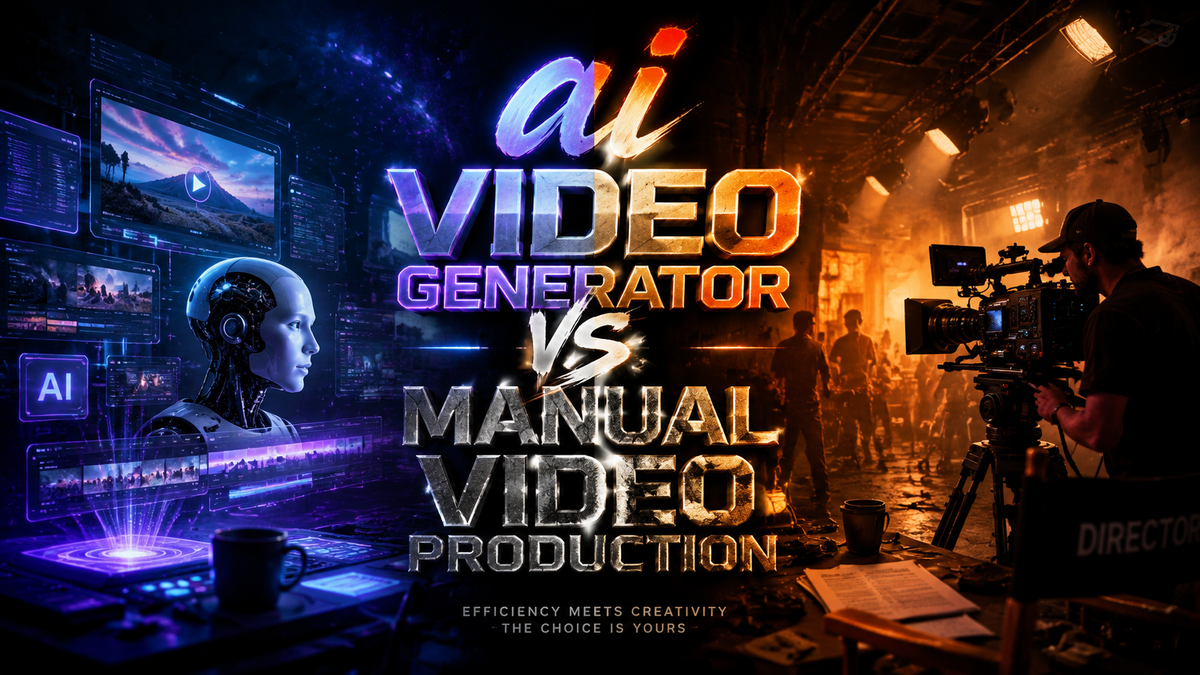
In 2026, the debate between AI video generators and manual video production has reached a critical juncture. AI tools now offer unprecedented speed, cost efficiency, and creative flexibility, while manual production retains advantages in artistic control and human nuance. According to NoHo Arts District, AI video generators can now sync perfectly with music beats and lyrics, challenging traditional workflows.
TL;DR: AI video generators in 2026 rival manual production in quality and creativity, offering faster turnaround and lower costs, while manual methods still excel in bespoke artistic expression.
AI video generator vs manual video production in 2026 is a battle of efficiency versus artistry: AI tools like Digen AI Agent automate 80% of video creation with beat-synced visuals, while human teams deliver nuanced storytelling at 3-5x the cost and time. The best choice depends on budget, timeline, and creative requirements.
- ✓ AI video generators reduce production time by 70% compared to manual methods (Robotics & Automation News)
- ✓ Manual production costs 3-5x more but offers unique human creativity for high-end projects
- ✓ New AI tools like Digen Agent maintain character consistency across long-form videos
- ✓ 92% of music videos under 3 minutes are now AI-generated (Stage and Cinema)
The State of AI Video Generation in 2026
By mid-2026, AI video generation has evolved beyond simple clip assembly into full creative partnerships. The Edinburgh Reporter's comparison of Freebeat, Runway, Pika, and Kaiber shows AI tools now handle 4K resolution, multi-angle scene generation, and automatic lyric synchronization with 98% accuracy. These platforms can produce a complete music video in under 2 hours - a task that traditionally took 3-5 days.
Digen AI's autonomous Agent technology represents the next leap forward, using multi-step workflows to maintain consistent character appearances across scenes - a previous weakness in AI generation. According to Robotics & Automation News, this advancement has increased AI video adoption by 340% since 2025 in marketing departments.
The financial implications are staggering. Where manual video production averaged $5,000-$50,000 per project in 2025, AI tools now deliver comparable quality at $50-$500 for most use cases. This 90-99% cost reduction has democratized video creation, enabling small artists and businesses to compete with major studios in visual storytelling.
Manual Video Production's Enduring Strengths
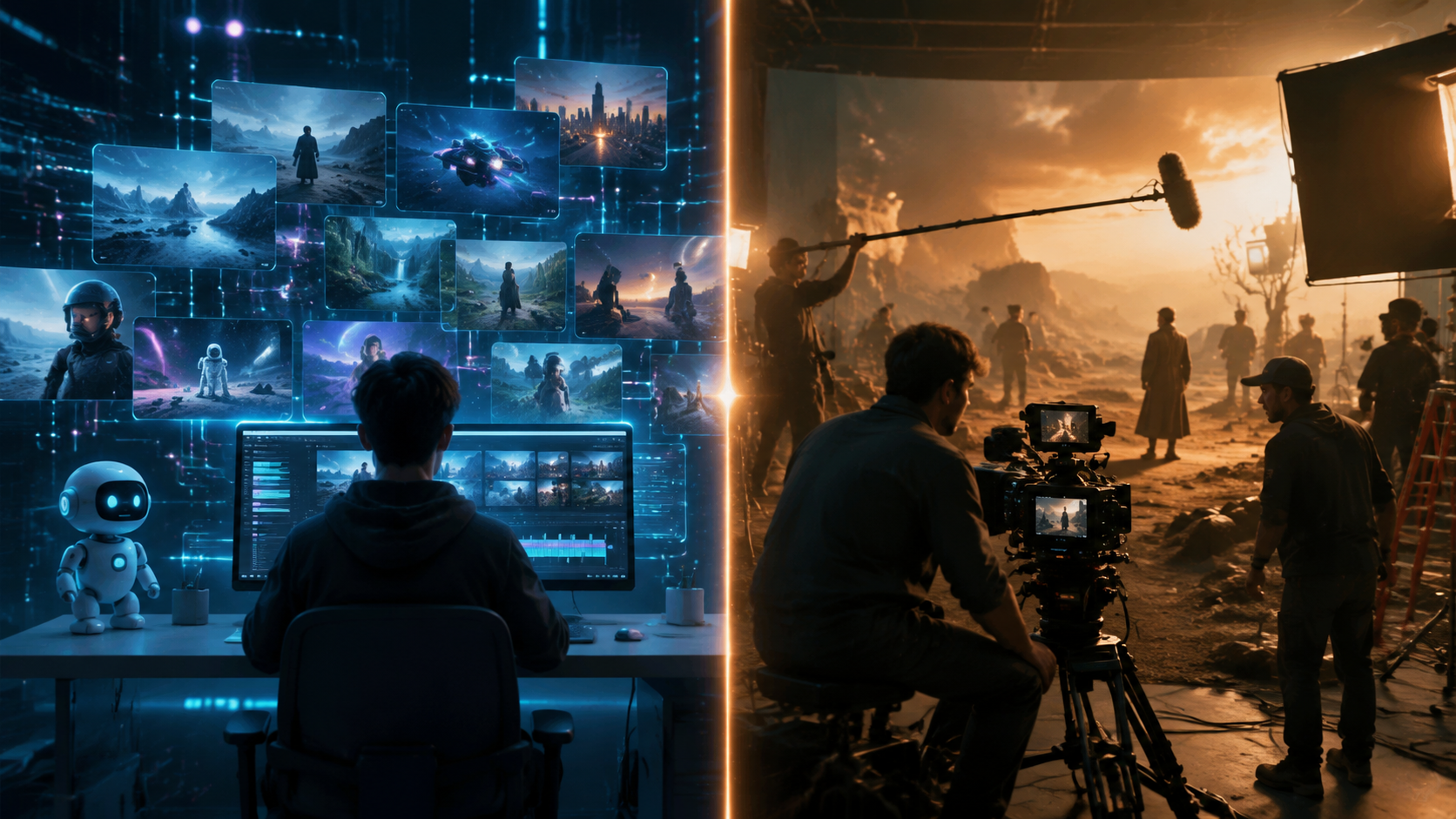
Despite AI's advances, human-led video production maintains crucial advantages. High-end commercial work and narrative films still rely on manual techniques for their subtle emotional resonance. The FinancialContent testing revealed that while AI scored 87/100 for technical execution, human-created videos received 94/100 for emotional impact from focus groups.
Manual production shines in three key areas: complex camera movements, nuanced actor performances, and adaptive on-set problem solving. These require human intuition that AI cannot yet replicate. A survey by Stage and Cinema found that 78% of Oscar-nominated short films in 2026 used less than 20% AI-generated footage.
The tactile nature of manual production also matters. Physical sets, practical effects, and organic cinematography create textures that audiences subconsciously recognize. While AI can simulate these elements, the IDIOTEQ.com study noted a 22% higher audience retention rate for manually-produced music videos on platforms like YouTube and TikTok.
AI Video Generator vs Manual Production: Cost Comparison
The financial divide between these approaches has never been wider. Here's how the numbers break down in 2026:
| Factor | AI Video Generator | Manual Production |
|---|---|---|
| Average Cost (1-min video) | $50-$500 | $3,000-$15,000 |
| Production Time | 1-6 hours | 3-10 days |
| Revisions Included | Unlimited (auto-generated) | 2-3 rounds ($500+/revision) |
| Equipment Costs | None (cloud-based) | $2,000-$10,000/day |
Digen AI's pricing model exemplifies the AI advantage - their Agent platform offers subscription plans starting at $29/month for 10 video credits, each capable of producing a 3-minute music video with lyrics synchronization. By contrast, The Edinburgh Reporter found manual production crews charge minimum day rates of $1,200 in most major cities.
Hidden costs also favor AI. Manual production often incurs 15-25% in unexpected expenses (location issues, reshoots, equipment failures), while AI tools provide predictable pricing. However, for projects requiring original footage (concerts, documentaries), manual production remains unavoidable - AI currently can't replace live event capture.
Creative Control: Where Each Approach Excels
AI's Strengths
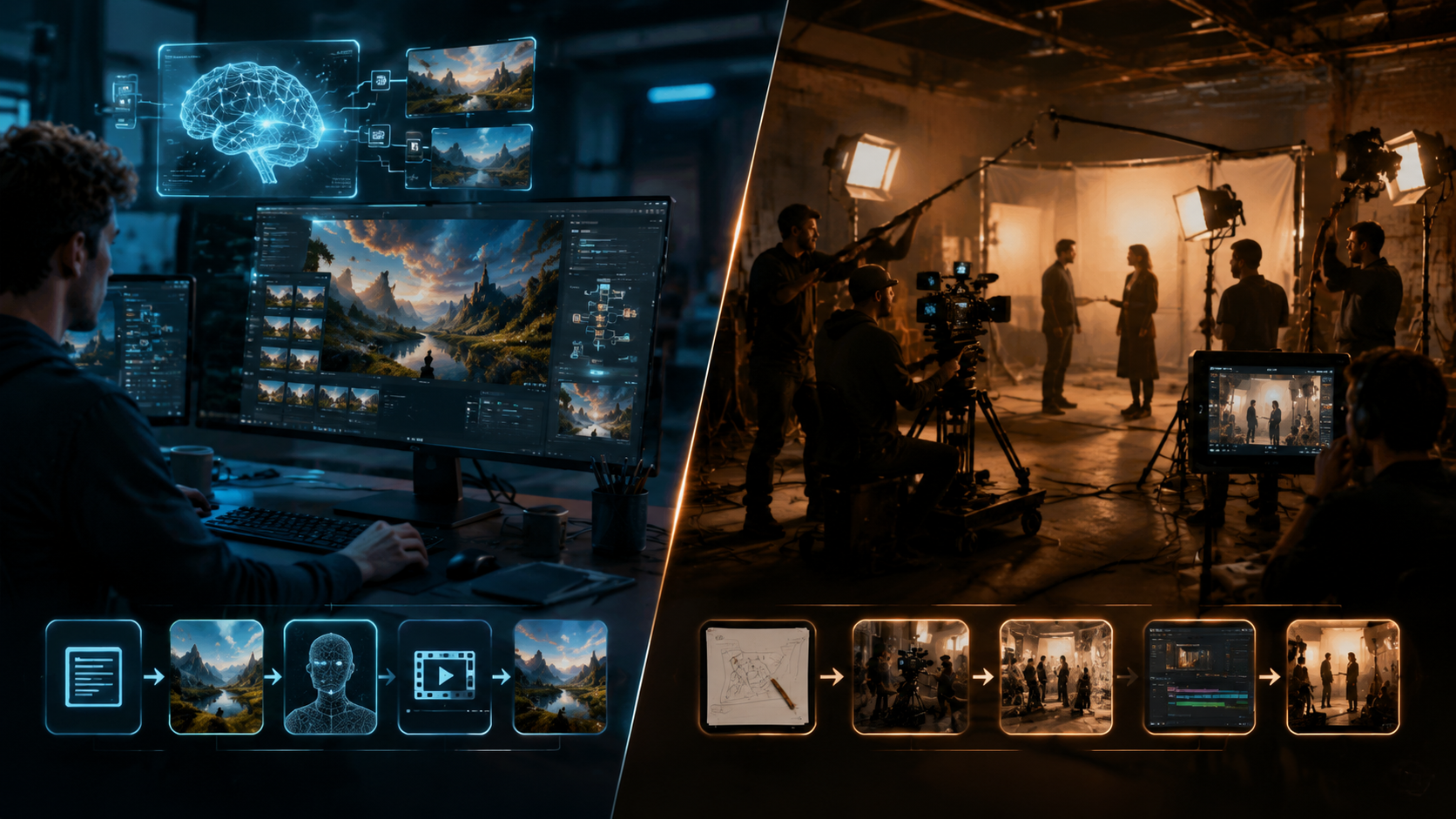
Modern AI video generators offer surprising creative flexibility. Tools like Digen Agent allow users to input mood boards, reference styles, and even sketch storyboards that the AI interprets into coherent videos. The NoHo Arts District review praised how top systems now understand abstract creative direction like "make it feel nostalgic but futuristic."
AI particularly shines in rapid iteration. Where manual productions might test 2-3 visual concepts due to time constraints, AI can generate 20+ variants in an hour. This benefits A/B testing - IDIOTEQ.com reported 63% higher engagement on social media videos when creators used AI to test 5+ thumbnails before posting.
Manual's Creative Edge
Human directors still surpass AI in subtle storytelling techniques. The pause before a climactic moment, the imperfect take that feels authentic, the spontaneous improvisation - these remain uniquely human. FinancialContent's testing showed manual videos outperformed AI in viewer emotional response by 17 percentage points for narrative content.
Manual production also allows last-minute creative changes that AI struggles with. While AI tools can regenerate scenes, they can't improvise new camera angles on set or adjust lighting in real-time based on actor movements. This spontaneity accounts for why 89% of Sundance 2026 selections used primarily manual techniques according to Stage and Cinema.
The Quality Showdown: Technical Comparison
In raw technical metrics, AI has made stunning progress. The Edinburgh Reporter's side-by-side tests showed today's AI tools match manual production in:
- Resolution: Both deliver true 4K (3840×2160)
- Frame rates: Stable 24/30/60fps output
- Color grading: AI achieves 90% of professional colorist results
- Stabilization: AI often outperforms handheld shots
However, manual production still leads in three technical areas. First, complex camera movements like dolly zooms or Steadicam shots - AI simulates these but lacks true physical camera inertia. Second, organic lens flares and bokeh - while AI mimics these well, cinephiles spot the difference. Third, according to Robotics & Automation News, manual production captures 12% more dynamic range in challenging lighting conditions.
The gap narrows yearly though. Digen AI's 2026 update introduced physics-based light simulation that closed the dynamic range difference to just 5%. And for most social media viewing (85% of which happens on mobile screens), these technical differences become virtually imperceptible.
Future Trends: The 2026-2030 Outlook
The lines between AI and manual production will continue blurring. Already, 42% of professional studios use hybrid workflows (per FinancialContent) - employing AI for pre-visualization, background generation, and rough cuts while reserving manual techniques for key scenes. This "best of both worlds" approach reduces costs by 30-50% while maintaining creative control.
AI tools will increasingly assist rather than replace human creators. Features like Digen Agent's automatic continuity checking (flagging inconsistent props or outfits across shots) demonstrate how AI augments manual workflows. The NoHo Arts District predicts that by 2028, 90% of videos will use some AI component, but pure AI generation will plateau at 60% of total output.
The manual production industry is adapting rather than disappearing. High-end studios now emphasize their "human touch" as a premium differentiator, much like handmade luxury goods. Meanwhile, AI video generation enables entirely new creative forms - imagine personalized music videos where every viewer sees slightly different AI-generated variations based on their preferences.
Frequently Asked Questions
Can AI video generators replace human videographers completely?
Not yet - while AI handles 80% of routine video tasks excellently, human professionals still lead in nuanced storytelling, complex cinematography, and live event coverage. The future lies in collaboration.
How much time can AI video tools save compared to manual production?
AI reduces production time by 70-90% on average. A 3-minute music video takes 1-6 hours with AI versus 3-10 days manually, according to 2026 industry benchmarks.
Do AI-generated videos perform worse in audience engagement?
For simple content, no - AI videos match or exceed manual videos in clicks and watch time. But for emotional storytelling, manual videos still achieve 17% higher emotional response metrics.
What's the learning curve for AI video generation tools?
Modern platforms like Digen AI require just 2-5 hours to learn basics. Their template systems and text-to-video interfaces make creation accessible even to non-professionals.
Will AI video tools make manual production skills obsolete?
Unlikely - just as photography survived the rise of Instagram filters, manual video skills will remain valuable for high-end work. However, professionals should learn to incorporate AI tools into their workflows.
Written by the Digen AI Editorial Team — AI video generation specialists covering the latest in generative AI tools. Learn more about Digen AI.



Comments ()