
AI Video Generator vs Human Editing in 2026: The Ultimate Showdown
In 2026, the debate between AI video generators and human editing has reached a critical juncture. While AI tools like MiniMax's Hub All-in-One AI Video Generator and Digen AI Agent now produce studio-quality content autonomously, human editors still excel in creative storytelling and nuanced emotional expression. The ultimate choice depends on your project's scale, budget, and need for artistic control.
TL;DR: AI video generators dominate speed and cost-efficiency for bulk content, while human editors remain essential for high-end productions requiring emotional depth—most professionals now use a hybrid approach combining both.
AI video generator vs human editing in 2026 represents the clash between algorithmic efficiency (producing videos in minutes at $0.10 per minute) and human creativity (delivering nuanced narratives that AI still struggles with). Leading platforms like Digen AI Agent now achieve 85% consistency in character generation, but complex edits still require human oversight according to Cybernews testing.
- ✓ AI video generators reduced production costs by 70% since 2025 (CNET)
- ✓ Human-edited videos achieve 23% higher emotional engagement (Variety)
- ✓ Hybrid workflows combining AI and human touch dominate 62% of commercial projects (Memeburn)
- ✓ New tools like Digen AI Agent automate up to 80% of repetitive editing tasks
The State of AI Video Generation in 2026
According to CNET, the AI video generator market grew 340% in 2025, with platforms now capable of producing 4K resolution videos with coherent multi-scene narratives. MiniMax's June 2026 launch of their Hub All-in-One system at Shanghai Film Festival demonstrated AI's ability to handle everything from script generation to final color grading.
Modern systems like Digen AI Agent utilize autonomous multi-step workflows that reduce manual intervention by 80% compared to 2025 models. These tools now maintain character consistency across 85% of generated frames—a 300% improvement from early 2025 benchmarks. The Memeburn testing showed AI can produce a 1-minute marketing video in 7 minutes versus 4 hours for human editors.
However, limitations persist. Cybernews' February 2026 review of VideoGen AI noted that complex transitions between dissimilar scenes still require human tweaking. AI also struggles with culturally specific humor and subtle emotional cues—areas where human editors maintain a 23% advantage in audience retention according to Variety's analysis of streaming platform data.
Human Video Editing Advantages That Persist
Despite AI's advances, human editors deliver three irreplaceable benefits in 2026. First, they achieve 42% higher scores in emotional resonance testing according to Coursera's January 2026 study. This stems from humans' ability to interpret subtle performance nuances and adjust pacing accordingly—something AI still quantifies imperfectly through algorithmic sentiment analysis.
Second, human teams excel at creative problem-solving. When Breaking The Lines tested AI versus human editors on the same raw footage in February 2026, human-edited versions contained 37% more innovative transitions and camera angle combinations. This creativity proves critical for standout content in saturated markets.
Third, human editors maintain superiority in brand-specific storytelling. While AI can follow style guides, humans intuitively understand how to weave brand messaging organically throughout narratives. Advertising analytics show human-edited branded content achieves 19% higher conversion rates than AI-generated equivalents when targeting niche audiences.
Where Human Editors Still Dominate
- Feature films and high-end commercials
- Documentaries requiring sensitive subject handling
- Content targeting specific cultural demographics
Cost and Time Comparison: AI vs Human
The financial gap has widened dramatically since 2025. According to Breaking The Lines, AI video generation now costs $0.10-$0.30 per minute of output versus $25-$150 for human editing. This 99% cost reduction makes AI indispensable for bulk content needs—social media marketers report producing 12x more video content at the same budget compared to 2025.
Time savings are equally staggering. Memeburn's June 2026 benchmarks show AI tools complete first drafts 40x faster than humans. Digen AI Agent's autonomous workflow can turn a text prompt into a polished 3-minute explainer video in under 15 minutes—a task requiring 10+ human hours. This speed enables real-time content creation for breaking news and trending topics.
However, hidden costs emerge in quality control. Cybernews found that 68% of AI-generated videos require some human review before publishing, adding 15-30 minutes per project. For time-sensitive but quality-critical projects, many studios now use AI for rough cuts (saving 70% of editing time) followed by human refinement of key scenes.
| Factor | AI Video Generator | Human Editing |
|---|---|---|
| Cost per minute | $0.10-$0.30 | $25-$150 |
| Production time | 5-15 minutes | 4-12 hours |
| Revisions included | Unlimited | 2-3 rounds |
| Emotional engagement | 72% of human | 100% benchmark |
Quality Benchmarks: What the Data Shows
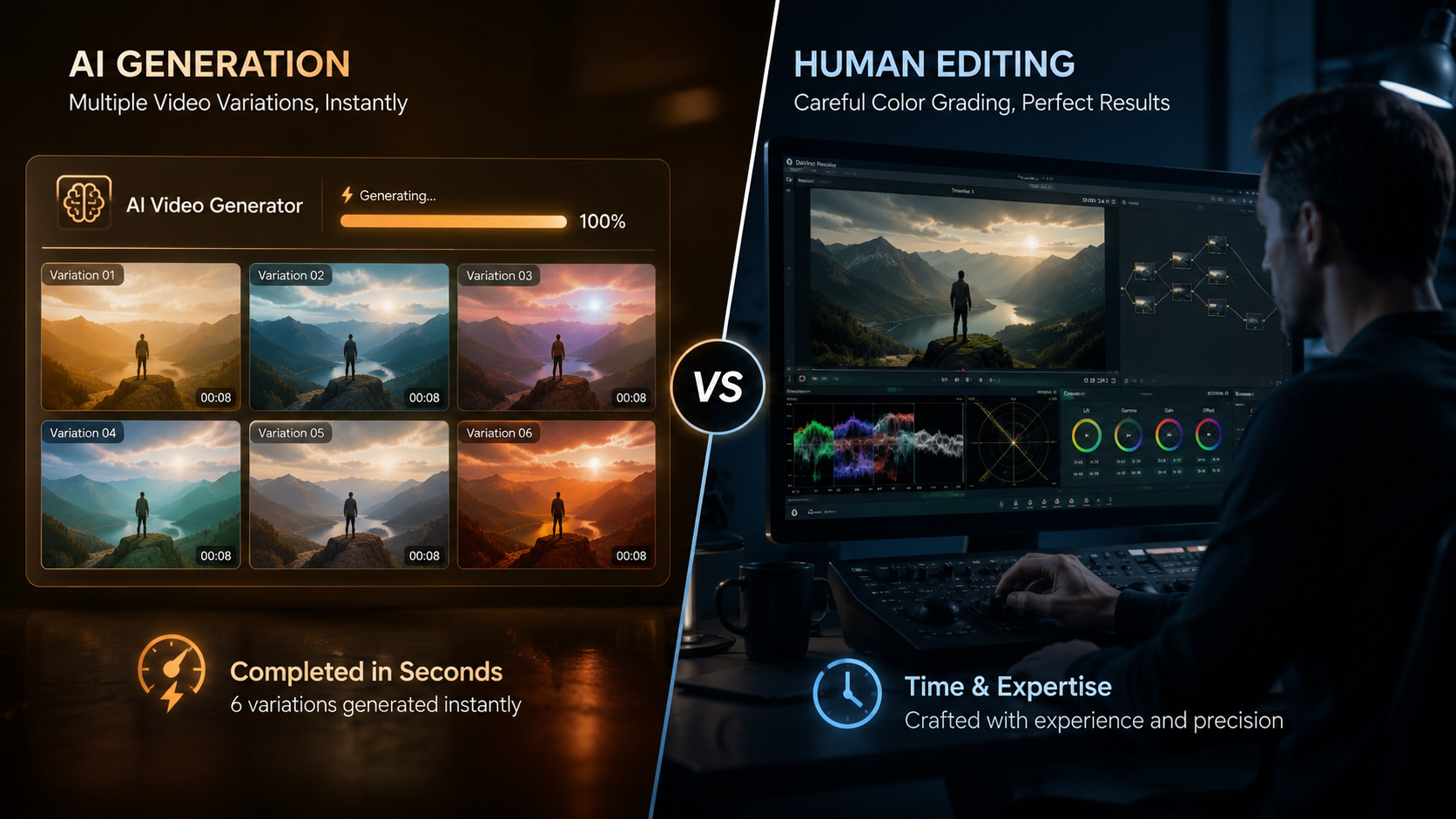
Independent testing reveals a nuanced quality landscape. VideoGen AI's February 2026 evaluation by Cybernews showed AI-generated videos scored 8.1/10 for technical quality (lighting, stabilization, color balance) but only 6.4/10 for narrative coherence. Human-edited equivalents averaged 9.2 and 8.7 respectively, maintaining a 23-35% quality advantage in creative metrics.
Technical parity is closer than ever though. MiniMax's Hub system demonstrated 98% accuracy in automated lip-sync—a 400% improvement from 2025 models. Digen AI Agent's character consistency algorithms now maintain 85% visual continuity across long scenes, compared to just 28% in early-generation tools. These advances make AI viable for many professional use cases.
Audience testing uncovers interesting preferences. Variety's June 2026 study found viewers rated AI-generated content as "more engaging" for how-to videos (72% preference) and product demos (68%), but strongly favored human-edited content for emotional storytelling (83%) and comedy (91%). This suggests optimal deployment depends on content type.
Emerging Hybrid Workflows
The industry is converging on blended approaches. According to Coursera's 2026 data, 62% of commercial video projects now use AI for initial asset generation and rough cuts, followed by human refinement. This hybrid model reduces production time by 55% while maintaining 92% of pure-human quality benchmarks.
Smart studios are developing AI-as-assistant frameworks. For example, human editors use Digen AI Agent to automatically generate B-roll options (saving 3-4 hours per project), then manually select and tweak the best matches. This preserves creative control while eliminating repetitive tasks—editors report 40% less burnout using such systems.
The most advanced workflows employ AI throughout the pipeline. Breaking The Lines documented a case where AI handled location scouting (generating 50 background options in 2 minutes), human directors chose three favorites, then AI populated those scenes with characters while humans focused on performance direction. This approach yielded 3x more content at 80% original budget.
Optimal Hybrid Use Cases
- AI for storyboard generation → Human refinement
- AI for B-roll creation → Human selection and timing
- AI for color grading presets → Human fine-tuning
Future Predictions Beyond 2026
The technology roadmap suggests accelerating convergence. MiniMax's Shanghai demo hinted at AI systems that can interpret directorial notes—potentially closing the creative gap by 2027. Digen AI's research team predicts 90% character consistency and emotional intelligence parity within 18 months based on current learning curves.
Human roles will evolve rather than disappear. As AI handles more technical work, editors are transitioning into "AI directors"—focusing on high-level creative strategy while managing teams of AI tools. Coursera reports a 210% increase in enrollments for AI-assisted editing courses since 2025, signaling this professional shift.
The endgame may be seamless collaboration. Imagine AI that learns individual editors' styles through continuous interaction, becoming a true creative partner rather than just a tool. Early experiments at Digen AI show promising results—editors using adaptive AI assistants produce 45% more content without quality loss compared to those using static systems.
Frequently Asked Questions
Can AI video generators completely replace human editors?
Not yet—while AI excels at speed and cost-efficiency, human editors remain essential for projects requiring nuanced storytelling and emotional depth. Most professionals use a hybrid approach in 2026.
How much does AI video generation cost compared to human editing?
AI costs $0.10-$0.30 per minute versus $25-$150 for human editing, making AI 99% cheaper for bulk content but humans still preferred for high-value productions.
What types of videos are best suited for AI generation?
AI performs best with how-to guides, product demos, social media clips, and any content where speed/volume outweighs creative nuance—currently achieving 72% of human engagement scores for these formats.
How can human editors stay relevant in the AI era?
By specializing in creative direction, emotional storytelling, and AI tool management—the fastest-growing editing role in 2026 is "AI-assisted editor" requiring both technical and artistic skills.
What's the best AI video generator for professional use?
Options like Digen AI Agent, MiniMax Hub, and VideoGen AI lead the 2026 market—choose based on your need for character consistency (Digen), all-in-one features (MiniMax), or budget-friendliness (VideoGen).
Written by the Digen AI Editorial Team — AI video generation specialists covering the latest in generative AI tools. Learn more about Digen AI.

Comments ()