
AI Video Generator vs Editing: 2026 Ultimate Guide
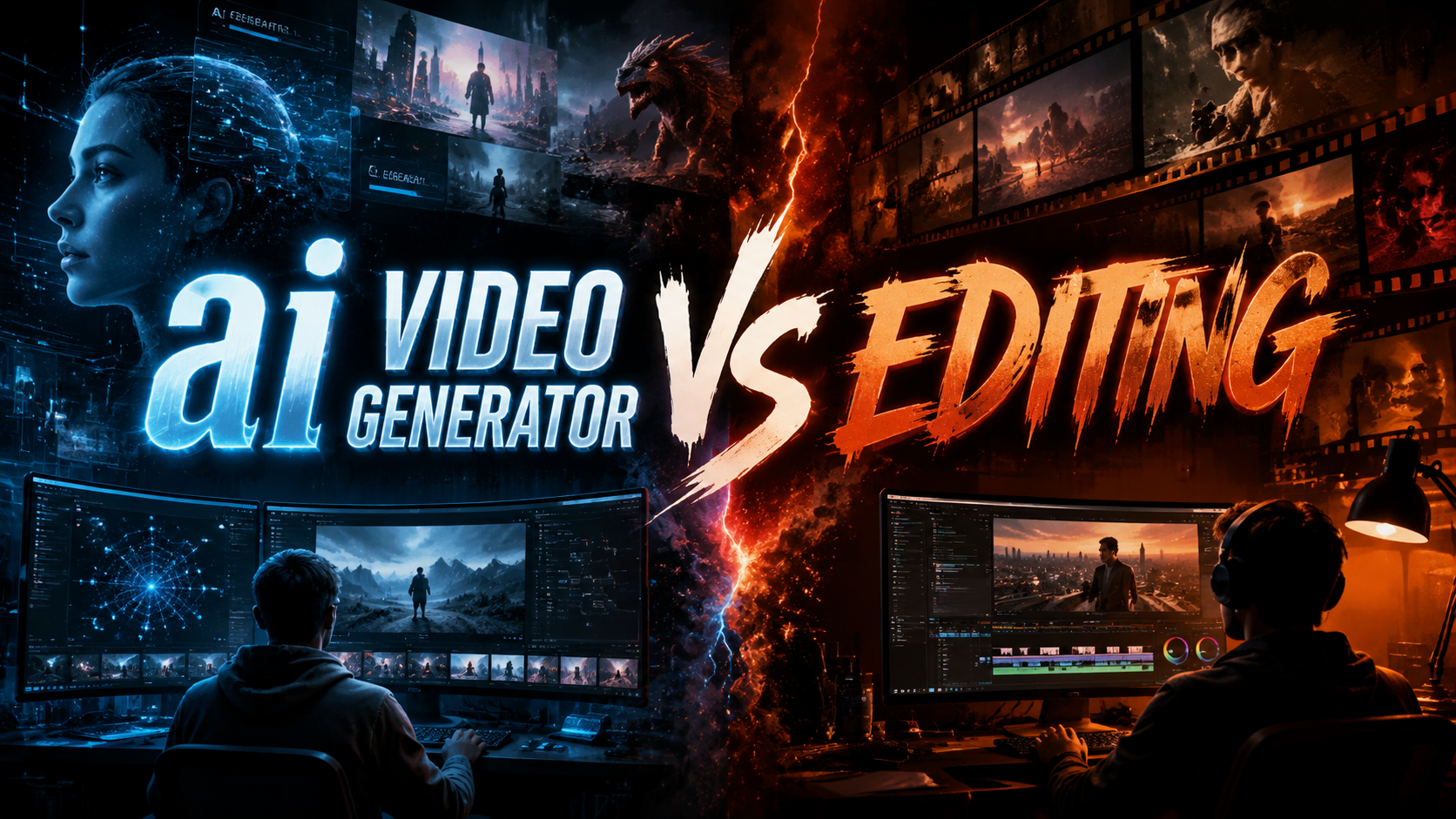
Choosing between an AI video generator vs editing workflow in 2026 isn't about picking a winner — it's about understanding two fundamentally different approaches to video creation, each with distinct strengths that serve different content goals, budgets, and skill levels.
TL;DR: AI video generators let you create footage from text prompts in minutes with zero editing skills, while traditional editing gives you full creative control over existing footage. The best strategy in 2026 combines both: use AI generators for ideation, rough cuts, and B-roll, then refine with editing tools for polish and precision.
An AI video generator vs editing comparison comes down to speed versus control. AI generators like the top-ranked tools from CNET's 2026 review produce complete video clips from text or audio inputs in under 60 seconds, while editing software requires existing footage but offers frame-level precision, complex effects, and multi-layer timelines. The right choice depends on whether your priority is rapid content production or cinematic craftsmanship.
- ✓ AI video generators in 2026 can produce 4K clips from text prompts with coherent motion and scene composition, eliminating the need for stock footage libraries.
- ✓ Traditional editing remains essential for brand-specific overlays, precise timing, multi-source compositing, and color grading that AI models still struggle to replicate consistently.
- ✓ The most successful content creators in 2026 use a hybrid workflow — generating base footage with AI tools and refining it with professional editing suites.
- ✓ Free AI video generators ranked by Ventureburn in May 2026 now offer commercial-grade output for marketing teams on limited budgets.
- ✓ Audio-to-video AI generators, highlighted by Robotics & Automation News, are transforming how podcasters and educators repurpose audio content into engaging visual formats.
AI Video Generator vs Editing: What's the Real Difference?
The fundamental distinction between an AI video generator vs editing workflow lies in how the raw video material is created. An AI video generator synthesizes entirely new footage from text prompts, audio files, or reference images — it creates something from nothing. Traditional editing, by contrast, rearranges, enhances, and composes existing footage into a coherent narrative. In 2026, this difference has become even more pronounced as AI generators have matured from producing abstract, glitchy clips to generating photorealistic scenes with consistent characters and logical motion.
According to CNET, the best AI video generators of 2026 have been "reviewed and ranked" based on criteria including output quality, generation speed, prompt adherence, and commercial licensing. Their testing revealed that top-tier generators can now handle complex prompts involving multiple subjects, camera movements, and lighting conditions — tasks that would have required a full production crew just two years ago. However, CNET also noted that even the best AI generators still occasionally produce artifacts or inconsistent physics, making human oversight necessary for professional-grade output.
Traditional editing, on the other hand, gives you absolute control over every frame. Tools like Premiere Pro, DaVinci Resolve, and Final Cut Pro allow editors to manipulate color, audio, transitions, and effects with surgical precision. When you're comparing ai video generator vs editing for a project, remember that editing workflows also require significant time investment — a 60-second commercial can take an experienced editor 4-8 hours to complete, whereas an AI generator can produce a usable first draft in under a minute. The trade-off is quality control versus speed, and in 2026, most professionals are choosing both.
When to Use an AI Video Generator Instead of Editing
AI video generators shine brightest in scenarios where speed, volume, and iteration are more important than pixel-perfect precision. Social media teams, for example, often need to produce dozens of short-form videos per week for platforms like TikTok, Instagram Reels, and YouTube Shorts. In these cases, an AI video generator can take a blog post or script and transform it into engaging visual content in minutes. The Cybernews report on the rise of AI video generators in 2026 notes that text-to-video technology is "changing content creation" by enabling non-technical marketers to produce video content without hiring editors or videographers.
Another compelling use case is rapid prototyping and ideation. When you need to visualize a concept before committing to a full production, AI generators let you experiment with different visual styles, camera angles, and narrative approaches in real time. This is particularly valuable in advertising and creative agencies, where clients often want to see multiple concepts before choosing a direction. Instead of storyboarding by hand or shooting test footage, creators can generate several variations of a scene in minutes, compare them side by side, and refine their vision before moving to production.
Audio-to-video generators represent a particularly exciting development in 2026. As Robotics & Automation News reported, the five best audio-to-video AI generators are now "modern content workflows" that allow podcasters, audiobook creators, and educators to convert audio content into visually engaging videos automatically. This eliminates the need to find or create matching footage for every spoken segment — the AI analyzes the audio's tone, pacing, and key themes to generate appropriate visuals. For content creators with large audio libraries, this is a game-changer that makes traditional editing seem impossibly slow by comparison.
Top AI Video Generators of 2026 According to Independent Testing
The Ventureburn ranking of the ten best free AI video generators in 2026 provides a useful starting point for creators who want to experiment without financial commitment. Their review highlighted that free tiers now offer watermark-free exports at 720p resolution for most tools, with paid upgrades unlocking 4K output, longer clips, and commercial licensing. This democratization of video production means that even solopreneurs and small businesses can access technology that was previously reserved for large production houses.
For creators willing to invest in premium tools, the Memeburn report from June 2026 tested and compared AI video generator tools "for every use case," ranking them based on performance across different content types including marketing videos, educational content, social media clips, and cinematic storytelling. Their findings showed that no single tool dominated every category — some excelled at realistic human faces while others produced better landscape shots or animated sequences. This underscores an important point in the ai video generator vs editing debate: the best tool depends on your specific output requirements.
It's also worth noting that PCMag's investigation into NSFW AI video generators, published in May 2026, highlights a growing niche within the AI generation space. While not suitable for mainstream content, this report indicates that AI video generation technology has advanced enough to handle sensitive and specialized content categories, with the four best tools in that category passing PCMag's rigorous testing for safety, quality, and consistency. This level of specialization wouldn't be possible with traditional editing alone — it requires the generative capabilities that only AI can provide.
AI Video Generator vs Editing: A Side-by-Side Comparison
To help you decide which approach fits your next project, the table below compares the key features of AI video generation and traditional editing across the dimensions that matter most to content creators in 2026.
| Feature | AI Video Generator | Traditional Video Editing |
|---|---|---|
| Content Source | Text prompts, audio files, reference images | Existing footage, stock media, screen recordings |
| Time to First Draft (60-sec clip) | 30–90 seconds | 4–8 hours (for assembled edit) |
| Learning Curve | Low — prompt-based interface | High — timeline, layers, keyframes |
| Creative Control | Moderate — guided by prompt engineering | Complete — frame-level precision |
| Cost (Entry Level) | Free to $30/month | $20–$60/month (subscription) |
| Output Resolution | Up to 4K (paid tiers) | Up to 8K (hardware dependent) |
| Best For | Social media, rapid prototyping, audio repurposing | Cinematic projects, brand content, multi-source edits |
| Artifact Risk | Occasional — requires human review | Minimal — direct control over every element |
The comparison table above makes it clear that neither approach is universally superior. AI generators win on speed, accessibility, and the ability to create footage from nothing — which is revolutionary for solo creators and small teams. Traditional editing wins on control, polish, and the ability to handle complex multi-source projects. The key insight for 2026 is that both toolsets are becoming complementary rather than competitive, and the most effective workflows borrow from both worlds.
The Hybrid Workflow: Combining AI Generation with Traditional Editing
The most forward-thinking content creators in 2026 aren't asking whether to use an ai video generator vs editing — they're asking how to combine both for maximum efficiency and quality. A typical hybrid workflow might begin with an AI generator producing a rough cut based on a script or outline. This rough cut establishes the pacing, shot composition, and visual flow of the video. The editor then imports this generated footage into a traditional editing suite to add brand elements, refine transitions, adjust color grading, insert captions, and layer in music or voiceover.
This hybrid approach offers several concrete advantages. First, it dramatically reduces the time spent on initial assembly — the AI handles what would be hours of manual shot selection and arrangement. Second, it allows editors to focus their energy on the parts of the process that genuinely require human judgment: emotional pacing, brand consistency, and creative problem-solving. Third, it enables rapid iteration: if a client requests a different visual style or narrative approach, the AI can regenerate the entire rough cut in minutes rather than requiring the editor to manually rebuild the timeline.
Several of the AI tools ranked by Memeburn in June 2026 now include direct export integrations with major editing platforms, making this hybrid workflow seamless. You can generate clips in the AI tool and immediately open them in your editing software with proper file formatting and metadata. This interoperability is a significant step forward from earlier generations of AI video tools, which often produced files that required extensive reformatting before they could be used in professional editing workflows. The result is a smoother pipeline that lets creators move fluidly between generative and editorial processes.
Practical Steps for a Hybrid Workflow
To implement a hybrid workflow effectively, start by using an AI generator for your initial shot list. Write detailed prompts for each scene you need, specifying camera angle, lighting, subject positioning, and desired mood. Generate multiple variations of each shot and select the best takes — this is analogous to how a director would review footage from a traditional shoot. Once you have a library of AI-generated clips, import them into your editing software and treat them as you would any other footage: trim, arrange, add transitions, and layer in graphics or effects.
The second step is to use AI as a B-roll generator. One of the most time-consuming aspects of traditional editing is sourcing or shooting supplementary footage to cover cuts, illustrate concepts, or maintain visual interest. In 2026, AI generators can create custom B-roll on demand from descriptive prompts. Instead of searching through stock footage libraries for the perfect clip of "a person typing on a laptop in a modern office," you can generate exactly that shot in seconds, perfectly matched to your video's color palette and composition.
Finally, use AI for end-card and transition generation. Many AI video generators now offer features specifically designed for creating intro sequences, transition animations, and end cards that match your video's visual style. This saves editors from having to build these elements from scratch in motion graphics software. Combined with the editing precision of traditional tools, this hybrid approach delivers the best of both worlds: the speed and creativity of AI generation with the control and polish of professional editing.
Cost-Benefit Analysis: AI Video Generator vs Editing in 2026
When evaluating ai video generator vs editing from a financial perspective, the cost structure differs significantly between the two approaches. AI video generators typically operate on a subscription model ranging from free (with limitations) to $20-$30 per month for professional tiers that include 4K output, commercial licensing, and priority generation speed. Some premium tools charge per minute of generated video, with rates around $5-$15 per minute of finished footage. For a creator producing 50 videos per month, the monthly cost might range from $50 to $200 depending on the tool and output quality.
Traditional editing software, by contrast, often involves a higher upfront cost but lower per-use expense. Adobe Premiere Pro runs approximately $55 per month for an individual subscription, while DaVinci Resolve offers a generous free tier with a one-time Studio upgrade of $295 for advanced features. However, the real cost of traditional editing isn't the software — it's the labor. A professional video editor charges $50-$150 per hour, meaning a single 3-minute marketing video could cost $200-$600 in editing time alone. For businesses producing high volumes of content, this labor cost quickly dwarfs any software subscription.
The research from Ventureburn and CNET both confirm that free AI video generators in 2026 have improved dramatically, making them viable for entry-level content creation. However, as Memeburn's comprehensive testing revealed, free tiers typically limit you to 720p output, watermarked exports, or a daily generation cap. For professional use, the paid tiers are essential — but even at $30/month, they represent a fraction of the cost of hiring a human editor. The decision ultimately comes down to your quality requirements, production volume, and whether you have the in-house skills to use traditional editing tools effectively.
Choosing the Right Approach for Your Content Strategy
The choice between an AI video generator and traditional editing depends heavily on your content strategy and audience expectations. For social media content destined for platforms where authenticity and speed matter more than polish, AI generators are often the better choice. A 15-second TikTok or Instagram Reel generated from a text prompt can perform just as well as a professionally edited piece, especially when the content is timely or trend-driven. The Cybernews analysis noted that brands using AI-generated video for social media in 2026 are seeing engagement rates comparable to traditionally produced content, with the added benefit of being able to respond to trends in hours rather than days.
For high-stakes content — product launches, brand films, client presentations — traditional editing still holds the edge. These projects demand consistent brand identity, precise timing, and the ability to weave together multiple sources of footage (customer interviews, product shots, animations, screen recordings). AI generators, while impressive, still lack the reliability and predictability required for projects where every frame must be perfect on the first take. In these cases, the best approach is to use AI for pre-visualization and B-roll generation, then rely on human editors for the final assembly and polish.
Educational and tutorial content represents a middle ground where both approaches can shine. An AI generator can quickly turn a written tutorial into a narrated video with relevant visuals, but a human editor is needed to ensure the pacing matches the learning objectives, the visuals align with the spoken instructions, and the final product includes interactive elements like quizzes or downloadable resources. As the Robotics & Automation News report on audio-to-video generators highlighted, this category is particularly well-suited to hybrid workflows because the AI handles the heavy lifting of visual generation while the editor focuses on pedagogical effectiveness.
The Future of Video Creation: Trends Shaping 2026 and Beyond
Looking ahead, the line between AI video generation and traditional editing will continue to blur. Several AI generators already include built-in editing features like trimming, transition effects, and text overlay, effectively absorbing the most basic editing functions. Meanwhile, traditional editing software is incorporating AI assistants that can suggest edits, generate transitions, and even auto-color-grade footage. By 2027, it's likely that the distinction between "generation" and "editing" will be less about the tools you use and more about the proportion of AI-generated versus human-directed decisions in your workflow.
The 2026 research from PCMag, Ventureburn, CNET, Cybernews, Robotics & Automation News, and Memeburn collectively points to a few key trends. First, the gap between free and paid AI video generators is widening, with free tools becoming genuinely useful for professional work. Second, specialization is increasing — tools are being optimized for specific use cases like marketing, education, or social media, rather than trying to be all things to all users. Third, integration with existing editing ecosystems is becoming a priority, with API access and direct export plugins becoming standard features.
Ultimately, the ai video generator vs editing question is a false dichotomy in 2026. The most successful content creators are those who understand the strengths and limitations of both approaches and build workflows that leverage each where it performs best. AI generation gives you speed, scale, and the ability to create footage from nothing. Traditional editing gives you control, consistency, and the ability to craft a final product that meets the highest production standards. Used together, they're more powerful than either could be alone — and that's the real lesson of the 2026 video landscape.
Frequently Asked Questions About AI Video Generators vs Editing
What is the main difference between an AI video generator and traditional video editing?
An AI video generator creates new footage from text prompts or audio inputs using machine learning models, while traditional video editing involves arranging, trimming, and enhancing existing footage. AI generators produce original content from scratch, whereas editing software requires source material to work with.
Can AI video generators completely replace human video editors in 2026?
No, AI video generators cannot fully replace human editors in 2026. While AI excels at rapid generation and ideation, human editors are still essential for tasks requiring emotional judgment, brand consistency, complex multi-source compositing, and pixel-perfect finishing. The best results come from combining both approaches.
Which is more cost-effective for small businesses: AI video generation or editing?
For small businesses producing high volumes of social media or marketing content, AI video generators are typically more cost-effective because they eliminate per-project labor costs. Free tiers from tools ranked by Ventureburn in 2026 offer commercial output at no cost, while paid subscriptions rarely exceed $30/month — far less than hourly editing rates.
What are the best free AI video generators available in 2026?
According to Ventureburn's May 2026 ranking, the best free AI video generators include tools that offer watermark-free 720p exports, daily generation limits, and commercial licensing. The specific tools vary by use case, but the top-ranked options consistently deliver reliable quality for short-form content and social media posts.
How do audio-to-video AI generators work, and who should use them?
Audio-to-video generators analyze audio files — such as podcasts or voiceovers — and automatically generate matching visuals based on the content's tone, pacing, and key themes. As highlighted by Robotics & Automation News in June 2026, these tools are ideal for podcasters, educators, and audiobook creators who want to repurpose audio content into video format without manual editing.
What quality can I expect from AI-generated video in 2026?
Top-tier AI video generators in 2026 produce 4K output with coherent motion, realistic textures, and consistent characters. However, occasional artifacts and physics inconsistencies still occur, making human review necessary for professional use. CNET's April 2026 review noted that quality has improved dramatically, but still doesn't match the reliability of traditionally captured footage.
Should I use an AI video generator or traditional editing for YouTube videos?
For YouTube videos, a hybrid approach works best. Use an AI generator for draft assembly, B-roll, and visual effects, then switch to traditional editing for final pacing, color grading, branding elements, and audio mixing. This workflow, recommended by multiple 2026 reviews, gives you the speed of AI with the polish that YouTube audiences expect.
Written by the Digen AI Editorial Team — AI video generation specialists covering the latest in generative AI tools and workflows. We help content creators navigate the evolving landscape of AI-powered video production with practical, research-backed guidance. Learn more about Digen AI.
Comments ()