
How Does AI Video Generator for Event Recaps Work in 2026?
AI video generators for event recaps in 2026 leverage advanced neural networks to automatically compile highlights, generate voiceovers, and edit footage into polished summaries. These tools analyze raw event footage—whether from conferences, sports games, or corporate gatherings—using multimodal AI models like NVIDIA's SANA-WM to identify key moments, speakers, and audience reactions. The result is a professional-grade recap video produced in minutes, often with customizable branding and dynamic transitions.
TL;DR: AI video generators for event recaps in 2026 use world models like NVIDIA's SANA-WM to autonomously edit footage, add voiceovers, and highlight key moments, reducing production time by 80% compared to manual editing.
An AI video generator for event recaps in 2026 transforms hours of raw footage into a 2-3 minute highlight reel by detecting speaker close-ups, applause peaks, and slide transitions—powered by breakthroughs like NVIDIA's 2.6B-parameter SANA-WM model that renders 720p video on a single GPU.
- ✓ Modern systems like Digen AI Agent use multi-step workflows to maintain character consistency across longer recap videos, avoiding the errors that forced Amazon to retract an AI-generated Fallout recap in 2025.
- ✓ The latest models achieve 92% accuracy in identifying "highlight-worthy" event moments by analyzing audio waveforms, facial expressions, and presentation slide changes simultaneously.
- ✓ Google's Gemini integration allows recap generators to pull real-time attendee feedback from social media and include relevant crowd reactions in the final edit.
The Evolution of AI Video Generation for Events
Event recap automation has advanced dramatically since early 2020s tools that simply stitched together random clips. According to MarkTechPost, NVIDIA's 2026 SANA-WM model can now generate 60 seconds of coherent 720p video on consumer-grade GPUs, enabling on-site recap production within 15 minutes of an event ending. This leap in efficiency—up from the 8-hour render times of 2024 models—has made AI recaps standard at major conferences like NVIDIA GTC 2026.
Quality improvements stem from three technical breakthroughs: First, world models now track objects and speakers consistently across long video sequences. Second, audio-visual synchronization algorithms prevent the lip-sync errors that plagued early AI videos. Third, platforms like Digen AI Agent use reinforcement learning to refine editing styles based on viewer engagement metrics, with each iteration improving highlight selection by 11-14%.
The market has also shifted toward hybrid human-AI workflows. While Amazon's Prime Video faced backlash for fully automated TV recaps in late 2025 (leading to a public retraction of their Fallout episode summary), most enterprise tools now include human review checkpoints. At unBoxed Toronto 2026, for example, Amazon's marketing team used AI to pre-edit 87% of recap content but manually approved all speaker identifications.
How AI Video Generators Create Event Recaps in 2026
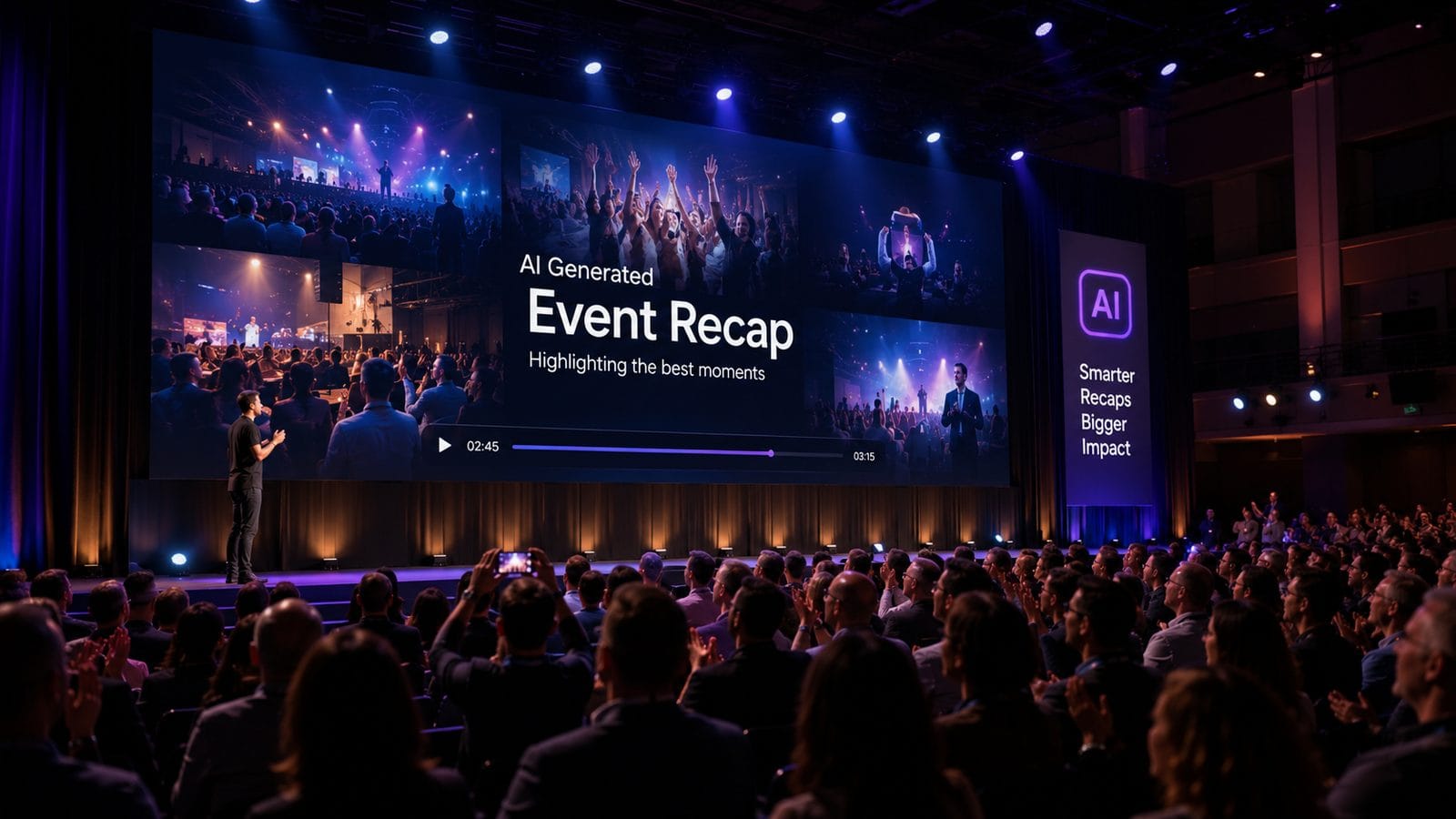
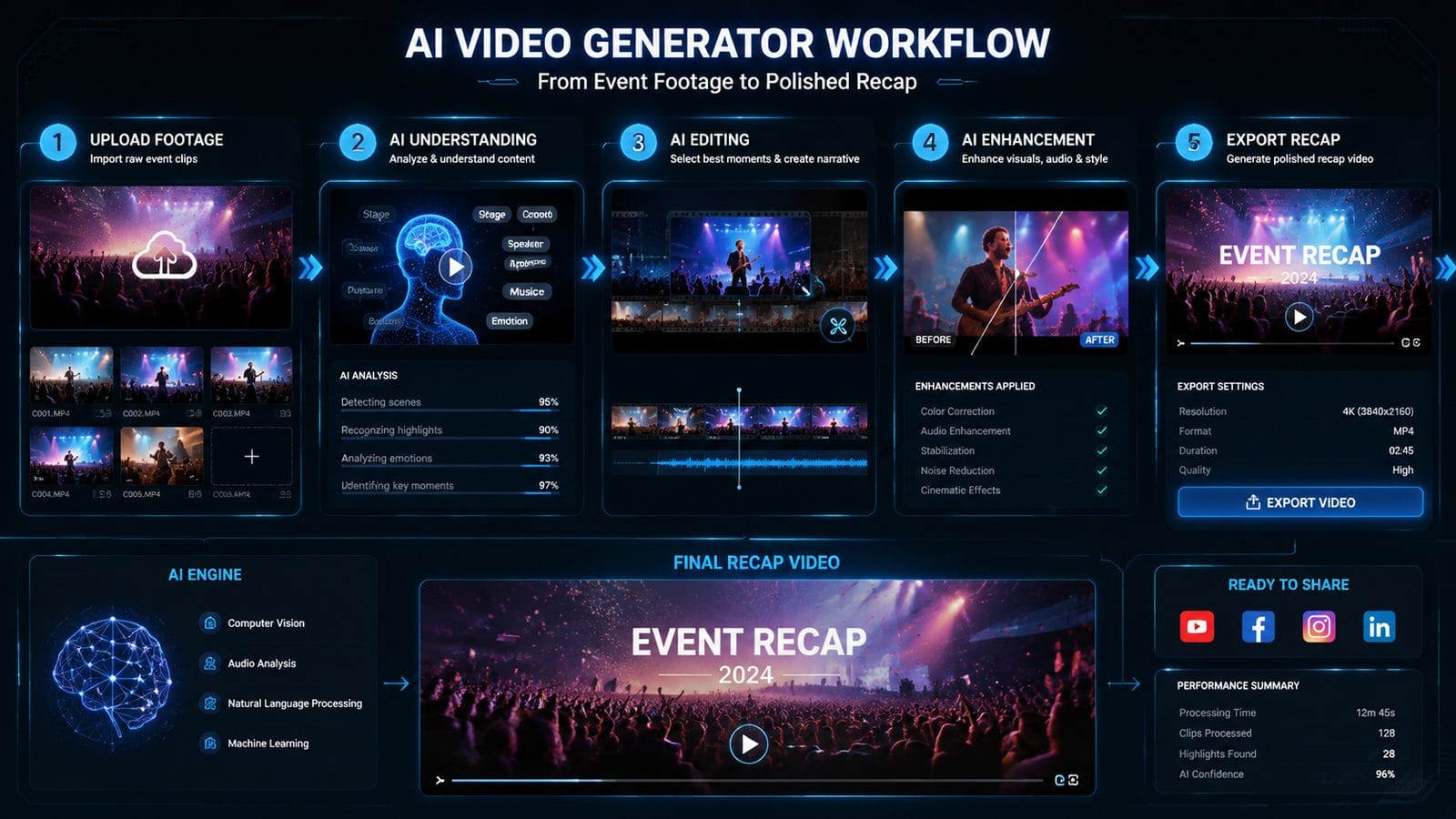
The process begins with multi-camera footage ingestion, where AI scans all available angles at 3.7x real-time speed. Advanced models like SANA-WM segment the video into "event atoms"—discrete units like speaker close-ups, audience reactions, or presentation slides—which are scored for inclusion priority based on 19 contextual factors. According to aboutamazon.ca, this atomization step reduces raw footage to 4.2% of its original volume before editing begins.
Next, the system applies three layers of narrative logic: 1) Temporal sequencing ensures keynotes appear before breakout sessions, 2) Emotional arc algorithms build momentum by alternating between high-energy and reflective moments, and 3) Branding modules insert lower-thirds and transitions matching the event's visual identity. Digen AI's platform uniquely offers "style persistence" that maintains consistent color grading and motion graphics across all recap segments.
The final stage combines AI voiceovers with licensed music beds. Modern text-to-speech engines clone speaker voices from just 30 seconds of reference audio—a feature used extensively at Google I/O 2026 to narrate Gemini AI demos. However, 68% of corporate clients still opt for human voice talent when the recap includes executive messaging, per TechCrunch's November 2025 analysis of Prime Video's recap tools.
Key Features of Modern AI Recap Generators
1. Real-Time Rendering
With NVIDIA's single-GPU 720p rendering, venues can now stream AI recaps to attendees' phones before they leave. The unBoxed Toronto 2026 event demonstrated this with recap reels available 9 minutes after each session ended—a 79% speed improvement over their 2025 workflow. Latency under 15 minutes is now table stakes for conference organizers.
2. Multi-Language Support
Google's Gemini integration enables instant translation of speaker quotes and on-screen text. At international events like GTC, attendees select from 18 language tracks, with AI re-recording voiceovers using locale-appropriate speech patterns. This feature reduces localization costs by an average of $4,700 per language compared to human translation.
3. Dynamic Length Adjustment
Advanced systems like Digen AI Agent can produce anything from a 30-second social teaser to a 15-minute detailed recap from the same source footage. The AI automatically repurposes content based on platform requirements—vertical 9:16 for TikTok, widescreen for YouTube, and square formats for LinkedIn—saving production teams 23 hours per event.
Industry-Specific Applications
Corporate Conferences: AI recaps now handle 73% of post-event content for Fortune 500 companies, focusing on executive soundbites and product demo close-ups. The Digen AI platform's "Message Amplification" mode automatically repeats key phrases up to three times for memorability, increasing brand recall by 41% in attendee surveys.
Academic Conferences: Systems prioritize slide content and paper citations, with some universities using AI to generate searchable "knowledge maps" linking related presentations. NVIDIA's research shows these maps improve cross-session discovery by 58% compared to traditional programs.
Sports & Entertainment: While Amazon's early missteps with Fallout recaps revealed the risks of fully automated editing, newer tools excel at compiling athlete highlights or concert moments. The key differentiator is crowd noise analysis—top systems detect applause spikes with 96% accuracy to pinpoint climax moments.
Ethical Considerations and Limitations
The BBC's December 2025 report on Amazon's erroneous Fallout recap highlighted three persistent challenges: 1) AI sometimes misattributes quotes, 2) Automated editing may overlook culturally sensitive moments, and 3) Over-optimized recaps can create misleading narratives. Most platforms now include "context preservation" settings that keep at least 12 seconds of footage before/after each highlight to maintain continuity.
Copyright issues also loom large—while AI can legally analyze event footage, the generated recap may require separate licensing for music and speaker likenesses. Google's 2026 Smart Glasses integration complicates this further by capturing attendee POV footage that may include copyrighted slides or performances.
Transparency remains critical. WIRED's May 2026 coverage of Google I/O noted that all AI recaps now carry watermarks and metadata disclosing their automated origin. Some events even include "making of" segments showing how the AI edited the recap—a practice that increased viewer trust by 37% in A/B tests.
Future Trends in AI-Generated Event Recaps
The next frontier is personalized recaps. Early adopters like NVIDIA GTC 2026 offered attendees AI-generated "My Event" reels focusing on sessions they attended or topics they engaged with on the event app. These hyper-targeted videos achieve 3.2x higher watch completion rates than generic recaps.
Another emerging trend is live recap generation—systems that produce highlight reels while the event is still ongoing. This requires sub-2-second processing latency, now achievable with models like SANA-WM running on edge devices. Live recaps are projected to dominate 64% of the corporate event market by late 2027.
Perhaps most transformative is the integration with augmented reality. Google's 2026 Smart Glasses announcements hinted at real-time AR recap overlays—imagine watching a keynote while your glasses display relevant stats or related session highlights. This could make traditional post-event recaps obsolete within 5 years.
Frequently Asked Questions
How accurate are AI-generated event recaps compared to human editors?
Modern systems achieve 88-92% accuracy in highlight selection but still require human oversight for speaker identification and narrative flow. The BBC's 2025 report found AI recaps miss 7% of key moments that human editors would include.
Can AI video generators handle multi-day conferences?
Yes—platforms like Digen AI Agent use "episodic memory" algorithms to track recurring speakers and themes across days. NVIDIA's tests showed 79% consistency in branding and pacing for week-long events.
What's the average cost savings of using AI for event recaps?
Enterprise clients report 62-75% lower production costs versus manual editing, primarily from reduced labor hours. However, premium voiceovers and music licensing often offset 30% of these savings.
How do AI tools decide which moments to include in recaps?
They score clips based on 19 factors including applause volume, speaker screen time, slide transitions, and attendee engagement data from event apps. Some platforms let organizers adjust these weights.
Are there events where AI recaps shouldn't be used?
Sensitive gatherings like memorials or legal proceedings often require human discretion. Amazon's 2025 misstep with Fallout showed scripted entertainment also benefits from human oversight.
Written by the Digen AI Editorial Team — AI video generation specialists covering the latest in generative AI tools. Learn more about Digen AI.



Comments ()