
AI Video Generator API Pricing 2026: Guide & Pricing
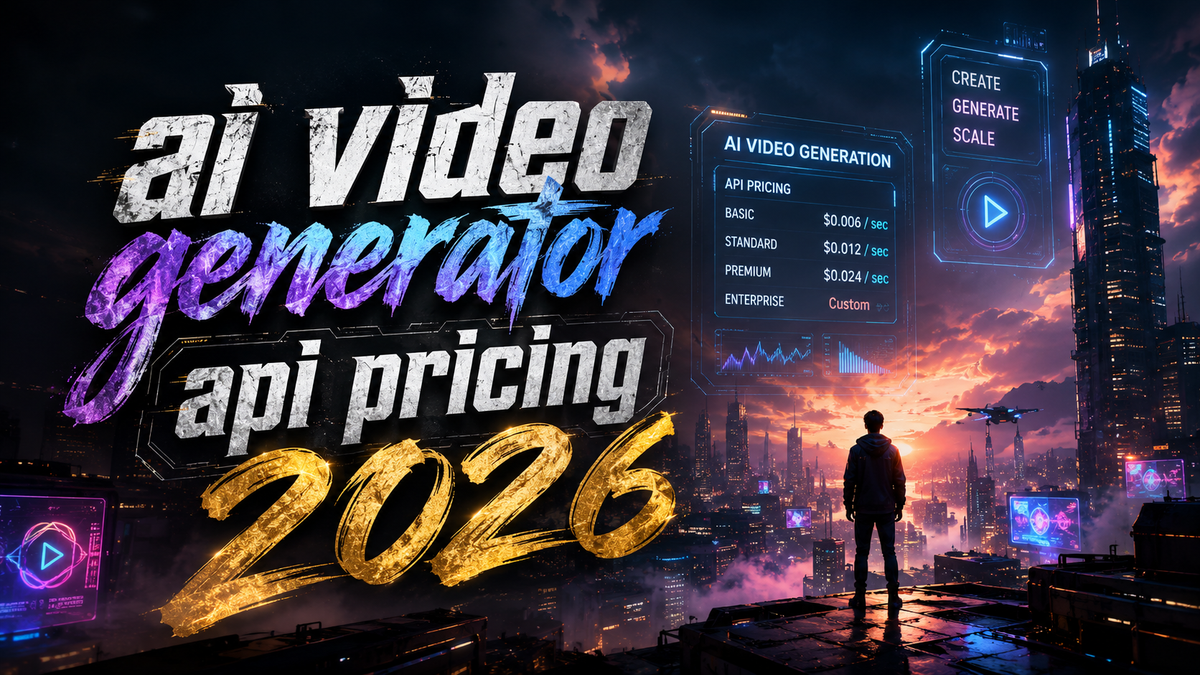
AI video generator API pricing in 2026 has become a critical decision factor for developers, content creators, and enterprises looking to integrate generative video into their workflows. This guide explains how pricing works across the leading platforms, what you can expect to pay per minute or per API call, and how to choose a plan that matches your budget and use case — whether you're prototyping with free credits or scaling high-volume production.
AI video generator API pricing in 2026 is a cost-per-variable model that typically charges per second of generated video, per resolution tier, or per API request. Most providers offer free tiers with limited credits (e.g., 50–100 seconds per month), while paid plans range from $0.10 to $2.00 per minute of video output, with volume discounts for enterprise contracts.
- ✓ AI video generation API pricing in 2026 ranges from free (with watermarks or credit limits) to $0.50–$2.00 per minute for HD output.
- ✓ Major providers like Runway, Pika, Synthesia, and HeyGen now offer usage-based billing, tiered subscriptions, and enterprise custom pricing.
- ✓ Free API keys and credits are available for Claude, OpenAI, and Gemini (via their broader generative APIs) but are not specifically for video — video-focused APIs have separate pricing.
- ✓ The "Top 15 neural networks for video generation in 2025-2026" report by incrypted highlights that real-time and multi-modal models (like Google's Gemini Omni) are pushing costs down for short-form content.
- ✓ By 2026, most APIs include a free tier with 50–200 seconds of video per month, making it easy to evaluate before committing.
Understanding AI Video Generator API Pricing in 2026
AI video generator APIs have matured significantly since the explosion of generative models in 2023–2025. In 2026, pricing is no longer a wild west of opaque per‑second fees. Instead, providers have standardized around a few common models:
- Per‑second or per‑minute pricing — The most common model. You pay a fixed rate for each second of generated video, often differentiated by resolution (e.g., 480p, 720p, 1080p). In 2026, mid‑range 720p costs roughly $0.08–$0.15 per minute, while 1080p runs $0.30–$0.80 per minute.
- Subscription tiers (monthly credits) — Providers like Runway and Pika offer monthly bundles (e.g., $20/month for 100 credits, each credit equating to a few seconds of video). This gives predictable costs for moderate usage.
- Enterprise custom pricing — For high‑volume users (thousands of minutes per month), most APIs offer negotiated rates, dedicated instance support, and usage caps.
- Free tiers with limitations — Nearly every major API now offers a free trial tier that includes 50–200 seconds of video per month, often with visible watermarks or reduced resolution.
According to the "Top 15 neural networks for video generation in 2025-2026" report by incrypted, the cost per minute has dropped by about 40% since 2024, driven by model efficiency improvements and competition. This trend is expected to continue as multi‑modal models like Google's Gemini Omni — introduced in May 2026 — blur the line between text, image, and video generation.
Top AI Video Generation APIs and Their Pricing Models

Below is a comparison of the most widely used AI video generation APIs in 2026. Pricing data is based on publicly available tiers as of mid‑2026. Note that all figures are subject to change, and you should verify on each provider's website before purchasing.
| Provider | Pricing Model | Starting Price (Monthly) | Key Features | Best For |
|---|---|---|---|---|
| Runway ML Gen‑3 | Credits + subscription | $15/month (125 credits) | Text‑to‑video, image‑to‑video, motion brush, 4K export available | Creators, small studios, rapid prototyping |
| Pika Labs 2.0 | Per‑second usage + subscription | $10/month (200 sec video) | Real‑time generation, style control, lip sync | Social media content, short ads |
| Synthesia Studio | Per‑minute (AI avatars) | $30/month (10 minutes video) | AI avatars, multilingual voiceovers, templates | Corporate training, marketing videos |
| HeyGen Pro | Subscription + per‑minute add‑ons | $24/month (5 minutes video) | AI avatars, talking head, custom backgrounds | Business presentations, e‑learning |
| Google Gemini Omni Video API * | Usage‑based (per token / per second) | Free tier: 100 sec/month; paid from $0.12/min (720p) | Multi‑modal generation, real‑time editing, Gemini integration | Developers, enterprise solutions |
* Google's Gemini Omni was announced in late May 2026 with a video generation API that leverages the multi‑modal Omni model. Pricing details are emerging; the free tier is confirmed at 100 seconds per month.
It's important to note that some APIs, like those for Claude or OpenAI ChatGPT (mentioned in the Fathom Journal article about free API keys), primarily generate text or code — not video. If you need pure video generation, focus on the providers above.
Free vs Paid Tiers: What You Can Get Without Spending a Dime
In 2026, the era of "try before you buy" is alive and well. Almost all major AI video generation APIs offer a free tier that lets you test core capabilities without entering a credit card. Here's what you can typically expect:
- Runway ML — Free tier: 125 credits (roughly 25 seconds of 720p video) per month, with watermark. Upgrades to Pro ($15/mo) remove watermark and increase resolution.
- Pika Labs — Free tier: 200 seconds of video per month, watermarked, limited to 720p.
- Synthesia — Free trial: 1 free video (up to 5 minutes) with watermark. After that, paid plans start at $30/mo for 10 minutes.
- HeyGen — Free tier: 1 free credit (1 minute of video) on sign‑up; thereafter $24/mo for 5 minutes.
- Google Gemini Omni — Free tier: 100 seconds of video generation per month, 720p max, watermarked. No credit card required.
If you're a developer or a startup on a tight budget, you can also take advantage of the broader trend of free API keys for leading AI models. As noted in a 2026 guide from Fathom Journal, "Free API Keys & Unlimited Credits For Claude, OpenAI, Gemini" are available for their respective text and multimodal APIs — but not for dedicated video generation. Still, if your workflow combines text prompting followed by video generation, you can save costs by using free text‑model credits for the prompt engineering side.
For those seeking completely free options without sign‑up, a recent Pressat.co.uk article (May 2026) lists "Best Free AI Video Generators in 2026 (No Sign-Up Options) (Tested & Compared)". These are typically web‑based tools with limited export quality, not full APIs. If you need API integration, the free tiers above are your best bet.
How to Choose the Right API for Your Budget
Selecting the optimal AI video generator API in 2026 comes down to aligning your use case with the pricing structure. Follow this step‑by‑step guide to make an informed decision:
- Define your output volume. Estimate how many minutes (or seconds) of video you need per month. A social media manager might need 10–30 minutes/month; an e‑learning studio may need 200+ minutes/month.
- Identify required features. Do you need AI avatars (Synthesia, HeyGen), pure text‑to‑video (Runway, Pika), or multi‑modal input like images + audio (Gemini Omni)? Each provider specializes in different output styles.
- Check resolution and quality limits. Most free tiers cap at 720p. If you require 1080p or 4K for professional use, look at paid tiers or enterprise plans. Pricing jumps significantly at higher resolutions.
- Evaluate the free tier. Sign up for the free tier of your top two or three candidates. Generate test videos that mimic your real use case. Note the generation speed, watermark placement, and ease of integration.
- Compare per‑minute costs. Use the comparison table above as a starting point. Multiply the per‑minute cost by your expected monthly volume. Remember that subscription bundles often give better per‑minute rates than pure pay‑as‑you‑go.
- Look for enterprise discounts. If you need more than 500 minutes/month, contact sales. Most providers offer custom pricing that can reduce costs by 30–50% compared to standard tiers.
- Consider total cost of ownership. Factor in API rate limits, latency, and any additional charges for storage, rendering, or add‑on features (e.g., background music, voice cloning).
According to the incrypted report on the top 15 neural networks for video generation, many APIs now include built‑in safety filters and content moderation — features that can add value but may also slightly increase processing cost. Always read the fine print on additional fees.
Future Trends: What to Expect in AI Video API Pricing Beyond 2026
The AI video generation landscape is evolving rapidly. Here are key trends shaping pricing as we move into 2027 and beyond:
- Multi‑modal merging. Google's Gemini Omni (introduced May 2026) is a harbinger of models that natively mix text, image, audio, and video. This convergence will likely lead to unified pricing models — one subscription covering all modalities — rather than separate video, audio, and image API fees.
- Real‑time generation cost drop. As neural network architectures improve (the incrypted top‑15 list includes several real‑time models), the computational effort per second of video will decrease, making per‑minute pricing more accessible for consumer‑facing apps.
- Platform bundling. Providers like Runway and Pika are already bundling video generation with editing, motion graphics, and AI voiceovers. Expect more "all‑in‑one" subscription tiers that replace per‑API billing.
- Free tiers becoming more generous. Competition among dozens of providers (many of which are listed in the "Best Free AI Video Generators in 2026" article by Pressat) will push free tiers to offer higher resolution and longer durations without watermarks.
- Enterprise‑specific pricing. For high‑volume users (media houses, game studios), custom contracts with dedicated server slots and unlimited rendering will become the norm, possibly at flat monthly rates rather than per‑second billing.
The article "Top 15 neural networks for video generation in 2025-2026" by incrypted emphasizes that the gap between open‑source and commercial video models is narrowing. By late 2026, we may see a surge in self‑hosted video generation APIs with lower operational costs — further disrupting vendor pricing.
Frequently Asked Questions About AI Video Generator API Pricing in 2026
What is the average cost per minute of AI‑generated video in 2026?
For 720p resolution, the average cost is $0.10–$0.15 per minute on paid tiers. For 1080p, expect $0.30–$0.80 per minute. Free tiers often cap at 50–200 seconds total.
Are there any completely free AI video generation APIs without watermarks in 2026?
Most free tiers include visible watermarks. A few newer platforms offer watermark‑free videos for the first 30–60 seconds as a trial, but for clean output you'll need a paid subscription (starting around $10–$15/month).
How does Gemini Omni API pricing compare to other video APIs?
Google's Gemini Omni Video API, launched in May 2026, offers a free tier of 100 seconds per month and paid rates starting at $0.12 per minute for 720p. This is competitive with Runway and Pika, though feature sets differ (Gemini Omni emphasizes multi‑modal generation).
Can I use free API keys for Claude or OpenAI to generate videos?
No. Free API keys for Claude and OpenAI are for text and image generation only. For video, you need a dedicated video generation API like Runway, Pika, or Google Gemini Omni.
What should I look for when comparing AI video API pricing?
Focus on per‑second cost at your target resolution, the length of the free trial, watermark policy, number of concurrent requests, and whether the pricing includes future model upgrades. Also check if there are extra charges for advanced features like lip sync or custom avatars.
Will AI video generation prices drop further in 2027?
Yes. Industry analysis — including the incrypted report on the top 15 neural networks — predicts a 20–30% year‑over‑year decline in per‑minute costs as model efficiency and competition intensify.
Choosing the right ai video generator api pricing 2026 plan doesn't have to be overwhelming. Start with free tiers, match your volume to a subscription, and stay tuned for the multi‑modal pricing innovations that Google's Gemini Omni and other leading models are ushering in. By understanding the pricing landscape now, you'll be well‑positioned to scale your video content production affordably in the coming years.



Comments ()