
AI Video Generator 2026: Pros & Cons Explained
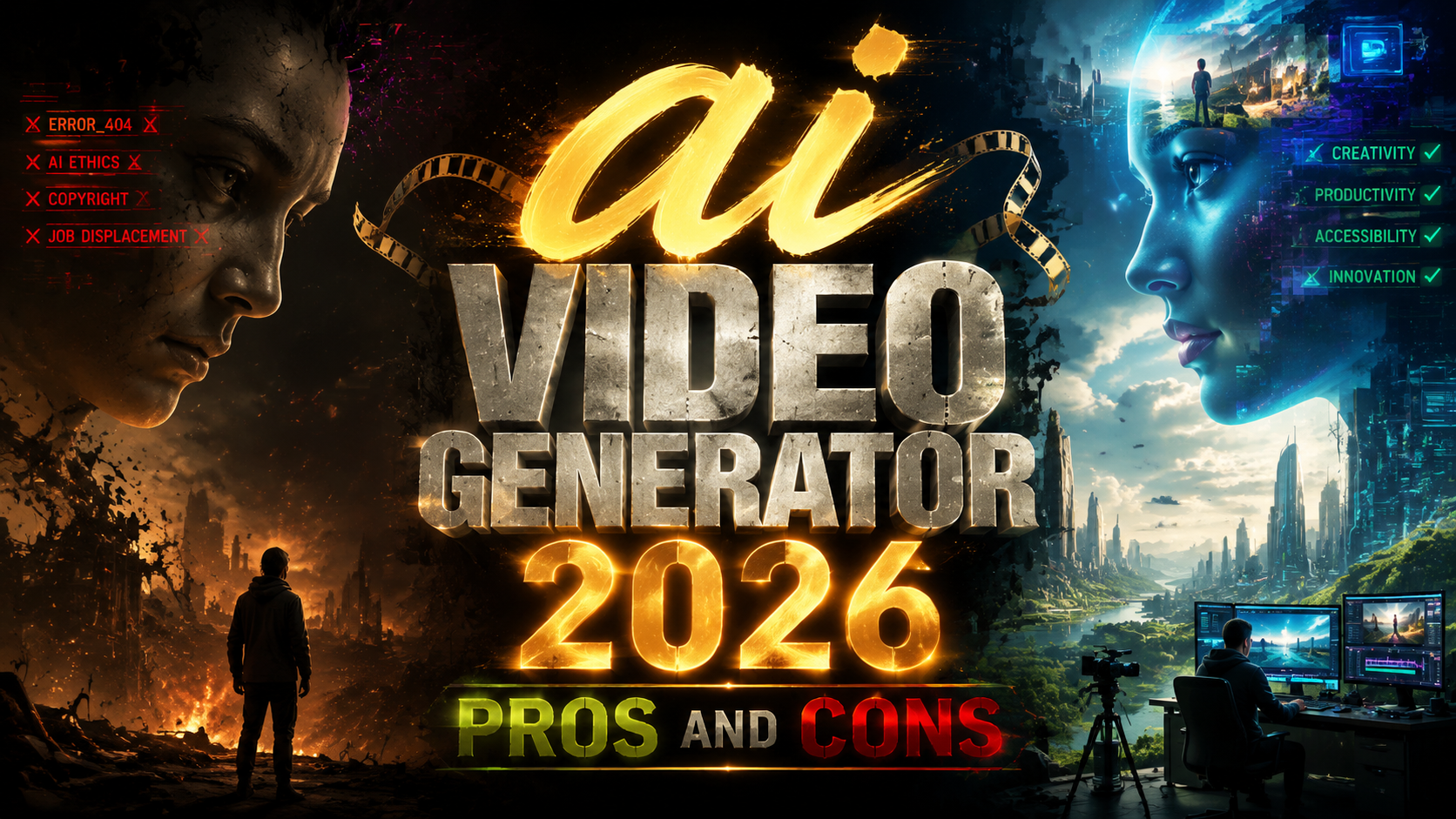
AI video generators have become dramatically more capable in 2026, but understanding their strengths and limitations is essential before adopting them for professional or personal projects. The ai video generator 2026 pros and cons landscape reveals that while these tools offer unprecedented speed and accessibility, challenges around consistency, cost, and ethical use remain significant. This article provides a balanced, evidence-based examination of what works, what doesn't, and how to choose the right tool for your needs.
TL;DR: AI video generators in 2026 offer rapid content creation, lower costs, and broad accessibility, but face ongoing issues with output consistency, ethical concerns, and a learning curve for advanced features. The best choice depends on your specific use case, budget, and quality requirements.
An AI video generator is a software tool that uses machine learning models to create video content from text prompts, images, or reference footage. In 2026, these tools range from free consumer apps to premium enterprise platforms, each offering different trade-offs between quality, control, and cost.
- ✓ AI video generators in 2026 can produce professional-grade footage in minutes, drastically reducing production timelines.
- ✓ Free tiers exist, but most advanced features require paid subscriptions ranging from $10 to $200+ per month.
- ✓ Output consistency, character coherence, and ethical concerns around deepfakes remain the top challenges.
- ✓ Hybrid workflows — combining AI generation with human editing — deliver the best results for most creators.
- ✓ The market has matured significantly, with CNET, Ventureburn, and Cybernews publishing comprehensive 2026 rankings.
What Is an AI Video Generator? (2026 Definition and Context)
An ai video generator is a software platform that leverages generative artificial intelligence to produce video content from textual descriptions, images, or existing video clips. By 2026, these tools have evolved from experimental novelty into production-ready systems capable of rendering high-resolution footage with coherent motion, consistent characters, and synchronized audio. Leading platforms now support outputs up to 4K resolution, multi-scene sequences, and integration with popular editing suites.
According to CNET, the best AI video generators of 2026 offer features like text-to-video, image-to-video, video-to-video style transfer, and real-time collaboration. These tools are trained on vast datasets of video content, allowing them to understand concepts like physics, lighting, and camera movement. The technology has advanced to the point where generated footage can be used in advertising, social media, education, and even early-stage film production.
The market in 2026 is segmented into free tools for casual users and premium platforms for professionals. Ventureburn ranked the 10 best free AI video generators in 2026, highlighting that free tiers have become surprisingly capable, often supporting 720p exports and limited generation minutes per month. This democratization of video creation means that anyone with an internet connection can now produce animated explainers, product demos, or social clips without prior editing experience.
How AI Video Generators Work in 2026
Modern AI video generators use a combination of diffusion models, transformer architectures, and temporal coherence algorithms. When you input a text prompt like "a cat walking through a neon-lit cyberpunk street at night," the model interprets the description, generates a sequence of frames that maintain visual consistency, and renders them into a smooth video file. The best systems use multi-stage pipelines where initial low-resolution generation is followed by upscaling and frame interpolation.
Most platforms now offer customization controls including camera angle, movement style, lighting conditions, and color palette. Some tools allow you to upload reference images to guide the aesthetic direction, while others support negative prompts to exclude unwanted elements. The processing time varies from seconds for short clips to several minutes for longer, high-resolution outputs.
Cloud-based processing remains the standard, though local inference options are emerging for users with high-end GPUs. The underlying models are updated regularly, with major version releases introducing significant quality jumps. According to Cybernews, Higgsfield AI's 2026 update introduced cinematic camera controls and improved character consistency, setting a new benchmark for the industry.
The Pros of AI Video Generators in 2026
The most compelling advantage of using an ai video generator in 2026 is the dramatic reduction in production time. What once required a full crew, studio space, days of shooting, and weeks of post-production can now be accomplished by a single person in a matter of hours. For content creators, marketers, and small businesses, this speed translates directly into lower costs and faster time-to-market for video campaigns.
Cost-effectiveness is the second major pro. Traditional video production involves equipment rental, talent fees, location costs, and post-production labor. AI video generators eliminate or dramatically reduce these expenses. Free tiers from top providers allow experimentation without financial risk, while paid plans — typically $15 to $100 per month — offer extensive generation allowances. For organizations producing high volumes of video content, the ROI compared to traditional production is often measured in multiples.
Accessibility is the third pillar of the pro argument. In 2026, you do not need to be a trained video editor or animator to create compelling video content. The natural language interface of most AI video generators means that anyone who can describe what they want can produce a usable video. This has opened up professional-quality video creation to educators, non-profits, small business owners, and hobbyists who previously lacked the resources or skills to enter the video production space.
Speed and Efficiency Gains
AI video generators can produce a 30-second clip in 1-3 minutes, depending on resolution and complexity. This is revolutionary compared to traditional production timelines. For social media content where frequency and timeliness matter, AI generation allows teams to produce daily video content without scaling their human resources. According to Tribune Online, the top AI video generators in 2026 include batch processing features that allow users to generate multiple video variants simultaneously, further accelerating workflows.
Iteration is also much faster. If a generated video doesn't meet expectations, you can tweak the prompt and regenerate in minutes rather than reshooting for hours. This encourages experimentation and creative exploration that would be cost-prohibitive with traditional production.
Many tools now integrate directly with social media platforms and content management systems, allowing for one-click publishing. This seamless workflow eliminates export and upload steps, saving additional time for high-volume creators.
Cost Savings Compared to Traditional Production
Traditional video production costs can range from $500 for a basic social clip to $50,000+ for a professional commercial. AI video generators offer monthly subscriptions that provide virtually unlimited generation within usage limits. Even the most expensive enterprise plans rarely exceed $200 per month, making AI video generation accessible to organizations of all sizes.
For small businesses and startups, this cost difference is transformative. A local restaurant can create a week's worth of social media videos showcasing menu items, behind-the-scenes content, and customer testimonials without hiring a videographer. The only investment is a subscription and time spent crafting effective prompts.
Educational institutions use AI video generators to create lecture summaries, course previews, and student orientation materials. Non-profits can produce compelling storytelling content for fundraising campaigns without diverting donor dollars to production costs. The democratization of video creation has genuine economic implications for sectors that previously could not afford professional video content.
The Cons of AI Video Generators in 2026
Despite their impressive capabilities, AI video generators in 2026 have notable limitations. The most frequently cited issue is output inconsistency. Even the best models can produce artifacts, weird physics, or character inconsistencies, especially in longer sequences or complex scenes. A character's face might change between shots, objects may flicker, or motion may appear unnatural. These issues require manual editing to fix, which eats into the time savings.
Ethical concerns represent a significant con, particularly around deepfakes, copyright, and the potential for misuse. The ability to generate realistic video of people — including public figures — raises obvious risks. According to CNET, most major platforms in 2026 have implemented content moderation and watermarking systems, but the technology still outpaces regulation. Copyright questions about training data and generated outputs remain legally unresolved in many jurisdictions.
There is also a learning curve for achieving professional-quality results. While basic generation is simple, getting exactly what you want often requires prompt engineering skills, understanding of the tool's parameters, and sometimes iterative refinement across multiple generations. Users expecting a magic "one prompt, perfect video" experience are often disappointed. The best results in 2026 come from users who treat AI video generators as collaborative tools rather than autonomous content factories.
Quality and Consistency Limitations
AI-generated video still struggles with maintaining character identity across multiple scenes. If you generate a 60-second video with several cuts, the main subject's appearance may shift subtly — or sometimes dramatically — between frames. This breaks immersion and requires post-production fixes like masking, color grading, or even regenerating specific segments. For professional clients who demand pixel-perfect results, this inconsistency remains a dealbreaker for fully automated workflows.
Another quality issue is the handling of complex motion. Fast-moving subjects, intricate interactions between objects, or subtle emotional expressions on human faces can all produce suboptimal results. The models sometimes default to "safe" but generic visual solutions that lack the creative spark of human-directed work. Backgrounds may appear blurry or generic, and lighting can be inconsistent across a sequence.
Resolution limitations also persist. While 4K output is available on premium tiers, the actual detail and sharpness often lag behind native 4K footage from a professional camera. AI upscaling helps, but it can introduce a characteristic smoothness that some viewers find uncanny. For cinema-grade applications, AI video generation in 2026 is a pre-visualization tool rather than a final output solution.
Ethical, Legal, and Copyright Concerns
The ease of generating realistic video raises profound ethical questions. Deepfake technology, which AI video generators directly enable, can be used for misinformation, impersonation, and harassment. While platforms have content policies and detection tools, bad actors continue to find ways around safeguards. The Washington City Paper reported on the growing market for NSFW AI generators, highlighting the challenges platforms face in moderating inappropriate content.
Copyright issues are equally complex. AI models are trained on internet-sourced data that includes copyrighted material. The legal status of generated outputs varies by jurisdiction, and several lawsuits in 2025-2026 have challenged the legality of using copyrighted works for training without permission. Users of AI video generators may face uncertainty about whether they actually own the rights to the content they generate, especially if it closely resembles existing works.
Platforms have responded with indemnification clauses, content provenance tools like C2PA metadata, and improved moderation. However, the regulatory landscape is still evolving, and users should remain cautious about using AI-generated video for commercial purposes without understanding the legal risks in their specific context. Transparency about AI generation in published content is becoming both an ethical expectation and, in some regions, a legal requirement.
AI Video Generator 2026: Pros and Cons Compared
When evaluating the ai video generator 2026 pros and cons, it is helpful to see the trade-offs side by side. The table below summarizes the key advantages and disadvantages across the major dimensions that matter to most users.
| Dimension | Pros (Advantages) | Cons (Limitations) |
|---|---|---|
| Production Speed | Generate a 30-second clip in 1-3 minutes; batch processing available | Complex scenes may require multiple attempts; post-production still needed |
| Cost | Free tiers available; paid plans $15-$200/month vs. thousands for traditional production | Premium features (4K, longer duration, commercial rights) require paid subscriptions |
| Ease of Use | Natural language prompts; no editing skills needed for basic use | Professional results require prompt engineering and iterative refinement |
| Output Quality | Up to 4K resolution; cinematic camera controls on top tools | Character inconsistency, artifacts, and uncanny visuals remain issues |
| Ethical & Legal | Platforms have moderation and watermarking; some offer indemnification | Deepfake risks, copyright uncertainty, regulatory gaps persist |
| Creative Control | Customizable camera angles, lighting, color palettes, negative prompts | Less control than a human director; "black box" generation can be unpredictable |
| Accessibility | Anyone can create video; lowers barrier for education, non-profits, small businesses | Requires reliable internet; cloud dependency; some learning curve for advanced features |
This comparison makes it clear that AI video generators in 2026 are powerful tools with genuine benefits, but they are not magic solutions. The pros tend to favor users who need speed, volume, and cost efficiency, while the cons matter most to users who demand pixel-perfect consistency, full creative control, or work in heavily regulated industries. Most successful adopters use AI generation as a starting point, combining it with human expertise for final polish.
The balance between pros and cons also varies significantly by tool. According to Ventureburn, free tools excel at quick social content but lack the controls needed for branded work. At the other end, platforms like Higgsfield AI, reviewed by Cybernews, offer cinematic quality but require a steeper learning curve and higher subscription cost.
Top AI Video Generators of 2026: A Closer Look
The market for AI video generators in 2026 includes a diverse range of tools catering to different use cases and budgets. CNET ranked the best AI video generators of 2026, highlighting platforms that excel in quality, features, and value. Their review process evaluated over a dozen tools across criteria including output quality, generation speed, customization options, and pricing transparency.
Higgsfield AI emerged as a standout for cinematic-quality video, particularly for users who need professional-looking results for advertising or social media. Its 2026 update, reviewed by Cybernews, introduced advanced camera controls including dolly shots, crane movements, and focus pulls. The tool supports text-to-video and image-to-video workflows, with output resolutions up to 4K. However, its premium pricing places it out of reach for casual users.
For budget-conscious creators, Ventureburn identified 10 free AI video generators that offer genuine utility without upfront investment. These tools typically limit export resolution to 720p or 1080p and cap monthly generation minutes, but they are excellent for learning, prototyping, and low-stakes social content. Many free tiers include watermarks on exports, though some offer watermark-free output in exchange for attribution or promotion.
Comparing Free vs. Premium Tools
The gap between free and premium AI video generators has narrowed in 2026, but important differences remain. Free tools generally use older model versions, lower resolution limits, and simpler prompt interfaces. They may also queue processing, resulting in longer wait times during peak usage. Premium tools offer priority processing, access to the latest model versions, higher resolution exports, and advanced controls like multi-scene sequencing and custom model fine-tuning.
For users who need AI video generation as a core part of their workflow — content studios, marketing agencies, e-learning providers — the premium subscription cost is easily justified by the quality and consistency gains. For occasional use, such as generating a single video for a school project or a small business promotion, free tools are often sufficient. The key is matching the tool to the use case rather than assuming that the most expensive option is always necessary.
Privacy and data security also vary between free and premium offerings. Free tiers may use your generated content for model training, while premium plans typically offer data isolation and commercial usage rights. Users with sensitive content or strict privacy requirements should review the terms of service carefully before choosing a platform.
How to Choose the Right AI Video Generator for Your Needs
Selecting the best ai video generator in 2026 requires a clear understanding of your specific requirements. Start by defining the primary use case: social media content, marketing ads, educational videos, internal communications, or creative projects. Each use case has different quality, volume, and speed requirements that will guide your choice. Social media content may prioritize speed and volume, while marketing ads demand higher quality and brand consistency.
Next, evaluate your budget and technical comfort level. Free tools are ideal for experimentation and low-volume needs. Mid-tier subscriptions ($15-$50/month) offer a good balance of features and cost for individual creators and small teams. Enterprise plans ($100-$200+/month) provide priority support, higher usage limits, and advanced features like team collaboration and custom branding. Be realistic about the time you can invest in learning the tool — more capable platforms often require more time to master.
Finally, consider the integration with your existing workflow. Some AI video generators offer direct exports to social media platforms, integration with video editing software like Adobe Premiere Pro or DaVinci Resolve, or API access for automated content pipelines. If you already have a content production workflow, choose a tool that fits into it rather than forcing a change. Testing two or three options on free trials is the best way to find the right fit before committing to a subscription.
Evaluating Output Quality Before Committing
Before subscribing to any tool, generate test videos that match your actual use case. If you need videos with human subjects, test how the tool handles faces, expressions, and movement. If you need product demos, test how well the tool renders objects with text or logos. Pay attention to resolution, frame rate consistency, and whether the AI-generated video achieves the emotional tone you need. Multiple test generations will reveal the tool's strengths and weaknesses for your specific needs.
Also evaluate the platform's content moderation and copyright policies. Some tools explicitly grant commercial rights to generated content, while others have more restrictive terms. For businesses creating content for clients or public distribution, clear commercial usage rights are non-negotiable. Platforms like those reviewed by CNET typically provide detailed documentation about licensing and usage rights.
Community and support resources matter too. Active user communities on Discord, Reddit, or the platform's own forums can provide prompt inspiration, troubleshooting help, and examples of what the tool can achieve. Responsive customer support is critical if you encounter technical issues during time-sensitive projects. Check reviews and community activity before committing to a platform.
Frequently Asked Questions About AI Video Generators
Are AI video generators in 2026 free to use?
Yes, many AI video generators offer free tiers with limited features. According to Ventureburn, the 10 best free AI video generators in 2026 include options with 720p or 1080p export, limited monthly generation minutes, and sometimes watermarks. For unlimited generation, higher resolutions, and commercial rights, paid subscriptions ranging from $15 to $200 per month are available.
Can AI video generators produce 4K video in 2026?
Yes, several premium AI video generators support 4K output in 2026. Tools like Higgsfield AI offer up to 4K resolution as part of their paid plans. However, the effective detail and sharpness may not match native 4K footage from professional cameras, and 4K generation typically requires more processing time and consumes more of your monthly generation allowance.
What is the biggest limitation of AI video generators in 2026?
The most significant limitation is output inconsistency, particularly with character appearance across multiple scenes and complex motion. AI-generated video can exhibit artifacts, flickering, and unnatural movement that require manual editing to fix. Ethical concerns around deepfakes and copyright also remain unresolved challenges for the industry.
How long does it take to generate a video with AI in 2026?
Generation times vary by tool, resolution, and scene complexity. A simple 15-second clip at 1080p can take 30 seconds to 2 minutes. Longer videos, higher resolutions, and complex scenes can take 5-15 minutes or more. Premium tools typically offer faster processing through priority queues. Batch processing can generate multiple variations simultaneously on some platforms.
Who should use AI video generators in 2026?
AI video generators are suitable for content creators, marketers, educators, small business owners, and social media managers who need to produce video content quickly and cost-effectively. They are less suitable for projects requiring pixel-perfect consistency, emotional nuance, or complex storytelling where a human director's vision is essential. The best results come from combining AI generation with human editing and creative direction.
Is AI-generated video legal to use for commercial purposes?
Legality depends on the platform's terms of service, the specific use case, and your jurisdiction. Most major platforms in 2026 offer commercial usage rights in their paid tiers, but users should verify the license terms. Copyright questions about training data remain unresolved in many countries, and users should stay informed about evolving regulations. Using AI-generated content for sensitive applications like news or advertising may require additional disclosure and ethical consideration.
Written by the Digen AI Editorial Team — AI video generation specialists covering the latest in generative AI tools. Learn more about Digen AI.

Comments ()