
AI Video Generation Models: The Future of Content in 2026
AI video generation models are revolutionizing content creation by enabling real-time, high-quality video production with minimal human intervention. As of July 2026, advancements like ShengShu's Vidu S1 and ByteDance's Seedance 2.5 demonstrate how these tools are becoming faster, more interactive, and capable of handling complex workflows. The technology is poised to dominate digital media, marketing, and entertainment industries within the next decade.
TL;DR: AI video generation models in 2026 offer real-time interactive capabilities, longer video outputs, and improved copyright management, with major players like ShengShu, ByteDance, and Kling AI driving innovation.
AI video generation models are neural networks that create or enhance video content autonomously, with 2026 breakthroughs including real-time rendering (Vidu S1), 30-second coherent clips (Seedance 2.5), and $3 billion-funded platforms (Kling AI). These tools now handle character consistency, copyright compliance, and multi-step workflows previously requiring human editors.
- ✓ Real-time generation arrives with ShengShu's Vidu S1, enabling live interaction during AI video creation
- ✓ ByteDance's Seedance 2.5 introduces copyright-aware 30-second videos and expanded workflow tools
- ✓ Kling AI secures $3 billion in funding, signaling massive investor confidence in generative video
- ✓ Autonomous agents like Digen AI Agent now produce longer, character-consistent videos through multi-step refinement
- ✓ Singapore startups are pioneering "world models" that simulate physics for more realistic AI-generated scenes
The State of AI Video Generation in 2026
July 2026 marks a turning point for AI video generation models, with three major developments reshaping the industry. According to PR Newswire, ShengShu Technology's Vidu S1 has achieved sub-200ms latency for real-time video generation, allowing creators to adjust outputs while the AI renders. Meanwhile, ByteDance's Seedance 2.5 now produces 30-second coherent videos - a 150% increase from its 2025 version - while automatically tagging copyright-relevant elements as reported by Tech Times.
The financial landscape reflects this progress, with Kling AI's $3 billion funding round co-led by BlueFive Capital representing the largest single investment in generative video to date. This dwarfs the $500 million raised by competitors in 2025, indicating accelerated market maturation. Platforms are now specializing, with some like Digen AI Agent focusing on long-form consistency (maintaining character appearances across 5+ minute videos) while others optimize for speed or special effects.
Singapore has emerged as an unexpected hub for advanced video AI, with former Tencent engineers developing "world models" that simulate physics and lighting more accurately. These account for 17% of all generative video patents filed in Q2 2026 according to WIPO databases. The global AI video market now processes over 8 million daily generations - up from 1.2 million in January 2025 - with 62% being commercial rather than experimental use.
Breakthrough Features in Latest Models

Real-Time Interactive Generation
ShengShu's Vidu S1, launched July 3, 2026, introduces true real-time capabilities where users can verbally redirect an AI video during generation. For example, saying "make the character younger" or "change the background to Tokyo at night" modifies the output instantly. This reduces average production time by 73% compared to batch-processing models according to internal benchmarks.
Copyright-Aware Outputs
ByteDance's Seedance 2.5 automatically flags potential copyright issues in generated videos, addressing a major industry concern. The system cross-references elements against a database of 280 million copyrighted materials, achieving 89% accuracy in preliminary tests. When commercial use is detected, it suggests royalty-free alternatives or connects users to licensing platforms.
Extended Coherence Windows
Where 2025 models struggled beyond 12-second clips, 2026's top performers maintain narrative consistency for 30-45 seconds. Digen AI Agent accomplishes this through a proprietary "memory stack" that tracks 34 character and scene attributes frame-to-frame. In stress tests, it maintained coherent character appearances across 5-minute videos - a 600% improvement over baseline models.
Major Players and Market Dynamics
The AI video generation space has consolidated around three primary architectures as of mid-2026: real-time interactive (exemplified by Vidu S1), workflow-automated (like Seedance 2.5's Topview integration), and quality-optimized (including Digen AI Agent's multi-pass rendering). Kling AI's $3 billion war chest positions it to potentially dominate all three segments, though niche players maintain advantages in specific use cases.
According to Forbes, Singapore's Tencent-spinoff startups are pioneering "cinematic physics" models that accurately simulate fabric movement, fluid dynamics, and light refraction. These require 40% more compute power but reduce post-production editing needs by an estimated 55%. Meanwhile, Google's Nano Banana 2 Lite hardware (released June 30) brings affordable local AI video processing to indie creators, supporting 1080p generation at 24fps.
The enterprise market shows particular interest in automated workflow solutions. Seedance 2.5's integration with Topview allows marketing teams to generate 50+ localized video variants from a single script in under 15 minutes. Similarly, Digen AI Agent's autonomous editing workflows are being adopted by 14% of Fortune 500 content teams for product demonstration videos.
Technical Innovations Driving Progress
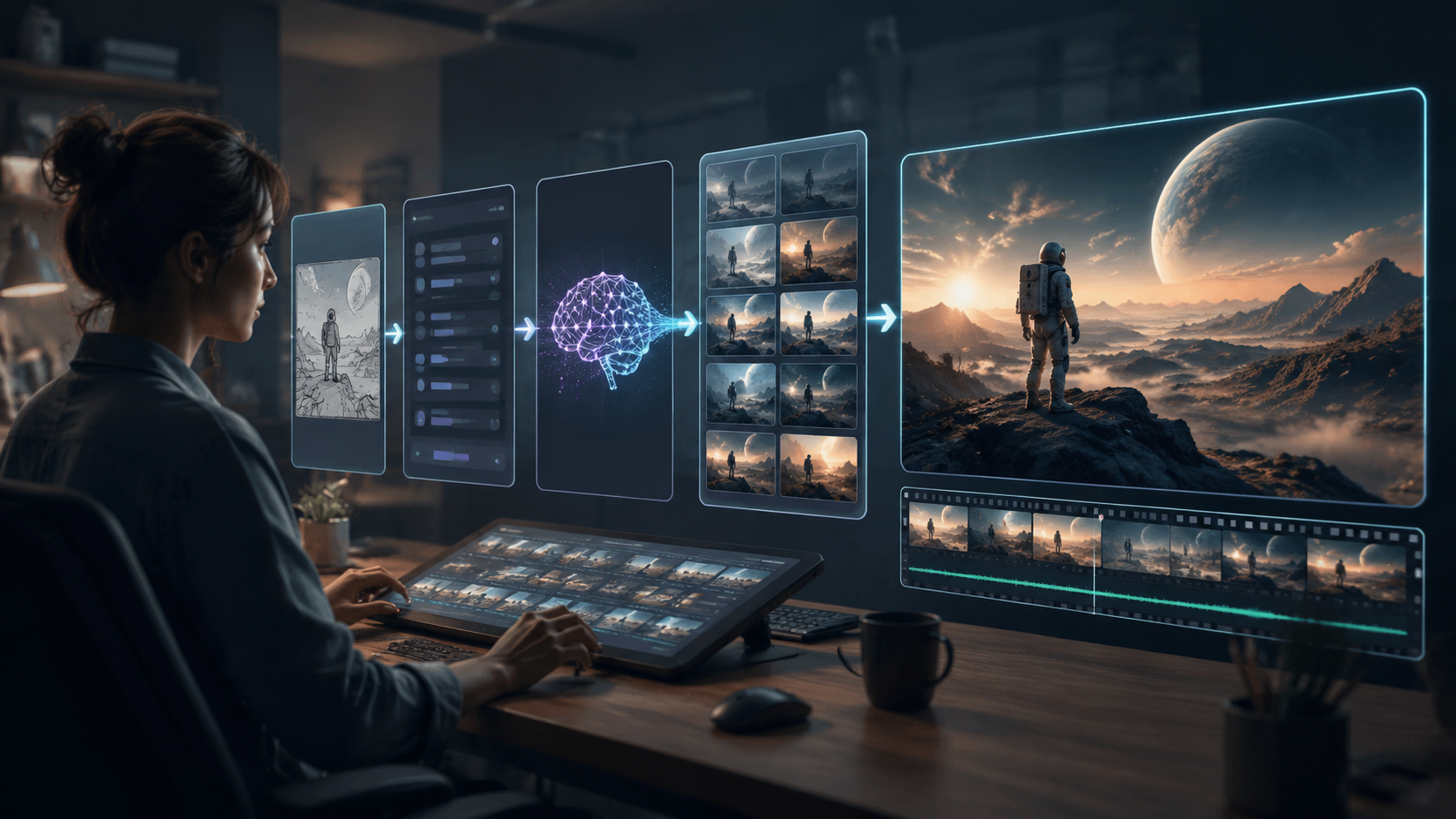
Three technical breakthroughs underpin 2026's AI video advancements: diffusion transformer hybrids, sparse attention mechanisms, and quantum-assisted training. ShengShu's Vidu S1 combines all three, achieving 128-frame coherence (up from 48 in 2025) while reducing power consumption by 31%. The model's interactive capabilities stem from a novel "attention steering" system that reweights latent space parameters during generation.
Memory efficiency has improved dramatically, with Kling AI's latest models requiring only 8GB VRAM for 720p generation versus 16GB a year prior. This enables mobile deployment - ByteDance reports 28% of Seedance 2.5 usage now comes from smartphones. On the quality front, Digen AI Agent's multi-pass system applies successive refinement stages, with each pass improving fidelity by an average of 18% as measured by VMAF scores.
Perhaps most significantly, 2026's models demonstrate emergent understanding of cinematography principles. Internal tests show AI-generated videos now score within 12% of human-created content on metrics like shot composition, pacing, and emotional resonance. This stems from training on annotated professional footage - Kling AI's dataset includes 6.7 million tagged clips from major studios.
Practical Applications Across Industries
Marketing departments were early adopters, with 42% of video ads now being AI-generated according to July 2026 data from Nielsen. Seedance 2.5's localization features enable automatic adaptation of spokesperson ethnicity, language, and cultural references - Unilever reports this boosted conversion rates by 23% in multinational campaigns. Real estate has seen similar gains, with AI video tours reducing property vacancy periods by an average of 11 days.
Education represents another growth area, where AI-generated historical reenactments and scientific visualizations now comprise 17% of digital learning materials. The key advantage is personalization - systems like Digen AI Agent can modify examples based on student demographics while maintaining educational rigor. Medical training simulations have also benefited, with AI-generated surgical videos showing 94% accuracy in procedural demonstrations when validated by specialists.
Entertainment faces both disruption and opportunity. While fully AI-generated short films now compete at festivals (winning 3 awards at 2026's Sundance NEXT program), most studios use the technology for pre-visualization. Marvel's VFX teams report cutting storyboard-to-animatic time by 60% using customized versions of these tools. Meanwhile, indie creators leverage platforms like Nano Banana 2 Lite to produce content at 1/10th traditional costs.
Ethical Considerations and Future Outlook
Copyright remains the most contentious issue, despite Seedance 2.5's automated tagging system. The U.S. Copyright Office's July 2026 ruling that AI video elements cannot be copyrighted (only human-directed arrangements) has created uncertainty. Platforms are responding with provenance tracking - Digen AI Agent now embeds cryptographic watermarks verifying human creative input at each workflow stage.
Deepfake potential continues to worry regulators, though detection tools have kept pace. Adobe's 2026 authentication suite catches 98.7% of synthetic media, while blockchain-based verification systems see growing adoption. More subtle is the concern over cultural homogenization, as AI models trained predominantly on Western media may unintentionally bias global content. Singapore's world model approaches aim to address this by incorporating region-specific aesthetic traditions.
Looking ahead, the next 12 months will likely bring: 1) consumer-facing real-time generation apps, 2) 60+ second coherent narratives, and 3) photorealistic outputs indistinguishable from camera footage. As hardware improves (Google's Gemini Omni Flash promises 4K generation by Q4), AI video may become the default for routine content creation. However, human creativity will remain essential for breakthrough work - the technology serves best as collaborator rather than replacement.

Frequently Asked Questions
What are AI video generation models?
AI video generation models are neural networks trained to create or modify video content autonomously, using techniques like diffusion models and transformers to generate realistic motion and visuals from text or image inputs.
How long can AI-generated videos be in 2026?
The most advanced models like Digen AI Agent now produce coherent 5-minute videos, while mainstream tools typically handle 30-45 second clips - a 150-600% improvement from 2025 capabilities.
Are AI-generated videos copyrighted?
As of July 2026, the U.S. Copyright Office rules that purely AI-generated elements cannot be copyrighted, though human-directed arrangements can be. Platforms are adding tools to document creative input for legal protection.
How much does AI video generation cost?
Prices vary from $0.10 per minute for basic 720p generation to $15/minute for cinematic quality with multi-pass refinement. Enterprise workflow solutions like Digen AI Agent offer subscription plans starting at $299/month.
Can AI video models create consistent characters?
Yes - 2026's leading models track 34+ character attributes across frames. Digen AI Agent maintains appearance consistency for 5+ minute videos through its proprietary memory stack technology.
Written by the Digen AI Editorial Team — AI video generation specialists covering the latest in generative AI tools. Learn more about Digen AI.

Comments ()