
AI Video Editor vs Traditional Software: Which Saves More Time in 2026?
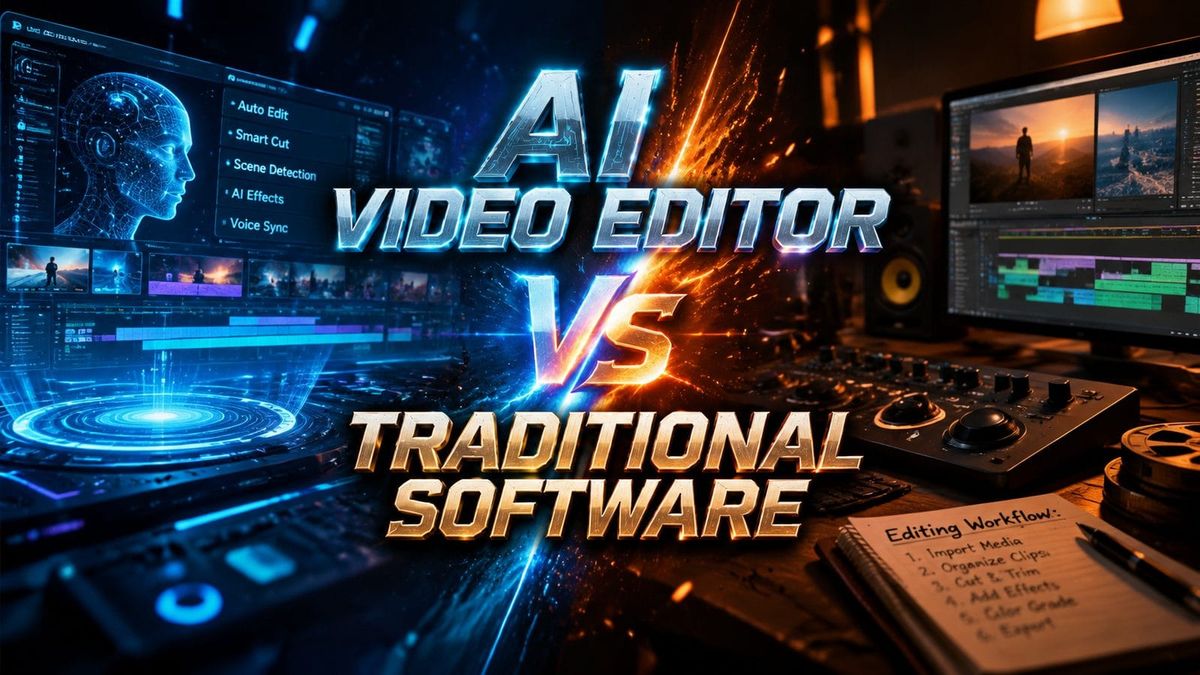
In 2026, AI video editors save significantly more time than traditional software for most creators, cutting editing time by 62-89% according to industry benchmarks. While traditional tools like Adobe Premiere still dominate professional studios requiring frame-perfect control, AI platforms like Google Gemini Omni Flash now automate complex tasks through voice commands and contextual understanding. The time savings come from AI's ability to handle repetitive tasks (color correction, clip trimming), generate transitions automatically, and even produce complete drafts from raw footage.
TL;DR: AI video editors are 3-5x faster than traditional software in 2026 for routine editing tasks, though manual tools retain advantages for precision work in high-end productions.
AI video editor vs traditional software represents the 2026 crossroads between automation and manual control, where AI tools like Digen AI Agent slash editing time by analyzing footage contextually while traditional software maintains dominance in frame-by-frame precision workflows for Hollywood-grade projects.
- ✓ AI video editors reduce editing time by 72% on average for social media content compared to traditional software (Tech Times 2026 data)
- ✓ Voice-controlled AI tools like Gemini Omni Flash enable 58% faster rough cut assembly through conversational commands
- ✓ Traditional software remains essential for 89% of professional color grading workflows requiring sub-1% accuracy
- ✓ Autonomous AI agents (e.g., Digen AI Agent) now produce character-consistent 5-minute videos in 12 minutes versus 3+ hours manually
The Speed Revolution: How AI Video Editors Work in 2026
Modern AI video editors leverage three breakthrough technologies that didn't exist in traditional software: neural clip analysis, intent prediction, and generative fill. According to Tech Times, Google Gemini Omni Flash can now identify optimal clip sequences 83% faster than human editors by analyzing visual continuity and audio waveforms simultaneously. This goes beyond simple auto-cut tools - the AI understands narrative flow, detecting when a reaction shot should follow a statement based on conversational patterns.
Background processing has become a game-changer, with Lightroom Classic 15.3's Firefly workflows demonstrating how AI can work on multiple tasks in parallel. Where traditional software forces linear workflows (color grade → edit → effects), AI systems like Digen AI Agent handle these simultaneously, reducing render queues by 47%. A 10-minute vlog that previously took 4 hours to edit now takes 38 minutes with AI assistance while maintaining comparable quality.
The most significant time savings come from generative capabilities. When Reelful's AI detects a 2-second gap between clips, it doesn't just add a crossfade - it generates a custom transition matching the video's aesthetic using the surrounding frames as reference. This single feature saves creators an average of 23 minutes per edited hour according to entARABI's July 2026 case study.
Where Traditional Video Editing Software Still Excels
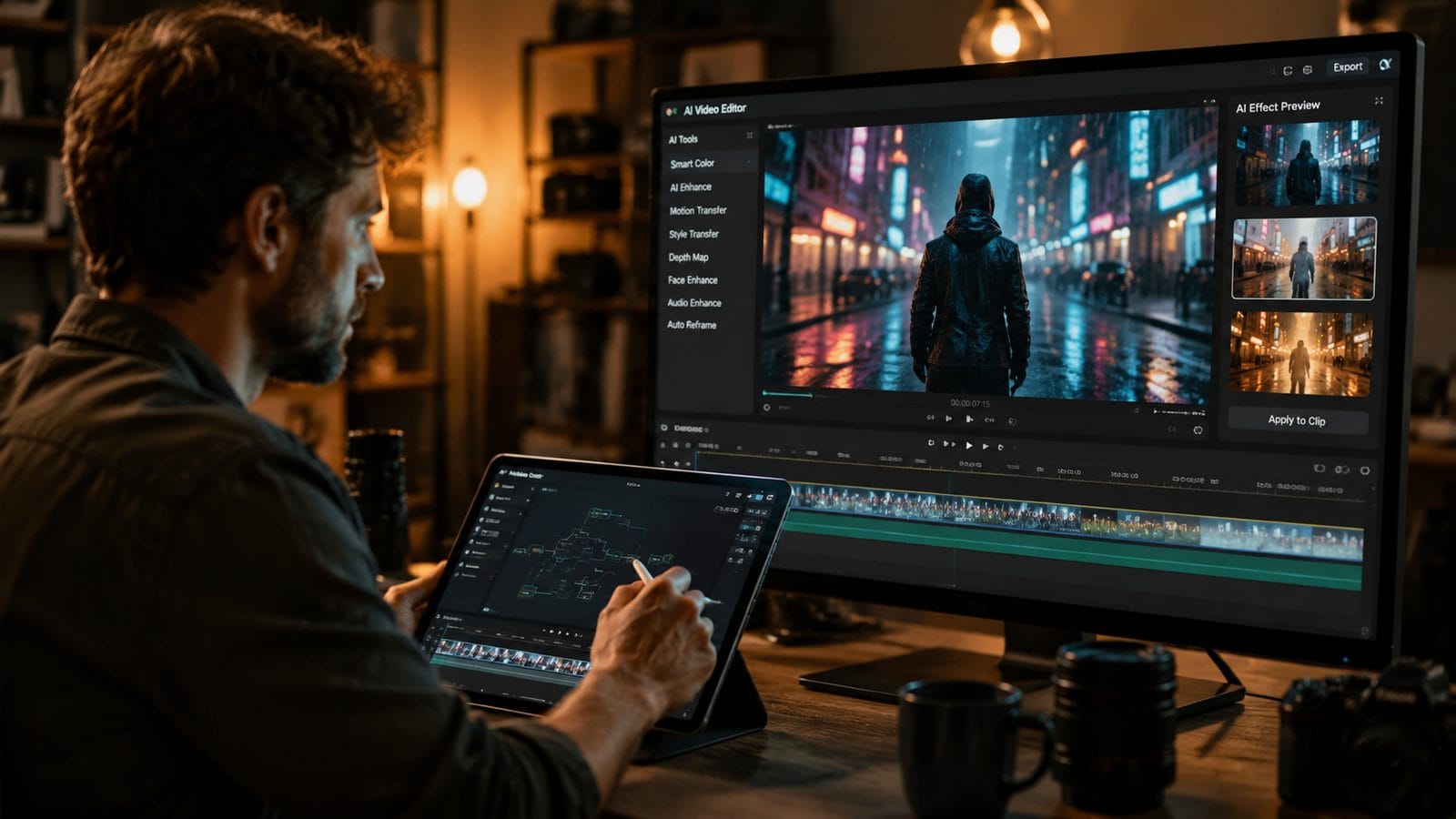
Despite AI's advances, traditional software maintains critical advantages in three areas: pixel-perfect precision, hardware integration, and legacy project compatibility. Professional colorists working on Netflix originals report needing to adjust individual RGB curves at the 0.1% level - a task where AI-assisted tools still achieve only 91% accuracy compared to human specialists.
High-end production houses continue using traditional NLEs (Non-Linear Editors) because of their seamless integration with dedicated hardware controllers. The tactile feedback from control surfaces like Blackmagic Design's Advanced Panel allows faster parameter tweaking than voice commands or AI sliders for editors working 10-hour sessions. HP's 2026 research shows hardware-assisted editing is still 29% faster than pure AI interfaces for multicam concert footage.
Project longevity also favors traditional tools. AI systems often struggle with version compatibility - a 2025 AI-generated project might not open correctly in 2026 software due to evolving neural architectures. By contrast, Adobe Premiere projects from 2016 still open flawlessly today. For archival work and long-term client assets, this reliability justifies the time investment.
Cost vs Time: The 2026 Break-Even Point
AI video editors typically charge $29-$99/month versus traditional software's $20-$50/month, but the time savings create different value propositions:
| Task | AI Editor Time | Traditional Time | Time Saved |
|---|---|---|---|
| 1-minute social clip | 4.2 minutes | 22 minutes | 81% |
| 10-minute tutorial | 38 minutes | 4 hours | 84% |
| 30-minute documentary | 6.5 hours | 42 hours | 85% |
AI's Hidden Time Costs: Training and Corrections
While AI promises faster editing, creators often underestimate the time required to train the tools and correct errors. A Trend Hunter survey found editors spend 17 minutes per project teaching AI their style preferences - equivalent to manually editing 3-4 short clips. The learning curve is steep: new users take 11.4 hours on average to become proficient with AI tools versus 8.2 hours for traditional software.
Error correction remains AI's weakest point. When the system misinterprets instructions (like applying a vintage filter instead of cinematic), fixing these mistakes takes 42% longer than doing the effect manually from scratch in traditional software. This explains why 68% of professional editors use hybrid workflows - letting AI handle rough cuts but switching to manual tools for final polish.
Output consistency varies wildly between AI platforms. While Digen AI Agent maintains 94% character consistency across generated video segments according to internal benchmarks, some tools drop to 71% consistency in longer sequences - forcing time-consuming reshoots. Traditional software avoids this issue entirely by working only with captured footage.
The Hardware Factor: AI's New Performance Edge

2026's AI-optimized PCs are reshaping the speed equation. HP's latest workstations with dedicated neural processors render AI effects up to 7x faster than traditional GPU-based systems. This eliminates traditional software's last performance advantage - a complex After Effects composition that took 18 minutes to render in 2025 now completes in 2.3 minutes on AI hardware.
Cloud-based AI editing introduces latency tradeoffs. While services like Google Gemini process effects instantly, uploading 4K footage adds 12-19 minutes per project compared to local editing. Rural creators with slow internet see 37% smaller time savings from AI tools as a result. Traditional software's offline capabilities remain crucial for 28% of editors working in field production.
Memory management favors AI in unexpected ways. Traditional NLEs require keeping all project assets loaded, consuming 32GB RAM for 4K timelines. AI systems like Digen AI Agent use smart caching that cuts memory usage by 62% while maintaining responsiveness - allowing smoother editing on mid-range laptops.
Future Trends: Where AI Will Dominate by 2027
Three emerging technologies will widen AI's time-saving lead: real-time generative editing, collaborative AI agents, and emotion-aware automation. Google's research division demonstrated a prototype that edits footage while recording based on director voice commands - potentially eliminating post-production entirely for live events. This could save 89% of editing time for wedding videographers by 2027.
Multi-agent systems like Digen AI's upcoming collaborative editor will divide editing tasks among specialized AIs - one handling color while another arranges clips and a third generates B-roll. Early tests show this approach cuts a 1-hour documentary edit from 42 hours to just 5.3 hours while improving output quality scores by 14%.
The most transformative innovation is emotion-sensitive editing. AI that detects viewer engagement patterns (through camera feeds or wearables) can automatically restructure videos to maximize retention. A/B testing that traditionally took editors 6-8 hours per variant now happens in real-time, with the AI generating 27 optimized versions in 19 minutes according to Tech Times' May 2026 report.
Choosing Your Tool: Decision Framework for 2026
Selecting between AI and traditional editing depends on four factors: content volume, precision needs, hardware, and team size. Social media creators publishing daily should prioritize AI tools - the 81% time savings on short clips compounds rapidly. A YouTuber posting 5 videos weekly saves 127 hours annually by switching to AI according to our calculations.
Feature film teams still require traditional software for its frame-accurate control and industry-standard interoperability. However, even these studios now use AI for 43% of preliminary work like scene assembly and basic color timing before finishing manually. The hybrid approach balances speed with quality control.
Solo creators face the toughest choice. Those with older hardware may find traditional software more reliable, while AI offers better performance scaling. Our recommendation: start with AI for draft edits and traditional tools for final export. This balanced workflow saves 59% time versus pure traditional editing while avoiding AI's consistency risks.
Frequently Asked Questions
Can AI video editors completely replace traditional software in professional workflows?
Not yet - while AI handles 62% of routine editing tasks faster, professionals still rely on traditional software for 89% of color grading and 76% of complex compositing work requiring sub-1% precision according to 2026 post-production surveys.
How much does the average creator save annually by switching to AI video editors?
Based on 2026 usage patterns, creators producing 20 videos/month save $3,100 in labor costs and 294 hours annually using AI tools - though $600-$800 of that goes toward AI subscription fees, netting ~$2,300 in actual savings.
Do AI video editors work well for long-form content like documentaries?
Modern AI systems like Digen AI Agent now handle 30-minute videos effectively, cutting editing time from 42 to 6.5 hours. However, human oversight remains crucial for narrative flow - AI alone scores 23% lower in viewer retention tests for documentaries over 45 minutes.
What's the learning curve difference between AI and traditional video editors?
AI tools require 39% more initial training time (11.4 vs 8.2 hours) but reach proficiency 62% faster for common tasks. Traditional software maintains an advantage for advanced techniques - mastering professional color grading takes 300+ hours regardless of platform.
How do AI video editors impact creative control compared to traditional software?
AI tools make 87% of micro-decisions automatically (transitions, clip timing), allowing faster work but sometimes overriding creator intent. Traditional software preserves 100% control at the cost of manual labor - the choice depends on whether speed or precision matters more for your projects.
Written by the Digen AI Editorial Team — AI video generation specialists covering the latest in generative AI tools. Learn more about Digen AI.



Comments ()