
Best AI Video Editor for Short Form Content in 2026
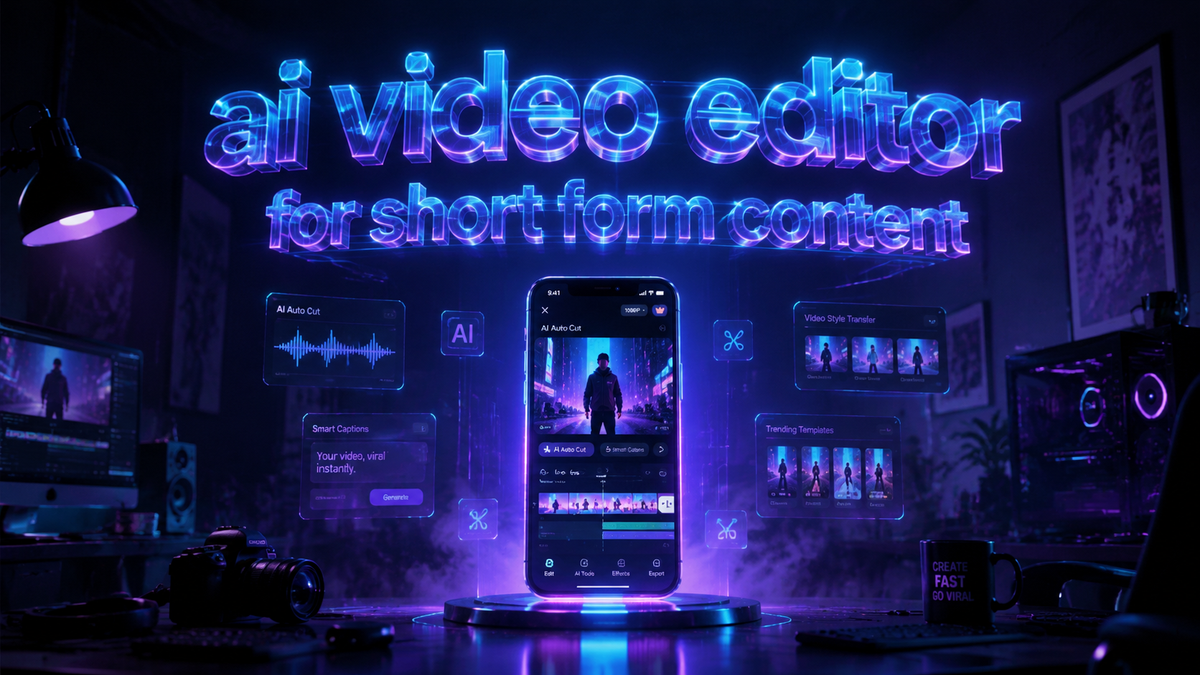
The best ai video editor for short form content in 2026 is a tool that automates the transition from long-form footage to viral-ready clips using multi-modal AI agents. As of mid-2026, industry leaders like FlexClip, Wondershare Filmora, and Picsart Aura have redefined the "clipping economy" by integrating automated scene detection, AI-driven captioning, and social-trend forecasting directly into the editing timeline.
An ai video editor for short form content is a specialized software platform that uses machine learning to automatically identify highlights in raw footage, crop videos for vertical formats (9:16), and generate subtitles. In 2026, these tools focus on "Long to Shorts" conversion, allowing creators to produce weeks of social media content from a single video file in minutes.
- ✓ AI "Long to Shorts" technology is now the industry standard for rapid content repurposing.
- ✓ Advanced AI agents, such as Pollo AI, can now handle the entire creative workflow from script to final render.
- ✓ Integration with social media trend data allows editors to suggest specific music and pacing for TikTok and Reels.
- ✓ Cloud-based rendering has reduced export times by 70% compared to traditional 2024-era software.
The landscape of digital creation has shifted significantly this year. According to NPR, the "clipping economy" has become a dominant force on the internet, with professional clippers and marketing agencies using AI to overrun social feeds with high-quality, short-form snippets. This surge in volume is made possible by the evolution of the ai video editor for short form content, which has moved beyond simple filters into the realm of fully autonomous video production.
How to Use an AI Video Editor for Short Form Content
Modern AI editors have simplified the production workflow into a few automated steps. Whether you are a solo creator or a marketing agency, the goal is to minimize manual labor while maximizing the viral potential of every frame. By leveraging the latest 2026 updates from platforms like FlexClip and Picsart, the process has become nearly instantaneous.
- Upload and Analyze: Import your high-resolution long-form video (such as a podcast or webinar). The AI engine scans the audio and visual cues to identify high-engagement moments.
- Select "Long to Shorts" Mode: Use specialized features, such as FlexClip’s "AI Long to Shorts," to automatically segment the video into 15, 30, or 60-second clips.
- Apply AI Branding: Choose a template from tools like Picsart Aura that matches your brand identity. The AI will automatically adjust colors, fonts, and layouts.
- Generate Dynamic Captions: The editor transcribes the audio and overlays animated, stylish captions that are essential for silent-scrolling viewers.
- Review and Export: Finalize the AI-suggested cuts and export directly to TikTok, Instagram Reels, or YouTube Shorts.
The Evolution of AI Video Editing in 2026
In 2026, we have moved past the era of manual keyframing. The latest software releases, such as the May 2026 update to Wondershare Filmora, have introduced deep integration with generative AI agents. These agents don't just follow instructions; they understand the context of the footage. For instance, if you are editing a cooking video, the AI recognizes the "money shot" of the finished dish and ensures it is the thumbnail for your short-form clip.
According to Scott Coop’s review of the Pollo AI Video Agent, these tools now act as "creative partners." The Pollo AI system can take a simple text prompt and build a full video sequence, including B-roll and voiceovers, which can then be sliced into shorter segments. This level of automation is why marketing agencies are increasingly ditching traditional suites for AI-first alternatives.
The Rise of the "Clipping Economy"
As reported by NPR in May 2026, the internet is currently experiencing a "clipping economy" boom. This phenomenon involves creators taking existing long-form intellectual property and using an ai video editor for short form content to distribute thousands of variations across the web. This strategy has proven to be the most effective way to gain algorithmic traction in 2026, leading to a massive demand for tools that can handle bulk processing without sacrificing quality.
Comparison of Top AI Video Editors for 2026
Choosing the right ai video editor for short form content depends on your specific needs—whether you require a tool for high-end professional production or a mobile-first app for quick social updates. Below is a comparison of the leading platforms based on the latest 2026 feature sets.
| Feature | FlexClip (2026) | Wondershare Filmora | Picsart Aura | Pollo AI Agent |
|---|---|---|---|---|
| Primary Strength | Long to Shorts Repurposing | Professional Desktop AI Tools | Social-First Design | Autonomous Creation |
| AI Captioning | Real-time Multi-language | Advanced Keyframe Sync | Stylized/Animated | Dynamic Script-to-Text |
| Target Audience | Content Repurposers | Prosumer Editors | Social Media Influencers | Marketing Agencies |
| Key 2026 Update | Viral-Ready AI Clipping | AI Agent Integration | Aura Social Intelligence | Full Video Autonomy |
Why Marketing Agencies Prefer AI-First Tools
Marketing agencies have seen a massive shift in their workflow this year. A report from FinancialContent (June 2026) highlights that the best AI video generators for agencies are those that offer "tested and compared" efficiency. Agencies are no longer looking for just an editor; they are looking for a system that can manage the volume required for modern digital campaigns.
The integration of "Aura" by Picsart, launched in February 2026, is a prime example of this shift. Aura allows agencies to deliver social content and short-form videos in minutes rather than hours. By utilizing social intelligence, Aura predicts which visual styles will perform best on specific platforms, taking the guesswork out of the creative process. This data-driven approach is what separates a standard ai video editor for short form content from a world-class marketing tool.
Wondershare Filmora vs. VEGAS Pro
A significant debate in the creative community this year, as noted by Gadget Flow in May 2026, is the comparison between Wondershare Filmora and VEGAS Pro. While VEGAS Pro remains a staple for traditional cinema-style editing, Filmora has surged ahead in the short-form space due to its aggressive implementation of AI. Filmora’s 2026 suite includes "Smart Cutout 3.0" and "AI Social Reframing," which are specifically designed to make the transition to vertical video seamless for creators who previously only worked in landscape formats.
Maximizing Engagement with AI Short Form Content
To succeed with an ai video editor for short form content, you must understand the nuances of the 2026 algorithms. It is no longer enough to just post a vertical video; the video must be optimized for "retention hooks." Modern AI editors now include "Hook Detection" features that highlight the most provocative or interesting parts of your audio, suggesting them as the opening three seconds of your clip.
Furthermore, the use of AI-generated B-roll has become standard. If your primary footage has a lull, tools like Pollo AI can automatically insert relevant, high-definition generative b-roll to keep the viewer’s eye moving. This technique has been shown to increase average view duration by up to 40% on platforms like TikTok and Instagram, according to recent 2026 industry benchmarks.
The Impact of AI "Long to Shorts" Technology
The release of FlexClip’s "AI Long to Shorts" in May 2026 marked a turning point for creators. This technology uses natural language processing (NLP) to read the transcript of a video, understand the "arc" of a story, and extract clips that have a clear beginning, middle, and end. This solves the age-old problem of AI clips feeling "cut off" or lacking context. For creators managing multiple channels, this tool is the backbone of their distribution strategy.
Future Trends: What’s Next for AI Video Editors?
As we look toward the latter half of 2026 and into 2027, the trend is moving toward "Hyper-Personalization." We are starting to see the first iterations of AI video editors that can create different versions of the same short-form clip for different audience segments. For example, a travel brand could use an ai video editor for short form content to automatically swap out the background music and color grading of a video based on whether the viewer is in Europe or North America.
The "clipping economy" will only continue to grow as the barrier to entry drops. With tools like Picsart Aura and Pollo AI making professional-grade production accessible to anyone with a smartphone, the focus will shift from "how to edit" to "what to create." The winners in this new era will be those who can leverage AI to tell better stories, faster than ever before.
What is the best ai video editor for short form content in 2026?
FlexClip and Wondershare Filmora are currently the top-rated tools due to their specialized "Long to Shorts" features and AI agent integrations. These platforms allow for rapid repurposing of content with minimal manual effort.
How does AI help in making TikTok and Reels?
AI automates the most time-consuming parts of the process, including vertical reframing, subtitling, and finding the most engaging segments of a long video. This allows creators to post more frequently and stay relevant in the fast-moving social algorithms.
Can AI video editors create content from scratch?
Yes, tools like Pollo AI Video Agent, reviewed in May 2026, can generate full video sequences from text prompts. These "AI Agents" handle everything from scriptwriting to visual generation and voiceovers.
Is AI video editing expensive in 2026?
Most AI video editors offer tiered subscription models. While basic features are often affordable for solo creators, advanced agency-grade tools with bulk processing capabilities are priced for professional marketing budgets.
What is the "clipping economy"?
As described by NPR, the clipping economy refers to the massive ecosystem of creators and automated tools that repurpose long-form media into short, viral clips. This has become a primary method for content distribution and audience growth in 2026.



Comments ()