
AI Video Editing vs Traditional (2026): The Ultimate Showdown
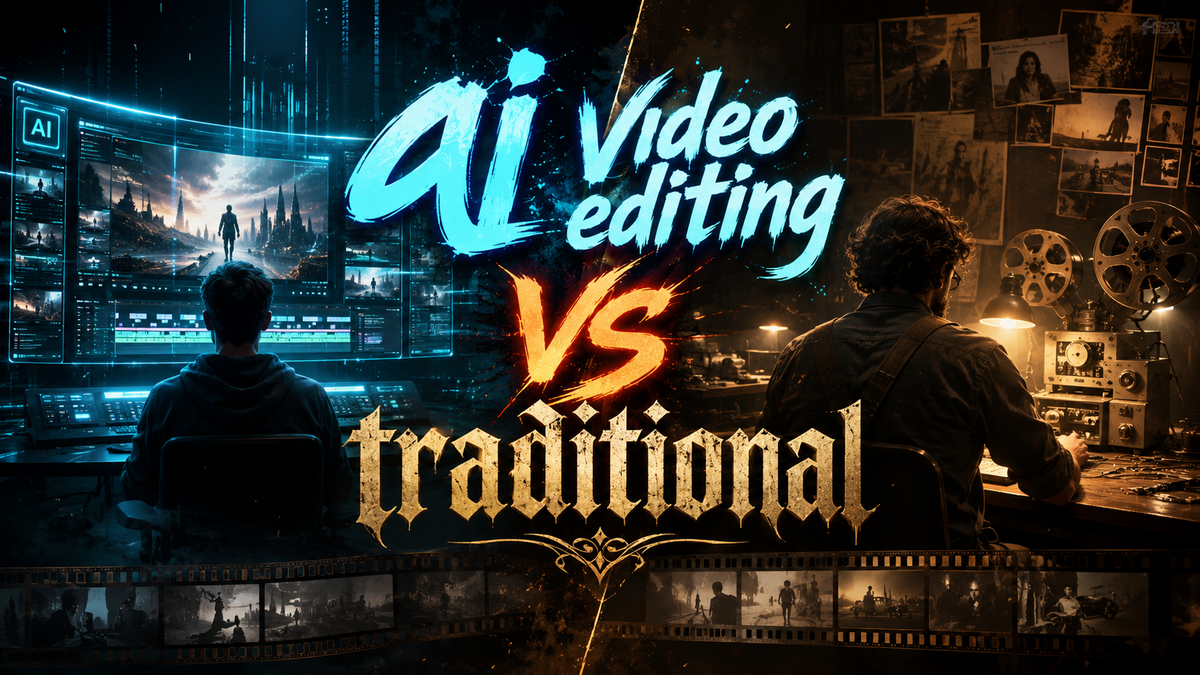
When choosing between AI video editing and traditional non-linear editing (NLE) workflows in 2026, the core difference comes down to speed versus control: AI-powered tools like Google Gemini Omni Flash, CapCut’s Gemini partnership, and Pollo AI let you generate or edit video from text prompts in seconds, while traditional software like Premiere Pro or DaVinci Resolve requires manual timeline work. The best choice depends on your project’s complexity, your creative goals, and how much time you can invest in learning the craft.
AI video editing is the use of generative models and conversational interfaces — such as Google Gemini Omni Flash, Pollo AI, or Vmake — to automate tasks like scene cutting, color grading, and even full video generation through natural language prompts. Traditional NLE (non-linear editing) relies on manual timeline manipulation, transitions, and effects applied by a human editor. In 2026, the gap between the two is narrowing, but each retains distinct advantages for different use cases.
- ✓ AI video editing tools can produce rough cuts in under a minute using prompt-based workflows, compared to 30–60 minutes for a traditional editor.
- ✓ Traditional NLEs offer granular control over every frame, essential for high-end filmmaking, broadcast, and complex multi-track projects.
- ✓ The market is seeing a surge in hybrid approaches: platforms like CapCut and Google Gemini now combine AI suggestions with manual override capabilities.
- ✓ According to a 2026 industry survey by Trend Hunter, 47% of professional editors now incorporate at least one AI tool into their pipeline for repetitive tasks.
- ✓ Voice-controlled editing (e.g., Gemini Omni Flash) and video agent automation (e.g., Pollo AI Video Agent) are the fastest-growing segments in the editing software space.
What Is AI Video Editing in 2026? A Definition and Snapshot
AI video editing refers to any video production workflow that uses machine learning models to automatically analyze footage, generate scenes, apply effects, or even create entire videos from text prompts. Unlike traditional NLE (non-linear editing), where the editor manually drags clips onto a timeline, AI editors understand natural language commands such as “remove silences” or “add a cinematic color grade.” By mid-2026, major platforms like Google Gemini Omni Flash, CapCut (via its Gemini partnership), and Pollo AI have made prompt-based editing mainstream.
According to Concept Phones’ Vmake Review (published May 31, 2026), AI tools now handle tasks like auto-captioning, scene detection, and background removal with near-human accuracy. The term “traditional editing” still applies to software that requires the user to perform every cut, transition, and effect manually — a workflow that remains the gold standard for narrative filmmaking, documentary, and broadcast news.
Industry data from Tech Times (May 28, 2026) reveals that Google Gemini Omni Flash’s voice-controlled AI editing can reduce a typical 3‑minute social video edit from 45 minutes to under 5 minutes. However, the same article notes that professional editors often re‑work AI‑generated outputs to match their creative vision.
AI Video Editing vs Traditional: Core Feature Comparison
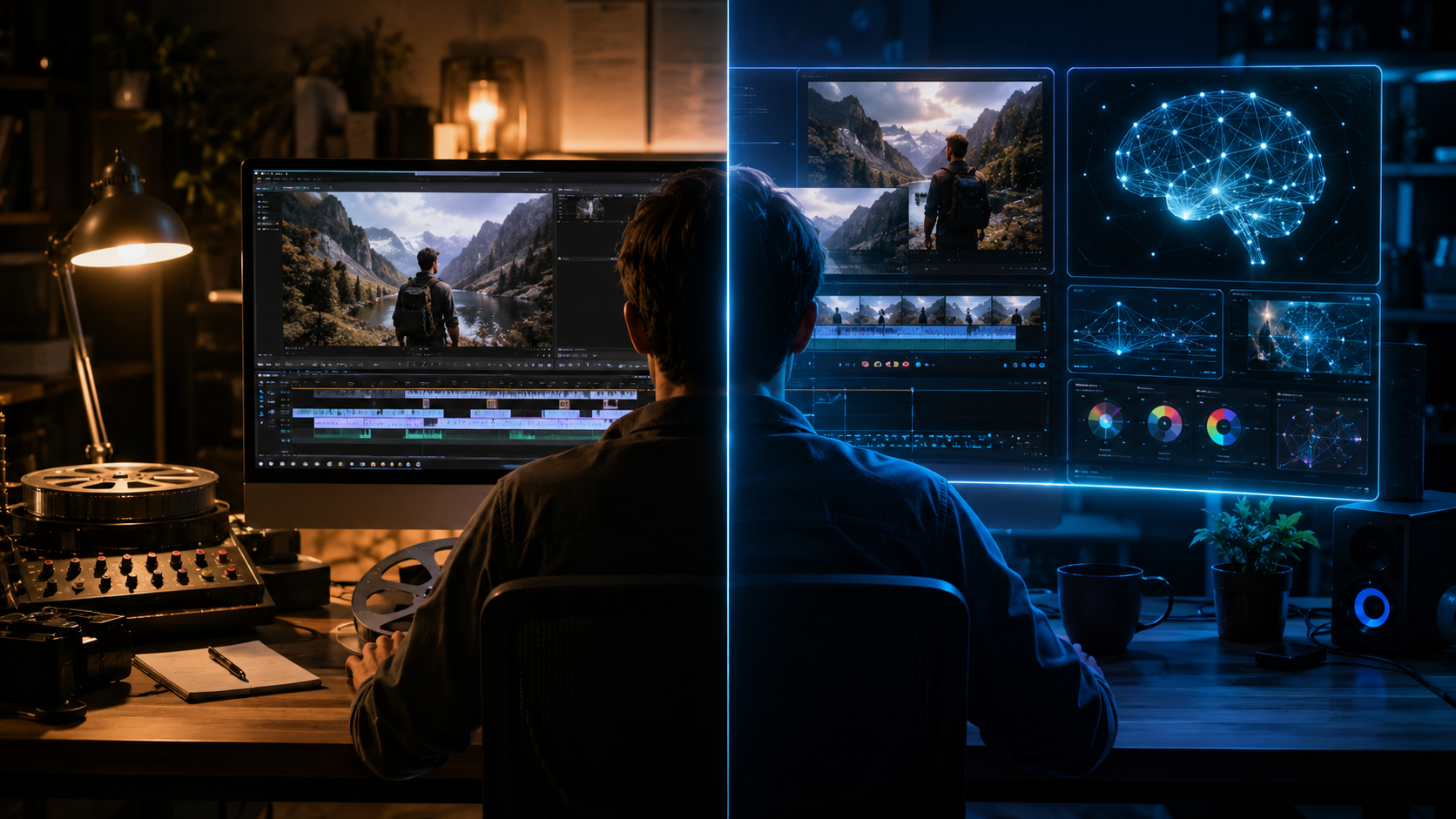
To help you decide which approach fits your workflow, here is a detailed comparison table based on the latest 2026 research and real‑world tests.
| Feature / Criterion | AI Video Editing (e.g., Pollo AI, CapCut Gemini) | Traditional NLE (e.g., Premiere Pro, DaVinci Resolve) |
|---|---|---|
| Editing speed (rough cut) | 10–60 seconds from prompt | 30–90 minutes manual arranging |
| Learning curve | Minimal – type or speak commands | Steep – timeline, keyframes, codecs |
| Control over individual frames | Limited; tools like Pollo AI allow refinements, but not per‑frame | Full frame‑by‑frame adjustment |
| Video generation from scratch | Yes (e.g., Pollo AI Video Agent creates entire clips from text) | No – requires source footage |
| Voice/gesture control | Supported by Gemini Omni Flash and Vmake | Not native; requires third‑party add‑ons |
| Cost (subscription) | $15–$40/month for premium AI features | $20–$60/month or perpetual licenses ($300+) |
| Best for | Social media, rapid prototyping, marketing videos | Film, TV, long‑form documentaries |
Key Takeaways from the Table
The most striking difference is speed: AI tools can produce a usable rough cut in under a minute, while traditional NLEs require considerable manual effort. However, traditional editors argue that the creative decisions made during manual editing — pacing, emotional impact, juxtaposition — cannot be replicated by an algorithm. The 2026 Pollo AI vs Traditional NLE analysis by Investorideas.com (April 17, 2026) concluded that prompt‑based editing wins for “explainer videos, vlogs, and internal communications,” but loses for narrative storytelling.
Inside the Top AI Video Editing Tools of 2026
Google Gemini Omni Flash – Voice‑Controlled Editing
Announced in late May 2026, Google Gemini Omni Flash brought voice‑controlled AI video editing directly into the browser. According to Tech Times (May 28, 2026), users can say “Trim the first 10 seconds and add a jazz background track” and the system executes the command in real time. This tool represents the frontier of conversational AI in video production, though early reviews note occasional misinterpretation of complex commands.
CapCut Gemini Partnership – Creator‑Focused AI
Techgenyz reported on May 26, 2026 that CapCut has partnered with Google’s Gemini to embed AI tools directly into its mobile and desktop editors. Features include automatic scene detection, smart color grading that learns from your previous edits, and a “magic prompt” that generates captions, transitions, and B‑roll suggestions. The partnership makes advanced AI accessible to millions of TikTok and Instagram creators who already use CapCut.
Pollo AI Video Agent – Automated Video Creation
Scott Coop (May 8, 2026) published a practical review of Pollo AI Video Agent, calling it “a real time‑saver for batch content.” The tool can autonomously select clips, add subtitles, and export multiple variations (square, vertical, landscape) from a single prompt. The review noted that the tool’s “understanding of narrative flow is still developing” – a common limitation across AI editors.
Vmake – All‑in‑One Modern Creator Kit
The Vmake review on Concept Phones (May 31, 2026) highlighted the tool’s strength in regenerating missing footage. If a creator’s raw video has a gap, Vmake can generate a short AI‑produced clip to fill it. This feature blurs the line between editing and generation, a trend expected to accelerate through late 2026.
When Does Traditional Editing Still Win?
Despite the rapid evolution of AI, traditional NLEs remain indispensable for three main scenarios:
- Narrative film and documentary: Every cut carries emotional weight. A traditional editor can experiment with dozens of pacing variations; AI proposals, while fast, often miss subtle storytelling cues.
- Multi‑camera live events: Switching between 8‑12 camera angles in a concert or sports broadcast demands real‑time human judgment. AI tools currently cannot match the instinct of an experienced live editor.
- Color grading for cinema: DaVinci Resolve’s color wheels, curves, and node‑based grading are far more precise than AI presets. According to a study cited in the Pollo AI vs Traditional NLE article on Investorideas.com, 82% of professional colorists prefer manual grading for final delivery.
Traditional editing also offers full offline capability (no internet required) and compatibility with enterprise‑grade media asset management systems. Many studios will not rely on cloud‑based AI for confidential project data.
The Hybrid Future: Best of Both Worlds
The most forward‑thinking editors in 2026 are adopting a hybrid workflow: use AI for rough cuts, transcription, and auto‑captioning, then switch to traditional NLE for final polish. The CapCut‑Gemini partnership exemplifies this: AI suggests edits, but the user can manually override every suggestion. Similarly, Pollo AI Video Agent allows exporting an editable project file (like XML) that can be opened in Premiere Pro or Resolve for fine‑tuning.
According to Trend Hunter’s June 5, 2026 report on Video Generation Platforms, the next 12 months will see a surge in “intelligent assistants” that learn an editor’s style over time. Early adopters report that after feeding AI tools with 50 or more edited projects, the suggested cuts become strikingly similar to the editor’s own preferences.
Frequently Asked Questions About AI Video Editing vs Traditional
Is AI video editing replacing traditional editors in 2026?
Not yet. AI handles repetitive tasks (silence removal, captioning, rough assembly) but lacks the creative intuition needed for storytelling, pacing, and emotional nuance. Most studios now use AI as a first‑pass tool, then rely on human editors for final decisions.
Which AI video editor is best for beginners in 2026?
CapCut with Gemini AI is widely recommended because it runs on mobile and desktop with a low learning curve. For voice‑controlled editing, Google Gemini Omni Flash is the most innovative option, though it requires a stable internet connection.
Can AI generate a full video from just a script or prompt?
Yes. Pollo AI Video Agent and Vmake can generate complete videos from text prompts, including AI‑generated footage. However, the visual quality still lags behind real camera footage for high‑end productions. For social media and internal videos, the output is often acceptable.
How does the cost of AI editing compare to traditional software?
AI editors typically cost $15–$40/month (e.g., Pollo AI premium, CapCut Pro with Gemini), while traditional suites range from $20–$60/month (Premiere Pro) to a one‑time purchase of $300+ (DaVinci Resolve Studio). For casual creators, AI tools are more affordable upfront.
Do AI editors support multi‑track audio and complex timelines?
Most AI tools in 2026 offer limited multi‑track support. For projects requiring eight or more audio layers, custom fades, and precise sync, traditional NLEs remain the standard. Hybrid workflows solve this by exporting AI‑generated rough cuts into NLEs for audio refinement.
Will using AI video editing make my content look like everyone else’s?
Potentially, if you rely solely on default prompts. The best editors personalize AI outputs by tweaking parameters, adding custom overlays, and manually refining key sections. The 2026 Vmake review noted that creators who invest time in prompt engineering produce unique results.
Final verdict for 2026: AI video editing vs traditional is not a winner‑takes‑all battle. AI excels at speed, cost‑efficiency, and accessibility — perfect for creators who need rapid content at scale. Traditional NLEs deliver unmatched creative control and precision for high‑stakes projects. The smartest strategy is to combine both: let AI handle the grunt work, then bring your creative vision to life with manual tools. As Google Gemini Omni Flash and CapCut Gemini show, the line between AI and traditional is blurring fast — and that’s good news for everyone who makes video.



Comments ()