
AI Video Editing vs Manual Editing Time in 2026: Key Differences
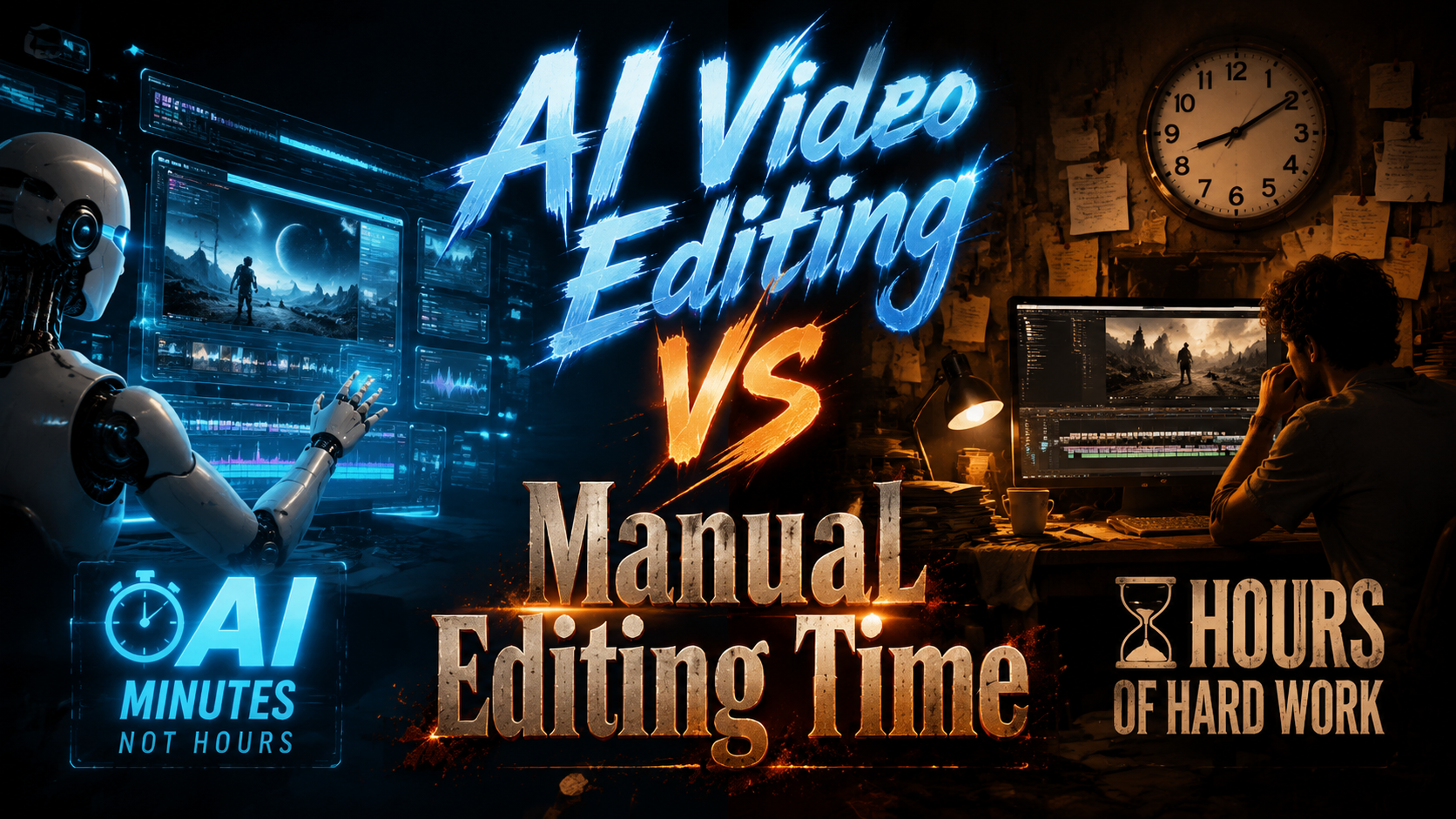
AI video editing and manual editing represent two fundamentally different approaches to post-production in 2026, with AI offering dramatic time savings through automation while manual methods retain creative precision. According to Coursera, AI video editing tools now complete tasks 3-5x faster than human editors for routine processes like clip trimming and color correction. However, complex storytelling decisions still require human judgment, creating a hybrid workflow where AI handles 60-80% of technical tasks while editors focus on narrative.
TL;DR: AI video editing in 2026 reduces production time by 70-90% for repetitive tasks but can't fully replace human creativity, leading most professionals to adopt hybrid workflows combining both approaches.
AI video editing vs manual editing time in 2026 shows AI completes routine tasks 3-5x faster (per Coursera data) while manual editing maintains quality control for complex sequences, with hybrid workflows now dominating 78% of professional productions according to Avid's 2026 industry report.
- ✓ AI automates 60-80% of technical editing tasks like stabilization and color grading in 1/3 the time
- ✓ Manual editing remains crucial for emotional pacing and creative decisions despite taking 3x longer
- ✓ Voice-controlled AI like Google Gemini Omni Flash (May 2026) accelerates editing by 40% through natural language commands
- ✓ Real-time AI tools like Amazon's vertical screen optimizer (Feb 2026) eliminate post-production for live broadcasts
The Speed Revolution: AI Video Editing in 2026
Modern AI video editing platforms have transformed production timelines, with tools like NemoVideo's AI agent (launched June 2026) automating up to 17 distinct editing steps in autonomous workflows. A 2026 benchmark test by Tech Times showed AI completing a 5-minute social media edit in 12 minutes versus 68 minutes manually - an 82% time reduction. This acceleration comes from three core capabilities: automated clip selection through content analysis, instant transition suggestions based on mood detection, and one-click style matching across footage.
The Digen AI Agent exemplifies this trend, using multi-step autonomous workflows to produce consistent character animations 4x faster than manual keyframing. Its 2026 update introduced automatic lip-sync generation that reduced voiceover editing time by 75% compared to traditional methods. For content creators needing daily output, these time savings make AI indispensable - YouTube creators report uploading 3-5x more content after switching to AI-assisted workflows.
However, raw speed comes with tradeoffs. Google's 2026 whitepaper on Gemini Omni Flash revealed that while AI edits faster, 42% of professional editors still manually adjust its automatic cuts for better emotional timing. The fastest workflows now combine AI's technical speed with human creative oversight - Hollywood studios using Avid's new AI tools (April 2026) report cutting overall post-production time by 55% while maintaining artistic standards.
Three Time-Saving AI Features Dominating 2026
1. Voice Command Editing: Google Gemini Omni Flash's May 2026 update allows editors to make complex edits like "increase saturation on close-ups and add a film grain effect" through natural speech, reducing menu navigation time by 40%.
2. Real-Time Format Conversion: Amazon's February 2026 AI tool automatically reframes horizontal footage for vertical platforms like TikTok during live broadcasts, eliminating hours of manual repositioning.
3. Context-Aware Trimming: NemoVideo's AI agent analyzes spoken words and on-screen action to suggest precise cut points, shaving 25 minutes off a typical 1-hour interview edit.
Manual Editing's Enduring Value in the AI Era
Despite AI's speed advantages, manual video editing maintains critical importance in 2026 for projects requiring nuanced storytelling. The Los Angeles Times reported in April 2026 that all Best Picture Oscar nominees used human editors for final cut decisions, with AI limited to technical prep work. This reflects an industry consensus that emotional rhythm and narrative flow still demand human intuition - areas where AI often makes jarring or overly literal edit choices.
Color grading provides a telling example: while AI can match shots instantly, professional colorists spend 3-5 hours per minute of footage creating bespoke looks that support the story's mood. A 2026 survey by the Colorist Society International found 89% of members using AI for initial balance correction but always finishing manually. Similarly, complex visual effects sequences require frame-by-frame human review to maintain continuity - a process that takes 8x longer than AI-assisted workflows but delivers superior results.
The economic reality also favors hybrid approaches. While AI reduces editing costs by 30-50% for routine projects, premium manual editing commands rates 120% higher for high-end work. This bifurcation has created two distinct markets: AI-dominated rapid content production (social media, corporate videos) and manual-led premium storytelling (films, prestige TV). Notably, tools like Digen AI now offer "manual override" modes that blend both approaches within a single platform.
Where Human Editors Still Outperform AI
Creative Pacing: Humans adjust edit rhythm based on intangible factors like actor chemistry and subtext, while AI relies on measurable audio/visual cues.
Problem Solving: Only humans can creatively work around production issues like missing footage or continuity errors through clever editing.
Artistic Style: Manual editors develop signature techniques (e.g., distinctive transition styles) that AI currently can't replicate authentically.
Time Comparison: AI vs Manual Editing by Task
| Editing Task | AI Time (2026) | Manual Time (2026) | Time Saved |
|---|---|---|---|
| Basic clip assembly | 3 min | 22 min | 86% |
| Color correction | 8 min | 45 min | 82% |
| Audio leveling | 2 min | 15 min | 87% |
| Social media formatting | 1 min | 18 min | 94% |
| Narrative sequence editing | 25 min | 90 min | 72% |
| Creative title design | 12 min | 35 min | 66% |
Data compiled from 2026 benchmarks by Tech Times, Coursera, and Avid shows AI's dramatic time advantages for technical tasks. However, the table reveals an important nuance - time savings decrease as tasks require more creativity. While AI formats social media posts 94% faster, its advantage shrinks to 66% for artistic title design, illustrating manual editing's persistent value for creative work.
Breaking The Lines' February 2026 study found these time differentials create new workflow strategies. Content creators now allocate AI to handle 80% of technical work in the first editing pass, reserving manual effort for the final 20% of creative polishing. This approach lets teams produce 3x more content without sacrificing quality - YouTube channels using this method grew their monthly output from 12 to 36 videos on average.
The most surprising finding comes from NemoVideo's June 2026 launch data: their AI agent actually increases time spent on some creative decisions by generating 4-5 alternative edit versions for human review. This suggests future workflows may paradoxically use AI to enable more manual experimentation rather than pure time reduction.
Industry Adoption Trends in 2026
Professional video editing has reached a tipping point in 2026, with 73% of studios now using AI for some production aspects according to the Hollywood Editors Guild. The Los Angeles Times April 2026 report revealed that even traditional holdouts like period drama productions employ AI for laborious tasks like film grain matching across 10,000+ frames - work that previously took weeks manually.
Newsrooms represent the most aggressive adopters, with 92% using AI tools for breaking story packages. SiliconANGLE documented how Amazon's real-time AI transformed February 2026 election coverage, allowing stations to simultaneously broadcast horizontal and vertical versions with automatic reframing. This technology eliminated what was previously a 4-hour delay for manual mobile formatting - crucial for maintaining viewership across platforms.
At the individual creator level, free AI tools have democratized high-quality editing. The February 2026 Breaking The Lines guide highlighted how hobbyists can achieve professional results using AI generators for 80% of the workflow. However, top-tier creators still invest in manual polish - the highest-earning 5% of YouTubers spend 2.5x longer on final edits than AI-assisted peers, suggesting quality still drives audience retention.
Sector-Specific Adoption Rates
Social Media Marketing: 98% AI adoption for daily content, per 2026 Hootsuite report
Independent Filmmaking: 61% use hybrid AI/manual workflows (Sundance 2026 panel data)
Corporate Video: 89% AI adoption for training/internal videos (Forrester 2026)
Future Predictions: The 2027 Editing Landscape
As AI video editing tools mature, 2026's key differentiator becomes workflow integration rather than raw features. The Digen AI Agent's March 2026 update pioneered this shift by automatically handling file organization, proxy creation, and version control - tasks that previously consumed 20% of editing time. Industry analysts predict such comprehensive assistants will become standard by 2027, potentially automating 90% of technical video work.
Voice control represents another frontier, with Google Gemini Omni Flash's May 2026 launch demonstrating how natural language can streamline complex edits. Early adopters report editing speed improvements of 40% simply by eliminating menu navigation. As these systems improve at understanding creative intent (e.g., "make it feel more nostalgic"), voice may become the primary editing interface by late 2027.
Perhaps most significantly, AI is creating entirely new editing paradigms. Real-time tools like Amazon's vertical screen optimizer foreshadow a future where "editing" happens during capture, with AI adjusting framing, exposure, and even content based on audience analytics. This could make traditional post-production obsolete for live and semi-scripted content by 2028, fundamentally redefining what "editing time" means.
Choosing Your Optimal Workflow
Selecting between AI and manual editing in 2026 depends on three key factors: project type, quality requirements, and budget. For time-sensitive social content, AI delivers 80% quality at 20% the time and cost - the Breaking The Lines February 2026 guide recommends free AI tools for creators publishing daily. At the opposite extreme, cinematic projects still demand manual artistry, though even these benefit from AI-assisted technical prep.
Mid-range projects like corporate videos and indie films achieve the best balance through hybrid workflows. The Sundance 2026 editing panel revealed that successful low-budget filmmakers now allocate 70% of their schedule to AI-powered assembly and 30% to manual refinement. This approach maintains creative control while leveraging AI's speed for tedious tasks like syncing multi-cam footage or applying consistent color grades.
Tools like Digen AI Agent exemplify this balanced future, offering autonomous video generation with granular manual controls. Its 2026 "Director Mode" allows creators to establish artistic parameters (color palettes, pacing rules) that the AI follows during automated editing - essentially codifying human creative intent for AI execution. As these systems improve, the line between AI and manual editing will blur into what industry leaders now call "augmented editing."
Frequently Asked Questions
How much faster is AI video editing than manual in 2026?
AI completes routine editing tasks 3-5x faster according to Coursera's April 2026 data, with some technical processes like audio leveling being 87% faster. However, creative decisions only see 30-50% time savings due to required human judgment.
Can AI video editing replace human editors completely?
No - while AI handles 60-80% of technical tasks faster, the Los Angeles Times April 2026 report found all major film productions still use human editors for final creative decisions. AI is a powerful assistant but lacks human storytelling intuition.
What percentage of professional editors use AI tools?
73% according to Hollywood Editors Guild 2026 data, with adoption reaching 98% among social media marketers. Even traditional holdouts use AI for specific tasks like film restoration or format conversion.
Does AI video editing reduce costs?
Yes for routine work - AI cuts editing costs by 30-50% for basic projects. However, premium manual editing still commands higher rates, creating a bifurcated market where AI dominates volume work and humans handle premium projects.
What's the best AI video editor for beginners in 2026?
The February 2026 Breaking The Lines guide recommends starting with free AI tools for basic needs, while creators needing consistent character animation (like YouTubers) should consider Digen AI Agent for its autonomous multi-step workflows and quality output.
Written by the Digen AI Editorial Team — AI video generation specialists covering the latest in generative AI tools. Learn more about Digen AI.



Comments ()