
AI Video Editing vs Manual Editing: 2026 Showdown
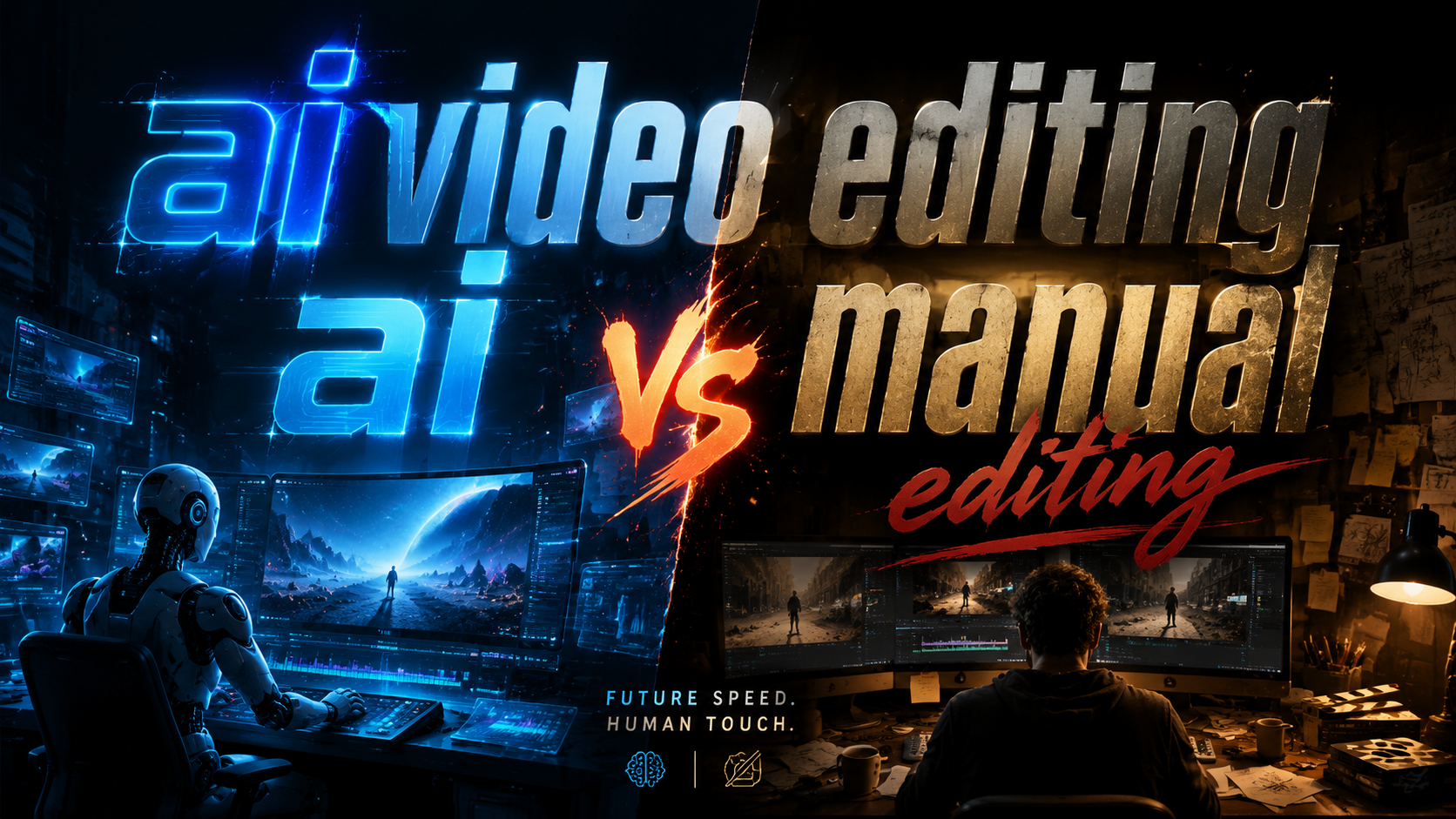
In the 2026 showdown between AI video editing and manual editing, the clear answer is that neither approach has rendered the other obsolete; instead, a hybrid workflow that leverages the speed of AI for repetitive tasks while retaining manual control for creative nuance is currently the most effective strategy for professional creators. While fully automated tools like VideoGen AI and Wondershare Filmora can now generate polished edits in minutes, manual editing in software such as VEGAS Pro remains essential for fine-grained artistic direction, color grading, and narrative pacing.
TL;DR: AI video editing in 2026 excels at speed and automation for social media and bulk content, while manual editing retains the upper hand in creative control, artistry, and complex storytelling. A hybrid approach combining both delivers the best results.
AI video editing is the use of machine learning algorithms to automate tasks such as scene detection, transcription, auto-captioning, color correction, and even full rough-cut assembly. Manual editing is the traditional hands-on approach where a human editor makes every creative and technical decision using non-linear editing software. In 2026, the most effective workflows integrate both methods.
- ✓ AI video editing can reduce editing time by up to 70% for routine content, but still struggles with nuanced storytelling and brand-specific creative direction.
- ✓ Manual editing remains irreplaceable for high-end cinema, complex VFX, and projects requiring a unique artistic voice.
- ✓ New entrants like CRAON are building AI-powered platforms that aim to bridge the gap between fully automated and fully manual workflows.
- ✓ The 2026 trend is hybrid editing: using AI for rough cuts, transcription, and repetitive tasks, then finishing with manual precision.
- ✓ Cost analysis shows AI tools can be cheaper at scale, but manual editors command premium rates for specialized creative work.
The Current State of AI Video Editing in 2026
According to Metricool's AI Video Editor Trends 2026 report, the landscape of video creation has shifted dramatically over the past twelve months. AI-powered tools have moved beyond simple filters and auto-captions to offering full scene detection, intelligent color grading, and even generative B-roll insertion. Wondershare Filmora and VEGAS Pro, two of the industry's most recognizable names, now directly compete on AI feature sets, with each releasing major updates in early 2026 that promise to cut editing time by half or more.
The Gadget Flow comparison between Wondershare Filmora and VEGAS Pro, published in May 2026, highlights that both platforms now include AI-driven text-to-video generation, intelligent audio ducking, and automated multicam syncing. The key differentiator is that Filmora leans toward accessibility for beginners while VEGAS Pro retains its professional-grade timeline and advanced color tools. This bifurcation reflects a broader market trend: AI is democratizing video production, but professional editors still demand manual override capabilities.
However, the rise of tools like VideoGen AI, reviewed by Cybernews in February 2026, raises an important question: can AI truly replace manual editing? The review concludes that for short-form social media content and internal corporate videos, the answer is increasingly yes. But for narrative filmmaking, advertising with specific brand guidelines, and any project requiring emotional nuance, manual editing remains the gold standard. The 2026 consensus is that AI video editing ai vs manual editing is not a winner-takes-all contest but a spectrum of capabilities.
AI Video Editing AI vs Manual Editing: The 2026 Landscape
The keyword "ai video editing ai vs manual editing" encapsulates the central tension in modern video production. On one side, AI tools promise speed, consistency, and scalability. On the other, manual editing offers creative control, artistic judgment, and the ability to make subjective decisions that algorithms cannot replicate. In 2026, this tension is more pronounced than ever because AI has become genuinely useful for professional work, yet it has also created a skills gap for editors who must now learn to collaborate with intelligent systems.
According to The AI Journal's April 2026 article "Stop Editing for Hours", four AI video tools have emerged as workflow transformers: Descript for transcription-based editing, Runway ML for generative video effects, Wondershare Filmora for all-in-one AI editing, and a newcomer called CRAON that raised pre-seed funding in May 2026. The article emphasizes that these tools do not eliminate the need for human editors but shift their role from technical operator to creative director.
Meanwhile, the CRAON funding news from Indiatimes (May 2026) signals that venture capital continues to flow into AI video startups, suggesting that the market believes there is still room for innovation. CRAON's platform reportedly focuses on collaborative AI editing, where the system learns a team's stylistic preferences over time and applies them automatically. This points to a future where AI video editing ai vs manual editing becomes less of a binary choice and more of a partnership.
What AI Handles Best in 2026
AI excels at repetitive, time-consuming tasks. Scene detection, keyword-based clip selection, auto-color correction, speech-to-text transcription, and caption generation are now reliably handled by AI with near-perfect accuracy. In 2026, even advanced tasks like audio clean-up, noise reduction, and automatic pacing adjustments for social media formats are being automated. The best AI tools learn from user corrections, improving their suggestions over time.
Where Manual Editing Still Leads
Manual editing remains superior for subjective creative decisions. No AI can yet match a human editor's ability to choose the perfect reaction shot, adjust timing for comedic effect, or craft a narrative arc that resonates emotionally. High-end color grading, custom transitions, keyframe animation, and complex compositing all require the nuanced control that only a manual workflow provides. Professional editors who master both AI automation and manual artistry are the most sought-after in 2026.
AI Video Editing vs Manual Editing: Feature Comparison
To help you decide which approach fits your project, below is a direct comparison of AI video editing and manual editing across key dimensions. This table reflects the state of the industry in mid-2026, based on current tool capabilities and professional workflows.
| Feature | AI Video Editing | Manual Editing |
|---|---|---|
| Speed (rough cut) | 2–5 minutes for a 10-minute source | 30–90 minutes for the same task |
| Creative control | Limited to presets and model outputs | Infinite — every choice is intentional |
| Learning curve | Low — most tools are drag-and-drop | High — requires months of practice |
| Cost per project (10 min video) | $0–$30 (subscription or free tier) | $200–$2,000 (editor rate) |
| Output quality (social media) | Excellent — optimized for each platform | Excellent — but takes longer |
| Output quality (cinematic) | Good — but lacks nuance and emotional timing | Superior — full artistic control |
| Iteration speed | Instant — regenerate with new prompts | Slow — each change requires manual work |
| Brand consistency | Good — can apply styles, but may miss context | Excellent — deep brand understanding |
As the table shows, the choice between AI and manual editing depends heavily on your project type, budget, and quality requirements. For a YouTube vlog or TikTok series, AI editing is often sufficient. For a commercial spot or documentary, manual editing—possibly augmented by AI—is the safer choice.
Speed and Efficiency: AI vs Manual Workflows
Speed is the most obvious advantage of AI video editing. According to The AI Journal, the four AI tools highlighted in their April 2026 article can reduce total editing time by 50–70% for standard projects. For example, transcription-based editing in Descript allows creators to edit video by deleting words in a text document, with the AI automatically removing the corresponding footage and smoothing the gap. This alone can cut a 30-minute editing session down to 5 minutes.
Manual editing, by contrast, requires each cut to be made on the timeline, each transition to be dragged and dropped, and each color correction to be applied by hand. While experienced editors work quickly—often faster than AI on complex projects—the cumulative time spent on repetitive tasks adds up. For a 10-minute YouTube video, a professional manual editor might spend 4–6 hours, whereas an AI-assisted workflow could produce a polished version in under an hour.
However, speed is not the only metric. Manual editing allows for real-time creative discovery: an editor might stumble upon a better arrangement of clips, a more impactful timing, or a visual motif that AI would never suggest. This serendipity is a genuine advantage of the manual process. The 2026 trend is therefore not to replace manual editing with AI, but to use AI for the first 80% of the work and then apply manual skill for the final 20% that makes the video truly exceptional.
Quality and Creative Control
Quality in video editing is subjective, but in 2026 the industry has established benchmarks for what AI can and cannot achieve. VideoGen AI, reviewed by Cybernews in February 2026, demonstrated impressive results for talking-head videos and screen recordings, producing clean edits with accurate captions and smooth transitions. However, the review noted that the AI occasionally missed contextual cues, such as preserving a meaningful pause or choosing a wider shot to emphasize scale.
Manual editing excels precisely in these subjective areas. A human editor understands pacing, dramatic tension, and the emotional weight of a moment. They know when to hold a shot an extra beat, when to cut away, and when to let silence speak. These are not problems that current AI models can solve reliably, because they require an understanding of narrative context and human emotion that goes beyond pattern recognition.
The best results in 2026 come from a layered approach. Editors use AI to generate a first pass—often called the "string-out"—which they then manually refine. This hybrid workflow combines the speed of AI with the artistry of manual editing. According to Metricool's trends report, 73% of professional video editors now use at least one AI tool in their pipeline, but 89% say that manual finishing is still essential for client-facing work. The AI video editing ai vs manual editing debate is thus settling into a pragmatic partnership rather than a competition.
Cost Analysis: AI Video Editing vs Traditional Manual Editing
Cost is a decisive factor for many creators. AI video editing tools in 2026 generally operate on a subscription model: Wondershare Filmora costs around $49.99 per year for the AI-enhanced plan, while VEGAS Pro's subscription starts at $19.99 per month. VideoGen AI offers a free tier with watermarks and a pro tier at $29 per month. For a small business producing ten videos per month, AI editing costs between $50 and $100 total—a fraction of the cost of hiring a manual editor.
Manual editing rates vary widely by region and expertise. A freelance editor in North America typically charges $50–$150 per hour, and a polished 10-minute video can take 6–10 hours. That means a single video costs $300–$1,500 for manual editing. For high-end commercial work, rates can exceed $200 per hour. The cost gap is substantial, and it explains why AI editing has been so rapidly adopted for internal communications, social media, and e-learning content.
However, cost savings must be weighed against quality and brand impact. A poorly edited video—even if cheap—can damage a company's reputation. Conversely, a beautifully edited video can command premium engagement and conversion rates. According to the Cybernews review of VideoGen AI, the tool's output was "good enough for internal use but lacked the polish needed for external marketing." The 2026 cost calculus is therefore: use AI for high-volume, low-stakes content, and invest in manual editing for high-value, brand-facing projects.
Making the Choice: Which Workflow Fits Your Needs in 2026?
There is no universal answer to the AI video editing ai vs manual editing question. Your choice depends on your content type, audience expectations, budget, and creative ambitions. For solo creators and small businesses producing daily social media content, AI editing is often the most practical solution. Tools like Wondershare Filmora and VideoGen AI can deliver consistent, platform-optimized videos with minimal effort, freeing you to focus on strategy and distribution.
For agencies, production houses, and filmmakers, manual editing—augmented by AI for specific tasks—remains the professional standard. The 2026 workflow for many professionals looks like this: AI handles transcription, scene detection, rough cut assembly, and captioning; the human editor then takes over for fine cuts, color grading, audio mixing, motion graphics, and final polish. This hybrid approach maximizes both efficiency and creative quality.
Ultimately, the most successful creators in 2026 are those who treat AI as a powerful assistant rather than a replacement. The technology continues to evolve rapidly—as evidenced by CRAON's pre-seed funding and the ongoing updates to Filmora and VEGAS Pro—but the fundamental human skills of storytelling, timing, and emotional intelligence remain irreplaceable. By combining the best of both worlds, you can produce videos that are fast to create, beautiful to watch, and uniquely yours.
Frequently Asked Questions About AI Video Editing vs Manual Editing
Can AI video editing fully replace manual editing in 2026?
Not entirely. AI can automate up to 80% of routine editing tasks, but manual editing remains necessary for creative nuance, emotional pacing, high-end color grading, and complex VFX work. Most professionals use a hybrid workflow.
Which is more cost-effective: AI or manual editing?
For high-volume content, AI is significantly cheaper—typically $50–$100 per month for unlimited edits versus $300–$1,500 per video for a manual editor. However, for premium brand content, the investment in manual editing often yields higher engagement and conversion rates.
What are the best AI video editing tools in 2026?
Top tools include Wondershare Filmora for all-in-one AI editing, VEGAS Pro for professional-grade AI features, VideoGen AI for fast social media content, and Descript for transcription-based editing. CRAON is a promising new entrant focused on collaborative AI editing.
Does AI video editing produce professional-quality results?
For social media, internal videos, and talking-head content, AI editing now produces excellent results. For cinematic films, high-end commercials, and projects requiring unique artistic direction, manual editing still delivers superior quality.
How do I combine AI and manual editing in my workflow?
Start by using AI for transcription, scene detection, rough cut assembly, and captioning. Then import the AI-generated timeline into your preferred NLE (like Premiere Pro, DaVinci Resolve, or VEGAS Pro) for manual fine-tuning, color grading, audio mixing, and final polish.
Will AI video editing tools replace video editors' jobs?
AI is shifting the editor's role from technical operator to creative director. Routine editing jobs may decrease, but demand for skilled editors who can collaborate with AI tools and deliver high-quality creative work is growing. Editors who upskill in AI workflows are in high demand.
What is the biggest limitation of AI video editing in 2026?
The biggest limitation is contextual understanding. AI cannot reliably interpret emotional nuance, narrative pacing, or brand-specific creative direction. It also struggles with complex storytelling where subjective human judgment is essential.
Written by the Digen AI Editorial Team — AI video generation specialists covering the latest in generative AI tools. Learn more about Digen AI.
Comments ()