
AI Video Editing vs Manual: Ultimate 2026 Showdown
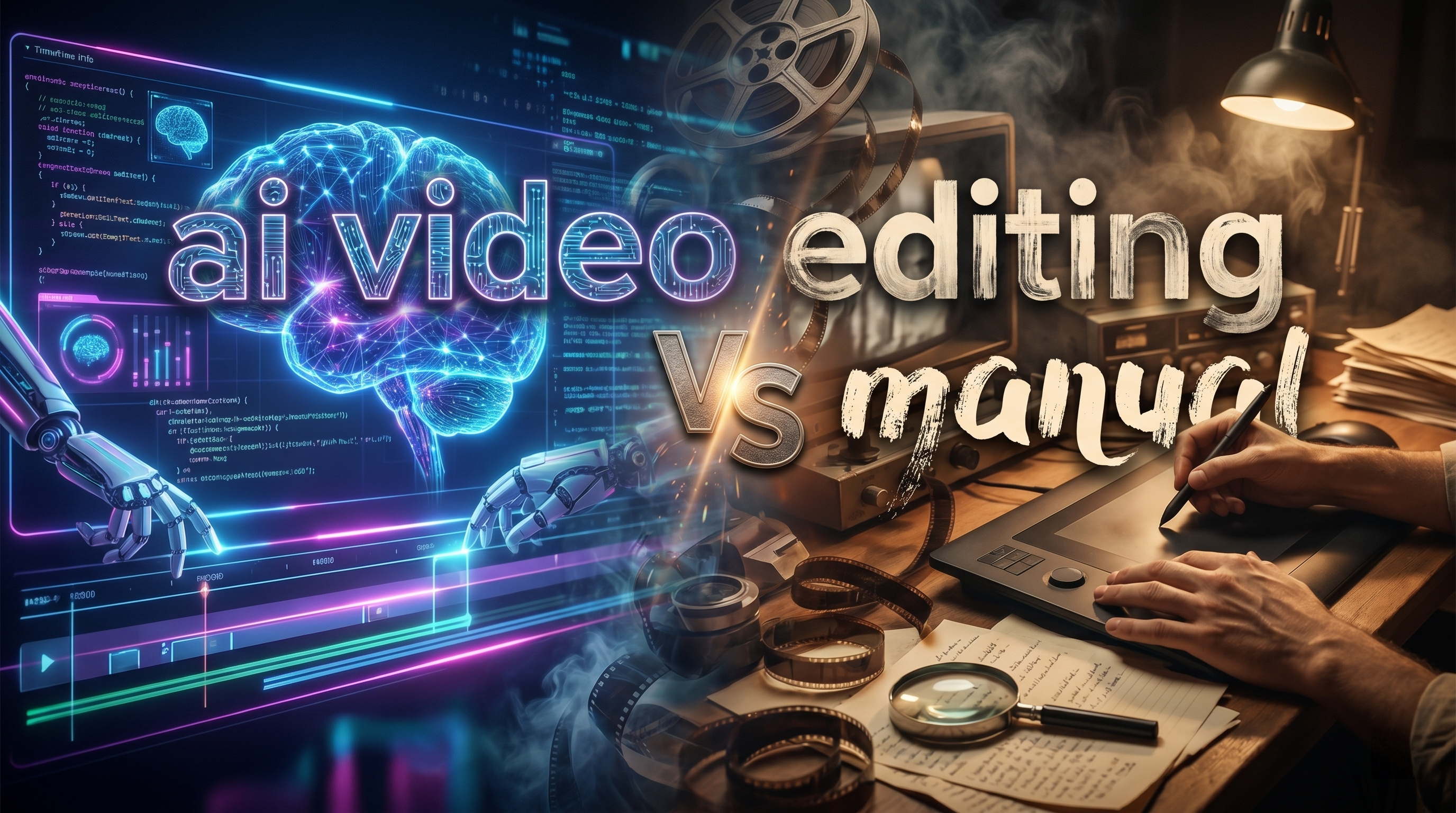
The debate between AI-powered and manual video editing has reached a tipping point in 2026. AI video editing vs manual editing ultimately comes down to a trade-off between speed and creative control: AI tools can automate repetitive tasks and produce polished results in minutes, while manual editing offers pixel‑level precision and complete artistic freedom. The best choice depends on your project's scale, deadline, and the level of creative nuance you require.
The showdown between AI video editing and manual editing in 2026 is less about which method is "better" and more about when to use each. AI tools excel at speed, transcription, and template‑based workflows, making them ideal for social‑media content and rapid prototyping. Manual editing remains essential for cinematic storytelling, complex color grading, and projects that demand a human creative touch.
- ✓ AI video editing tools can reduce production time by up to 80 % for routine tasks, but manual editing still dominates high‑end creative work.
- ✓ Recent 2026 launches — including a major AI tool exiting beta — are directly targeting Premiere Pro and DaVinci Resolve users with new automation features.
- ✓ Hybrid workflows that combine AI for rough cuts and transcription with manual fine‑tuning are becoming the industry standard.
- ✓ Accessibility improvements, such as AI‑powered transcription, are making video content more inclusive without sacrificing quality.
- ✓ Start‑up funding in the AI video space continues to surge, signaling that the technology will only become more capable in the near future.
1. The 2026 Landscape: AI Editing’s Leap Forward
The past twelve months have seen an explosion of AI‑powered video editing capabilities. In April 2026, a highly anticipated AI editing tool exited beta, and according to No Film School, it is "coming for Premiere and Resolve users." The tool promises to automate timeline assembly, suggest transitions, and even perform preliminary color grading — tasks that previously required hours of manual work. This launch has intensified the long‑running conversation around ai video editing vs manual workflows, pushing professional editors to reconsider where they draw the line between automation and artistry.
Meanwhile, Metricool’s November 2025 report on AI Video Editor Trends in 2026 highlighted that the majority of content creators now use at least one AI‑assisted feature — such as auto‑reframing, speech‑to‑text captioning, or scene detection — even if they still complete final edits manually. The trend is clear: AI is no longer a futuristic novelty; it is a practical tool that has quietly embedded itself into the daily routines of editors worldwide.
1.1 The CRAON Effect
In May 2026, Indiatimes reported that CRAON raised pre‑seed funding to build an AI‑powered video editing platform. While still early‑stage, CRAON’s approach focuses on collaborative cloud‑based editing with AI‑assisted timeline management — a direct response to the growing demand for remote‑first, hybrid workflows. This signals that investors see a strong future for AI that augments, rather than replaces, the manual editor.
2. Speed vs Precision: Where Each Approach Wins
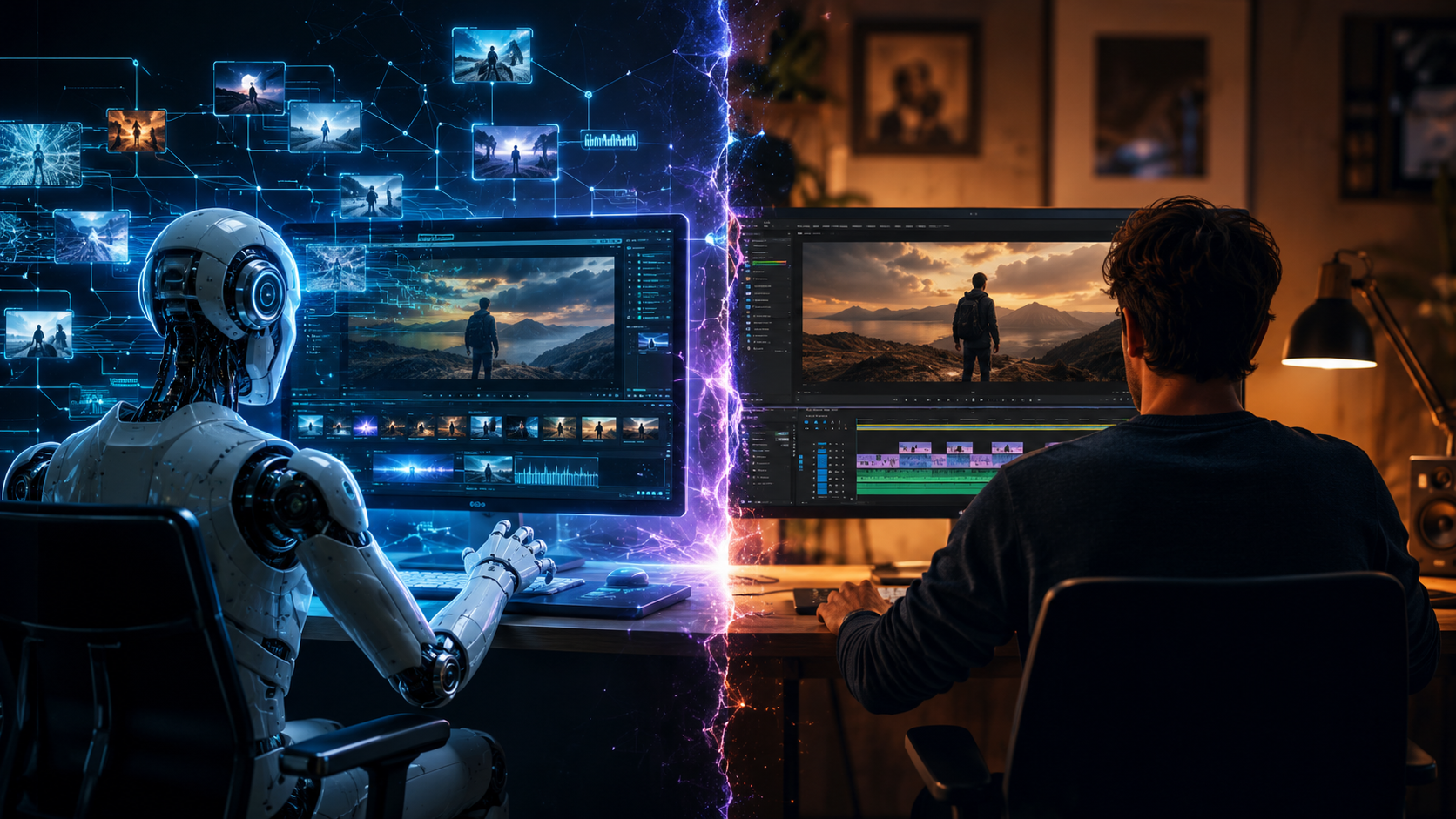
The most immediate difference between AI and manual editing is speed. AI tools can ingest raw footage, detect scenes, and generate a rough cut in minutes. According to Cybernews (February 2026), VideoGen AI demonstrated the ability to produce a 60‑second promotional video from a text prompt in under five minutes — a task that would take a human editor several hours. For time‑sensitive content like social‑media ads or breaking news clips, AI is often the clear winner.
However, speed comes with trade‑offs. Manual editing allows for micro‑adjustments that AI currently cannot replicate — a perfectly timed beat, a custom color look that evokes a specific emotion, or a subtle audio fade that guides the viewer’s attention. When the project demands a unique artistic vision, manual editing still holds the edge. The question of ai video editing vs manual therefore becomes a question of priority: speed or creative control?
2.1 Use Case Comparison
- Social‑media shorts & ads: AI wins for speed and volume.
- Corporate training & internal comms: AI with manual polish is the sweet spot.
- Film & high‑end commercial: Manual editing remains the gold standard.
- Accessibility & transcription: AI transcription tools, like those reviewed by Atlassian in August 2025, now achieve near‑human accuracy and are widely adopted.
3. The Rise of the AI Video Agent
One of the most talked‑about developments in 2026 is the emergence of "AI video agents" — autonomous systems that can take an idea and produce a finished video with minimal human input. In January 2026, World Business Outlook covered an AI video agent that "revolutionizes product marketing" by turning a brief product description into a complete promotional video, complete with stock footage, voiceover, and music. These agents are designed for marketers who need rapid content generation without learning complex editing software.
For professional editors, the rise of AI agents represents both a threat and an opportunity. On one hand, agents reduce the demand for routine editing work. On the other, they create a new niche for manual editors who can step in to refine and personalize AI‑generated content — adding the human touch that makes a video truly memorable. This evolving dynamic is at the heart of the ai video editing vs manual debate in 2026.
4. Manual Editing’s Unshakable Strongholds
Despite AI’s impressive gains, several aspects of video editing remain firmly in the manual domain. Advanced color grading — particularly when matching shots from different cameras or creating a specific film look — still requires a trained eye and hands‑on adjustment of curves, scopes, and LUTs. Sound design, too, is an area where AI often falls short: foley, ambient layering, and precise audio‑video sync are tasks that benefit from human intuition.
Furthermore, narrative editing — the art of selecting the right take and arranging scenes for emotional impact — is something AI has not yet mastered. A machine can detect a smile, but it cannot feel the moment. For documentaries, weddings, and narrative films, manual editing remains irreplaceable. The No Film School article from April 2026 noted that even the most advanced AI tools still struggle with "the gut feeling" that guides experienced editors.
4.1 The Hybrid Workflow
The most successful editors in 2026 are those who adopt a hybrid approach: using AI for the heavy lifting — transcription, scene detection, rough cuts — and then switching to manual mode for the creative finish. This workflow maximizes efficiency without sacrificing quality, and it is rapidly becoming the standard in post‑production houses around the world.
5. Comparison Table: AI Video Editing vs Manual in 2026
| Feature | AI Video Editing | Manual Editing |
|---|---|---|
| Speed of rough cut | Minutes | Hours to days |
| Creative control | Limited to tool presets | Pixel‑level precision |
| Color grading | Auto‑balance & presets | Full manual control |
| Sound design | Basic auto‑mix | Advanced multi‑track editing |
| Transcription & captions | Near‑perfect accuracy (Atlassian, 2025) | Manual time‑coding |
| Learning curve | Low — intuitive interfaces | Steep — years to master |
| Best for | Social media, ads, quick turnarounds | Film, documentary, high‑end commercial |
| Cost | Subscription usually under $50‑100/month | Software licenses & hourly labor |
6. Key Factors to Consider When Choosing
When weighing ai video editing vs manual, consider three primary factors: your deadline, your audience, and your creative vision. If you need to publish a TikTok video within the hour, AI is your best friend. If you are cutting a short film for a festival, manual editing gives you the control you need to realize your vision. For everything in between, a hybrid approach offers the best of both worlds.
Budget also plays a role. AI tools typically operate on a subscription model — often between $20 and $100 per month — which can be more predictable than hiring a freelance editor. However, manual editing can be more cost‑effective for large, complex projects where the AI tool would require extensive manual correction anyway.
6.1 The Future Outlook
With start‑ups like CRAON attracting pre‑seed funding and established tools leaving beta in 2026, the trajectory is clear: AI will continue to absorb more of the technical burden of editing. But as Cybernews concluded in its VideoGen AI review, "AI will not replace manual editing — it will replace only the parts of editing that are not truly creative." The human editor’s role is evolving from technician to artist, and that shift is the most exciting development in video production today.
Frequently Asked Questions
Can AI video editing completely replace manual editing in 2026?
No. While AI tools have become extremely capable, they still lack the creative intuition and emotional intelligence required for high‑end narrative, cinematic, and artistic projects. Manual editing remains essential for work that demands a unique human touch.
Which is faster: AI video editing or manual editing?
AI video editing is significantly faster for tasks like rough cuts, transcription, and template‑based videos — often reducing production time by 80 % or more. Manual editing takes longer but offers greater control and precision.
What are the best AI video editing tools in 2026?
According to recent coverage, tools like VideoGen AI and the newly emerged platform that exited beta in April 2026 (targeting Premiere and Resolve users) are leading the space. CRAON is also a promising start‑up to watch. Each tool offers different strengths depending on your workflow.
Is hybrid editing (AI + manual) the standard in 2026?
Yes. Most professional editors now use AI for repetitive tasks — such as transcription, scene detection, and auto‑captioning — and then switch to manual editing for the creative finish. This hybrid approach is widely considered the most efficient and effective workflow.
How much does AI video editing software cost compared to manual editing?
AI video editing tools typically charge a monthly subscription of $20 to $100. Manual editing software like Premiere Pro or DaVinci Resolve requires a one‑time license or subscription plus the cost of a skilled editor’s time — which can be $50–$150 per hour or more depending on the market.
Will AI video editing tools make manual editors obsolete?
Unlikely. AI is more likely to augment human editors than replace them. As Cybernews noted in its 2026 review, AI takes over technical, repetitive tasks — freeing editors to focus on the creative and emotional aspects of storytelling that machines cannot replicate.
— This article was researched and written based on the latest 2026 industry reports, including coverage from No Film School, Cybernews, Metricool, World Business Outlook, Atlassian, and Indiatimes.



Comments ()