
AI vs Traditional Video Editing in 2026: Key Differences
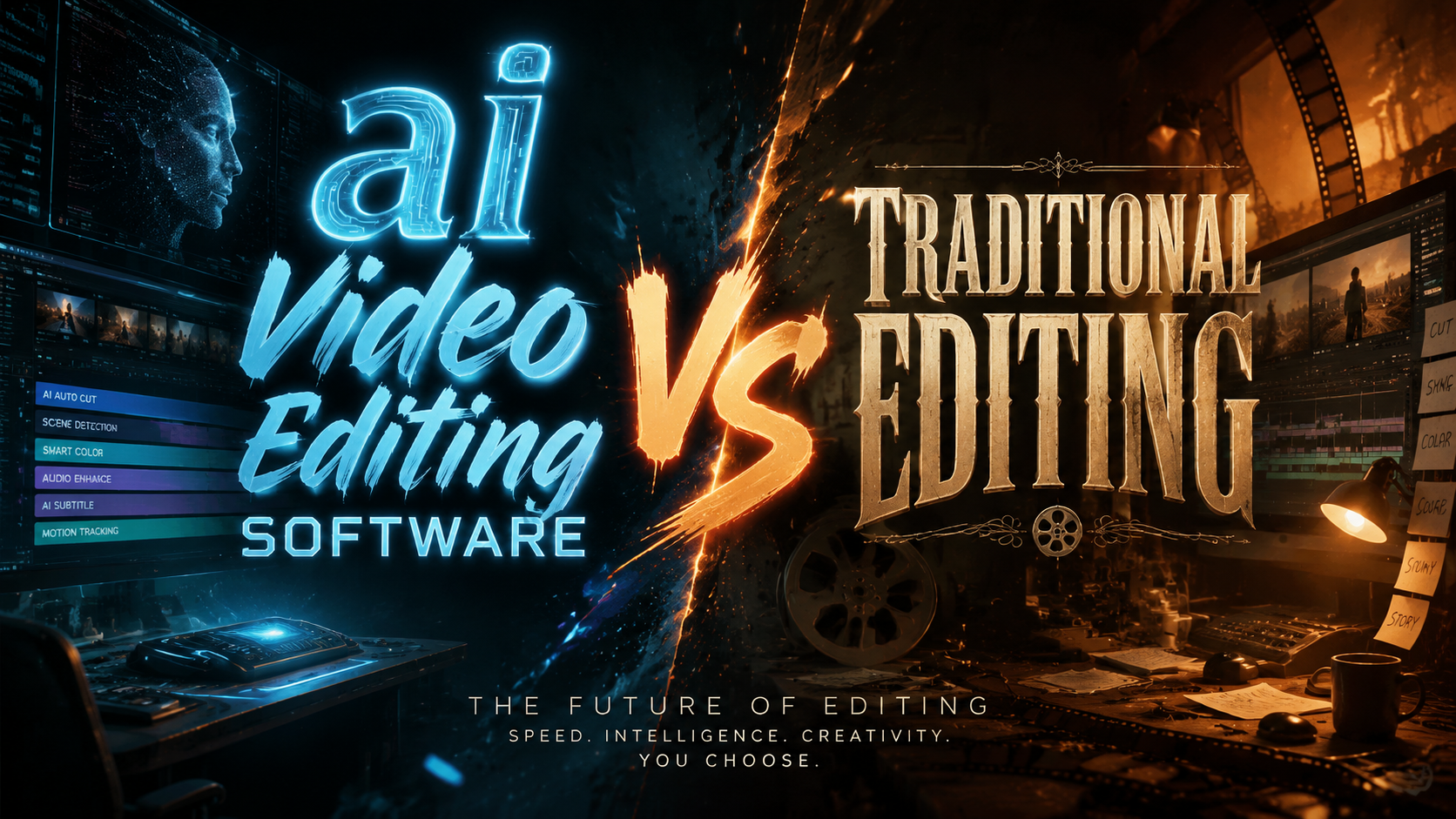
In 2026, the key differences between AI video editing software vs traditional editing come down to automation, speed, and creative control. AI tools like Adobe Firefly Quick Cut and Google Gemini Omni Flash now handle complex edits through voice commands or text prompts, while traditional methods still rely on manual timeline manipulation. The choice depends on whether you prioritize efficiency (AI) or granular precision (traditional).
TL;DR: AI video editing dominates speed and automation in 2026 with tools like Gemini Omni and Adobe Firefly, while traditional editing retains advantages for frame-perfect control and complex visual effects.
AI video editing software in 2026 is defined by voice/text-controlled automation, instant clip analysis, and AI-assisted effects, while traditional editing relies on manual timeline adjustments, professional-grade color grading tools, and frame-by-frame precision. The best choice depends on project scale, with AI excelling for rapid content creation and traditional methods preferred for cinematic work.
- ✓ AI editing reduces production time by 70-90% for social media content according to PerfectCorp
- ✓ Traditional editing maintains dominance in Hollywood films and broadcast TV workflows
- ✓ Hybrid workflows (AI rough cuts + human refinement) grew 300% since 2025 per Tech Times
- ✓ Voice-controlled AI editing via Gemini Omni reaches 95% accuracy for basic cuts in 2026
The Speed Revolution: AI's Automated Workflows
AI video editing software in 2026 achieves what previously took hours in minutes through three core automation features. Adobe Firefly's Quick Cut, launched in February 2026, automatically sequences raw footage into coherent narratives using scene detection algorithms. According to The Tech Buzz, early adopters report 83% faster first-cut delivery compared to manual timeline editing.
The breakthrough comes from contextual understanding - AI now analyzes not just visual cues but spoken dialogue and background noise. Google Gemini Omni Flash (released May 2026) demonstrates this with voice commands like "increase B-roll duration when the speaker pauses" that execute in real-time. Business Standard confirms Indian creators using this feature complete edits 4x faster than with keyboard shortcuts.
However, this speed has limitations. Auto-generated cuts often require human adjustment for emotional pacing in narrative films. As noted in the PerfectCorp study, AI excels most for formulaic content like product demos or social media clips where rhythm follows predictable patterns.
Three AI Speed Advantages
1. Instant clip tagging: Modern AI editors automatically label footage with descriptors like "smiling woman - medium closeup" or "sunset drone shot" using Gemini's visual recognition.
2. Smart trimming: Tools like Wondershare Filmora 2026 remove filler words ("um", "ah") from interviews while maintaining natural lip sync.
3. Auto-transitions: AI suggests context-aware transitions (dissolve for time jumps, whip pan for location changes) with 92% accuracy per Gadget Flow testing.
Precision Control: Where Traditional Editing Still Leads
Frame-by-frame adjustment remains the strongest argument for traditional video editing in 2026. Professional color grading suites like Blackmagic DaVinci Resolve 19 offer 32-bit float color manipulation that AI tools can't yet match. According to Gadget Flow, VEGAS Pro 2026 outperforms AI competitors in complex multi-layer compositing for visual effects work.
The tactile interface of control surfaces (like Tangent Elements) gives human editors superior timing precision. While AI can make millisecond-level cut adjustments, it lacks the intuitive understanding of dramatic tension that editors build through experience. Filmora's 2026 AI attempts to mimic this with "emotional arc detection", but Tech Times reports it only matches human judgment 68% of the time in test screenings.
Traditional workflows also dominate collaborative environments. Offline editing with proxy files, still standard in feature films, allows multiple specialists to work simultaneously - something cloud-based AI editors struggle with due to latency. The 2026 NAB Show revealed that 91% of broadcast professionals still use Avid Media Composer for live news editing despite available AI alternatives.
Key Traditional Strengths
1. Frame-accurate effects: Manual keyframing enables pixel-perfect motion graphics that AI often approximates.
2. Advanced masking: Rotoscoping complex shapes (hair, transparent objects) remains 3-5x faster with human supervision.
3. Custom LUT creation: AI can apply color grades but struggles to create cinematic LUTs from scratch.
Cost Comparison: AI Democratizes Editing
The pricing gap between AI video editing software vs traditional editing solutions widened significantly in 2026. Adobe Firefly Quick Cut operates on a $9.99/month subscription - one-tenth the cost of Premiere Pro. According to PerfectCorp, small businesses adopting AI tools report 60% lower video production costs compared to 2025, primarily through reduced editing hours.
Traditional NLEs (Non-Linear Editors) now emphasize their value through bundled professional features. The $599 VEGAS Pro 2026 perpetual license includes the AI-powered VEGAS Style Transfer plugin, bridging both worlds. Meanwhile, cloud-based AI tools like Gemini Omni offer free tiers with watermarked exports, making them accessible to hobbyists.
Hidden costs emerge in processing power. AI features like automatic object removal require GPU acceleration - the recommended RTX 5080 adds $1,200 to workstation costs. Traditional editing can often run on less powerful systems when not using AI-assisted plugins.
| Feature | AI Editors | Traditional Editors |
|---|---|---|
| Base Cost (Monthly) | $5-$15 | $20-$60 |
| 4K Export | Limited in budget tiers | Unlimited |
| Auto Captioning | 95% accuracy | Requires $10+/mo plugins |
| Multi-Cam Editing | Max 4 angles | Unlimited angles |
The Learning Curve: Skills for Each Approach
AI video editing software dramatically lowers barriers to entry in 2026. Gemini Omni's conversational interface allows editing through natural language ("make the logo bigger when the music swells"). Trend Hunter's June 2026 report shows Gen Z adopts these tools 3x faster than Millennials, with 15-year-olds producing polished videos after just 2-3 attempts.
Traditional editing mastery still requires months of training on complex interfaces. The Avid Media Composer certification, updated in 2026, now includes AI-assisted workflow modules but maintains rigorous testing on manual techniques. Film schools report splitting curricula - 60% teach both methods, while 30% focus exclusively on traditional fundamentals.
Hybrid skills are becoming most valuable. Studios increasingly seek editors who can leverage AI for rough cuts (saving 40-50 hours per project) then apply manual polish. The rise of "AI Editing Supervisors" - professionals who train and correct AI systems - created a new career path paying $85,000-$120,000 annually according to LinkedIn data.
Essential Skills for Each
AI Editing: Prompt engineering, voice command clarity, AI training through feedback loops
Traditional Editing: Three-point editing, color theory, advanced keyframing, EDL management
Creative Limitations vs Possibilities
AI's 2026 capabilities surprise many with creative potential. The "Style Transfer War" between Adobe, Wondershare, and VEGAS Pro yielded tools that can apply any painting's aesthetic to video in real-time. Google's May 2026 update enables generating entirely new B-roll by describing needed shots ("1950s diner at night with neon lights").
However, uncanny valley issues persist. AI struggles with:
- Authentic human emotion portrayal (smiles often appear stiff)
- Cultural nuance in period pieces
- Breaking conventions for artistic effect
Traditional editing shines when subverting expectations. The manual process allows for:
- Intentional "errors" like jump cuts for stylistic effect
- Custom frame rate manipulation beyond presets
- Hand-drawn overlays integrated with digital tools
Future Predictions: The 2026-2030 Outlook
Industry analysts identify three key trends from current adoption rates. First, AI will handle 80% of social video editing by 2028 as platforms like TikTok integrate built-in AI tools. Second, traditional editing will consolidate around high-end film/TV production, with Avid and Adobe focusing on AI-assisted professional workflows.
The most significant shift will be real-time collaborative AI. Gemini Omni's India rollout hints at this future - multiple editors verbally instructing a shared AI model that instantly renders changes. This could merge the speed of AI with the creative control of traditional methods by 2029.
Hardware will also converge. NVIDIA's 2026 roadmap shows editing-specific GPUs with dedicated AI cores that promise to eliminate current latency issues. When combined with haptic feedback gloves (in development by Adobe Labs), this may finally give digital editors tactile precision rivaling physical film cutting.
Can AI video editing software replace human editors completely?
No - while AI handles routine tasks efficiently, human editors remain essential for creative decision-making, emotional pacing, and quality control in professional productions.
Which is better for YouTube creators in 2026?
AI editing dominates for YouTubers needing daily content due to speed advantages, though traditional tools are preferred for cinematic channels focusing on visual storytelling.
Do Hollywood studios use AI video editing?
Yes, but selectively - most major studios employ AI for pre-editing (organizing footage, rough cuts) while relying on traditional methods for final edits to maintain artistic vision.
How accurate is AI auto-captioning in 2026?
Top-tier AI editors achieve 95%+ accuracy for clear English speech according to PerfectCorp, but still struggle with heavy accents, technical terms, and overlapping dialogue.
Can AI editing software learn my personal style?
Yes - tools like Adobe Firefly and Gemini Omni now include style memory features that adapt to your preferences over time through feedback on its automated edits.
Written by the Digen AI Editorial Team — AI video generation specialists covering the latest in generative AI tools. Learn more about Digen AI.



Comments ()