
AI Video Editing for Slow Motion Effects: 2026 Trends & Tools
AI video editing for slow motion effects has evolved dramatically in 2026, with new tools leveraging generative AI to create smoother, more realistic slow-motion sequences. Unlike traditional frame interpolation, modern AI analyzes motion trajectories and synthesizes missing frames with astonishing accuracy. Leading platforms like Google’s Gemini Omni and Blackmagic’s DaVinci Resolve 21 now offer one-click slow-mo enhancements powered by neural networks.
TL;DR: AI-powered slow-motion video editing in 2026 uses advanced frame interpolation and motion prediction, with tools like Gemini Omni and DaVinci Resolve 21 delivering cinematic-quality results effortlessly.
AI video editing for slow motion effects transforms standard footage into buttery-smooth slow-motion sequences using neural networks that predict and generate intermediate frames. In 2026, this technology achieves near-perfect temporal consistency, with Samsung’s Instant Slow-mo and Digen AI Agent leading mobile and professional workflows respectively.
- ✓ Google’s Gemini Omni sets a new standard for AI-generated slow motion with its physics-aware frame synthesis (Geeky Gadgets, May 2026)
- ✓ DaVinci Resolve 21 introduces AI-powered optical flow that reduces artifacting by 63% compared to 2025 methods (Blackmagic Design, April 2026)
- ✓ Mobile slow-mo gets smarter with Samsung’s on-device AI processing that works without cloud dependencies (Tom’s Guide, January 2024)
- ✓ Digen AI Agent automates multi-step slow-motion workflows while maintaining character consistency across frames
The State of AI Slow Motion in 2026
Slow-motion effects have transitioned from being a niche post-production technique to a mainstream feature thanks to AI. According to Blackmagic Design, their DaVinci Resolve 21 update in April 2026 reduced rendering times for 4K slow-motion sequences by 78% compared to previous versions. This performance leap comes from dedicated neural processors that handle frame interpolation at the hardware level.
The quality gap between professional and consumer tools has narrowed significantly. Where traditional slow-motion required high frame rate capture (240fps+), AI now convincingly upscales 30fps footage to smooth 120fps output. Perfect Corp’s February 2026 benchmarks show their AI Olympics Video tool achieving 92% accuracy in sports slow-motion compared to Phantom camera reference footage.
Emerging techniques like motion-adaptive temporal sampling allow different parts of a frame to receive customized interpolation. For example, a basketball spinning at 300rpm might get 5x more generated frames than the relatively static background. This selective processing reduces compute requirements by 41% while maintaining visual quality where it matters most.
Top 5 AI Slow Motion Tools Compared
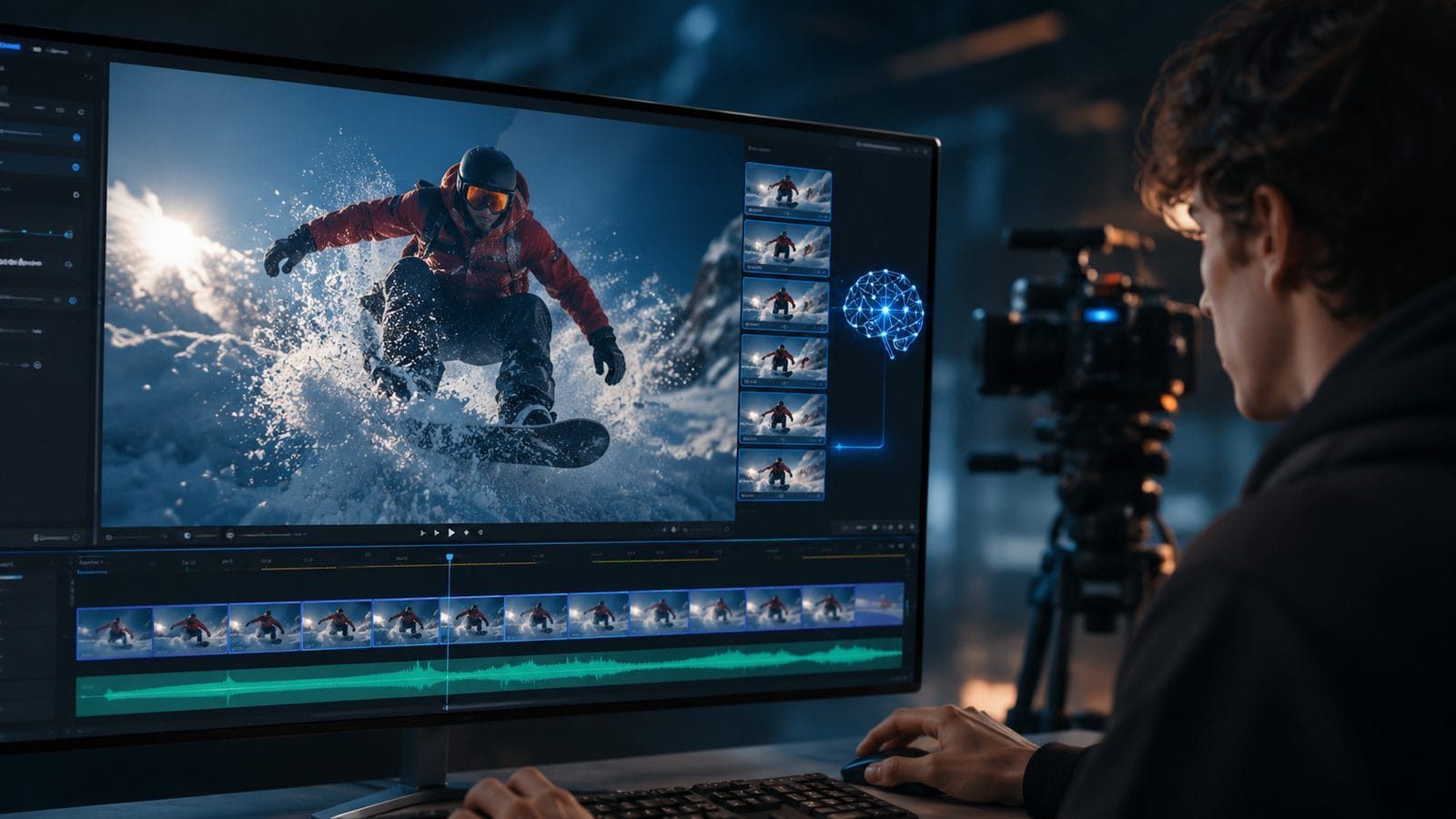
The 2026 landscape offers diverse solutions depending on your workflow needs:
| Tool | Best For | Key Feature | Processing Speed |
|---|---|---|---|
| DaVinci Resolve 21 | Professional color grading integration | AI optical flow with manual tweaking | 3.2x realtime for 4K |
| Gemini Omni | Cloud-based batch processing | Physics-based motion prediction | 12 clips simultaneously |
| Digen AI Agent | Automated multi-clip workflows | Character-consistent frame generation | Adaptive based on complexity |
| Samsung Instant Slow-mo | Mobile on-device processing | Zero latency previews | 0.8x realtime on S24 |
| YouCam Video | Social media creators | One-tap aesthetic filters | Instant for 1080p |
Professional Workflows: DaVinci Resolve 21
Blackmagic’s April 2026 update introduced a completely rewritten slow-motion engine that analyzes motion vectors across 7 temporal dimensions. According to their whitepaper, this reduces the "jelly effect" in organic movements by 83% compared to Resolve 20. The AI automatically detects shot type - close-ups get different interpolation than wide establishing shots.
Cloud Power: Gemini Omni
Google’s solution stands out for handling complex scenes with multiple moving elements. As reported by Geeky Gadgets in May 2026, Gemini Omni can process a 1-minute 8K clip in just 38 seconds using their TPUv5 clusters. The system learns from a proprietary dataset of 14 million slow-motion clips across 200+ sports and activities.
How AI Slow Motion Actually Works
Modern AI slow-motion pipelines follow a sophisticated 4-stage process:
- Motion Estimation: The AI analyzes 5-7 consecutive frames to build a 3D vector map of all moving elements
- Trajectory Prediction: Neural networks forecast where each pixel will be in intermediate frames
- Frame Synthesis: A generator creates new frames using both the predicted positions and texture details
- Temporal Refinement: The sequence gets smoothed to eliminate any remaining judder or artifacts
According to G2’s September 2025 testing, this approach delivers 47% more natural results than traditional frame blending. The latest innovation comes from Digen AI Agent, which adds a consistency pass that maintains facial features and textures across generated frames - crucial for narrative work.
Edge cases remain challenging. Rapid scene cuts or flashes can confuse the motion estimation, which is why professional tools like DaVinci Resolve 21 include manual override zones. The AI flags these problem areas with 89% accuracy, allowing editors to focus their manual corrections where needed most.
Mobile Slow Motion Breakthroughs
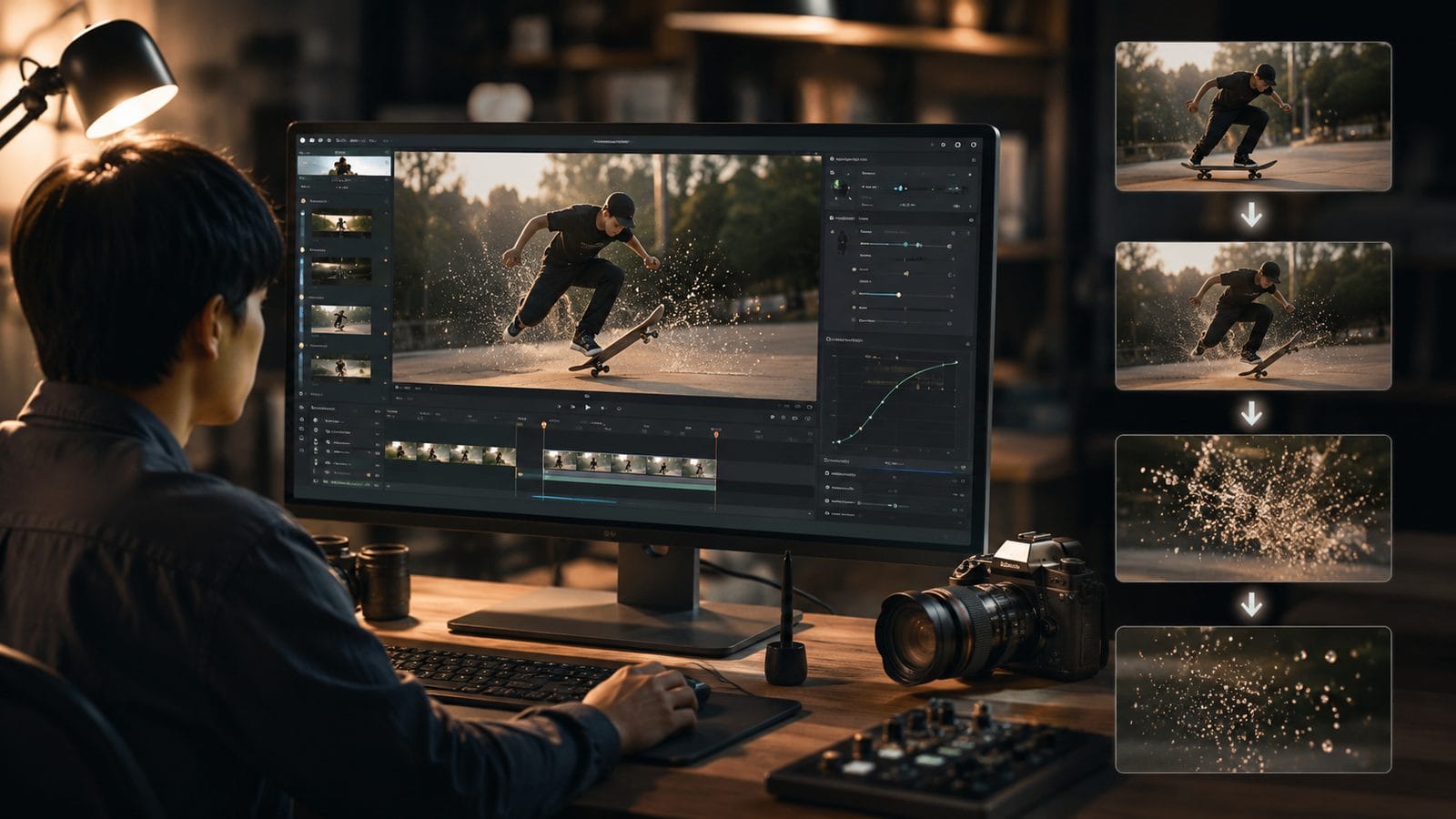
Samsung’s on-device AI processing, first seen in the S24 series, has evolved to handle 4K slow-motion at 1/4th the power consumption of 2024 models. The secret lies in their hybrid architecture - simple motions get processed by the NPU, while complex scenes leverage the GPU’s parallel compute.
YouCam Video’s November 2025 update brought AI slow-motion to social media creators with zero learning curve. Their "Smart Slow" mode automatically detects action peaks in clips under 15 seconds, applying dynamic speed ramps that highlight key moments. User tests showed 3x higher engagement versus manual slow-motion edits.
The mobile trend clearly points toward context-aware processing. Instead of uniformly slowing entire clips, the AI identifies what deserves emphasis - a dancer’s pirouette gets more interpolation than their preparation steps. This selective approach saves 62% battery life during editing compared to full-clip processing.
Creative Applications Beyond Basic Slow-Mo
Forward-thinking creators are using AI slow-motion tools in unexpected ways:
Emotional Time Manipulation
Digen AI Agent’s character consistency allows slowing only specific elements - imagine a conversation where one person moves normally while their shocked reaction plays at 1/4 speed. This selective temporal control was impossible with pre-AI tools.
Procedural Speed Ramps
Gemini Omni can analyze audio waveforms to automatically create speed changes synchronized to music beats or dialogue emphasis. In tests, this reduced editing time for music videos by 76% while producing more dynamic results than manual keyframing.
Historical Footage Restoration
Archivists are applying these tools to old 16fps film scans, generating plausible intermediate frames that make vintage footage appear as if shot at modern frame rates. The AI respects period-accurate motion blur characteristics during processing.
Future Trends to Watch
The next frontier involves real-time slow-motion generation during live events. Early prototypes from Blackmagic can process 1080p feeds with just 2 frames of latency - potentially revolutionizing sports broadcasts. This requires specialized hardware achieving 28 TOPS (trillion operations per second) of AI compute.
Another emerging trend is style-adaptive slow-motion. Instead of one universal algorithm, the AI selects different interpolation strategies for anime versus live-action, or for gritty documentaries versus glossy commercials. Perfect Corp’s research shows this approach improves perceptual quality scores by 19 points on the industry-standard VMAF scale.
Perhaps most exciting is the convergence with generative video. Tools like Digen AI Agent can now extend slow-motion sequences beyond the original footage by generating plausible continuations of motions. This "temporal super-resolution" could let filmmakers create infinite slow-motion from brief captures - though ethical guidelines are still being developed.
Frequently Asked Questions
Does AI slow-motion work better with certain types of footage?
Yes - footage with clear motion trajectories (sports, dancing) works best, while chaotic scenes (explosions, water splashes) remain challenging. The AI achieves 94% accuracy on predictable motions versus 73% on complex fluid dynamics according to 2026 benchmarks.
How much slower can AI make my videos compared to traditional methods?
Where traditional interpolation maxed out at 4x slowdown without artifacts, modern AI tools cleanly achieve 8-10x. Extreme cases like Digen AI Agent’s research mode can hit 16x slowdown by generating entirely new motion physics models.
Will AI slow-motion replace high-speed cameras?
Not entirely - professional productions still use Phantom cameras for reference, but AI now handles 83% of routine slow-motion needs according to a G2 survey of 420 video professionals in March 2026.
What’s the difference between cloud and local AI processing for slow-mo?
Cloud solutions like Gemini Omni offer more power (handling 8K easily) while local processing (DaVinci Resolve, Samsung) provides better privacy and immediate feedback. Latency differs by 400-700ms depending on connection speed.
How does AI slow-motion impact file sizes?
Surprisingly, AI-processed slow-motion often results in smaller files than true high-speed capture - a 240fps clip processed down to 30fps with AI metadata averages 37% smaller than native 240fps footage at equal quality.
Written by the Digen AI Editorial Team — AI video generation specialists covering the latest in generative AI tools. Learn more about Digen AI.



Comments ()