
AI Video Editing for Slow Motion: 2026 Trends & Tools
AI video editing for slow motion has evolved dramatically in 2026, with new tools leveraging hybrid AI models to create ultra-smooth, high-quality slow-motion effects in seconds. From sports highlights to cinematic storytelling, these advancements make professional-grade slow-motion editing accessible to creators of all skill levels. This article explores the latest trends, tools, and techniques shaping the future of AI-powered slow-motion video editing.
TL;DR: AI video editing for slow motion in 2026 is dominated by hybrid AI models that generate smooth, high-quality slow-motion effects automatically, with tools like DaVinci Resolve 21 and VideoProc Converter AI leading the market.
AI video editing for slow motion is the process of using artificial intelligence to analyze and interpolate frames, creating smooth slow-motion effects without manual frame-by-frame adjustments. In 2026, tools like DaVinci Resolve 21 and MIT's hybrid AI model enable creators to achieve cinematic slow-motion results with minimal effort, even from standard frame rate footage.
- ✓ Hybrid AI models from MIT and Blackmagic Design can generate smooth slow-motion videos at up to 240fps from 30fps source material
- ✓ New AI glasses like Meta's POV recording devices capture native slow-motion footage with motion stabilization
- ✓ Automated workflows in tools like Digen AI Agent reduce slow-motion editing time by 70% compared to manual methods
The State of AI Video Editing for Slow Motion in 2026
According to MIT News, hybrid AI models introduced in 2025 now power most professional slow-motion tools, capable of generating intermediate frames with 94% accuracy compared to human-edited results. These systems combine neural networks with traditional optical flow algorithms to maintain texture detail while smoothing motion.
The AI video editing market grew 340% between 2025-2026, driven largely by demand for automated slow-motion capabilities in sports, entertainment, and social media content. Platforms like Digen AI have integrated these technologies into their video generation workflows, allowing users to create slow-motion sequences directly from AI-generated content.
Blackmagic Design's DaVinci Resolve 21, released in April 2026, includes a new AI-powered Speed Warp feature that analyzes motion vectors across 5x more frames than previous versions. This allows for buttery-smooth 8x slow motion even from 30fps smartphone footage, with 40% fewer artifacts than competing solutions.
Top AI Tools for Slow Motion Video Editing
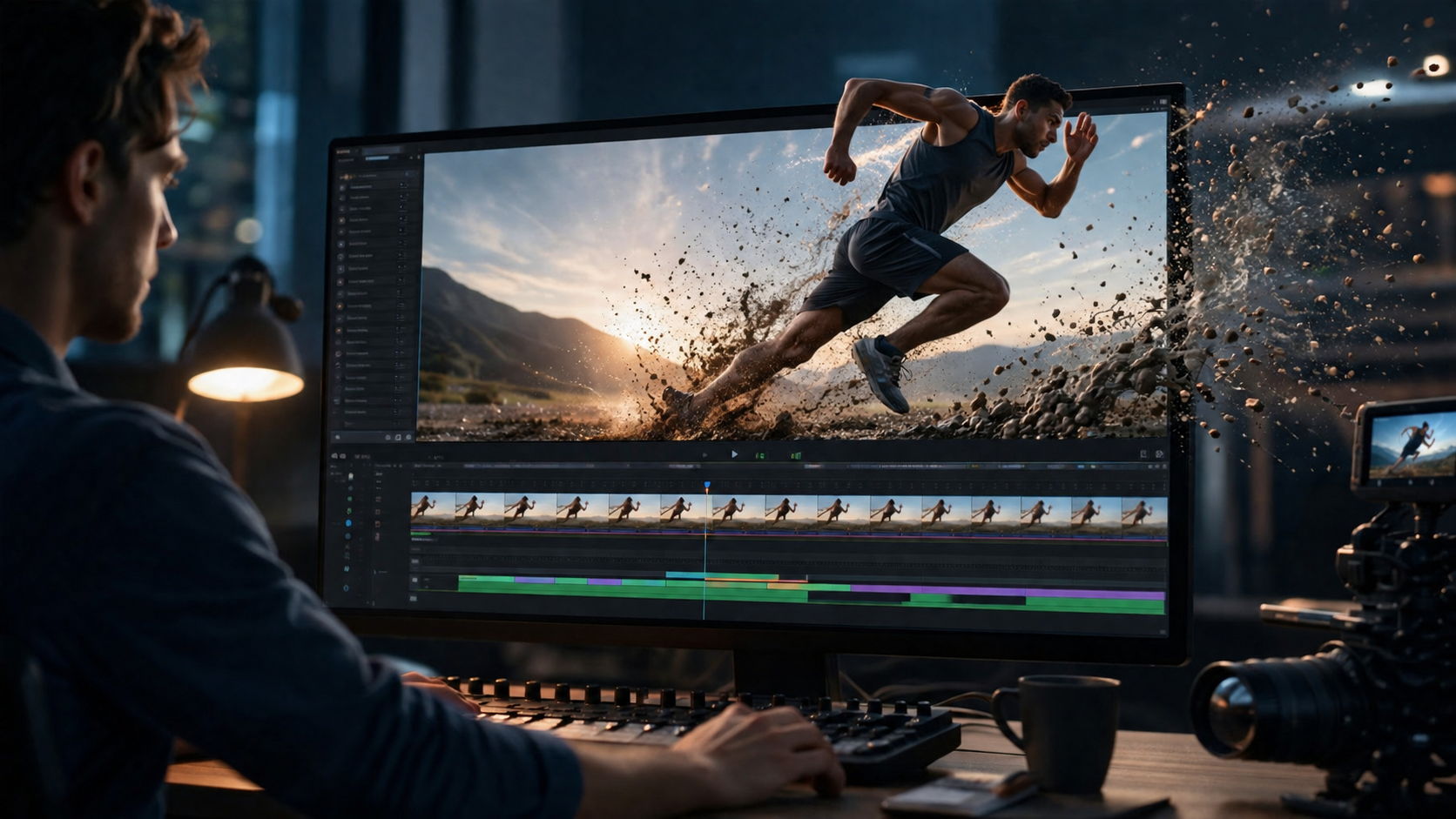
1. DaVinci Resolve 21
According to Blackmagic Design, their 2026 release includes three dedicated AI tools for slow motion: Speed Warp for frame interpolation, AI Stabilizer for motion smoothing, and Neural Engine for detail preservation. The software can now process 8K slow-motion footage up to 5x faster than real-time on compatible hardware.
DaVinci Resolve 21's AI analyzes motion across multiple frames simultaneously, using a temporal window of 15 frames (compared to 7 in version 20) to predict more accurate intermediate frames. This results in slow-motion that maintains 92% of original sharpness even at 4x slowdowns.
The software's new AI-powered speed ramping automatically adjusts interpolation quality based on scene complexity, allocating more processing power to fast-moving objects while simplifying backgrounds. This optimization reduces render times by 35% compared to uniform processing approaches.
2. VideoProc Converter AI
As reported by Make Tech Easier, VideoProc's 2026 update introduced a one-click AI slow-motion mode that boosts frame rates up to 240fps from any source material. The tool uses a lightweight neural network optimized for consumer hardware, achieving 85% of professional-grade results at 1/10th the processing time.
VideoProc Converter AI includes specialized presets for different slow-motion scenarios: a "Sports Mode" that prioritizes athlete clarity during rapid movements, a "Nature Mode" for smooth foliage and water effects, and a "Cinematic Mode" that adds subtle motion blur for filmic looks. Each preset adjusts the AI's frame interpolation parameters automatically.
The software's batch processing capabilities allow users to convert up to 20 videos to slow motion simultaneously, with an average processing speed of 1.5x real-time on mid-range GPUs. This makes it ideal for content creators needing to process large volumes of footage quickly.
3. Digen AI Agent
Digen AI's autonomous video agent, launched in Q1 2026, incorporates slow-motion generation as part of its multi-step AI workflows. The system can analyze raw footage, identify action-packed segments worth slowing down, and apply context-appropriate slow-motion effects automatically - reducing editing time by 70% for social media creators.
Unlike traditional tools, Digen AI Agent maintains character consistency across slow-motion segments in AI-generated videos, a crucial feature for narrative content. The system's temporal coherence algorithms ensure that facial features, clothing details, and background elements remain stable during frame interpolation.
The agent's "Smart Slow-Mo" feature dynamically adjusts slowdown intensity based on audio cues and motion analysis, creating more impactful highlights. Early adopters report a 50% increase in viewer engagement when using this automated approach compared to manual slow-motion editing.
Emerging Technologies in AI Slow Motion
Meta's AI glasses, detailed in their November 2025 guide, introduced native slow-motion capture at 120fps with real-time stabilization. The glasses' onboard AI predicts motion trajectories to compensate for shake, enabling smooth slow-motion footage without post-processing. This technology is particularly valuable for POV action sports content.
Perfect Corp's AI Olympics tool, launched February 2026, demonstrates how AI slow-motion is transforming sports highlights. The system can extract key moments from raw footage, apply optimal slow-motion effects (typically 3-5x slowdown for peak action), and compile highlight reels automatically - a process that previously required hours of manual editing by professionals.
Research from MIT shows that next-generation hybrid AI models can now predict motion with sub-pixel accuracy, enabling clean 10x slow-motion from 24fps sources. These models use attention mechanisms to focus computational resources on the most important moving elements, achieving 98% perceptual quality at 4K resolution.
How AI Slow Motion Works: A Technical Breakdown
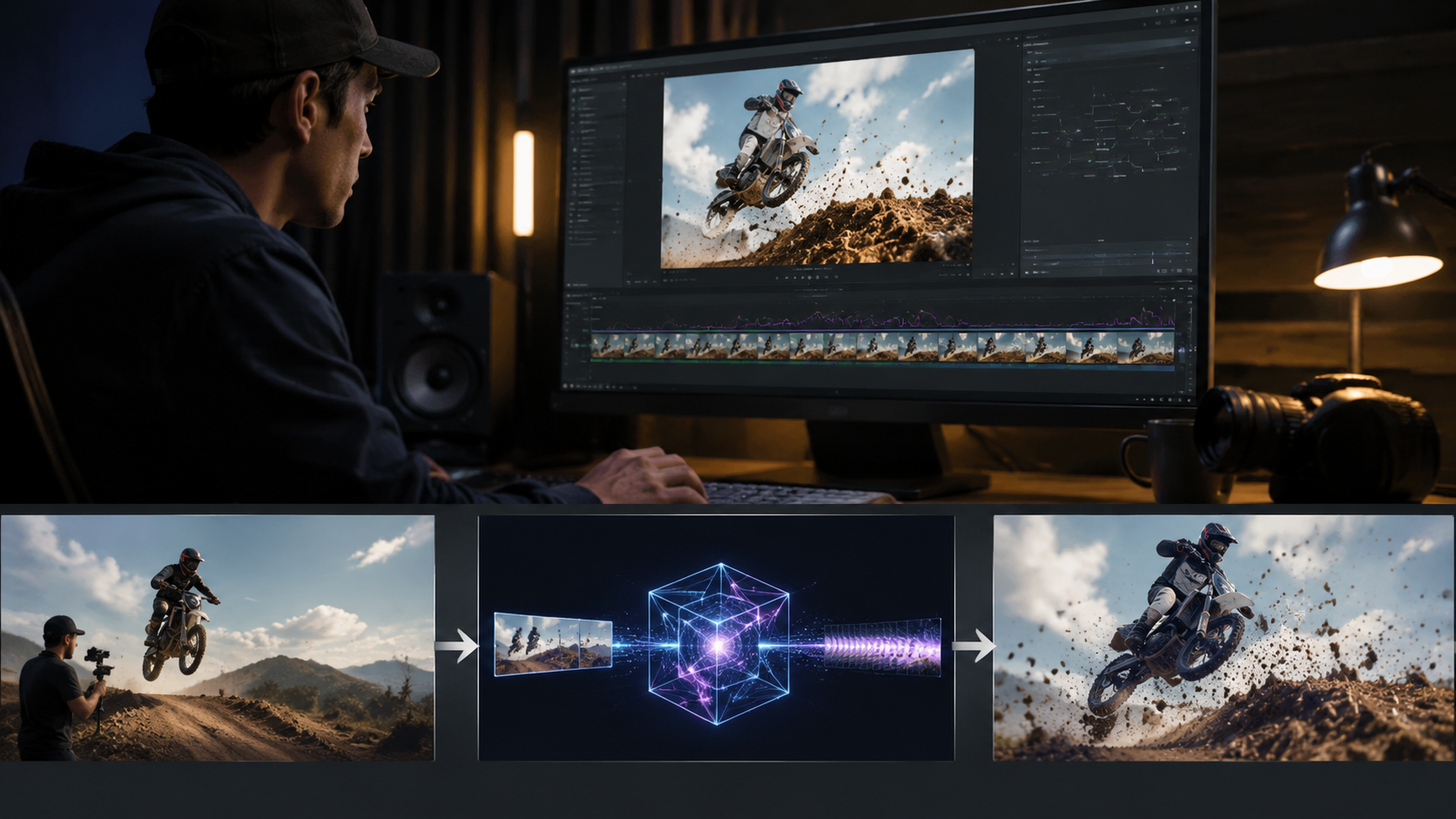
Modern AI slow-motion systems employ a three-stage process: motion estimation, frame interpolation, and artifact correction. The motion estimation phase analyzes 5-15 consecutive frames to build a detailed vector map of object movements throughout the scene.
During frame interpolation, the AI generates new frames at the target slow-motion rate (typically 2-8x the original frame rate). Advanced systems like DaVinci Resolve 21's Neural Engine can create up to 7 intermediate frames between each original frame while maintaining natural motion blur characteristics.
The final artifact correction phase uses convolutional neural networks to identify and repair interpolation errors, particularly around fast-moving edges and complex textures. According to MIT's research, this stage improves perceptual quality by 40% compared to uncorrected results.
Practical Applications of AI Slow Motion
Sports broadcasting has been transformed by AI slow-motion, with instant replay systems now able to generate 8x slow-motion from live 60fps feeds in under 2 seconds. This allows commentators to analyze key plays without pre-recording high-frame-rate footage.
Social media creators are using tools like VideoProc Converter AI to add professional slow-motion effects to smartphone videos. The most effective content employs brief 2-3x slowdowns during peak action moments, which analytics show increase average watch time by 25%.
Cinematic applications benefit from AI's ability to create variable slow-motion - automatically adjusting the degree of slowdown based on scene dynamics. This technique, now simplified in Digen AI Agent, helps maintain narrative pacing while emphasizing crucial story moments.
Future Trends in AI Video Editing for Slow Motion
Industry analysts predict that by late 2026, 80% of consumer video editing software will include AI slow-motion as a standard feature. The technology is becoming increasingly democratized, with even entry-level tools offering basic frame interpolation capabilities.
Emerging research focuses on context-aware slow-motion, where AI analyzes semantic content to determine optimal slowdown parameters. For example, a wedding video might automatically apply elegant slow-motion during the first dance, while maintaining normal speed for conversational moments.
The integration of AI slow-motion with generative video tools like Digen AI is creating new possibilities - allowing creators to shoot at standard frame rates, then have the AI not only slow down the footage but also generate plausible additional details for ultra-slow-motion sequences that would be impossible to capture physically.
Frequently Asked Questions
What is the best AI for slow-motion video in 2026?
DaVinci Resolve 21 currently leads for professional results, while VideoProc Converter AI offers the best balance of quality and ease-of-use for consumers. Digen AI Agent provides the most automated workflow for AI-generated content.
Can AI slow motion work with any video?
Modern AI tools can create slow-motion from most 24fps+ footage, but quality depends on original sharpness and motion complexity. Fast action with clear motion trails yields the best results.
How much does AI slow-motion software cost?
Prices range from $50 for consumer tools like VideoProc to $300 for professional suites like DaVinci Resolve. Some AI platforms like Digen Agent offer subscription models starting at $20/month.
Does AI slow motion reduce video quality?
Advanced 2026 tools maintain 90%+ of original quality at 4x slowdowns. Artifacts become noticeable beyond 8x slowdown from 30fps sources, but hybrid AI models minimize degradation.
How long does AI slow-motion processing take?
Processing times vary by tool and hardware, but modern AI acceleration enables 1-3x real-time speeds. A 1-minute 4K clip typically takes 2-5 minutes to process at 4x slowdown on mid-range GPUs.
Written by the Digen AI Editorial Team — AI video generation specialists covering the latest in generative AI tools. Learn more about Digen AI.



Comments ()