
AI Video Editing for Long-Form Content: 2026 Strategy Guide
AI video editing for long-form content is the process of using artificial intelligence algorithms to automate the assembly, pacing, and optimization of extended video files, such as podcasts, webinars, and documentaries. In 2026, this technology has evolved beyond simple automated cuts to include semantic understanding, allowing creators to instantly identify key narrative beats and repurpose long-form assets into multi-platform campaigns. By leveraging machine learning, creators can now reduce the post-production timeline for an hour-long video from several days to under thirty minutes.
AI video editing for long-form content is a transformative workflow that utilizes neural networks to analyze footage, sync audio, and perform multi-cam switching automatically. It enables creators to maintain high production values while scaling output, specifically by identifying "viral" segments within long videos to generate optimized short-form clips for social media distribution.
- ✓ AI now handles the heavy lifting of "rough cuts" by identifying speaker changes and removing filler words with 99% accuracy.
- ✓ Modern tools like FlexClip and Jellysmack allow for the instant conversion of one long-form video into dozens of platform-specific shorts.
- ✓ 2026 workflows emphasize "AI + Editor" collaboration, where AI manages technical tasks while humans focus on creative storytelling.
- ✓ Advanced features like "AI Video Cut" have simplified the entry barrier, making professional-grade editing accessible to non-technical creators.
The Evolution of AI Video Editing for Long-Form Content in 2026
As we navigate the media landscape of 2026, the role of ai video editing for long-form content has shifted from a luxury to a fundamental necessity. In previous years, long-form creators were burdened by the sheer volume of footage required for platforms like YouTube, Twitch, and corporate training portals. Today, the integration of generative AI within the editing timeline allows for real-time processing of 4K and 8K streams, ensuring that the technical bottlenecks of the past are virtually eliminated. The focus is no longer just on cutting clips, but on understanding the context of the dialogue to ensure the most impactful moments are highlighted.
According to recent industry reports from Trend Hunter, AI video editors have become the dominant toolset for digital agencies, with over 85% of high-volume creators adopting AI-assisted workflows this year. This shift is driven by the need for speed and the rising demand for "snackable" content derived from longer master files. The ability of AI to "watch" a video and understand the emotional arc allows it to suggest edits that once required a human editor hours of deliberation. This synergy between human intuition and machine efficiency defines the modern production era.
How to Implement an AI-Driven Long-Form Workflow
- Upload and Transcribe: Import your raw long-form footage into an AI-enabled editor to generate a time-coded transcript.
- Semantic Analysis: Use the AI's "Key Moment" detection to highlight the most engaging segments based on audience retention patterns.
- Automated Rough Cut: Apply an "AI Video Cut" to remove dead air, filler words (um, ah, like), and redundant takes.
- Multi-Platform Repurposing: Utilize tools like FlexClip’s "Long to Shorts" feature to automatically reframe and caption segments for vertical formats.
- Final Human Polish: Review the AI-generated sequence to add personal branding, nuanced color grading, and final creative touches.
Comparison of Leading AI Video Editing Platforms (2026)
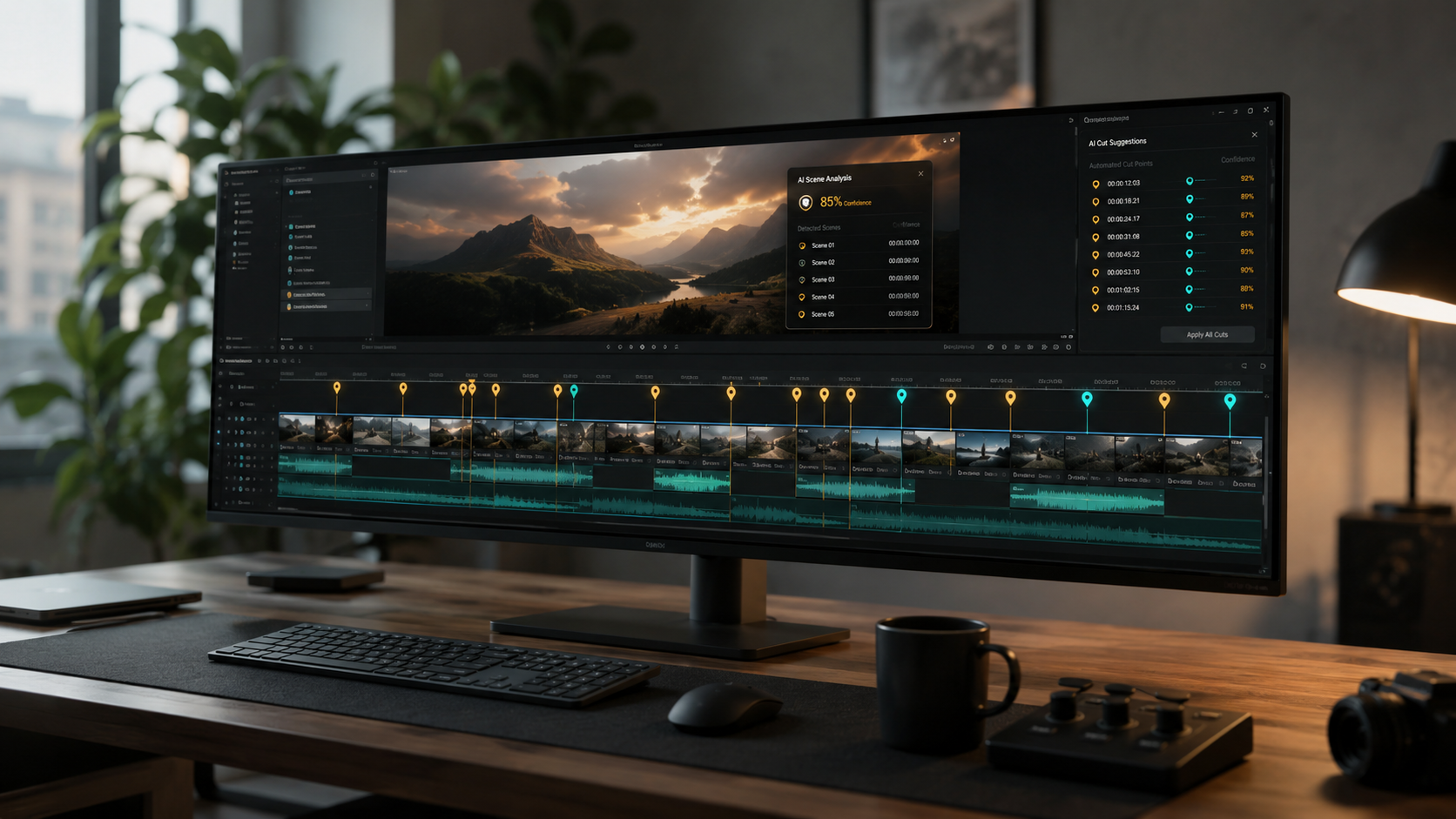
Choosing the right tool for ai video editing for long-form content depends on your specific output goals. Whether you are a solo YouTuber or a large-scale media house, the software landscape in 2026 offers specialized solutions for every niche. Below is a comparison of the top-performing platforms based on the latest releases in May 2026.
| Platform | Core Strength | Best Feature (2026) | Target Audience |
|---|---|---|---|
| FlexClip | Social Media Scalability | AI Long to Shorts (Viral-Ready) | Content Creators & Influencers |
| Wondershare Filmora | User-Friendly Interface | Smart Scene Detection & AI Cut | Beginners & Semi-Pros |
| VEGAS Pro | Professional Precision | Deep Learning Color Match | Professional Editors & Film |
| Jellysmack | Distribution & Virality | One-to-Fifty Viral Clip Engine | High-Growth YouTube Channels |
| Perfect Corp | Ease of Use | AI Video Cut (One-Click) | Marketing Teams |
Maximizing ROI with AI Long-to-Short Workflows
One of the most significant breakthroughs in 2026 is the ability to turn a single hour of footage into a month's worth of content. As reported by PR Newswire on May 21, 2026, FlexClip’s new AI capabilities allow creators to turn hours of video into viral-ready shorts almost instantly. This "repurposing revolution" is critical for long-form creators who need to maintain a presence on TikTok, Instagram Reels, and YouTube Shorts without doubling their workload. The AI identifies high-energy moments, tracks the speaker’s face to keep it centered in vertical frames, and adds dynamic captions that match the brand's voice.
Furthermore, Jellysmack has refined the "AI + Editor" model. Their 2026 updates allow creators to turn one long video into 50 viral shorts in a matter of minutes. According to Quasa, this hybrid approach ensures that while the AI handles the technical extraction and formatting, human editors can provide a final layer of quality control. This is particularly effective for podcasts and interview-style content where the "hook" of a story is essential for social media engagement. By automating the extraction process, creators can increase their reach by up to 500% without increasing their filming time.
The Role of "AI Video Cut" in Streamlining Production
The "AI Video Cut" technology, highlighted by Perfect Corp in May 2026, has become the standard for initial assembly. This technology uses audio-visual synchronization to detect errors in speech and visual glitches. For long-form content like webinars or lectures, this means the software can automatically "clean" the video, leaving only the valuable information. This significantly reduces the "time to publish," allowing brands to stay relevant in a fast-moving digital economy.
Advanced Features: Wondershare Filmora vs. VEGAS Pro
For those requiring more control over their ai video editing for long-form content, the debate often centers on Wondershare Filmora and VEGAS Pro. As of May 2026, Gadget Flow notes that both platforms have integrated sophisticated AI, but they cater to different philosophies of editing. Filmora has doubled down on automation, making it the "easiest way to create videos in 2026" for those who want professional results with minimal manual input. Its AI Copilot can now take text prompts to rearrange scenes or suggest background music that matches the emotional tone of the long-form narrative.
On the other hand, VEGAS Pro remains the choice for editors who want AI to assist rather than lead. Its 2026 updates focus on deep learning for technical correction, such as AI-driven noise reduction and advanced rotoscoping. For long-form projects like independent films or long-form documentaries, VEGAS Pro provides the stability and precision needed for high-bitrate editing. The choice between these two often comes down to whether the creator values speed and automation (Filmora) or granular control and technical depth (VEGAS Pro).
AI-Driven Audio Enhancement for Long-Form Projects
Audio is often the most challenging aspect of long-form video. In 2026, AI video editors include "Voice Isolation" and "Auto-Ducking" features that are specifically tuned for long-duration files. These tools can distinguish between a speaker’s voice and background noise over a two-hour recording, ensuring consistent levels throughout. This is a game-changer for outdoor long-form content, such as travel vlogs or on-site interviews, where environmental noise used to be a major production hurdle.
The Future of Storytelling: AI as a Creative Partner
As we look toward the remainder of 2026, the narrative surrounding ai video editing for long-form content is shifting from "replacement" to "augmentation." AI is now capable of suggesting B-roll footage based on the transcript of a long-form video. If a speaker mentions "urban development in Singapore," the AI can automatically search a linked stock library and place relevant clips onto the timeline. This level of integration allows creators to focus on the "why" of their story rather than the "how" of the software.
Studies show that creators using AI-integrated workflows report a 60% increase in creative satisfaction because they are no longer bogged down by repetitive tasks. The ability to experiment with different "cuts" of a long-form video—creating a dramatic version, a comedic version, and an educational version all from the same source files—allows for unprecedented creative freedom. AI is not just making editing faster; it is making it more versatile.
What is the best AI tool for turning long videos into shorts in 2026?
As of May 2026, FlexClip and Jellysmack are the industry leaders for this task. FlexClip offers a streamlined "Long to Shorts" AI feature, while Jellysmack provides a comprehensive service that can generate up to 50 viral clips from a single source video.
Can AI edit a full-length documentary automatically?
While AI can perform a "rough cut" by removing silence and organizing scenes by topic, a full-length documentary still requires a human editor for narrative pacing and emotional nuance. However, AI tools like VEGAS Pro significantly speed up the technical aspects of this process.
Is AI video editing for long-form content expensive?
In 2026, AI editing tools are available at various price points. Many platforms like Wondershare Filmora offer affordable monthly subscriptions, while high-end enterprise solutions like Jellysmack are priced based on the volume of content and distribution needs.
Does AI video editing reduce the quality of the video?
No, modern AI editors in 2026 support 4K and 8K resolutions. Features like AI upscaling and neural noise reduction actually improve the visual quality of the original footage during the editing process.
How does AI Video Cut work?
AI Video Cut uses machine learning to analyze both the audio and video tracks to identify "dead zones," mistakes, or filler words. It then automatically removes these segments to create a concise, professional-looking video without manual trimming.



Comments ()