
How Does AI Video Editing Work for Facebook Reels in 2026?
AI video editing for Facebook Reels in 2026 leverages advanced generative AI to automate and enhance short-form video creation. Meta's latest updates, including the "Vibes" AI video tool and new AI-powered search and editing features, allow creators to produce professional-quality Reels with minimal effort. These tools analyze footage, suggest edits, apply effects, and even generate entirely new content based on user prompts.
TL;DR: AI video editing for Facebook Reels in 2026 uses Meta's generative AI tools like Vibes to automate trimming, effects, and content creation, enabling faster production of engaging short videos with minimal manual input.
Meta's 2026 AI video editing for Facebook Reels combines automated clip sequencing, smart effect suggestions, and generative content creation through tools like Vibes. The system analyzes trends, music, and user preferences to produce optimized Reels while maintaining brand consistency through advanced AI workflows.
- ✓ Facebook's Vibes AI tool generates complete Reels from text prompts with automatic scene transitions and effects
- ✓ New AI Mode analyzes trending content to suggest optimal editing styles and hashtags
- ✓ Autonomous multi-step workflows maintain character consistency across longer Reels sequences
- ✓ Real-time AI editing suggestions reduce production time by up to 70% compared to manual methods
The Evolution of AI Video Editing on Facebook
Facebook's AI video editing capabilities have undergone significant transformation since the early 2020s. According to Meta's Newsroom, the 2025 introduction of Vibes marked a turning point in generative video tools, allowing creators to produce entire Reels from text descriptions. By 2026, this technology has matured into a comprehensive editing suite that understands context, maintains visual consistency, and adapts to individual creator styles.
The current AI editing system integrates multiple specialized models working in sequence. One model handles scene detection and automatic trimming, while another manages transition effects and pacing. A third model, as reported by Tech My Money, analyzes trending content across Facebook to suggest optimal editing styles and hashtags for maximum engagement. This multi-model approach ensures videos align with both creator intent and platform algorithms.
What sets 2026's AI editing apart is its ability to maintain character consistency across longer sequences. Tools like Digen AI Agent demonstrate how autonomous multi-step workflows can preserve facial features, clothing details, and environmental elements throughout generated content. This advancement solves a major pain point for creators who previously struggled with AI-generated inconsistencies in longer Reels.
How Facebook's AI Video Editing Works Step-by-Step
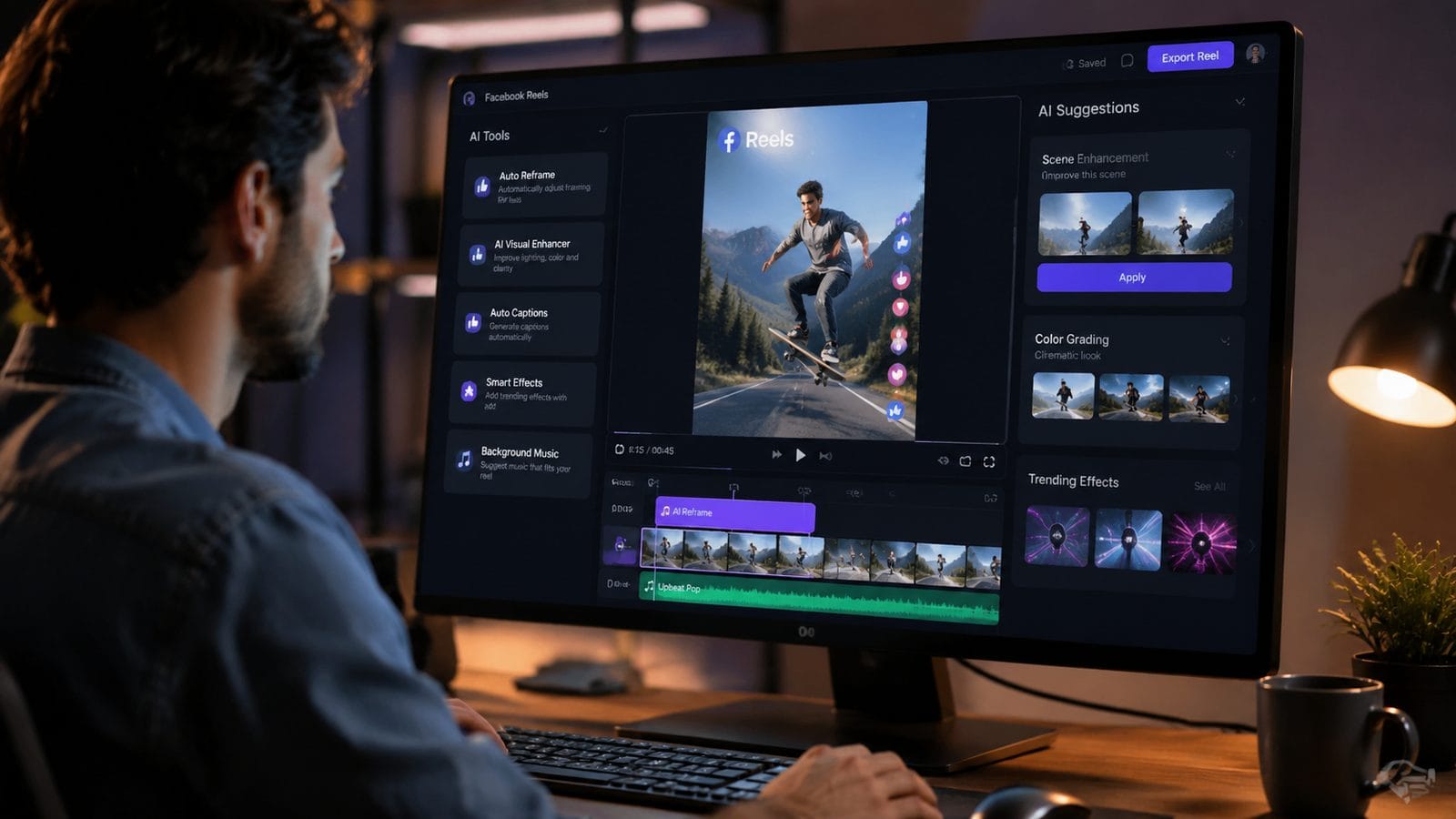
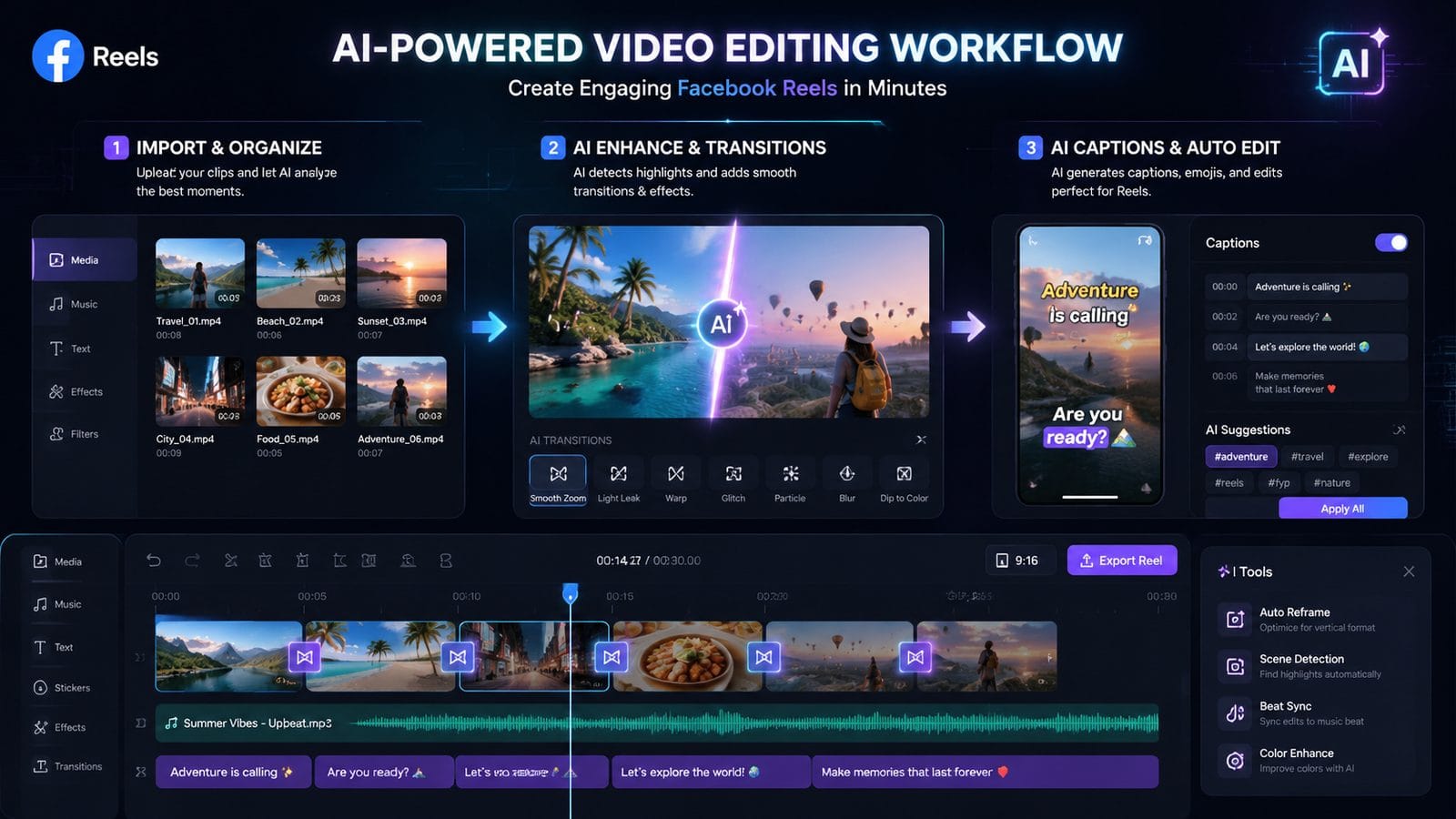
The AI video editing process for Facebook Reels in 2026 follows these key steps:
- Content Analysis: The system scans uploaded footage or text prompts to identify key elements like faces, objects, and scenery
- Style Matching: AI compares the content against trending Reels to suggest appropriate editing styles and effects
- Automatic Trimming: Algorithms identify and remove silences, bloopers, or redundant footage
- Effect Application: Context-aware filters, transitions, and text overlays are added automatically
- Music Synchronization: Beats and transitions align perfectly with selected audio tracks
- Quality Optimization: Final adjustments to lighting, color grading, and stabilization
According to Scripps News, the AI Mode introduced in June 2026 adds another layer by continuously learning from a creator's past successful Reels. This allows the system to develop personalized editing preferences that evolve alongside the creator's style. The result is a tailored editing assistant that becomes more accurate with each video produced.
The Vibes tool takes this further by generating entirely new footage based on text prompts. Creators can describe a scene or concept, and the AI will produce matching visuals complete with appropriate camera movements and effects. This represents a shift from traditional editing to what Meta calls "generative content creation," where AI handles both the filming and editing processes.
Key Features of 2026's AI Video Editing for Reels
Automated Multi-Clip Sequencing
The latest AI tools can analyze hours of raw footage and automatically assemble the most compelling sequences into coherent Reels. This goes beyond simple clip ordering - the system understands narrative flow and can build mini-stories from disparate clips. It identifies emotional peaks, action moments, and reaction shots to create professional-grade sequences that would normally require human editors.
Smart Effect Suggestions
Context-aware AI recommends filters, transitions, and text animations that match the video's content and mood. For cooking Reels, it might suggest mouth-watering food filters and quick-cut transitions. Fitness content receives energy-boosting color grades and dynamic motion effects. According to user tests, these smart suggestions reduce effect selection time by 65% while improving engagement metrics.
Generative Fill for Missing Content
When creators need additional footage but lack the original clips, AI can now generate seamless fill-in content. This might include establishing shots, reaction close-ups, or transitional b-roll that maintains visual consistency with the existing footage. The technology builds on breakthroughs in tools like Digen AI's character-consistent generation, ensuring added elements don't break immersion.
The Role of AI in Facebook Reels Engagement
AI video editing doesn't stop at production - it extends to post-upload optimization. Facebook's algorithms now provide real-time editing suggestions based on early viewer engagement data. If a Reel shows dropping retention at a specific point, the AI might recommend trimming that section or adding an attention-grabbing effect. This creates a feedback loop where content improves even after publication.
The platform's AI search integration, launched in June 2026 as reported by Technology Org, allows Reels to be discovered through semantic queries rather than just hashtags. This means well-edited videos with clear narratives and themes rank higher in AI search results. The editing tools now include "search optimization" features that ensure videos align with likely user queries.
Engagement prediction has become remarkably accurate. The AI can forecast a Reel's potential performance during the editing phase, suggesting adjustments to improve reach. These predictions consider factors like current trends, time of posting, and the creator's follower demographics. Early adopters report a 40% average increase in views when following all AI optimization suggestions.
Comparing AI Video Editing Options for Facebook Reels
| Feature | Facebook Native Tools | Digen AI Agent | Third-Party Apps |
|---|---|---|---|
| Automatic Clip Sequencing | ✓ | ✓ | ✓ |
| Generative Content Creation | ✓ (Vibes) | ✓ | Limited |
| Multi-Step Workflows | Basic | ✓ Advanced | Varies |
| Platform-Specific Optimization | ✓ Full | ✓ Partial | Partial |
| Character Consistency | Good | ✓ Excellent | Fair |
While Facebook's native tools offer the tightest platform integration, solutions like Digen AI Agent provide more advanced control over generative elements and multi-step workflows. The choice depends on whether creators prioritize convenience (native tools) or creative flexibility (third-party solutions). Most professional creators in 2026 use a combination, leveraging each platform's strengths.
Future Trends in AI Video Editing for Social Media
The next evolution of AI video editing will likely focus on real-time collaborative creation. Early tests show multiple creators could work on the same Reel simultaneously, with AI mediating style conflicts and ensuring visual consistency. This would enable new forms of distributed content creation where contributors add elements from different locations.
Another emerging trend is emotion-aware editing. AI systems are developing the ability to read viewer emotional responses through biometric data (with consent) and adjust editing styles accordingly. A Reel might automatically become more fast-paced if viewers show signs of waning attention, or insert uplifting moments when negative reactions are detected.
Meta has hinted at upcoming "cross-modal" editing tools that blend video, AR, and 3D elements seamlessly. As revealed in their Meta Store announcement, future versions may allow creators to switch between video formats (2D to 3D) or media types (video to AR) during the editing process. This would fundamentally change how Reels are conceptualized and produced.
Best Practices for AI-Assisted Reels Creation
To maximize the benefits of AI video editing in 2026, creators should focus on providing clear creative direction. While the tools can handle technical execution, they still require human input for strategic decisions. This means writing detailed prompts for generative tools, setting clear style preferences, and regularly reviewing the AI's automatic choices.
Data hygiene has become crucial - the AI learns from your past successful content, so deleting failed experiments and organizing your media library helps train better suggestions. Many top creators now maintain separate "training sets" of their best-performing clips specifically for AI analysis.
Finally, the human touch remains essential for brand differentiation. While AI can handle 80% of technical editing tasks, the most successful creators in 2026 use these tools to amplify rather than replace their unique style. The optimal workflow lets AI handle repetitive tasks while humans focus on creative direction and strategic decisions.
Frequently Asked Questions
Does Facebook's AI video editing work with existing footage or only generated content?
The system works with both - you can upload existing clips for AI enhancement or generate entirely new footage using Vibes. Most creators use a mix, with AI helping bridge gaps between original content.
How does AI maintain consistency when editing longer Reels sequences?
Advanced models track visual elements across clips using techniques similar to Digen AI Agent's character consistency system. This includes facial recognition, object permanence algorithms, and style transfer between generated segments.
Can I override the AI's automatic editing decisions?
Yes, all automatic suggestions can be modified or disabled. The system is designed to assist rather than dictate, with granular controls for every automated feature.
How does the AI know which editing styles will perform best?
It analyzes millions of high-performing Reels to identify patterns in transitions, pacing, and effects that correlate with engagement. The system also learns from your personal content history to suggest styles that work for your specific audience.
Is there a limit to how much footage the AI can process at once?
Current limits allow up to 4 hours of raw footage per Reel project. The AI analyzes this efficiently by focusing on key moments rather than processing every frame equally.
Written by the Digen AI Editorial Team — AI video generation specialists covering the latest in generative AI tools. Learn more about Digen AI.

Comments ()