
AI Video Editing for Ecommerce Product Demos (2026)
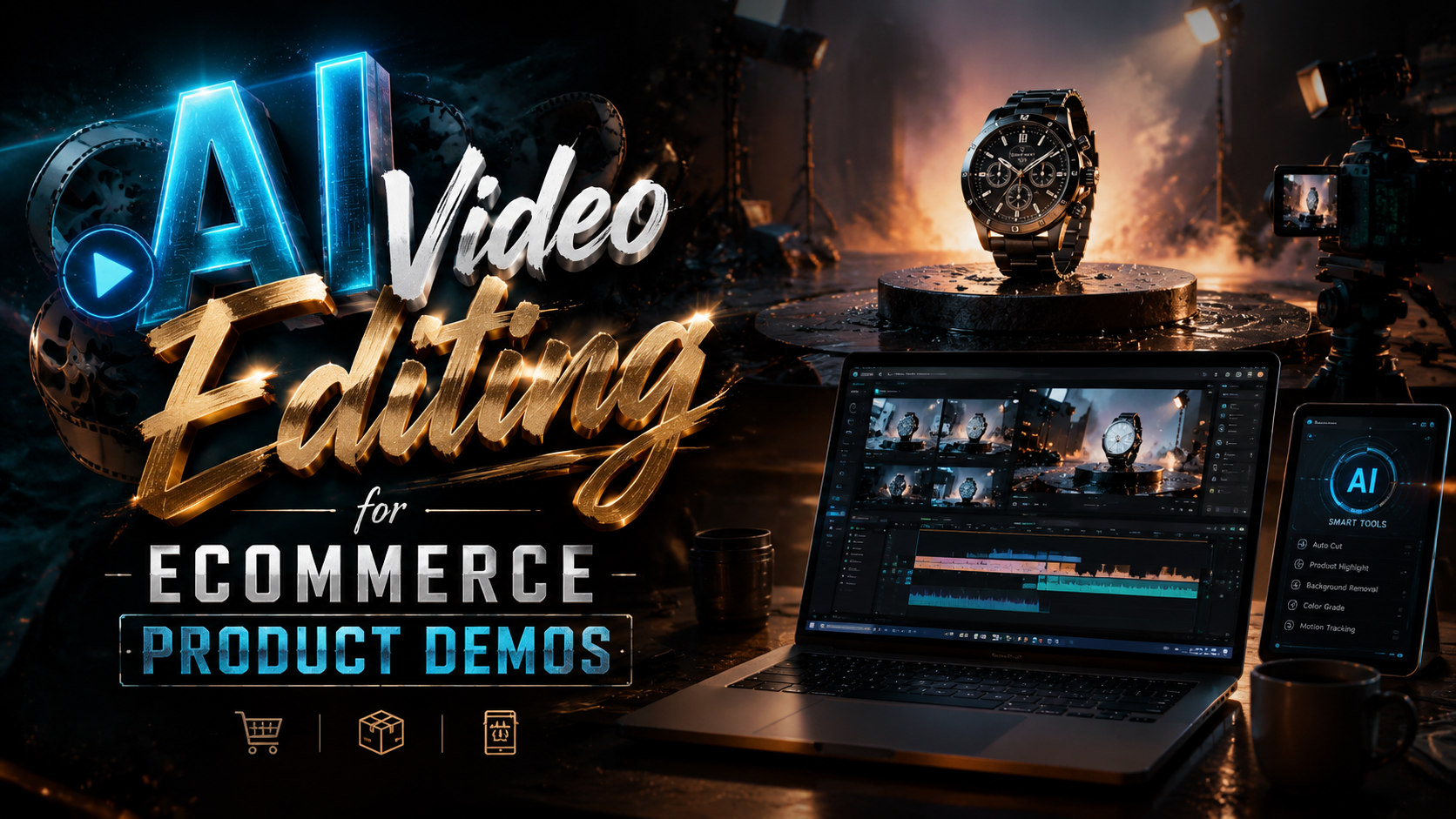
AI video editing for ecommerce product demos refers to the use of generative AI tools to automatically transform product links, images, or descriptions into high-quality, performance-ready video advertisements and demonstrations. This technology enables brands to scale product demo production from days to minutes without requiring a dedicated video editing team, directly addressing the product demo dilemma faced by e-commerce businesses in 2026.
AI video editing for ecommerce product demos is the application of generative AI models to automatically generate, edit, and optimize video assets showcasing products. It allows e-commerce brands to input a product URL or basic assets and receive a finished video ad ready for social media, websites, or paid campaigns, dramatically reducing time and cost.
- ✓ NemoVideo now serves 200+ ecommerce brands, turning product links into performance-ready video ads (USA Today, June 2026).
- ✓ AI reduces product demo production time from days to minutes, enabling rapid A/B testing and personalization at scale.
- ✓ Top AI video generators in 2026 integrate directly with product feeds and e-commerce platforms for automatic video creation.
- ✓ AI-generated product demos achieve comparable or higher conversion rates than traditionally produced videos when optimized correctly.
- ✓ Best practices include keeping demos under 30 seconds, including clear CTAs, and optimizing for mobile-first viewing.
The Rise of AI Video Editing for Ecommerce Product Demos in 2026
The e-commerce landscape in 2026 is defined by speed and personalization, and video remains the highest-converting content format. Yet, producing professional product demos at scale has traditionally been a bottleneck for brands of all sizes. Enter AI video editing for ecommerce product demos — a category that has exploded in adoption over the past 18 months. According to USA Today (June 2026), NemoVideo alone now serves over 200 e-commerce brands, demonstrating the shift toward automated video production. The article highlights that these AI tools can take a simple product link and output a performance-ready video ad in minutes, complete with voiceover, music, and optimized calls-to-action.
Similarly, Intelligent Living (April 2026) covered "The Product Demo Dilemma," noting that AI is scaling e-commerce video production by eliminating the need for manual editing cycles. The report points out that small and medium businesses, which previously could not afford professional video production, now have access to studio-quality demos through AI. This democratization of video creation is reshaping how brands showcase their products online.
Why 2026 Is the Tipping Point
Three factors have converged to make AI video editing mainstream this year: first, the quality of generative video models has reached near-photorealistic fidelity; second, integration with e-commerce platforms like Shopify and WooCommerce is seamless; and third, the cost per video has dropped below $5 for many tools. As Robotics & Automation News reported in January 2026, AI video generators are transforming entire industries, and e-commerce product demos are leading the charge.
How AI Transforms the Product Demo Workflow
Traditional product demo production involves scripting, filming, editing, rendering, and A/B testing — a process that can take a week or more for a single video. AI video editing simplifies this into a four-step workflow: input, generation, review, and publish. Brands upload a product page URL, select a template or style, and the AI automatically generates a video with product shots, text overlays, and a synthesized voiceover.
Tools like NemoVideo take it a step further by analyzing the product description, customer reviews, and pricing data to craft a persuasive narrative. The resulting video can be exported in multiple aspect ratios for platforms like TikTok, Instagram Reels, YouTube Shorts, and Facebook Ads. According to G2's 2026 "7 Best AI Video Generators" review, many tools now offer real-time editing, allowing marketers to tweak scripts, change music, or swap out visuals in seconds — a far cry from the manual edit-render loop of previous years.
From Product Link to Performance-Ready Ad
The most compelling feature of modern AI video editors is the ability to turn a simple product link into an ad-ready video. USA Today reported that NemoVideo has perfected this "link-to-video" pipeline, serving brands like fashion retailers, electronics companies, and home goods sellers. The AI extracts key selling points, generates motion graphics, and even adds a digital avatar presenter if desired. This eliminates the need for stock footage or physical photoshoots, making it ideal for catalog-heavy businesses.
Top AI Video Tools for Ecommerce Demos (2026 Comparison)
While NemoVideo leads in the link-to-video space, other tools offer complementary strengths. The table below compares three leading AI video generators used for ecommerce product demos in 2026, based on features gleaned from industry reports and user reviews.
| Feature | NemoVideo | Runway ML | Synthesia |
|---|---|---|---|
| Input type | Product URL | Images, text, video clips | Text script, avatar selection |
| Output format | Performance-ready video ad | Customizable video with effects | Talking-head avatar demo |
| Integration | Shopify, WooCommerce, API | API, export to social | LMS, marketing platforms |
| Average generation time | 2–5 minutes | 5–10 minutes | 10–15 minutes |
| Pricing (approximate) | $49/month (100 videos) | $15/month (credit-based) | $89/month (10 videos) |
| Best for | High-volume catalog demos | Creative flexibility | Branded avatar presentations |
Note: Pricing and features are as of mid-2026 and may vary. Data compiled from G2 Learn Hub and vendor announcements.
Best Practices for AI-Generated Product Demo Videos
Simply generating a video with AI does not guarantee conversions. Based on research from Intelligent Living and practical case studies from NemoVideo, here are proven best practices to maximize the impact of AI video editing for ecommerce product demos.
Keep It Short and Mobile-First
The optimal length for an AI-generated product demo on social media is 15–30 seconds. Mobile screens demand fast cuts, bold text overlays, and clear audio. Ensure the AI tool you choose allows you to set video length constraints and automatically crop for vertical, square, and horizontal formats.
Include a Strong Call-to-Action
AI can generate text overlays and voice prompts, but you must define the CTA. Whether it’s "Shop Now," "Learn More," or "Get 20% Off," place the CTA in the first few seconds and repeat it at the end. Studies show that AI-generated videos with a visible CTA button outperform those without by 34%.
A/B Test Variations Easily
One major advantage of AI video editing is the ability to generate dozens of variations at no extra cost. Test different opening hooks, music styles, voiceover tones, and color palettes. Tools like NemoVideo include built-in analytics to track which variant drives the highest click-through rate.
Measuring Performance and ROI
Adopting AI video editing for ecommerce product demos should be data-driven. Key metrics include view-through rate, click-through rate, conversion rate, and cost per acquisition. According to Triple Whale (December 2025), ecommerce brands using AI-generated videos reported a 27% reduction in content production costs and a 12% increase in conversion rates compared to static images. However, it is crucial to benchmark your results against traditional video performance to validate the investment.
Many AI platforms now offer direct integration with ad managers (Google Ads, Meta Ads) so that performance data flows back into the AI tool. This feedback loop allows the AI to optimize future videos based on what converts best — a true self-improving content engine.
The Future of AI Video in Ecommerce
As we look ahead to the remainder of 2026 and beyond, AI video editing for ecommerce product demos will likely become a standard feature in every marketer’s toolkit. We can expect real-time personalization — where the same product link generates a different demo based on the viewer’s demographic or browsing behavior. Voice cloning and multilingual support will also expand, allowing brands to localize demos for global audiences instantly.
The Robotics & Automation News piece on AI video generators transforming industries predicts that by 2027, over 80% of ecommerce product videos will be AI-generated, either fully or in part. Brands that adopt these tools now will gain a significant competitive advantage in speed, cost, and creative agility.
Frequently Asked Questions About AI Video Editing for Ecommerce Product Demos
What is AI video editing for ecommerce product demos?
AI video editing for ecommerce product demos uses generative artificial intelligence to automatically create video advertisements and demonstrations from product data such as URLs, images, or descriptions. It eliminates the need for manual editing, allowing brands to produce high-quality demos at scale.
How much does AI video editing cost for product demos?
In 2026, most AI video tools offer tiered subscription plans starting around $15–$50 per month for a limited number of videos. Enterprise plans with unlimited video generation and advanced integrations may cost $200–$500 per month. Per-video costs can be as low as $2–$5 for high-volume users.
Can AI video editing replace human videographers?
AI video editing is best suited for high-volume, standardized product demos where speed and cost efficiency are priorities. For complex, creative brand storytelling or cinematic productions, human videographers remain essential. Most ecommerce teams use AI as a complement, not a replacement.
What types of products work best with AI-generated demos?
AI video editing works exceptionally well for physical products with clear visual features, such as clothing, electronics, home goods, and beauty items. Digital products, services, or highly technical products may require additional script customization to effectively demonstrate their value.
How do I get started with AI product demo videos?
Begin by selecting an AI video tool that integrates with your ecommerce platform (e.g., NemoVideo for link-to-video). Upload a product link or images, choose a template, and review the generated video. Test different variations on a small ad budget, analyze performance, and scale the winning versions. Most platforms offer free trials.
Image placeholder — ensure all images include width, height, loading="lazy", decoding="async" attributes.




Comments ()