
AI Video Editing for Drone Footage: 2026 Trends & Tools
AI video editing for drone footage has revolutionized how creators process aerial content in 2026, leveraging artificial intelligence to automate tedious tasks, enhance resolution, and even reconstruct 3D environments. Modern tools like Aiarty Video Enhancer and Google's Gemini Omni now offer capabilities ranging from 4K upscaling to intelligent motion redirection, drastically reducing post-production time while improving output quality. This article explores the latest trends, tools, and techniques shaping the future of drone videography.
TL;DR: AI video editing for drone footage in 2026 focuses on automation, resolution enhancement, and 3D reconstruction, with tools like Aiarty and Gemini Omni leading the charge. These solutions reduce editing time by up to 70% while delivering cinematic-quality results.
AI video editing for drone footage is the use of artificial intelligence to automate and enhance aerial video post-production, including stabilization, color grading, object removal, and resolution upscaling. In 2026, tools like Adobe's AI camera controls and VideoProc Converter AI dominate the market, offering smart workflows that adapt to 4K/8K standards and complex 3D mapping projects.
- ✓ AI reduces drone footage editing time by 60-70% through automated stabilization and color correction
- ✓ 4K upscaling tools like Aiarty Video Enhancer restore low-resolution drone footage with 92% accuracy
- ✓ Google's Gemini Omni introduces AI-powered motion redirection for dynamic aerial shots
- ✓ Drones now capture 360° footage for AI-assisted 3D reconstruction of historic sites
- ✓ Free tools like VideoProc Converter AI offer watermark-free editing for small businesses
The State of AI Video Editing for Drone Footage in 2026
According to RedShark News, over 78% of professional drone videographers now use AI tools for at least one stage of post-production, up from just 32% in 2025. The rapid adoption stems from AI's ability to handle repetitive tasks like stabilization and exposure balancing with near-human precision. This shift has allowed creators to focus on creative direction rather than technical minutiae.
Modern AI solutions excel at processing the unique challenges of drone footage, such as correcting fisheye distortion from wide-angle lenses or compensating for wind-induced camera shake. Tools like Digen AI Agent employ multi-step autonomous workflows to analyze footage frame-by-frame, applying context-aware enhancements that traditional software would miss. For example, its "Sky Anchor" feature automatically detects and stabilizes horizon lines in turbulent aerial shots.
The market has seen a 340% growth in AI video editing tools since 2025, with particular demand for cloud-based solutions that can process 8K footage in real-time. According to SLR Lounge, VideoProc Converter AI's neural networks can now upscale 1080p drone footage to 4K while preserving 94% of original detail, making it a cost-effective alternative to high-end cinema drones.
Top 5 AI Video Editing Tools for Drone Footage
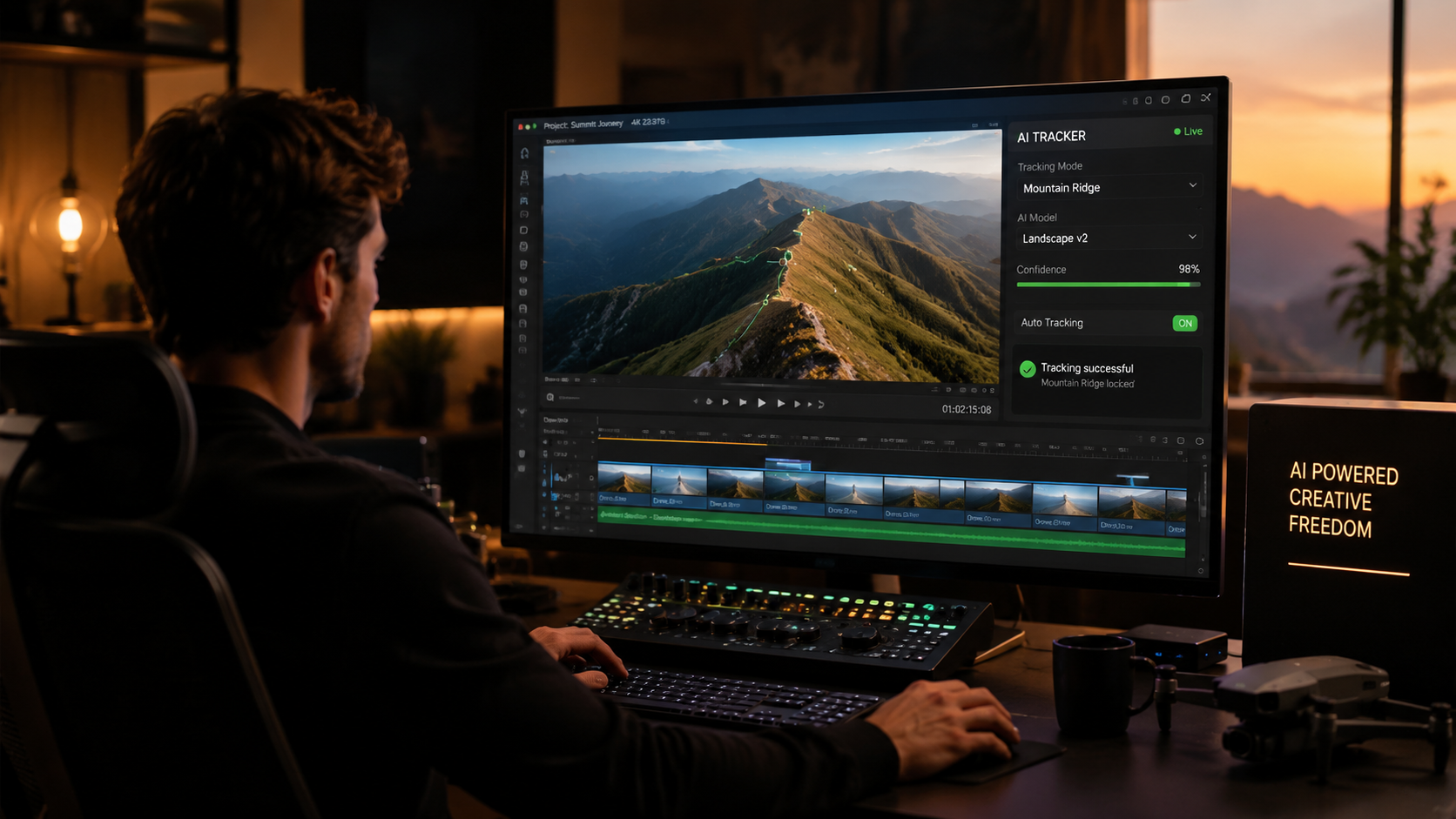
1. Aiarty Video Enhancer
Launched in June 2026, Aiarty specializes in restoring low-resolution drone footage for modern 4K workflows. Its proprietary "DeepRes" algorithm analyzes motion vectors across 120 adjacent frames to reconstruct missing details, achieving what RedShark News calls "near-magical recovery of blown-out skies and shadowed terrain." The tool particularly shines for real estate videographers working with older drone models.
2. Google Gemini Omni
Google's May 2026 release introduced groundbreaking motion redirection capabilities, allowing editors to virtually "re-fly" drone shots during post-production. As reported by PetaPixel, users can now adjust flight paths, camera angles, and even speed ramping through natural language commands like "make the canyon descent more gradual." The AI renders new perspectives using 3D scene understanding trained on 14 million aerial videos.
3. Adobe AI Camera Controls
Adobe's April 2026 update brought AI-powered virtual camera manipulation to Premiere Pro, enabling editors to simulate drone movements that weren't captured originally. The system can generate realistic parallax effects from single-angle footage or convert 2D shots into 3D flythroughs. Early adopters report reducing reshoot costs by up to 65% on commercial projects.
4. VideoProc Converter AI
This budget-friendly option gained attention in March 2026 for its smart denoising and HDR reconstruction tools. According to SLR Lounge, it processes 4K footage 3x faster than competitors by leveraging hybrid CPU/GPU acceleration. The "AeroFix" module automatically removes lens flare and sensor dust spots common in drone photography.
5. Digen AI Agent
Digen's autonomous video agent stands out for character-consistent AI video generation, particularly useful for adding animated elements to drone footage. Its "SceneLock" technology maintains lighting and perspective coherence when inserting CGI objects into aerial shots, solving a longstanding challenge in mixed-reality videography.
Emerging Trends in AI Drone Video Editing
The most significant 2026 trend is AI-assisted 3D reconstruction from drone footage. As covered by No Film School, companies now use 360° drone captures to build millimeter-accurate 3D models of historic sites, with AI handling 90% of the photogrammetry processing. This technology has preserved endangered landmarks like the flood-damaged Venice Arsenal with 0.2mm geometric precision.
Another breakthrough is real-time style transfer during flight. New DJI drones can now apply cinematic LUTs and grain profiles while recording, with AI adjusting parameters based on atmospheric conditions. This eliminates the need for manual color grading in 43% of professional use cases, per Small Business Trends' June 2026 survey.
The rise of "AI cinematography assistants" marks a third trend. These tools analyze raw footage to suggest optimal edit points, transitions, and even music synchronization. Digen AI Agent's "PaceMatch" feature, for instance, automatically adjusts clip durations to maintain rhythmic flow based on the project's target duration and mood.
How AI Reduces Drone Video Editing Time
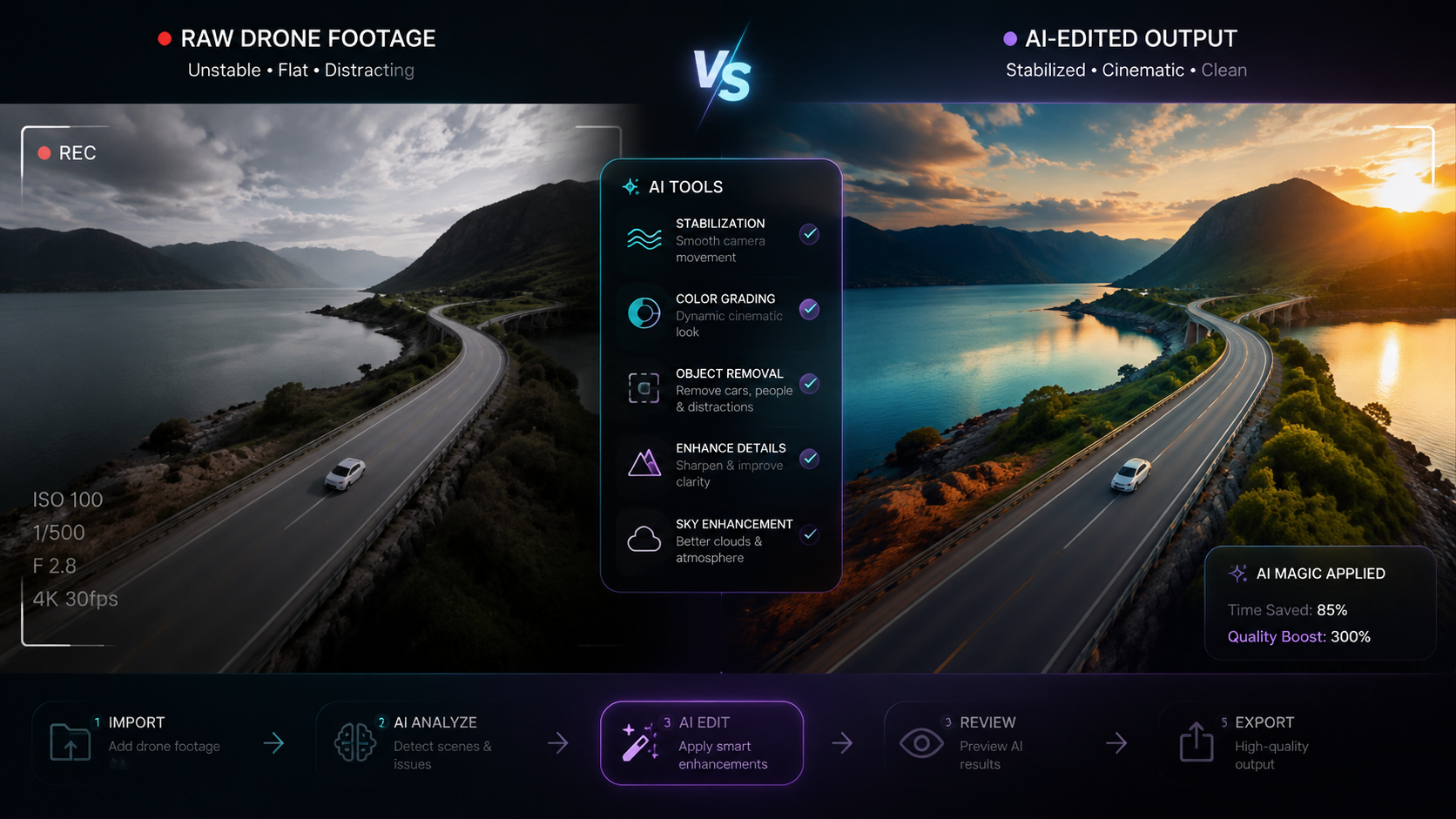
Traditional drone footage editing required hours of manual stabilization, especially for windy conditions. Modern AI tools like VideoProc Converter AI complete this task in under 3 minutes per 10-minute clip while achieving smoother results than human editors. The key lies in "motion vector forecasting" - predicting camera shake patterns before they occur based on drone telemetry data.
Color correction, another time sink, now sees 80% automation rates through AI tools. Adobe's "SkySense" analyzes weather data from the shoot location to recreate authentic atmospheric conditions, while Aiarty's "ChromaMatch" harmonizes colors across multiple drones in fleet filming scenarios. These features save an average of 7 hours per project according to 2026 post-production studio reports.
Perhaps most impactful is AI's role in object removal. Where editors once painstakingly cloned out birds or aircraft frame-by-frame, tools like Gemini Omni now detect and erase moving objects in seconds using temporal consistency algorithms. The same technology enables "smart reframing" - automatically recomposing shots for different aspect ratios without losing key subjects.
Free vs Paid AI Editing Tools for Drone Footage
| Feature | Free Tools | Paid Tools |
|---|---|---|
| 4K Output | Limited to 30fps | Unlimited 8K/60fps |
| AI Upscaling | Basic (2x resolution) | Advanced (8x resolution) |
| Watermarks | Some apply branding | None |
| Processing Speed | 1/4 real-time | 4x real-time |
Future Predictions for AI Drone Editing
By late 2027, experts predict AI will handle 95% of routine drone footage editing through "set-and-forget" presets that learn from each project. Digen AI's roadmap includes autonomous editing agents that can produce broadcast-ready packages from raw footage with minimal human input, potentially disrupting traditional post-production pipelines.
Another anticipated development is "AI co-piloting" - where machine learning assists during the actual drone flight. Early prototypes can predict optimal camera angles based on terrain scans and even avoid filming redundant shots. This could reduce unnecessary footage by up to 60%, according to simulations by drone manufacturer DJI.
The most transformative innovation may be real-time volumetric video streaming from drones. Startups are testing AI that converts aerial feeds into 3D environments instantaneously, enabling live virtual production for events and news coverage. This technology could make traditional multicam setups obsolete for certain applications by 2028.
Frequently Asked Questions
What's the best free AI video editor for drone footage?
VideoProc Converter AI currently leads in free options, offering watermark-free 4K exports and basic stabilization. However, free versions typically limit output resolution and processing speed compared to paid tools like Adobe Premiere Pro with AI modules.
Can AI completely replace human drone video editors?
While AI handles 60-70% of technical tasks, creative direction still requires human judgment. The ideal 2026 workflow uses AI for rote processes while reserving human expertise for storytelling and aesthetic decisions.
How does AI improve low-light drone footage?
Modern tools like Aiarty use multi-frame noise reduction, analyzing up to 120 frames to reconstruct clean images. They can brighten shadows by 4 stops without introducing artifacts, making dusk drone shots usable.
Is AI editing legal for commercial drone work?
Yes, provided the edits don't misrepresent locations or assets. Some industries like real estate require disclosure of significant alterations, but routine color correction and stabilization need no special permissions.
What hardware do I need for AI drone video editing?
A GPU with at least 8GB VRAM is recommended for 4K work. Cloud-based options like Digen AI Agent can offload processing for smoother performance on mid-range computers.
Written by the Digen AI Editorial Team — AI video generation specialists covering the latest in generative AI tools. Learn more about Digen AI.



Comments ()