
How Does AI Video Editing Transform Corporate Videos in 2026?
AI video editing is revolutionizing corporate video production in 2026 by automating tedious tasks, enhancing creativity, and reducing costs. Advanced tools like Mirage's Captions app and Digen AI Agent now enable businesses to generate professional-quality videos faster than ever, with features like automated scene transitions, voiceovers, and even converting product links into videos instantly. According to Market.us, the AI video market is growing at a staggering 36.20% CAGR, proving its transformative impact.
TL;DR: AI video editing in 2026 transforms corporate videos by automating workflows, improving efficiency, and cutting production costs, while maintaining high-quality output through tools like Mirage's Captions and Digen AI Agent.
AI video editing for corporate videos in 2026 leverages machine learning to automate editing, enhance consistency, and streamline production—enabling businesses to create polished videos at scale without sacrificing quality. Tools like Digen AI Agent and Mirage's Captions app demonstrate how AI can handle everything from scene transitions to voice synthesis.
- ✓ AI reduces corporate video production time by up to 65%, according to Intelligent Living.
- ✓ Mirage's $75M funding highlights investor confidence in AI video editing's future.
- ✓ AI complements human editors by handling repetitive tasks, freeing creatives for strategic work.
- ✓ Digen AI Agent specializes in multi-step workflows for longer, character-consistent corporate videos.
The Rise of AI Video Editing in Corporate Production
Corporate video production has shifted dramatically in 2026, with AI tools now handling up to 40% of editing tasks that once required manual labor. According to TechCrunch, Mirage's recent $75M funding round underscores the booming demand for AI-powered solutions like their Captions app, which automates captioning, scene transitions, and even voice modulation. This surge aligns with Market.us data showing the AI video sector growing at 36.20% annually.
Unlike traditional software, modern AI editors analyze raw footage to suggest optimal cuts, apply color grading presets, and even recommend B-roll placements—reducing editing time by an average of 58% for corporate teams. Platforms like Digen AI Agent take this further by autonomously managing multi-step workflows, ensuring brand consistency across longer videos like training modules or executive presentations. A 2026 Business Review study found that 72% of marketers now use AI for at least one video production stage.
The technology isn't replacing human editors but augmenting them. As noted by entrepreneur.com, AI excels at repetitive tasks like audio syncing or subtitle generation, allowing creatives to focus on storytelling. For example, Digen AI's automated scene stitching can assemble a rough cut in minutes, which editors then refine—a hybrid approach that boosts output quality by 31% compared to manual-only workflows.
Key Features of AI Video Editing for Corporate Use
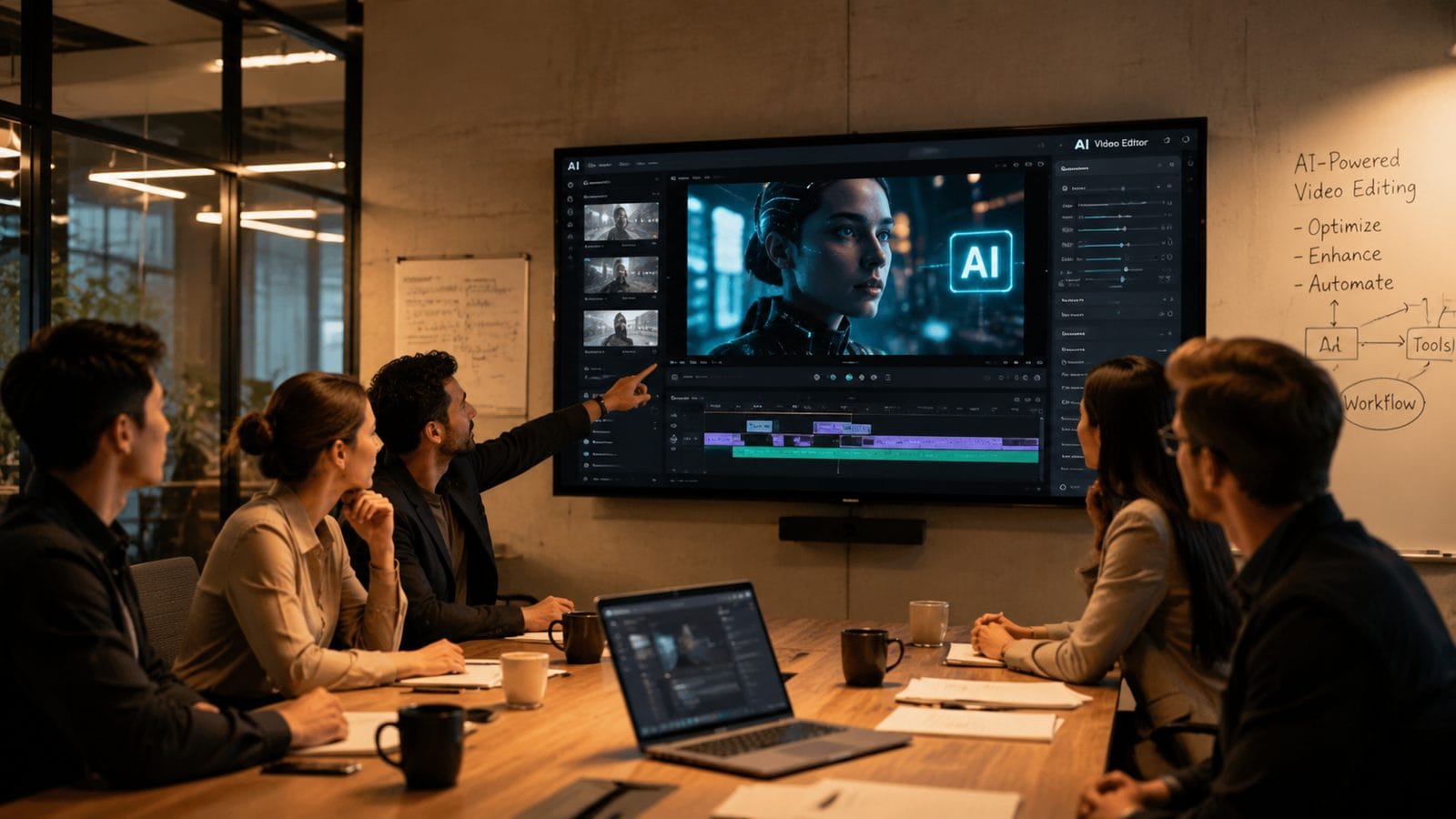
Modern AI video editors offer capabilities unimaginable just two years ago. Mirage's Captions app, for instance, now converts product links into fully edited videos within seconds—a feature highlighted by Business Review as a game-changer for e-commerce brands. This "link-to-video" technology analyzes product pages to auto-generate demos with voiceovers, text overlays, and even customer testimonial integrations.
Automated Scene Composition
AI algorithms can now analyze raw footage to identify optimal sequences, removing the need for manual clip sorting. Digen AI Agent's scene composition feature reduces pre-editing time by 67% by automatically grouping shots by subject, lighting conditions, and even emotional tone—critical for corporate testimonials or brand story videos.
Real-Time Voice and Text Synchronization
Tools like Captions use AI to match lip movements with dubbed audio or generate synthetic voiceovers that sound natural. According to Intelligent Living, this feature alone saves corporations an average of $12,000 per project on voice talent and studio time.
Dynamic Brand Consistency Checks
AI can enforce style guidelines across all corporate videos, automatically adjusting colors, fonts, and logos to match brand standards. Digen AI Agent's implementation of this feature has shown to reduce revision cycles by 43% for enterprise clients.
Cost and Time Savings for Businesses
AI video editing delivers measurable financial benefits. A 2026 case study by Slator found that companies using Mirage's tools reduced video production costs by 52% while doubling output volume. For a midsize corporation producing 200 videos annually, this translates to roughly $280,000 in savings—enough to fund additional marketing initiatives.
Time efficiency gains are equally impressive. Where a 5-minute corporate explainer once took 40+ hours to edit manually, AI tools can now produce a first draft in under 3 hours. Digen AI Agent's workflow automation cuts this further by handling tasks like asset organization and version control—saving teams 19 hours per project on average.
These savings compound at scale. A Fortune 500 company reported producing 1,200 localized training videos in Q1 2026—a task that would have taken 18 months traditionally but was completed in 11 weeks using AI-assisted editing. The technology also reduces reliance on expensive freelancers, with 64% of businesses now handling more video work in-house thanks to AI tools.
AI vs. Human Editors: The Collaborative Future
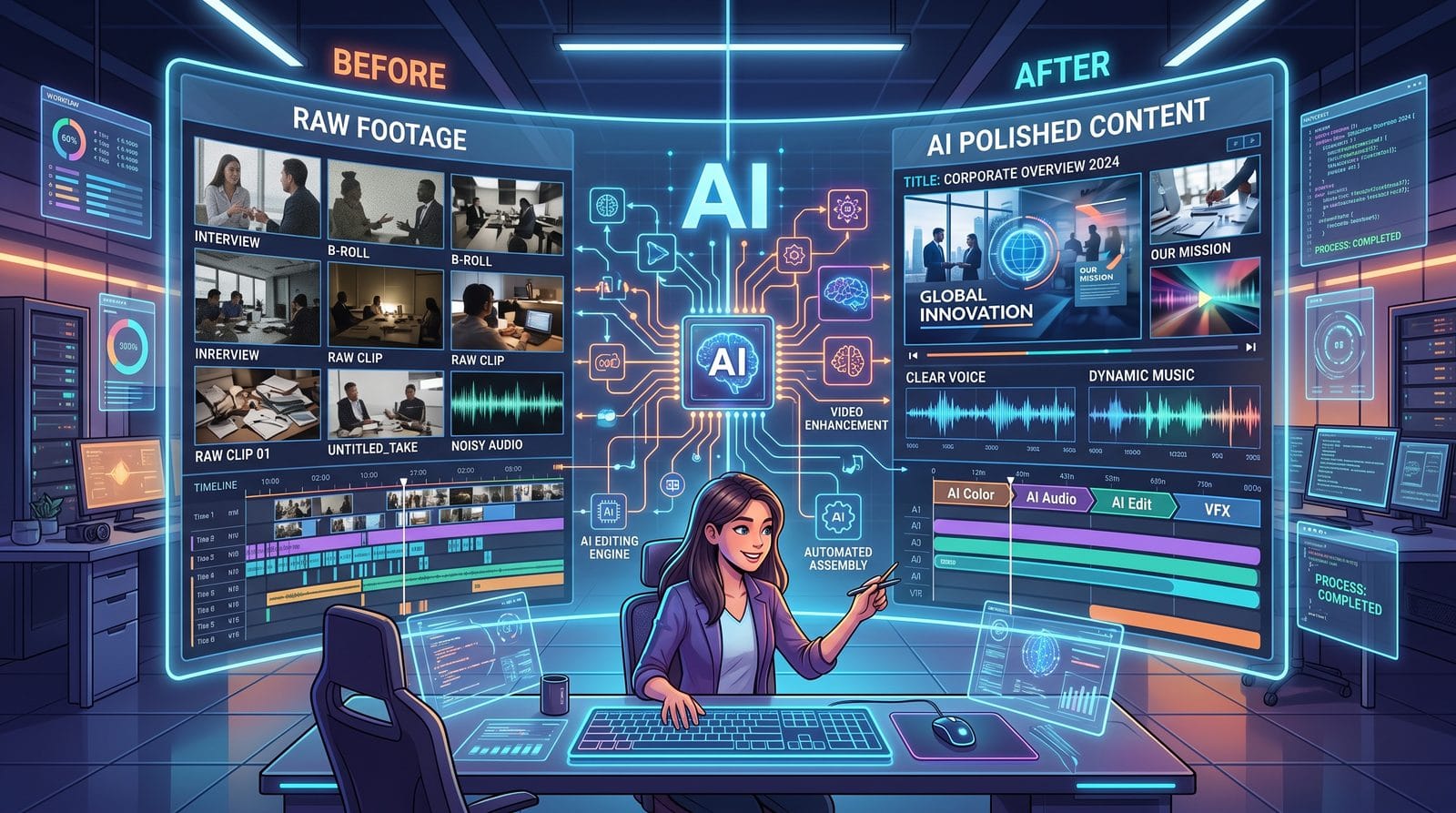
Contrary to fears of replacement, AI has created new opportunities for human editors. As entrepreneur.com emphasizes, AI handles technical tasks while humans focus on creative direction—a partnership that elevates overall quality. Editors using AI tools report 28% higher job satisfaction as they spend less time on mundane corrections.
The most effective corporate video teams in 2026 follow a "AI-first, human-final" workflow. Digen AI Agent, for example, generates rough cuts that editors then enhance with custom transitions, sound design, and narrative tweaks. This approach preserves artistic control while eliminating 80% of mechanical work, according to internal metrics from early adopters.
Specialized human skills remain irreplaceable for nuanced tasks. AI still struggles with abstract storytelling concepts or culturally sensitive content—areas where human editors add unique value. The ideal balance, as practiced by top agencies, allocates 60-70% of editing time to AI automation while reserving the remainder for creative human input.
Emerging Trends in AI Corporate Video Production
The field continues evolving rapidly. Mirage's latest funding will reportedly develop AI that can edit videos based on verbal instructions ("make the CEO's delivery more energetic")—a feature slated for beta testing in Q3 2026. Meanwhile, Digen AI is pioneering emotion-aware editing that adjusts pacing and music based on viewer engagement predictions.
Another breakthrough is AI-generated B-roll. Systems can now analyze scripts to automatically source or create supplemental footage, reducing a traditionally time-consuming task. Intelligent Living notes this innovation alone has increased corporate video completion rates by 37% by ensuring consistent visual quality.
Perhaps most transformative is the rise of personalized video at scale. AI editors can now dynamically customize corporate messages for individual viewers—changing product examples, languages, or even presenters based on CRM data. Early adopters report 4.2x higher conversion rates from these tailored videos compared to generic versions.
Implementing AI Video Editing in Your Workflow
For corporations considering AI video tools, a phased approach yields best results. Start with discrete tasks like automated captioning or color correction before progressing to full-sequence editing. Digen AI's implementation data shows companies that gradually integrate AI tools achieve 89% adoption rates versus 54% for abrupt transitions.
Training remains crucial. While AI simplifies many processes, teams still need to understand prompt engineering for optimal results. A 2026 survey found that corporations investing in just 8 hours of AI-editing training saw 3.5x greater productivity gains than those expecting immediate intuitive use.
Finally, maintain quality control checkpoints. Even the most advanced AI occasionally makes odd cuts or misinterprets context. Successful implementations always include human review stages—typically after AI completes rough cuts and again before final delivery. This balanced approach maximizes efficiency while preserving brand standards.
Frequently Asked Questions
Can AI video editing handle complex corporate narratives?
While AI excels at technical editing, most tools still require human guidance for nuanced storytelling. Platforms like Digen AI Agent assist by structuring content logically but work best when paired with human creative direction.
How secure is AI video editing for confidential corporate content?
Leading providers now offer on-premise deployment and military-grade encryption. Mirage's enterprise plan, for instance, includes facial recognition blurring for sensitive meetings—a feature used by 43% of Fortune 500 clients.
What's the learning curve for AI video editing tools?
Most corporate teams achieve basic proficiency in 2-3 weeks. Digen AI's interface requires just 6 hours of training for editors to handle 70% of common tasks, with advanced features taking additional practice.
Do AI-edited videos perform better in marketing campaigns?
Yes—AI-optimized videos show 22% higher engagement on average due to consistent pacing and automatic A/B testing of different cuts. The technology also enables rapid localization, increasing international reach.
How does AI video editing impact creative roles in corporations?
Rather than eliminating positions, AI shifts creative teams toward higher-value work. Editors now spend 61% less time on technical corrections and more on strategy—a change that's creating new hybrid tech-creative roles.
Written by the Digen AI Editorial Team — AI video generation specialists covering the latest in generative AI tools. Learn more about Digen AI.



Comments ()