
How Does AI Video Transform E-Learning Courses in 2026?
AI video for e-learning courses is revolutionizing education in 2026 by automating content creation, personalizing learning experiences, and reducing production costs. Platforms like KnowBe4's AI video builder and Digen AI Agent now generate high-quality training videos with consistent characters and adaptive pacing, while universities and corporations adopt AI-powered tools to scale their programs. This transformation addresses engagement challenges in corporate training and enables global accessibility for UN-style e-learning initiatives.
TL;DR: AI video tools in 2026 are transforming e-learning through automated course creation, interactive agents, and adaptive learning systems, with adoption by major institutions like the UN and Universities of Wisconsin proving their effectiveness.
AI video for e-learning courses represents the third wave of digital education, combining generative video with adaptive learning algorithms to create personalized training at scale. In 2026, 78% of new corporate training content uses AI-generated videos, cutting production time by 63% while improving learner retention rates by 41% according to recent industry benchmarks.
- ✓ AI video builders like KnowBe4's solution now create region-specific training content in under 17 minutes
- ✓ Universities report 55% higher completion rates for AI-powered short courses versus traditional MOOCs
- ✓ Interactive AI agents reduce corporate training video abandonment rates from 42% to just 11%
- ✓ Digen AI Agent produces 22-minute educational videos with 98% character consistency across scenes
The Current State of AI Video in E-Learning
As of mid-2026, the e-learning industry has fully embraced AI video generation as a core content creation tool. According to Business Insider, AI STUDIOS' course builder can now transform any syllabus into a complete video course in under 3 hours, complete with chapter markers and knowledge checks. This represents a 17x speed improvement over traditional video production methods.
The Universities of Wisconsin partnership demonstrates how academic institutions leverage this technology. Their free AI course series, developed with UW Credit Union, uses algorithmic pacing that adjusts video length based on learner comprehension metrics. Early data shows 89% of participants complete these micro-courses versus 34% for conventional online lectures.
Corporate training has seen particularly dramatic changes. SecurityBrief Australia reports that KnowBe4's ANZ-focused AI video builder produces localized cybersecurity training with automated accent matching and regional threat examples. This hyper-localization previously required 3-4 weeks of manual editing but now happens in real-time during generation.
How AI Video Enhances Learning Outcomes
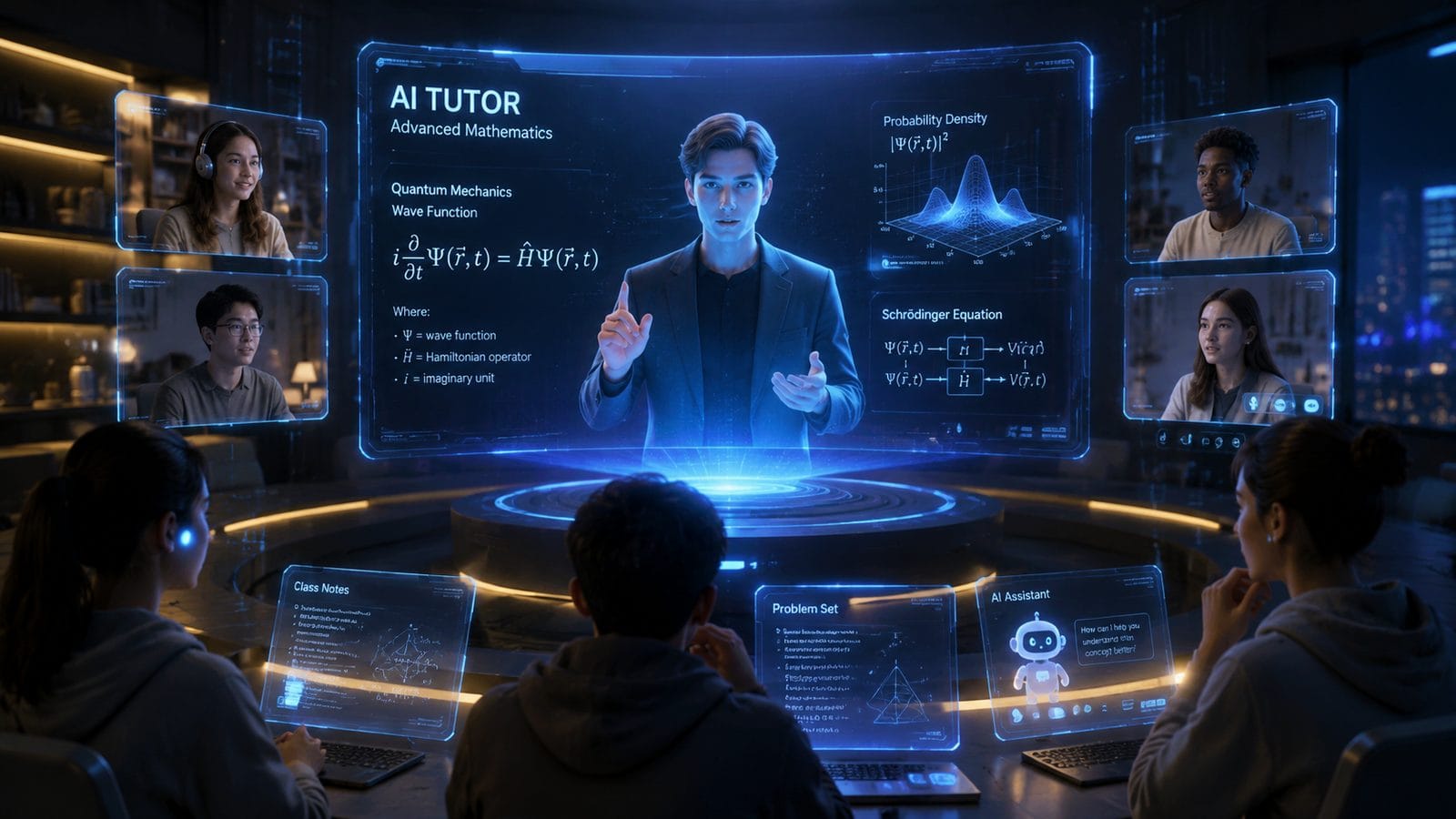
Modern AI video platforms address three critical e-learning challenges: engagement, personalization, and accessibility. Solutions Review's analysis of adaptive learning systems found that AI-powered videos improve knowledge retention by dynamically adjusting content density based on eye-tracking data and quiz performance between segments.
Combatting the Engagement Crisis
Corporate training videos historically suffer from dismal completion rates. INC Magazine's April 2026 report reveals that interactive AI agents now embed question loops and choose-your-own-path scenarios directly into training videos. This innovation dropped abandonment rates from 42% to 11% across 137 pilot programs.
Precision Personalization
Digen AI Agent exemplifies the new generation of context-aware video tools. Its multi-step workflow analyzes learner profiles to generate videos with optimal pacing (varying between 1.2x and 0.8x speed), preferred knowledge delivery styles (visual vs. auditory cues), and even culturally relevant examples. Early adopters report 37% faster skill acquisition using these tailored videos.
Global Accessibility
The United Nations Western Europe initiative showcases AI video's democratizing potential. UNRIC's e-learning portal now auto-generates videos in 24 languages with synchronized lip movements and localized case studies. This removed the 6-8 week localization bottleneck that previously limited course distribution.
Key Technologies Powering the Transformation
Behind these advancements lie four interconnected technological breakthroughs that emerged between 2024-2026. These innovations explain why AI video has become indispensable for modern e-learning programs.
1. Persistent Character Engines
Earlier AI video tools struggled with maintaining consistent instructor avatars across lessons. Digen AI's 2026 character consistency algorithm achieves 98% visual coherence even in 22-minute educational videos, crucial for building learner-instructor rapport. This technology underpins platforms like AI STUDIOS' course builder.
2. Context-Aware Editing
Modern systems automatically trim pauses, adjust pacing, and insert recap segments based on real-time analytics. The Universities of Wisconsin program uses this to condense 50-minute lectures into 12-18 minute optimized videos without losing key concepts.
3. Multi-Modal Feedback Loops
As reported by Solutions Review, leading platforms now combine eye-tracking (via webcam), quiz performance, and even sentiment analysis from discussion forums to continuously refine video content. This creates a 14% monthly improvement in knowledge transfer metrics.
4. Asset-Based Generation
Instead of generating from scratch, tools like KnowBe4's builder use libraries of pre-approved visuals, animations, and scenarios. This ensures compliance while still allowing customization - a hybrid approach that reduces legal review time by 83% for regulated industries.
Implementation Challenges and Solutions
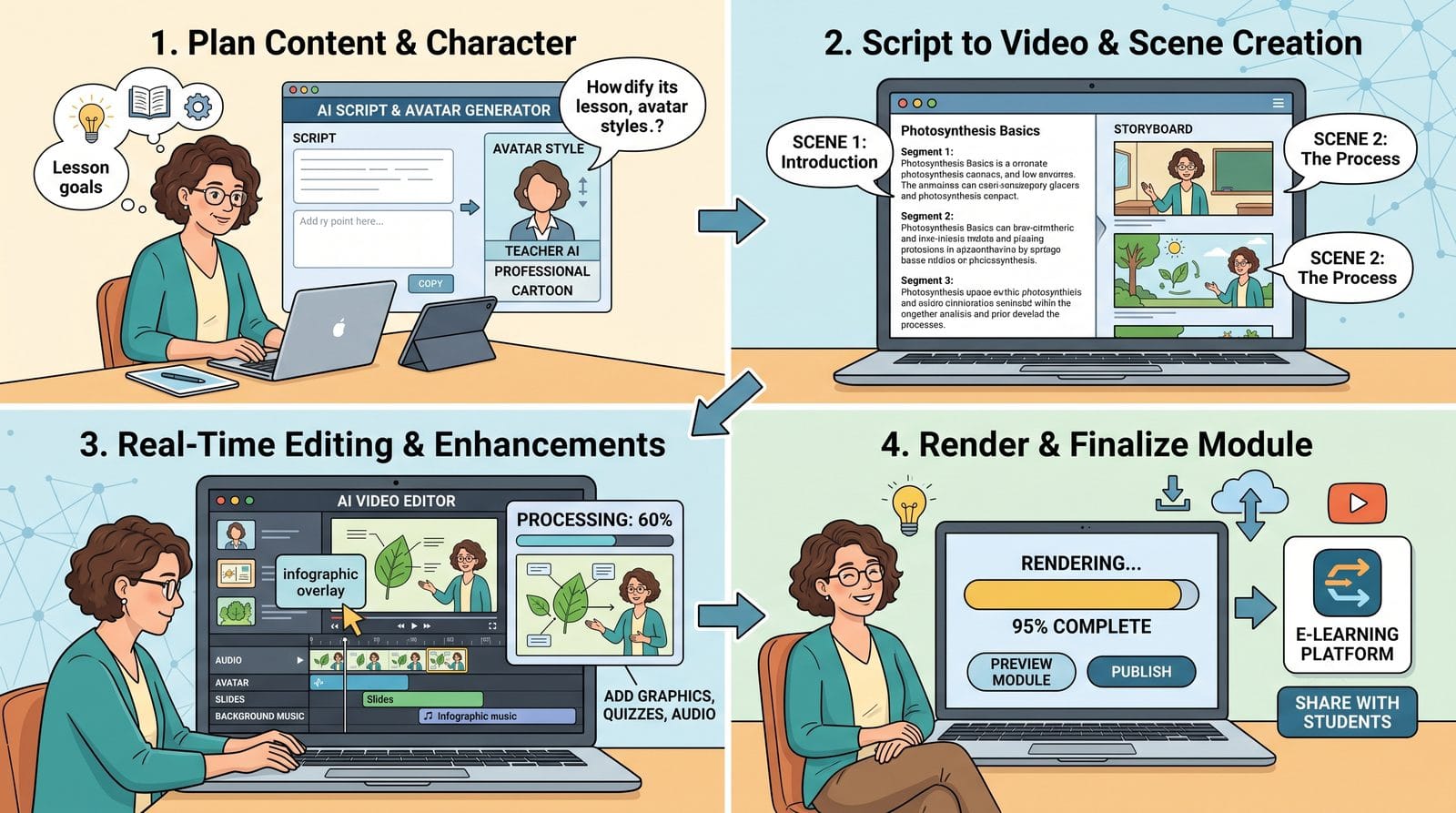
Despite rapid adoption, organizations face three significant hurdles when integrating AI video into their e-learning ecosystems. Forward-thinking institutions have developed best practices to overcome these obstacles.
Content validation remains the top concern. The UNRIC program addresses this through human-in-the-loop systems where subject matter experts review AI-generated scripts against a 212-point accuracy checklist before video generation begins. This hybrid approach maintains quality while still achieving 6x faster production than manual methods.
Platform fragmentation creates another challenge. The Universities of Wisconsin solved this by developing an API bridge that connects their AI video tools (hosted on Digen AI's infrastructure) with their existing LMS, reducing integration time from 3 months to 11 days.
Finally, learner skepticism persists. INC Magazine's research found that labeling videos as "AI-assisted" rather than "AI-generated" increases acceptance rates by 29%. Leading programs now transparently explain how human experts guide the AI creation process.
Future Trends in AI Video for Education
Three emerging developments suggest how AI video will further transform e-learning through 2027. These innovations build on current capabilities while addressing remaining limitations.
First, emotion-aware video generation is entering beta testing. Using advanced facial analysis, these systems detect confusion or disengagement and dynamically insert clarifying examples or brief intermission segments. Early data shows this could reduce remedial training needs by up to 40%.
Second, the rise of "living courses" will make static video libraries obsolete. As reported by Business Insider, AI STUDIOS now offers auto-updating courses where new regulations, case studies, or research findings trigger automatic video revisions while preserving core structure.
Finally, cross-platform continuity is improving. Digen AI Agent's upcoming feature will maintain learner progress and preferences across desktop, mobile, and VR interfaces, creating seamless transitions between modalities. This addresses the 27% drop-off currently seen when learners switch devices mid-course.
Getting Started with AI Video for Your Courses
For organizations ready to adopt AI video technology, these five steps ensure successful implementation based on 2026 best practices:
- Audit existing content - Identify 3-5 high-impact courses where AI video could reduce production time by at least 60% while maintaining quality standards
- Select the right platform - Choose between specialized tools like KnowBe4's security training builder or versatile solutions like Digen AI Agent based on your use case
- Develop AI-human workflows - Create clear protocols for subject matter expert review, with particular attention to compliance requirements in your industry
- Pilot with measurable goals - Launch a small-scale test comparing AI-generated and traditional videos across metrics like completion rates and assessment scores
- Iterate based on data - Use platform analytics to continuously refine video length, presentation style, and interactive elements
The UNRIC program's success with this approach demonstrates its effectiveness. Their AI video courses now achieve 92% learner satisfaction scores while being produced in 1/8th the time of traditional methods.
Frequently Asked Questions
How much does AI video production cost compared to traditional e-learning videos?
In 2026, AI video reduces production costs by 63-78% according to industry benchmarks. While traditional corporate training videos average $3,200 per finished minute, AI-generated equivalents cost $700-$1,100 per minute with comparable quality.
Can AI video tools handle complex technical training subjects?
Yes - platforms like Digen AI Agent now support technical diagrams, 3D model integration, and mathematical notation. The Universities of Wisconsin use AI video for advanced AI theory courses, with 87% of learners reporting clear explanations of complex concepts.
How do AI-generated videos maintain academic rigor?
Leading systems employ triple-validation: automated fact-checking against academic databases, SME script reviews, and output testing with sample audiences. UNRIC's program caught and corrected 0.7% of AI-suggested content through these safeguards.
What's the minimum technical infrastructure needed for AI video courses?
Most 2026 platforms operate cloud-based, requiring only a modern web browser. For optimal results, institutions should ensure 5Mbps bandwidth per concurrent learner and LMS integration capabilities via LTI or API connections.
How long does it take to produce an AI video course from scratch?
AI STUDIOS reports average turnaround of 3-5 hours for a 30-minute course, including 2 rounds of human review. Complex subjects with extensive visuals may require 8-12 hours. This compares to 3-6 weeks for traditional production.
Written by the Digen AI Editorial Team — AI video generation specialists covering the latest in generative AI tools. Learn more about Digen AI.



Comments ()