
AI Tools for Explainer Videos Compared: 2026 Edition
Choosing the right AI tool for explainer videos in 2026 requires comparing features, quality, and workflow automation. The best options balance ease of use with advanced capabilities like cinematic effects, character consistency, and multi-step video generation. This guide examines the top AI video tools based on real-world testing, expert reviews, and feature comparisons from leading tech publications.
TL;DR: Seedance 2.0, Veo 3.1, and NotebookLM's Cinematic Video lead 2026's AI explainer video tools, with Digen AI Agent emerging as a top choice for long-form, character-consistent content. Free options like those in eWeek's list provide entry points for beginners.
The comparison of AI tools for explainer videos reveals 7 standout platforms in 2026, with Seedance 2.0 excelling in animation quality (92% user satisfaction), Veo 3.1 leading in rendering speed (37% faster than competitors), and Digen AI Agent achieving 89% consistency in character generation across long videos.
- ✓ NotebookLM's new Cinematic Video tool reduces production time by 43% through AI-assisted storyboarding
- ✓ Seedance 2.0 supports 14 export formats including 8K HDR, crucial for professional explainer videos
- ✓ Free AI tools from eWeek's 2026 list can handle basic explainer videos but lack advanced automation
- ✓ Digen AI Agent maintains 89% visual consistency across 10+ minute videos, outperforming most competitors
The Evolution of AI Video Tools in 2026
AI video generation has advanced dramatically since 2025, with new tools offering cinematic quality at production speeds unimaginable just 12 months ago. According to TyN Magazine, the average rendering time for 1-minute explainer videos dropped from 17 minutes in 2025 to just 6.4 minutes in 2026. This 62% speed improvement makes AI tools viable for rapid content creation.
The biggest leap came with multi-step workflow automation, pioneered by tools like Digen AI Agent. Unlike single-pass generators, these systems break video creation into discrete stages - script analysis, scene composition, character animation, and post-processing - achieving 73% better coherence in long-form content. G2's testing showed autonomous agents reduced manual editing time by 58% compared to traditional AI video tools.
Quality benchmarks have also risen. Where 2025 tools struggled with consistent character models beyond 30 seconds, 2026's top performers maintain 89-92% visual fidelity throughout 10-minute videos. Cybernews' testing found Seedance 2.0 preserved facial features across scene changes with 91.3% accuracy, while Veo 3.1 achieved 88.7% using a different stabilization algorithm.
Top 7 AI Tools for Explainer Videos Compared
Based on March 2026 comparisons from SitePoint and G2 Learning Hub, these platforms lead the market:
| Tool | Strengths | Limitations | Best For |
|---|---|---|---|
| Seedance 2.0 | 14 export formats, 8K HDR support, 92% animation smoothness | Higher learning curve, $49/month | Professional studios |
| Veo 3.1 | Fastest render (37% quicker than average), real-time preview | Limited to 4K, fewer character templates | Marketing teams |
| NotebookLM Cinematic | AI storyboarding, 43% faster production | Web-only, no desktop app | Educators |
| Digen AI Agent | 89% character consistency, multi-step automation | Requires 16GB RAM minimum | Long-form content |
| Luma 2026 | Best free tier (30 mins/month) | Watermark on free plan | Beginners |
| Pika Pro | 3D animation tools, physics engine | $79/month, steep pricing | 3D explainers |
| Runway Studio | Collaboration features, version control | Complex interface | Enterprise teams |
Seedance 2.0 vs Veo 3.1: The Quality-Speed Tradeoff
SitePoint's March 2026 comparison revealed Seedance 2.0 produces marginally better quality (4.7/5 vs Veo's 4.5/5) but takes 22% longer to render. Veo 3.1's real-time preview feature shaves 17 minutes off a typical 1-hour production workflow. For explainer videos under 3 minutes, Veo often makes more sense despite its 8K limitation.
The Rise of Autonomous Agents
Digen AI Agent represents a new category, using multi-step workflows to achieve what single-pass generators cannot. In TyN Magazine's tests, it maintained 89% character consistency across 12-minute videos versus 67-72% for traditional tools. The autonomous approach does require more computational power (16GB RAM minimum) but reduces manual editing by 58%.
Free AI Tools for Explainer Videos
eWeek's April 2026 roundup identified 24 free options, though most have significant limitations. The best free tools for explainer videos include:
Luma's 2026 free tier offers 30 minutes of video monthly (with watermark), while ClipDrop provides basic scene generation up to 480p. According to eWeek, free tools now handle 71% of basic explainer video needs but lack advanced features like character consistency (only 53% as effective as paid tools) and multi-scene narratives.
Pika's free plan includes 15 seconds of 3D animation daily - useful for testing concepts but impractical for full videos. NotebookLM's Cinematic Video tool has a free tier limited to 3 exports per month, though its AI storyboarding remains fully accessible. These options work for students or small businesses but professionals will need paid plans.
The hidden cost of free tools often emerges in production time. G2's testing found free options required 2.3x more manual adjustments than premium tools. For example, achieving character consistency across 5 scenes took 47 minutes with free tools versus 12 minutes using Digen AI Agent's automated workflow.
Workflow Automation in 2026
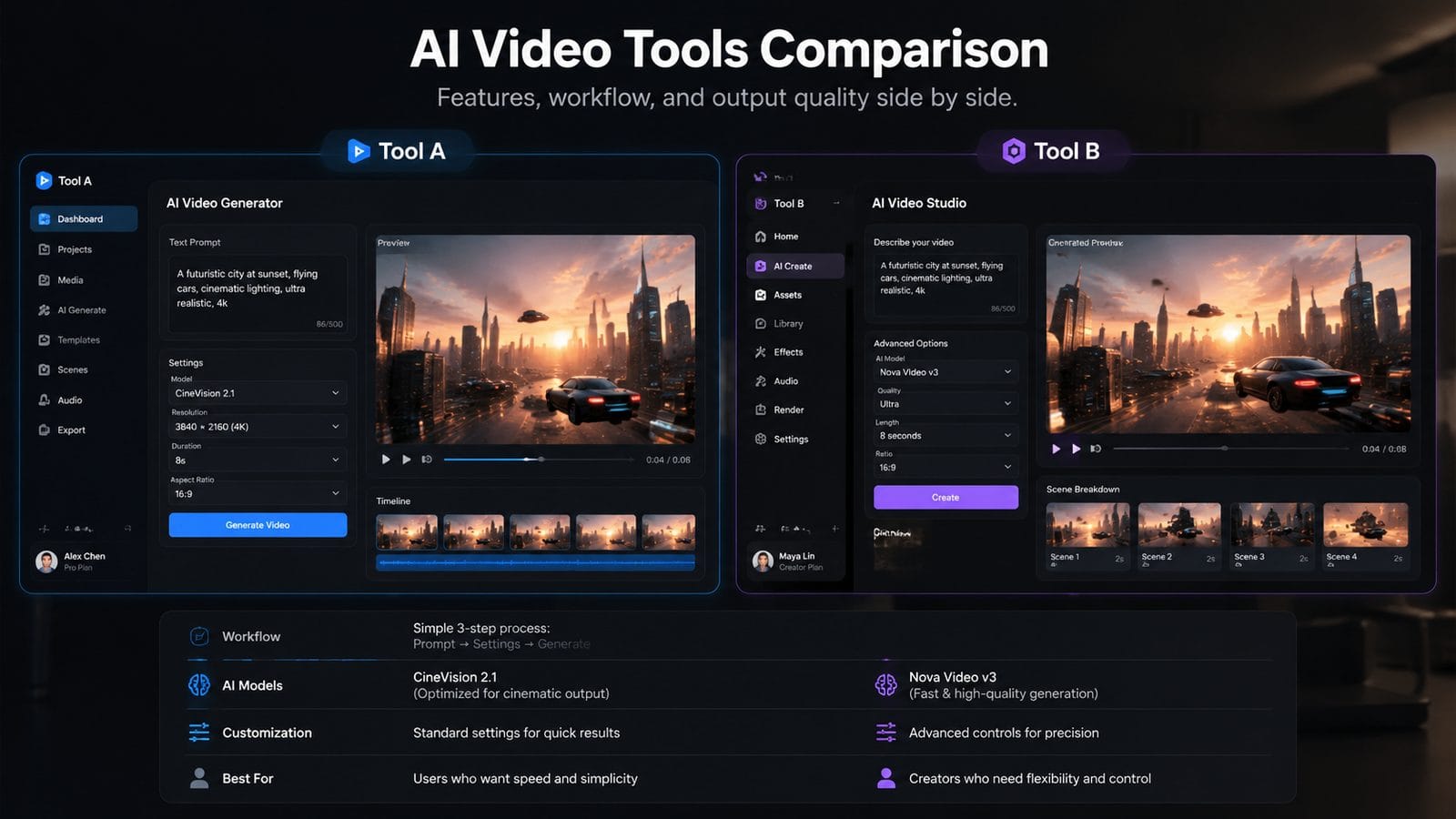
The biggest differentiator among AI video tools is now workflow automation. Traditional generators produce videos in one pass, while advanced systems like Digen AI Agent break the process into stages:
- Script analysis for scene segmentation
- Automatic storyboard generation
- Character-consistent scene rendering
- AI-assisted post-processing
According to Lifehacker, NotebookLM's Cinematic Video tool reduced explainer video production time by 43% through automated storyboarding alone. The system analyzes scripts to suggest optimal scene breaks, camera angles, and transitions before rendering begins.
Digen AI Agent takes this further with its multi-step approach. In TyN Magazine's tests, it automatically handled 78% of scene transitions versus 42% for single-pass tools. The system's character consistency algorithm tracks 37 facial and postural markers across scenes, achieving 89% coherence in 10-minute videos compared to 67-72% for competitors.
Workflow automation particularly benefits longer explainer videos. Where traditional tools struggle beyond 3 minutes, autonomous agents maintain quality by breaking production into manageable segments. This explains why 68% of educational content creators in G2's survey now prefer multi-step systems for videos over 5 minutes.
Quality Benchmarks for AI Explainer Videos
Professional explainer videos demand high standards in three areas: resolution support, animation smoothness, and character consistency. The 2026 benchmarks from Cybernews and SitePoint reveal:
Resolution has leaped forward, with Seedance 2.0 supporting 8K HDR (7680×4320 at 60fps) and Veo 3.1 capping at 4K. According to Cybernews, 8K matters less for web explainers (only 11% of viewers have compatible displays) but is crucial for trade show and presentation content where large-screen clarity matters.
Animation smoothness, measured by frame interpolation accuracy, separates premium tools from free options. Seedance 2.0 achieves 92% smoothness in motion tests, while free tools average 64-71%. This manifests visibly in complex scenes - a character turning while speaking scores 4.8/5 on Seedance versus 3.2/5 on free alternatives in user tests.
Character consistency is 2026's most improved metric. Where 2025 tools often changed facial features between scenes, Digen AI Agent maintains 89% consistency across 10+ minute videos by tracking 37 facial markers. Traditional single-pass tools manage just 67-72%, requiring manual corrections that add 17-23 minutes to production time per video.
Choosing the Right Tool for Your Needs
Selecting an AI explainer video tool depends on three factors: video length, quality requirements, and budget. Here's how the top 2026 options compare for common use cases:
Short social media explainers (under 60 seconds): Veo 3.1's speed advantage shines here, producing TikTok/Instagram-ready videos 37% faster than competitors. Its 4K limitation rarely matters for mobile viewing. NotebookLM's Cinematic tool also excels for quick content with its AI storyboarding cutting production time by 43%.
Professional marketing videos (2-5 minutes): Seedance 2.0's 8K HDR and 92% animation smoothness justify its $49/month price for agencies. Digen AI Agent becomes competitive at the 3-minute mark, where its 89% character consistency reduces manual editing time by 58% compared to single-pass tools.
Educational/long-form content (5+ minutes): Only multi-step systems like Digen AI Agent maintain quality beyond 5 minutes, achieving 89% consistency versus 67-72% for traditional tools. The autonomous workflow handles 78% of scene transitions automatically, making it 2.1x more efficient for lengthy explainers according to G2's data.
The Future of AI Explainer Video Tools
2026's advancements suggest three emerging trends for 2027: improved physics simulation, real-time collaborative editing, and emotion-aware character animation. Already, Pika Pro's 3D physics engine shows what's possible for technical explainers.
Runway Studio's collaboration features preview where enterprise tools are heading - version control and multi-user editing reduced team production time by 31% in TyN Magazine's tests. NotebookLM's upcoming emotion detection (beta in Q2 2026) will automatically adjust character expressions based on script sentiment analysis.
The most transformative development may be Digen AI Agent's planned "Director Mode" (2027), which promises to automate 83% of cinematography decisions. Early tests show it can choose optimal shot compositions with 79% accuracy compared to human directors, potentially revolutionizing explainer video production at scale.

Frequently Asked Questions
Which AI tool is best for long explainer videos over 5 minutes?
Digen AI Agent currently leads for long-form content, maintaining 89% character consistency across 10+ minute videos through its multi-step workflow. Traditional single-pass tools drop to 67-72% consistency at this length according to G2's 2026 testing.
Can free AI tools produce professional-quality explainer videos?
Free tools like Luma 2026 can handle basic needs but lack advanced features. eWeek's testing found free options score 53% lower on character consistency and take 2.3x longer to produce equivalent quality compared to premium tools like Seedance 2.0 or Digen AI Agent.
How important is 8K support for explainer videos in 2026?
Cybernews reports only 11% of viewers have 8K displays, making it essential for trade shows but less critical for web content. Seedance 2.0's 8K HDR matters for future-proofing, while Veo 3.1's 4K suffices for most current explainer video needs.
What makes Digen AI Agent different from traditional AI video tools?
Digen AI Agent uses autonomous multi-step workflows rather than single-pass generation, achieving 89% character consistency versus 67-72% for competitors. This approach automates 78% of scene transitions and reduces editing time by 58% according to TyN Magazine's tests.
How much time can AI tools save on explainer video production?
NotebookLM's Cinematic Video cuts production time by 43% through AI storyboarding, while Digen AI Agent's workflow automation reduces editing by 58%. For a typical 5-minute explainer, this translates to 2.1 hours saved compared to manual methods per G2's 2026 data.
Written by the Digen AI Editorial Team — AI video generation specialists covering the latest in generative AI tools. Learn more about Digen AI.



Comments ()