
AI Text to Video Education in 2026: The Future of Learning
AI text to video education refers to the use of generative artificial intelligence that converts written prompts, scripts, or lesson plans directly into instructional video content, enabling educators to produce personalized learning materials in minutes rather than weeks. As the technology matures in 2026, it is reshaping how schools, universities, and corporate training programs design and deliver visual knowledge, making high-quality video production accessible to institutions of any size or budget.
AI text to video education is a paradigm shift in instructional design where natural language descriptions are transformed into dynamic, narrated video sequences — complete with visuals, animations, and synthetic voiceovers — allowing educators to create curriculum-aligned content on demand without requiring video editing skills, expensive equipment, or large production teams.
- ✓ The AI-powered video generator market is growing at a CAGR of 23.5%, signaling strong institutional adoption in education (Market.us, 2026).
- ✓ Retrieval Augmented Generation (V-RAG) from AWS is enabling contextually accurate educational videos by grounding AI outputs in curated academic databases.
- ✓ Researchers at Nature (2025) have validated AI-generated medical images for ophthalmology training, proving AI video tools can meet rigorous educational standards.
- ✓ Student competition winners — such as the Broadcast Education Association's AI video contest — demonstrate that learners themselves are becoming proficient AI video creators.
- ✓ The World Bank (2025) now explicitly advises education ministries on integrating generative AI tools, including text-to-video, into national curricula.
What Is AI Text to Video Education and Why Does It Matter in 2026?
AI text to video education describes a workflow in which an educator inputs a text prompt — such as "Explain photosynthesis for a 10th-grade biology class" — and the system generates a complete video including animated diagrams, background footage, voice narration, and subtitles. Unlike traditional video production, which can take days or weeks and cost thousands of dollars per minute of finished content, AI text to video tools can produce a five-minute explainer in under an hour.
The significance of this shift, as reported by Market.us in June 2026, is reflected in the AI-powered video generator market's compound annual growth rate of 23.5%. Education is one of the fastest-adopting sectors, driven by the need for personalized, on-demand learning materials that can keep pace with rapidly evolving curricula. The World Bank's August 2025 expert analysis on the AI revolution in education specifically highlighted that generative video tools lower the barrier for creating culturally relevant, localized content in multiple languages, which is critical for global education equity.
How AI Text to Video Education Works: A Step-by-Step Guide
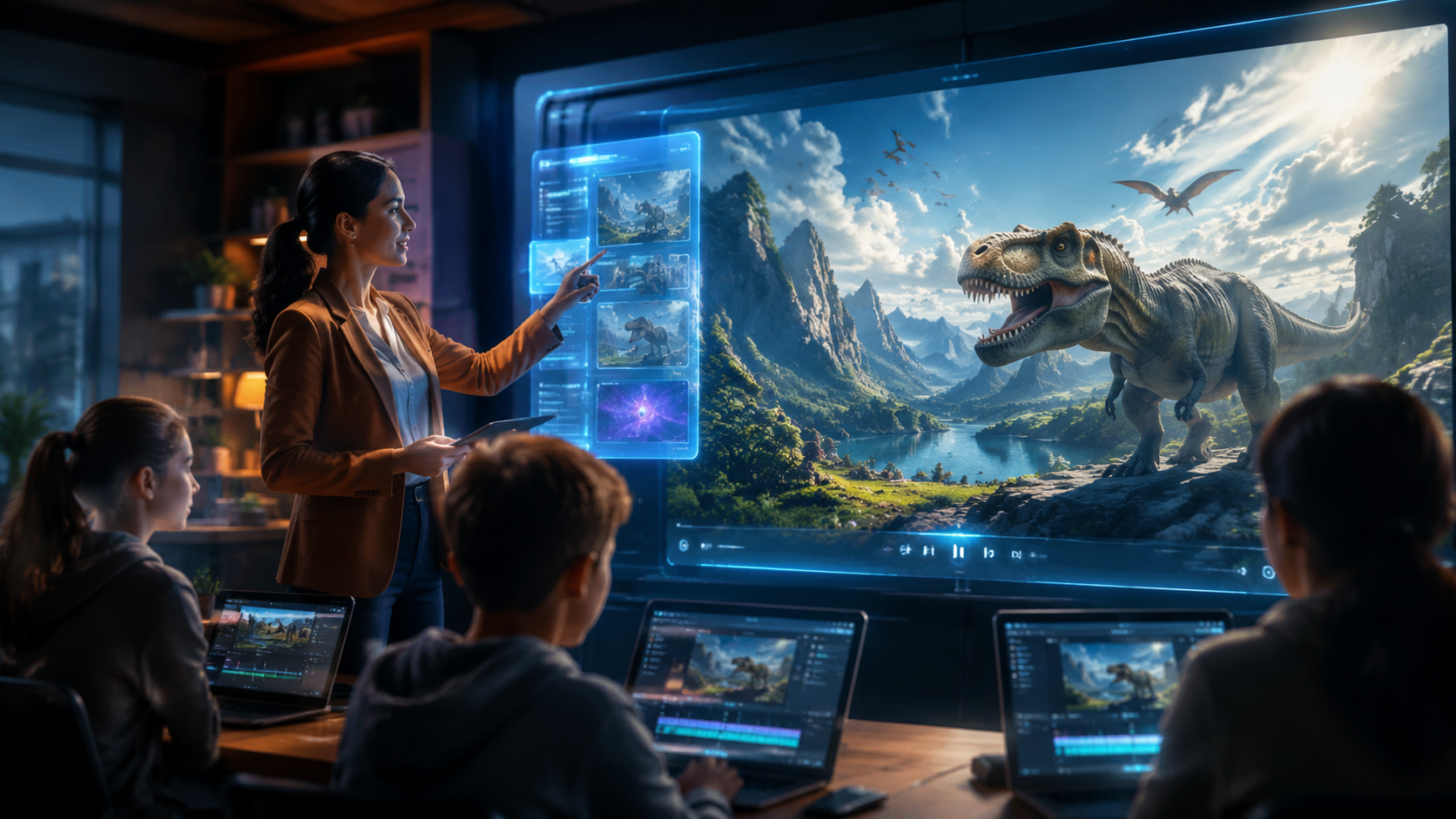
For educators and instructional designers who want to implement AI text to video education in their workflows, the process is straightforward and repeatable. Below is a step-by-step guide based on current best practices in 2026.
- Define your learning objective. Start by writing a clear, concise statement of what students should know or be able to do after watching the video. For example, "Students will be able to identify the three main parts of a plant cell and describe their functions."
- Write a structured script. Break the objective into a logical sequence of 3–5 key points. Each point should be one paragraph of 50–100 words. Include any specific visuals you need — for example, "Show a labeled diagram of a plant cell at the 30-second mark."
- Choose an AI text to video platform. Select a tool that supports educational features like captioning, language selection, and citation generation. Many platforms now offer templates for lesson videos, lab demonstrations, and assessment overviews.
- Input your script and customize settings. Paste the script, select a narrator voice (options typically include multiple languages and accents), choose video style (animation, live-action stock footage, or whiteboard), and set the target grade level.
- Review and refine. The AI will generate a draft video. Watch it through, checking for factual accuracy, pacing, and visual alignment with your learning objectives. Most platforms allow you to edit specific scenes or regenerate sections.
- Add interactivity (optional). Some advanced tools let you embed quiz questions, clickable glossary terms, or reflection prompts directly into the video timeline. This transforms a passive viewing experience into an active learning exercise.
- Export and distribute. Once finalized, export the video in standard formats (MP4, YouTube-compatible, or SCORM for LMS integration). Distribute through your learning management system, classroom projector, or student devices.
The entire workflow, from script to finished video, typically takes 45 minutes for a 5-minute lesson — a 95% reduction in production time compared to traditional methods.
Core Technologies Powering AI Text to Video in Educational Settings
Generative Video Engines and Neural Rendering
Modern AI text to video education platforms use generative adversarial networks (GANs) and diffusion models to render realistic or stylized video frames from text descriptions. As Cybernews reported in June 2026, these engines have improved dramatically in the past year, now capable of producing coherent multi-scene narratives rather than disconnected clips. For educational use, this means a video about the water cycle can show continuous transitions from evaporation to condensation to precipitation without jarring cuts.
V-RAG: Retrieval Augmented Generation for Accurate Content
A groundbreaking development from Amazon Web Services (AWS), announced in March 2026, is V-RAG — a retrieval-augmented generation framework specifically designed for video production. V-RAG grounds AI video outputs in a curated knowledge base, pulling verified facts, images, and diagrams from trusted educational sources before generating scenes. This dramatically reduces the risk of hallucinated facts or misleading visuals, which has been a primary concern for educators adopting AI tools. For example, when generating a video on the French Revolution, V-RAG cross-references dates, names, and events against a verified history database before rendering each scene.
Multimodal Learning Analytics
AI text to video platforms in 2026 are increasingly integrated with learning analytics dashboards. These systems track which parts of a video students rewatch, where they pause, and how they perform on embedded assessments. This feedback loops back into the text-to-video generation process, allowing the AI to suggest script revisions or alternative visuals for concepts that students consistently struggle with. According to the World Bank's analysis, this closed-loop system represents a fundamental shift from one-size-fits-all video content to adaptive learning materials.
Practical Applications of AI Text to Video Across Academic Disciplines
Medical and Health Sciences Education
A landmark study published in Nature in November 2025 demonstrated that AI-generated anterior segment images of the eye were judged by ophthalmology experts to be educationally equivalent to real clinical photographs. This validation opens the door for AI text to video education in medical training, where generating rare or sensitive clinical footage has always been a bottleneck. Medical educators can now type a description of a specific pathology — such as "cataract with nuclear sclerosis grade 3" — and receive a high-fidelity animated video showing the condition from multiple angles, complete with narration explaining diagnostic criteria.
Broadcast and Media Studies
In December 2025, a senior student at St. Bonaventure University won the Broadcast Education Association's AI video contest, demonstrating that learners themselves are becoming adept at using text-to-video tools. This signals a growing expectation that media and communications programs will teach AI video creation as a core competency. Students can now script, produce, and edit professional-quality news packages or documentary segments using only text prompts, then refine the output with traditional editing tools for final polish.
STEM and Laboratory Demonstrations
For subjects requiring visual demonstrations — chemistry experiments, physics simulations, engineering prototypes — AI text to video education allows instructors to generate safe, repeatable visualizations of procedures that might be too expensive, dangerous, or time-consuming to film in a real lab. A chemistry professor can type "Show the reaction of sodium metal with water, including a flame test, with slow-motion replay of the ignition phase" and receive a scientifically accurate animated demonstration in minutes.
Language Learning and Humanities
Language instructors use AI text to video to create immersive cultural scenarios — for example, a video of a market scene in Madrid with embedded dialogue in Spanish, complete with subtitles and vocabulary highlights. Humanities professors generate visual timelines of historical events, featuring archival-style footage and narration that adapts to different reading levels. The ability to quickly produce content in multiple languages aligns with the World Bank's recommendation for inclusive, multilingual educational materials.
Comparative Analysis: AI Text to Video vs. Traditional Educational Video Production
To understand the practical advantages of AI text to video education, it is helpful to compare it directly with traditional video production workflows. The table below outlines key differences across several dimensions that matter most to educators and administrators.
| Dimension | Traditional Video Production | AI Text to Video (2026) |
|---|---|---|
| Time to produce 5-minute lesson | 2–5 days (scripting, filming, editing, revisions) | 30–60 minutes (prompt, review, export) |
| Cost per finished minute | $500–$5,000 (crew, equipment, studio, editing) | $5–$50 (platform subscription or per-video credits) |
| Equipment required | Cameras, lights, microphones, green screen, editing suite | Computer with internet connection only |
| Technical skill level needed | Professional video production and editing expertise | Basic writing and prompt design ability |
| Revision turnaround | 1–2 days (re-filming or re-editing) | 10–15 minutes (adjust text, regenerate) |
| Multilingual support | Separate recording for each language; costly | Automatic translation and narration in 50+ languages |
| Content accuracy verification | Manual fact-checking by subject matter expert | V-RAG grounded in curated databases reduces errors; still requires expert review |
| Scalability (e.g., 100 lessons) | Requires full production team for months | Single instructor can produce in days |
As the table illustrates, AI text to video education offers dramatic improvements in speed, cost, and accessibility. However, institutions should note that human oversight remains essential — particularly for verifying factual accuracy and ensuring pedagogical alignment — a point emphasized by both the World Bank and the AWS V-RAG development team.
Challenges and Considerations for Adopting AI Text to Video in Education
Despite its transformative potential, AI text to video education is not without challenges that educators and administrators must address. The market research from Cybernews (June 2026) identifies three primary concerns: content hallucination, data privacy, and digital equity.
Content Hallucination and Accuracy Risks
While V-RAG and similar retrieval-augmented frameworks have significantly reduced factual errors, no AI system is yet 100% reliable. Educators must implement a review workflow — ideally involving a subject matter expert — before distributing AI-generated videos to students. The Nature study on ophthalmology images is encouraging, but it also noted that AI-generated images required expert verification before being used in formal curricula. A best practice is to use AI text to video tools as a first draft generator, with human refinement as the final quality gate.
Data Privacy and Student Information
Many AI text to video platforms process scripts and prompts on cloud servers, raising questions about data residency, FERPA compliance, and the storage of student-facing content. Institutions should conduct a privacy review of any platform they adopt, ensuring that student data is encrypted, not used for model training without explicit consent, and stored in compliance with local regulations. The AWS V-RAG announcement specifically highlighted enterprise-grade security features designed for educational institutions.
Digital Equity and Access
While AI text to video lowers the cost of content creation, it does not automatically solve the device and bandwidth gap. Students in low-resource settings may lack the hardware or internet speed to stream high-resolution AI-generated videos. The World Bank's August 2025 analysis recommends that AI video content be designed with accessibility options — low-bitrate versions, offline download capability, and text transcripts — to ensure equitable access. Some platforms now offer automatic compression and download features specifically for this purpose.
Preparing for 2027: The Next Frontier in AI Text to Video Education
As the AI-powered video generator market continues its 23.5% CAGR trajectory, several developments are likely to shape the next phase of AI text to video education. First, real-time personalization will become standard — meaning a single script could generate dozens of video versions tailored to individual student reading levels, learning preferences, or language backgrounds. Second, multimodal integration will allow AI text to video to incorporate live data feeds, such as real-time scientific data from lab instruments or current news headlines, making videos dynamically updatable. Third, assessment integration will deepen, with AI-generated videos that adapt their content based on student quiz performance, creating truly personalized learning pathways.
For educators who want to stay ahead, the key is to begin experimenting with AI text to video tools now, starting with low-stakes content like lesson introductions or review summaries. Build a workflow that combines AI efficiency with human expertise, and document what works for your specific discipline and student population. The institutions that invest in AI text to video literacy today — both for instructors and students — will be best positioned to deliver the personalized, engaging, and scalable education that 2026 and beyond demands.
Frequently Asked Questions About AI Text to Video Education
What is the difference between AI text to video and traditional video editing?
AI text to video generates complete video content from written text prompts alone, without requiring any manual editing, timeline manipulation, or media asset sourcing. Traditional video editing involves assembling raw footage, adding transitions, adjusting audio, and color grading using software like Adobe Premiere or Final Cut Pro. AI text to video automates the entire production pipeline, though some educators use both tools in combination.
How accurate are AI-generated educational videos in 2026?
Accuracy has improved significantly with the introduction of retrieval-augmented generation (RAG) frameworks like AWS V-RAG, which cross-reference AI outputs against curated academic databases. However, accuracy still depends on the quality of the input text and the knowledge base used. The Nature study on ophthalmology images found AI-generated content to be educationally equivalent to real clinical images after expert verification, but human review remains the gold standard.
Can AI text to video replace human teachers or instructional designers?
No. AI text to video is a content creation tool, not a replacement for pedagogical expertise, classroom facilitation, or student mentorship. It automates the production of video materials, freeing educators to focus on higher-value activities like one-on-one tutoring, curriculum design, and assessment. The World Bank's analysis emphasizes that AI should augment — not replace — human educators.
What are the best practices for prompting AI text to video for education?
Start with a clear learning objective, write a structured script in short paragraphs, specify visual requirements (diagrams, animations, examples), indicate the target grade level and language, and include any accessibility needs such as captions or slow narration. Always review the generated video for factual accuracy and pedagogical alignment before sharing with students.
How do I cite AI-generated videos in academic or research contexts?
Citation guidelines are still evolving, but current best practice is to credit the AI tool and platform used, specify the prompt and date of generation, and note any human modifications made to the output. Some platforms automatically generate a citation in APA or MLA format. For research use, follow your institution's guidelines on generative AI disclosure.
What is the cost of implementing AI text to video in a school or university?
Costs vary widely depending on scale. Individual educators can access basic AI text to video platforms for $10–$30 per month, while institutional licenses range from $1,000 to $50,000 per year depending on user count, video volume, and features like V-RAG, multilingual support, and analytics. Compared to traditional video production costs of $500–$5,000 per minute, AI text to video offers dramatic cost savings for most institutions.



Comments ()