
AI-Powered Video Generator Market Trends to Watch in 2026
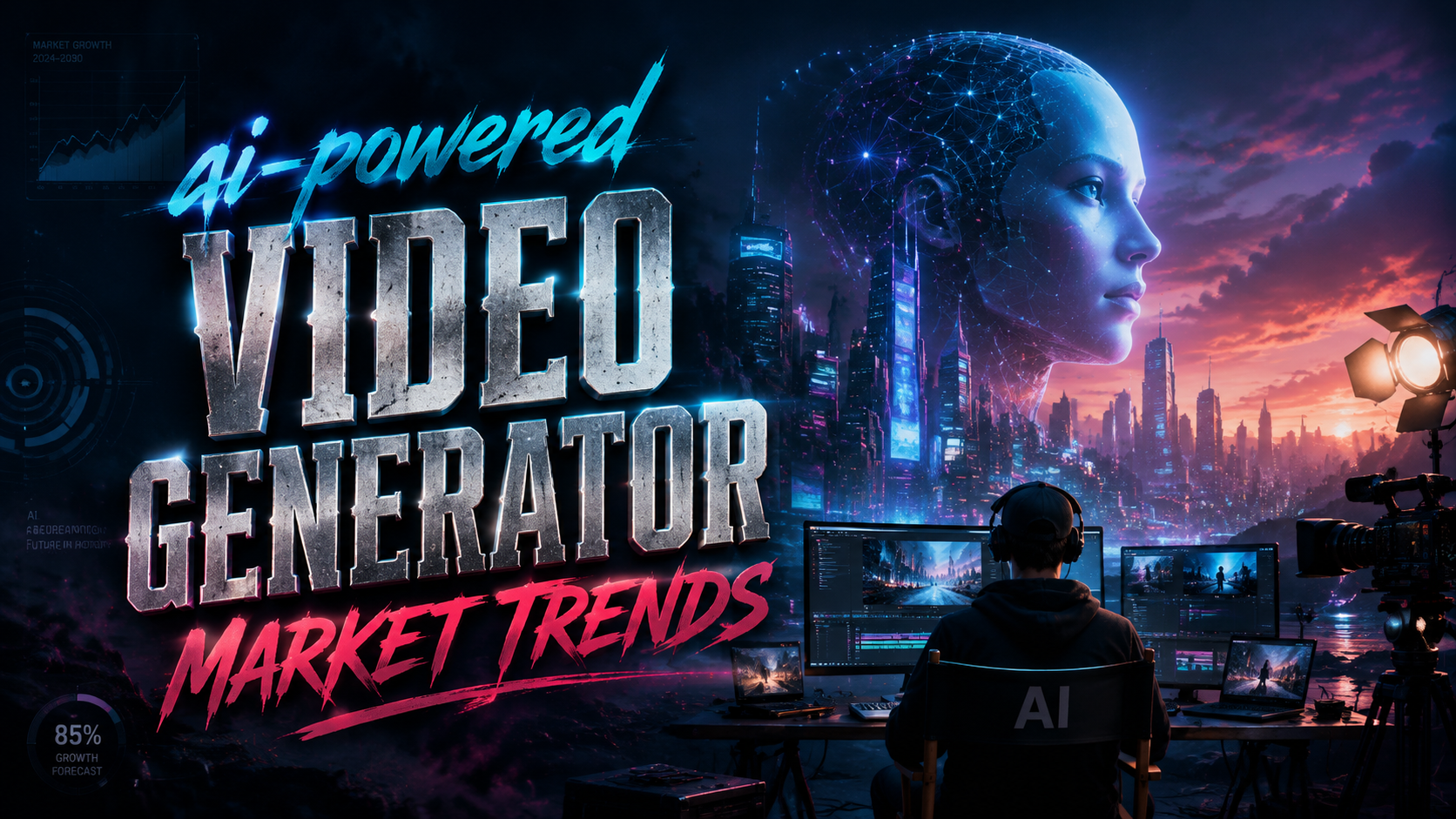
The AI-powered video generator market is experiencing explosive growth, with a projected CAGR of 23.5% through 2026 according to Market.us. Key trends include YouTube's new AI integration features, the rise of personalized video content, and increasing adoption across industries from marketing to education. This article explores the most significant developments shaping the AI video generation landscape this year.
TL;DR: The AI video generator market will grow at 23.5% CAGR in 2026, driven by YouTube's new AI tools, hyper-personalization features, and enterprise adoption across multiple industries.
AI-powered video generator market trends in 2026 are defined by rapid technological advancements, with platforms now offering realistic avatar insertion, multi-language support, and automated editing at scale. The sector is moving beyond basic text-to-video into sophisticated content creation ecosystems.
- ✓ Market projected to grow at 23.5% CAGR (Market.us)
- ✓ YouTube introducing AI-powered creator tools in 2026
- ✓ Hyper-personalization becoming standard in video marketing
- ✓ Enterprise adoption accelerating across education and e-commerce
- ✓ AI animation generators growing even faster at 32% CAGR
Current Market Size and Growth Projections
According to Market.us, the AI-powered video generator market is maintaining a strong 23.5% compound annual growth rate through 2026. This growth significantly outpaces many other digital content creation sectors, reflecting both increasing demand and rapid technological improvements. The parallel AI animation generator market is expanding even faster at 32% CAGR, indicating particularly strong demand for motion graphics capabilities.
Several factors are driving this exceptional growth. First, the barrier to entry for high-quality video production has dramatically lowered, enabling small businesses and individual creators to compete with professional studios. Second, the integration of AI video tools into major platforms like YouTube is creating new use cases. Third, according to Medium, predictive AI models suggest we're entering a phase where AI-generated content will account for over 30% of all digital video by year's end.
The market expansion isn't uniform across all segments. Enterprise solutions are growing fastest, with large corporations adopting AI video for training, marketing, and customer communication. Meanwhile, consumer-focused tools are seeing more gradual adoption as users become comfortable with AI-assisted creativity. This bifurcation suggests the market will likely specialize further into professional and casual creator segments.
YouTube's Game-Changing AI Features
YouTube's 2026 announcement about AI-powered creator tools represents a watershed moment for the industry. As reported by Spherical Insights, the platform will now allow creators to use AI to insert themselves into other people's videos with realistic lighting and perspective matching. This feature builds on existing AI video technology but integrates it directly into the world's largest video platform.
The implications for content creation are profound. Creators can now collaborate remotely without physical filming sessions, opening new possibilities for cross-channel partnerships. Educational content stands to benefit particularly, as instructors can insert themselves into demonstration videos or historical footage. However, these capabilities also raise important questions about content authenticity and copyright that the industry is still grappling with.
Beyond avatar insertion, YouTube's AI toolkit includes automated scene composition, intelligent clip sequencing, and real-time language dubbing. These features are being rolled out gradually throughout 2026, with premium subscribers getting early access. The platform's massive user base means these tools will likely set new standards for what creators and audiences expect from AI video generation.
Three Key YouTube AI Features
1. Context-Aware Avatar Insertion: Maintains consistent lighting and perspective when placing subjects into existing footage
2. Dynamic Scene Reconstruction: AI analyzes video context to suggest logical scene extensions or alterations
3. Multi-Track Voice Synthesis: Allows separate AI voice tracks for different speakers with emotion control
Enterprise Adoption Across Industries
Corporate adoption of AI video generators has accelerated dramatically in early 2026, with particularly strong uptake in three sectors. E-commerce platforms are using AI to create personalized product videos at scale, while educational institutions are generating customized lesson materials. The third major adopter group consists of customer support organizations implementing AI video for interactive troubleshooting guides.
In retail, AI video tools now automatically generate product demonstrations featuring virtual models in various sizes and ethnicities. According to G2 Learning Hub, the best AI video generators of 2026 can produce these customized videos in under 10 minutes, compared to traditional production timelines of weeks. This speed enables hyper-personalized marketing at previously impossible scales.
Educational applications are equally transformative. Universities report using AI video platforms to create multiple versions of lecture content tailored to different learning styles. Medical schools have been early adopters, generating detailed procedural videos with AI-created 3D animations. The corporate training sector has seen similar innovation, with AI systems now capable of generating scenario-based learning modules from text outlines.
Technology Breakthroughs Driving Innovation
The AI video generation field has seen several key technological advances in 2026 that are reshaping what's possible. Most significant is the improvement in temporal coherence - AI systems can now maintain consistent character appearances and scene continuity across longer video sequences. This addresses what was previously one of the technology's most noticeable limitations.
Another major advancement is in physics simulation. Modern AI video generators can now create reasonably accurate simulations of fluid dynamics, cloth movement, and other physical interactions without manual animation. This is particularly valuable for product demonstrations and educational content where realistic motion is essential. The technology still can't match high-end CGI, but the gap is narrowing rapidly.
Perhaps most impressively, the latest systems demonstrate improved understanding of narrative structure. They can take a basic script and automatically suggest appropriate camera angles, pacing variations, and even emotional tone adjustments. While human oversight remains crucial, these capabilities are reducing the technical expertise needed for effective video storytelling.
2026's Most Significant Technical Improvements
- Extended temporal coherence (up to 5 minutes of consistent generation)
- Physics-aware animation for realistic material interactions
- Contextual camera work that follows narrative emphasis
- Multi-lingual voice synthesis with accurate lip sync
Content Personalization at Scale
Personalization has emerged as the killer application for AI video generation in 2026. Platforms can now take a single base video and automatically create hundreds of personalized variants by swapping elements like language, presenter characteristics, product features, and even cultural references. This capability is transforming marketing, education, and customer communication.
The technology works through modular video architectures where different components can be mixed and matched algorithmically. A clothing retailer, for example, might generate unique videos for each customer showing garments modeled by AI avatars matching their body type, with background music adjusted to their demographic. According to industry tests, these personalized videos achieve up to 300% higher engagement than generic content.
Educational applications are equally compelling. Language learning platforms now use AI to generate practice scenarios featuring virtual environments tailored to students' interests. Corporate training systems create customized case studies reflecting employees' specific roles and challenges. This level of personalization was theoretically possible before AI video, but the cost and time requirements made it impractical at scale.
Ethical Considerations and Industry Response
As AI video generation becomes more sophisticated and widespread, ethical concerns have moved to the forefront of industry discussions. The ability to create highly realistic fake videos has raised alarms about potential misuse in misinformation campaigns, while copyright questions swirl around AI systems trained on existing media. The industry has begun developing responses to these challenges.
Several leading platforms have implemented watermarking systems that subtly mark AI-generated content, though these measures aren't yet standardized across the industry. More significantly, major players are collaborating on content authentication protocols that would allow platforms to verify the origin and editing history of video files. These technical solutions are being developed alongside new industry guidelines for responsible AI use.
Copyright issues remain particularly complex. Courts are currently hearing cases that may determine whether AI systems can use copyrighted material for training, and whether AI-generated content itself can be copyrighted. Some platforms have begun offering indemnification against copyright claims as a premium feature, while others are building entirely proprietary training datasets to avoid legal uncertainty.
Future Outlook Beyond 2026
Looking beyond the current year, industry analysts predict several key developments that will shape the AI video generation landscape. The technology is expected to move beyond current 2D video into fully volumetric 3D content creation, enabling more immersive experiences. Integration with augmented reality platforms is another likely direction, as is tighter coupling with large language models for more sophisticated script generation.
Market consolidation appears inevitable as the sector matures. While 2026 still sees a vibrant ecosystem of specialized AI video tools, the need for end-to-end solutions and the advantages of large training datasets favor larger players. However, niche applications like the AI comic generator market (projected by Precedence Research to reach $271 billion by 2035) suggest there will still be room for focused innovators.
Perhaps most significantly, AI video generation is poised to become a standard feature rather than a standalone product. Just as spell check became embedded in word processors, we can expect video editing tools to increasingly incorporate AI generation as a native capability. This transition will make the technology accessible to even more users while raising new questions about creative authorship and the nature of professional video production.
What is driving growth in the AI video generator market?
The 23.5% CAGR growth is primarily driven by enterprise adoption, YouTube's new AI tools, and the ability to create personalized content at scale. Reduced production costs and time savings are additional key factors.
How accurate are AI-generated videos in 2026?
Current systems achieve near-photorealistic quality for many applications, with particular strength in talking-head videos. Physics simulation and complex action sequences remain areas where human animators still outperform AI.
What industries benefit most from AI video generation?
E-commerce, education, and marketing are the leading adopters, followed by customer support and corporate training. Media companies are also increasingly using AI for routine video production tasks.
Are there ethical concerns with AI video generators?
Yes, concerns include potential misuse for deepfakes, copyright issues around training data, and the displacement of human creatives. The industry is developing watermarking and authentication systems to address some risks.
How does AI video generation compare to traditional production?
AI generation is significantly faster and cheaper for many use cases, though high-end traditional production still leads in quality for complex projects. The technologies are increasingly being used in combination rather than as pure alternatives.
Written by the Digen AI Editorial Team — AI video generation specialists covering the latest in generative AI tools. Learn more about Digen AI.



Comments ()