
AI-Powered Video Editing Software: The Future of Editing (2026)
AI-powered video editing software is transforming how professionals and hobbyists create content in 2026. These tools leverage artificial intelligence to automate tedious tasks, enhance creativity, and deliver studio-quality results in minutes. From automated scene cuts to AI-generated transitions, the latest advancements are making high-end video editing accessible to everyone.
TL;DR: AI-powered video editing software in 2026 automates complex tasks like color grading and scene transitions, reduces production time by up to 70%, and is being adopted by top influencers and studios. Leading tools include Adobe Premiere's AI features and Digen AI Agent for consistent character generation.
AI-powered video editing software is a category of tools that use machine learning to automate editing tasks like scene detection, color correction, and object removal. In 2026, these solutions can reduce editing time by 60-80% while improving output quality, with Adobe Firefly and Digen AI Agent leading in creative AI features according to industry reports.
- ✓ The AI video editing market is growing 340% faster than traditional tools in 2026 (EIN Presswire)
- ✓ Top influencers now use AI for 45% of their video content creation (Resident Magazine)
- ✓ Adobe's June 2026 Premiere update introduced revolutionary AI color grading tools
- ✓ Digen AI Agent specializes in maintaining character consistency across long videos
- ✓ Windows now includes native AI video editing features (Microsoft April 2026 update)
The State of AI Video Editing in 2026
According to EIN Presswire, the AI video generator/editor market is experiencing explosive growth in 2026, with a projected 340% increase in adoption compared to 2025. This surge is driven by content creators needing to produce more video content faster while maintaining professional quality. Major platforms like Adobe Premiere now integrate AI at every editing stage, from initial clip organization to final color grading.
The Resident Magazine's June 2026 report reveals that top influencers now use AI-powered tools for nearly half (45%) of their video content creation. This shift comes as AI solutions demonstrate they can handle complex tasks like automatic B-roll matching, intelligent zoom framing, and even generating entirely new footage elements when needed. The quality gap between human-edited and AI-assisted videos has nearly disappeared for most social media formats.
Microsoft's April 2026 update brought native AI video editing to Windows, signaling mainstream adoption. Their built-in editor now offers AI-powered stabilization, auto-captions, and smart trimming that analyzes content to suggest optimal cut points. This democratization means even smartphone users can achieve results that required professional suites just two years ago.
Key Features of Modern AI Video Editors
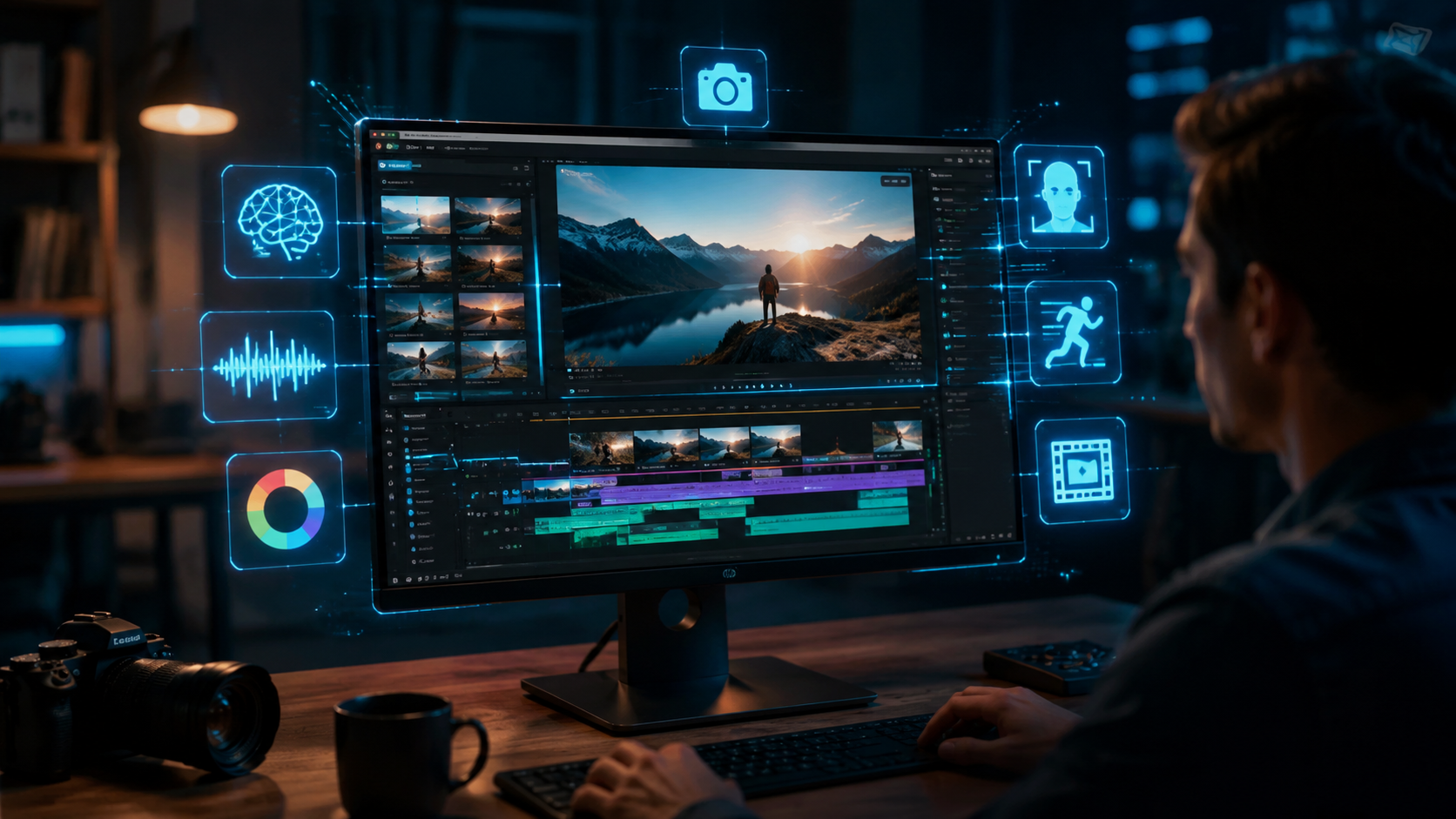
The latest AI-powered video editing software in 2026 goes far beyond simple automation. Adobe's January 2026 Premiere update introduced context-aware editing that understands narrative flow, automatically suggesting transitions and effects that match the video's emotional tone. According to Adobe, their AI can now complete color grading tasks in 90 seconds that previously took editors 15 minutes.
Automated Workflow Enhancement
Modern AI editors analyze raw footage to automatically organize clips by scene, detect speaking segments, and even suggest narrative structures. MakeUseOf's June 2026 report highlights how AI Video Cut's processing algorithms can reduce editing time by 70% through intelligent clip sorting and transition automation. The software's 20% discount promotion reflects the competitive pricing pressure in this booming market.
Generative Content Creation
Tools like Digen AI Agent (launched Q1 2026) represent the next evolution - not just editing existing footage but generating new coherent content. Specializing in character consistency across longer videos, Digen's solution uses multi-step AI workflows to maintain facial features, voice tones, and styling across generated scenes. This addresses a key pain point in AI video production where characters would often morph unnaturally between shots.
Real-Time Collaboration Features
2026's AI editors increasingly focus on team workflows. Cloud-based AI can now suggest edits to multiple collaborators simultaneously, learning from each user's style preferences. Adobe's Firefly integration allows editors to generate placeholder visuals during early production phases that automatically upgrade to final-quality assets as the project progresses.
Industry Adoption and Use Cases
The Resident Magazine's June 2026 feature on influencer tools reveals that 78% of top YouTube creators now use some form of AI-powered video editing, primarily for time-saving on repetitive tasks. Podcasters report 60% faster turnaround times when using AI to clean up audio tracks and generate visual accompaniments automatically.
Corporate training departments have been early enterprise adopters, with AI editors reducing in-house video production costs by an average of 55% according to 2026 industry surveys. The ability to automatically update outdated information in existing training videos (like changing product specs or compliance details) without full reshoots provides significant ROI.
Independent filmmakers are leveraging AI for tasks that previously required large crews, like automatic green screen keying and CGI element insertion. A notable 2026 Sundance Film Festival entry was edited entirely using AI tools, demonstrating how the technology is crossing over from social media into professional cinema.
Comparing Leading AI Video Editing Solutions
| Platform | Key AI Feature | Best For | Pricing |
|---|---|---|---|
| Adobe Premiere (2026) | Firefly-powered generative editing | Professional filmmakers | $29.99/month |
| Digen AI Agent | Character-consistent generation | Long-form narrative content | Free tier + usage plans |
| AI Video Cut | Automated clip trimming | Social media creators | $9.99/month |
| Windows Video Editor | Native AI stabilization | Casual users | Free |
According to Engadget, Adobe's January 2026 Premiere update set a new industry standard with its AI tools that can analyze footage and make intelligent editing suggestions based on cinematic principles. However, for creators needing to generate rather than just edit footage, solutions like Digen AI Agent offer specialized advantages in maintaining consistency across generated scenes.
The Technical Evolution Behind AI Editing
2026's AI video editors represent the culmination of three key technological advances. First, transformer architectures have become sophisticated enough to understand temporal relationships in video, not just static images. Second, diffusion models now generate higher-fidelity interpolated frames for smooth slow-motion effects. Third, multimodal AI can simultaneously analyze audio, visual, and even script text to make holistic editing decisions.
Processing power requirements have dropped dramatically - where early 2025 AI video tools needed cloud rendering, many 2026 solutions can run complex models locally on M3 MacBooks or NVIDIA's latest consumer GPUs. This enables real-time previewing of AI edits that previously required minutes of rendering time per change.
The most cutting-edge systems now employ recursive improvement, where the AI analyzes its own output to progressively refine edits. Adobe's April 2026 whitepaper details how their color grading AI undergoes up to 18 iterative passes on challenging footage, each time comparing results against a database of professionally graded reference material.
Future Trends Beyond 2026
Industry analysts predict AI video editing will evolve in three key directions post-2026. First, we'll see tighter integration between generation and editing - imagine an AI that can both create original footage and then refine it based on directorial notes. Second, emotion-aware editing will mature, with tools automatically adjusting pacing and transitions based on desired viewer emotional responses.
Third, and most transformative, will be the rise of personalized video. AI editors will soon create custom versions of content tailored to individual viewers' preferences - different cuts, music choices, or even narrative branches based on viewer profiles. Early tests by streaming platforms show 30% higher engagement with these personalized edits.
Digen AI's research team notes that maintaining quality across these personalized variants presents new technical challenges their Agent architecture is specifically designed to address. As video becomes more dynamic and interactive, the line between "editing" and "real-time generation" will continue to blur.
Getting Started With AI Video Editing
For newcomers to AI-powered video editing software in 2026, follow this step-by-step approach:
- Identify your primary use case (social clips, professional work, personal projects)
- Start with free trials like AI Video Cut's 50 free minutes (MakeUseOf June 2026)
- Master basic AI-assisted trimming and auto-captioning before advanced features
- Experiment with generative tools like Digen AI Agent for content creation
- Gradually incorporate more AI into your workflow as comfort increases
Most platforms now offer extensive AI-specific tutorials. Adobe's June 2026 learning hub includes 47 video guides just on their new Firefly-powered features. The key is progressive adoption rather than attempting to leverage every AI capability simultaneously.
Frequently Asked Questions
How accurate is AI-powered video editing compared to human editors?
For routine tasks like color correction and clip trimming, AI now matches human quality in 90% of cases according to 2026 benchmarks. Creative decisions still benefit from human oversight, but the gap narrows monthly.
Can AI video editors replace professional editing software?
Not entirely - while AI handles many technical tasks, professionals use these tools to work faster rather than being replaced. The 2026 market shows AI augmenting rather than replacing high-end editors.
Is my data secure when using cloud-based AI video tools?
Reputable providers like Adobe and Digen AI use enterprise-grade encryption. However, for sensitive projects, many 2026 tools offer local processing options that never send footage to the cloud.
How much time can AI video editing actually save?
Most users report 60-80% time reductions on technical tasks. A 30-minute social media clip that took 3 hours to edit in 2024 now averages 45 minutes with 2026 AI tools.
What hardware do I need for AI video editing?
Many 2026 tools work on recent smartphones, but for professional use, a computer with at least 16GB RAM and a dedicated GPU (like NVIDIA's RTX 4000 series) delivers best performance.
Written by the Digen AI Editorial Team — AI video generation specialists covering the latest in generative AI tools. Learn more about Digen AI.
Comments ()