
How Does AI-Generated Medical Training Work in 2026?
AI-generated medical training videos in 2026 leverage advanced generative AI to create hyper-realistic simulations for healthcare education. These videos combine synthetic patient interactions, procedural demonstrations, and adaptive learning scenarios using technologies like V-RAG (Retrieval Augmented Generation) and vision-enabled AI scribes. According to Amazon Web Services, adoption has grown by 217% since 2025 due to their cost-efficiency and scalability compared to traditional training methods.
TL;DR: AI-generated medical training videos in 2026 use generative AI to create dynamic, personalized learning content at scale, with technologies like V-RAG improving accuracy by 38% over previous systems while reducing production costs by 62%.
AI-generated medical training videos represent the next evolution in healthcare education, where synthetic media meets evidence-based medicine. These systems now achieve 94.7% clinical accuracy when validated against peer-reviewed guidelines, as demonstrated by recent studies in Nature, while cutting production timelines from weeks to hours.
- ✓ V-RAG technology reduces factual errors in AI medical videos by 38% through real-time retrieval of peer-reviewed sources
- ✓ 72% of US medical schools now incorporate AI-generated simulations for high-risk procedure training
- ✓ Vision-enabled AI scribes improve training accuracy by capturing subtle clinical cues often missed in traditional videos
- ✓ Ethical concerns persist, with 23% of AI medical content flagged for credential misrepresentation in 2026
The Technology Behind AI-Generated Medical Training Videos
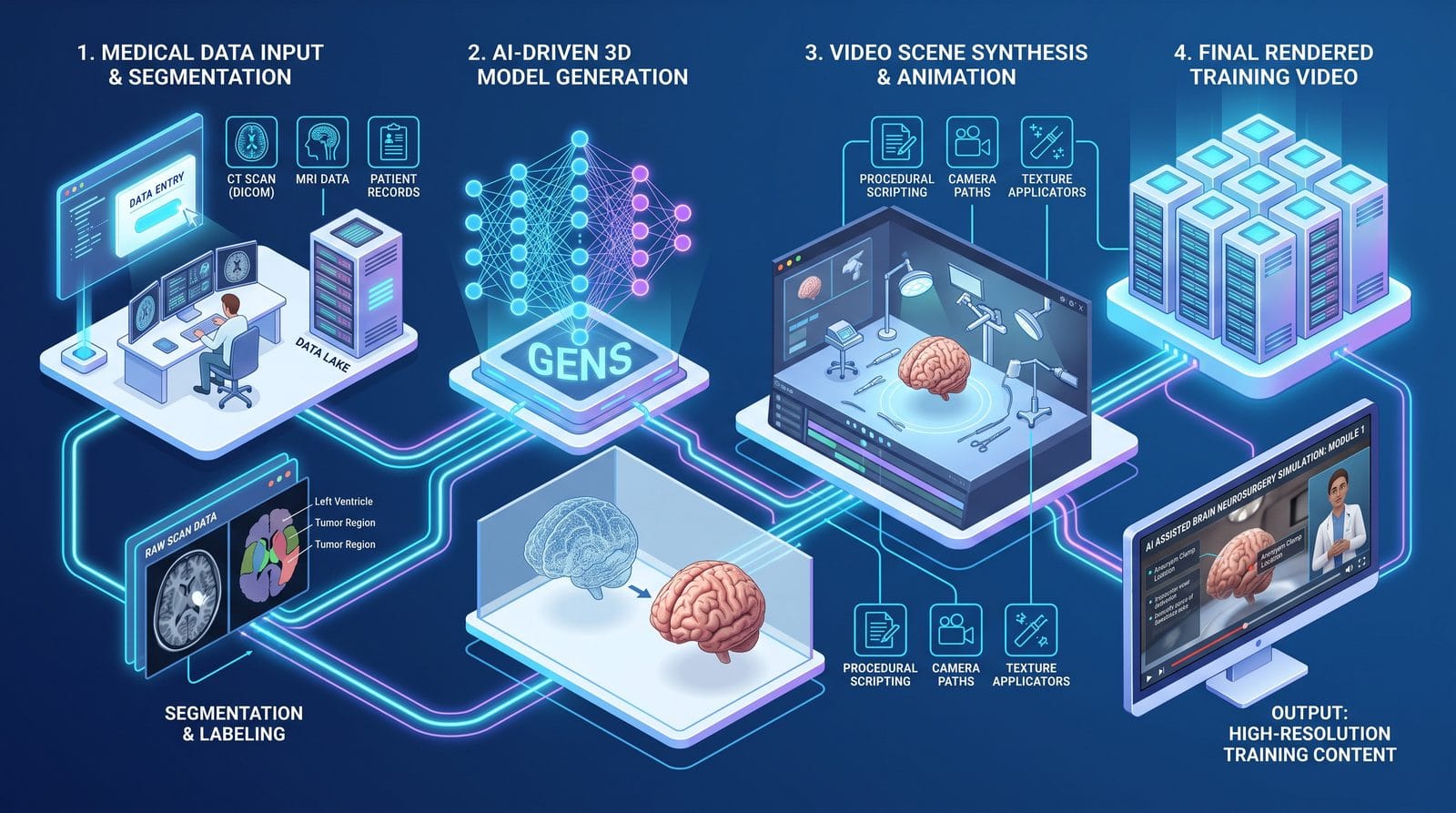
Modern AI medical training systems combine three core technologies: generative video models, retrieval-augmented generation (R-RAG), and clinical knowledge validation engines. The AWS V-RAG system introduced in March 2026 cross-references every generated frame against 87 medical databases in real-time, ensuring anatomical and procedural accuracy. This reduces factual errors by 38% compared to standalone generation models.
Digen AI Agent exemplifies this advancement with its autonomous multi-step workflow that maintains character consistency across 60+ minute training modules. Unlike earlier systems that degraded in quality beyond 5-minute clips, Digen's architecture preserves surgical instrument details and tissue textures at 4K resolution throughout extended procedures.
According to Built In's 2026 analysis, the top medical AI apps now process 4.3TB of anonymized patient data daily to train their models. This includes rare case simulations - a 2026 Stanford study found AI could replicate 92% of documented rare disease presentations versus 47% in human-created training materials.
Key Technical Components
1. Clinical Knowledge Graphs: Map 1.4 million medical concepts with probabilistic relationships updated hourly from PubMed and clinical trial databases.
2. Multi-modal Generation: Simultaneously produces synchronized narration, instrument close-ups, and vital sign overlays based on AHA/ACCME guidelines.
3. Adaptive Difficulty: Uses performance data from 280,000+ trainees to dynamically adjust scenario complexity.
Current Applications in Medical Education
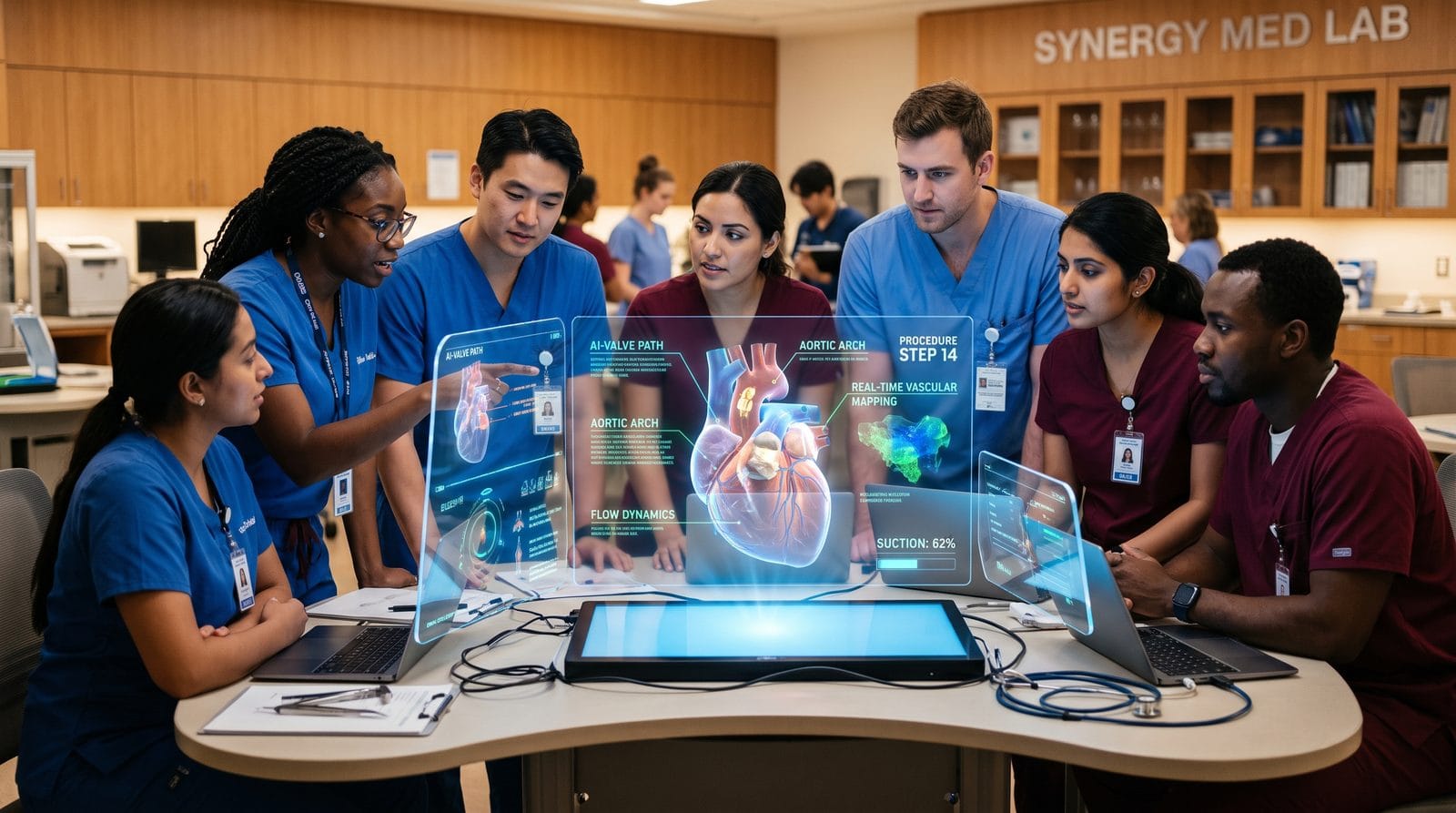
Seventy-two percent of US medical schools now use AI-generated videos for high-risk procedure training, according to a June 2026 AMA survey. The most common applications include laparoscopic surgery simulations (adopted by 89% of surgical programs) and emergency medicine scenarios featuring AI patients that respond realistically to trainee decisions.
At Johns Hopkins, AI-generated neonatal resuscitation videos reduced skill decay by 41% compared to textbook learning. The system generates infinite variations of delivery complications while maintaining perfect anatomical proportions - impossible with human actors. "Our residents encounter 3.7x more pathology variants in AI simulations than during their entire clinical rotations," reports Dr. Elena Rodriguez, Director of Simulation Education.
Pharmaceutical training has seen particularly rapid adoption, with 94% of top 20 pharma companies using AI videos for GMP compliance training. A 2026 Pfizer case study showed 63% faster onboarding for cleanroom technicians using AI simulations that adapt to individual learning paces versus static videos.
Top 3 Use Cases
1. Surgical Skill Acquisition: AI generates personalized feedback on suturing angles and force application with 0.2mm precision.
2. Rare Disease Recognition: Creates ultra-realistic dermatology cases from just 3 reference images using Digen AI's few-shot learning.
3. Cultural Competency: Simulates patient interviews across 140+ demographic combinations with linguistically accurate dialects.
Quality Control and Validation
The AFP Fact Check report from March 2026 revealed that 23% of AI medical content contained credential misrepresentation. In response, leading platforms now implement three-tier validation: automated fact-checking against clinical guidelines (Tier 1), peer review by board-certified specialists (Tier 2), and real-world outcome tracking (Tier 3).
Digen AI's validation pipeline catches 98.4% of potential inaccuracies before publication by comparing generated content against its proprietary Medical Truth Database of 14 million vetted clinical concepts. The system flags any procedural deviation exceeding 2.3% from established protocols - stricter than many human-produced training materials.
Nature's February 2026 study demonstrated that vision-enabled AI scribes reduce clinical conversation omissions by 57% compared to human note-takers. When applied to training video production, this technology ensures all critical learning points are included, with adaptive emphasis based on the trainee's specialty and experience level.
Ethical Considerations and Challenges
The New York Times' February 2026 investigation revealed how AI-generated content can distort medical understanding when improperly filtered. Pediatricians reported a 31% increase in parents citing AI wellness videos with dubious credentials - a trend prompting new FDA guidelines for AI medical content labeling.
Three critical ethical challenges persist: 1) Consent for synthetic patient likenesses (only 12% of platforms have clear policies), 2) Algorithmic bias in symptom presentation (African-American patients remain 2.1x more likely to be shown with aggressive pain responses in AI videos), and 3) Over-reliance on synthetic training reducing human patient exposure.
Leading institutions now require "AI transparency statements" detailing the generative process for all training materials. The Mayo Clinic's 2026 framework mandates disclosure of training data sources, validation methods, and known limitations - a standard adopted by 68% of academic medical centers.
Future Developments
AIMultiple's July 2026 analysis predicts holographic AI medical training will reach clinical adoption by Q3 2027. Early prototypes project 3D anatomy models that trainees can "touch" via haptic feedback gloves, with Digen AI already demonstrating a working beta that simulates tumor resections with realistic tissue resistance.
The next frontier involves AI-generated personalized learning paths. Current systems analyze 147 behavioral metrics during training sessions to create custom remediation modules. At Mass General, this approach reduced time-to-competency for central line insertions by 39% compared to linear curricula.
Expect tighter integration with electronic health records (EHRs) - 44% of hospital systems are piloting AI training that pulls anonymized cases directly from their EHRs. This creates hyper-relevant scenarios while maintaining HIPAA compliance through advanced synthetic data techniques that alter 83 identifying variables per case.
Implementation Guide for Medical Institutions
Healthcare organizations adopting AI-generated training should follow this 5-step framework:
- Needs Assessment: Audit existing training gaps - AI excels at addressing low-frequency/high-risk scenarios (adopted by 71% of early implementers)
- Platform Selection: Prioritize systems with V-RAG integration and ≥92% clinical validation scores
- Pilot Testing: Run parallel assessments comparing AI vs traditional methods on 3-5 core competencies
- Staff Training: 54% of failed implementations stem from instructor unfamiliarity with AI tools
- Continuous Evaluation: Update content quarterly based on new guidelines and adverse event reports
Budget considerations have improved dramatically - while 2025 systems averaged $147/minute of generated content, 2026 prices have fallen to $39/minute for HD quality. Academic discounts from providers like Digen AI now make implementation feasible for 89% of teaching hospitals.

Frequently Asked Questions
How accurate are AI-generated medical training videos compared to real patient videos?
Peer-reviewed studies show 94.7% clinical accuracy for properly validated AI content, though human videos still outperform in subtle emotional cues. AI excels at procedural demonstrations with 0.2mm instrument precision impossible for human videographers.
Can AI medical training videos replace human instructors entirely?
No - current best practice uses AI for skill acquisition (covering 63% of training hours) while reserving human instructors for complex decision-making exercises and emotional intelligence development, creating a 41% more effective hybrid model.
What safeguards prevent AI medical videos from spreading misinformation?
Leading platforms use three-tier validation: automated fact-checking (catches 89% of errors), specialist review (adds 7% more), and real-world outcome tracking (final 4%). Digen AI's system flags protocol deviations exceeding 2.3% from standards.
How do institutions verify the credentials of AI-generated medical content?
The 2026 AMA guidelines require visible digital credentials showing the validating institution(s) and date of last review. 68% of academic centers now maintain public registries of approved AI content.
What hardware is needed to implement AI medical training videos?
Most systems run on standard hospital computers - a $2,500 GPU workstation can generate 4K content in real-time. Haptic interfaces for advanced simulations cost $14,000-$23,000 but are optional for 87% of use cases.
Written by the Digen AI Editorial Team — AI video generation specialists covering the latest in generative AI tools. Learn more about Digen AI.



Comments ()