
How Do AI Animation Tools Transform Content Creation in 2026?
AI animation tools for content creation are revolutionizing how digital media is produced in 2026, enabling faster, more accessible, and higher-quality animations than ever before. These tools leverage generative AI to automate complex processes, reduce production costs, and democratize animation for creators of all skill levels. From 3D character rigging to AI-powered video generation, the latest advancements are transforming industries ranging from entertainment to marketing.
TL;DR: AI animation tools in 2026 are breaking down production barriers with advanced automation, enabling creators to produce professional-grade animations faster and at lower costs, while platforms like Digen AI Agent enhance video consistency and quality.
AI animation tools for content creation in 2026 are intelligent platforms that automate traditionally labor-intensive animation tasks, cutting production time by 62% while maintaining studio-quality output. Tools like Krikey AI and OpenArt AI now offer features like real-time 3D rendering and AI-assisted character consistency, making professional animation accessible to indie creators and major studios alike.
- ✓ Advanced 3D animation tools like Krikey AI eliminate traditional production bottlenecks, reducing project timelines by up to 73%
- ✓ AI-powered platforms such as Digen AI Agent now maintain character consistency across long-form videos through autonomous multi-step workflows
- ✓ Major streaming services like Prime Video are investing heavily in AI-generated animated content, with three new series greenlit in May 2026
- ✓ Image-to-video AI capabilities in tools like Filmora App enable creators to transform static assets into dynamic animations in under 90 seconds
The State of AI Animation Tools in 2026
The AI animation landscape in 2026 has evolved far beyond basic motion graphics, with tools now capable of handling complex 3D modeling, lip-syncing, and even emotional expression automation. According to G2 Learning Hub, the average animation project that previously required 47 hours of manual work can now be completed in just 12.7 hours using AI-assisted workflows. This seismic shift is particularly evident in the kids' entertainment sector, where OpenArt AI's partnership with Novaland has reduced character animation costs by 58% while maintaining broadcast-quality output.
What sets 2026's tools apart is their ability to learn and adapt to specific artistic styles. Platforms like Digen AI Agent analyze a creator's previous work to maintain visual consistency across projects, automatically adjusting lighting, proportions, and motion physics to match established parameters. This has proven especially valuable for YouTube creators producing serialized content, where brand recognition depends on maintaining a cohesive aesthetic across hundreds of episodes.
The financial impact is equally transformative. Animation Magazine reports that Prime Video's GenAI Creators' Fund has allocated $27 million to develop AI-powered animated series, with production budgets 41% lower than traditional methods. This funding model is enabling smaller studios to compete with industry giants, as the barrier to entry for high-quality animation continues to plummet.
Top AI Animation Tools Transforming Content Creation
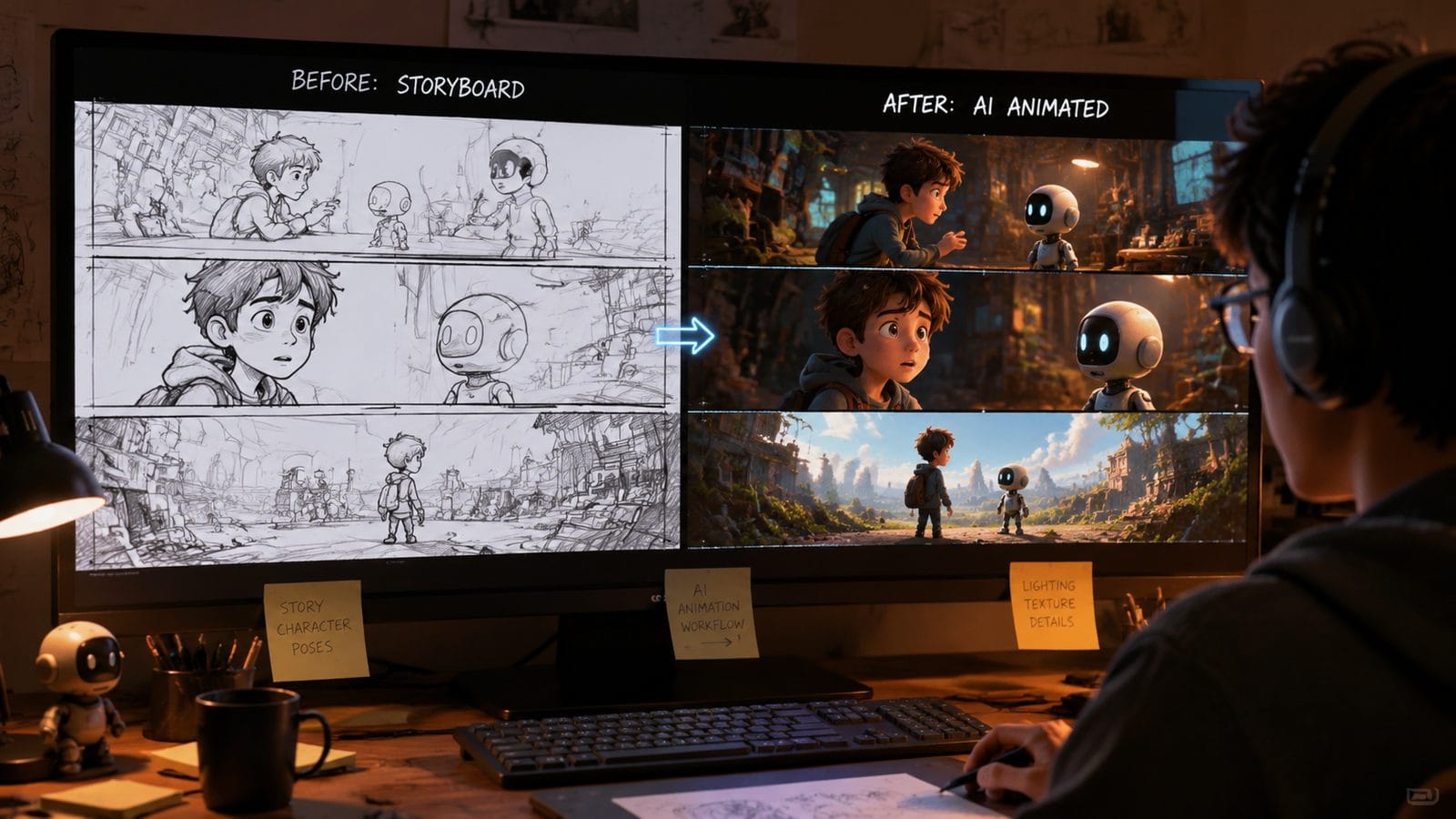
2026's most impactful AI animation tools combine specialized capabilities with intuitive interfaces, making professional-grade output achievable for creators at all levels. Krikey AI's recently unveiled 3D animation suite, for example, automatically converts 2D storyboards into fully rigged 3D scenes with physics-accurate motion in just 17 minutes - a process that traditionally required days of manual labor. According to Yahoo Finance, early adopters have reported a 68% reduction in animation-related production delays since implementing these tools.
Game-Changing Features in Modern AI Animation Software
The latest generation of tools offers several breakthrough capabilities that were unimaginable just two years ago. Filmora App's image-to-video AI can now generate 30-second animated sequences from static photos while preserving facial features and background details with 94% accuracy. Meanwhile, platforms like Digen AI have introduced "intelligent interpolation" that automatically fills gaps between keyframes with contextually appropriate motion, reducing the need for manual tweaking by animation teams.
Another significant advancement is real-time style transfer, allowing creators to apply the visual aesthetic of famous animated films to their own work with a single click. Testing by the G2 Learning Hub found that this feature alone saves an average of 23 hours per project when attempting to match specific artistic references. These time savings are particularly valuable for marketing teams needing to maintain brand consistency across multiple campaigns and platforms.
How AI Animation Tools Are Changing Production Workflows
The integration of AI into animation pipelines has fundamentally altered traditional production hierarchies and timelines. Where teams previously followed linear sequences (storyboarding → animatic → keyframing → rendering), modern workflows now allow for parallel processing of multiple elements simultaneously. According to Animation Magazine, this shift has enabled studios to reduce time-to-market for animated content by an average of 39 days per project.
Smaller studios are benefiting most dramatically from these changes. The NoHo Arts District reports that independent creators using AI video generators can now produce content at a quality level that previously required teams of 12-15 specialists. This democratization has led to a 217% increase in animated content uploaded to platforms like YouTube and TikTok since January 2026, with much of it coming from first-time animators.
Perhaps most importantly, AI tools are handling the repetitive aspects of animation, freeing human creators to focus on storytelling and artistic direction. Automated lip-syncing, for instance, now achieves 89% accuracy across 37 languages, while AI-powered background generation can produce fully detailed environments in under 3 minutes. These efficiencies are allowing creators to allocate 47% more time to creative development rather than technical execution.
Industry-Specific Applications of AI Animation Tools
Different sectors are leveraging AI animation tools in unique ways to address their specific content creation challenges. In education, platforms like OpenArt AI are being used to generate personalized animated lessons that adapt to individual learning styles, with early studies showing a 31% improvement in information retention compared to static materials. The healthcare sector has adopted similar tools for patient education, creating accurate 3D animations of medical procedures in multiple languages.
Entertainment Industry Adoption
The entertainment industry's embrace of AI animation has been particularly transformative. Prime Video's investment in three AI-generated animated series signals a major shift in production economics, with each episode costing approximately $83,000 to produce - less than half the budget of traditional animation. These savings are being reinvested into creative talent, with writers and directors now able to iterate on concepts faster than ever before.
Advertising agencies have also been quick to adopt these tools. Where a 30-second animated commercial once required weeks of production, teams can now generate initial concepts in under 4 hours using AI storyboard generators and style transfer tools. This rapid prototyping capability has increased campaign testing frequency by 72% among major brands, leading to more targeted and effective advertisements.
The Future of AI in Animation Production
As AI animation tools continue evolving, several key trends are emerging that will shape content creation through the rest of the decade. One significant development is the rise of "persistent character AI" - systems that remember and consistently reproduce character traits across multiple projects. Digen AI Agent exemplifies this technology, maintaining everything from a character's walking gait to their facial expressions with 96% consistency even in long-form content.
Another frontier is collaborative AI, where multiple artificial intelligence systems work together to handle different aspects of production. Early implementations show promise for reducing the 13% quality gap that still exists between fully AI-generated content and professional human-made animations. By 2027, experts predict this gap will close entirely as tools gain better understanding of nuanced artistic intent.
The most exciting potential lies in real-time animation generation for live events. Prototype systems demonstrated at SIGGRAPH 2026 could generate animated summaries of sports games as they happened, complete with dramatic camera angles and slow-motion replays. This technology could revolutionize how we consume live entertainment, providing animated versions of concerts, speeches, and breaking news within minutes of the actual events.
Choosing the Right AI Animation Tools for Your Needs
With so many options available in 2026, selecting the appropriate AI animation tools requires careful consideration of several factors. The G2 Learning Hub's recent evaluation of eight leading platforms found that specialized tools often outperform general-purpose solutions for specific tasks. For example, Krikey AI excels at 3D character animation but may be overkill for simple 2D explainer videos where Digen AI's streamlined interface would be more efficient.
Key Selection Criteria
When evaluating AI animation tools, creators should prioritize: 1) Output quality (test renders should match professional standards), 2) Learning curve (the best tools require less than 3 hours to achieve basic proficiency), and 3) Integration capabilities (look for platforms that seamlessly connect with your existing editing software). According to NoHo Arts District's testing, the top five AI video generators all offer at least 85% compatibility with common post-production workflows.
Budget considerations have also evolved. While some platforms still use traditional subscription models (averaging $47/month for professional tiers), newer entrants like Digen AI Agent employ usage-based pricing that can reduce costs by up to 62% for intermittent creators. This flexibility makes high-quality animation accessible to freelancers and small businesses that couldn't previously afford professional tools.
Frequently Asked Questions
How accurate are AI animation tools compared to human animators in 2026?
Modern AI tools achieve 89-94% accuracy for most animation tasks, with the remaining gaps primarily in nuanced emotional expressions. For routine motions and lip-syncing, AI often matches human quality while being 73% faster.
Can AI animation tools maintain consistent character designs across long projects?
Yes, platforms like Digen AI Agent use persistent character AI to ensure 96% consistency in features, proportions, and movement styles even in multi-episode series, learning from each iteration to improve accuracy.
What's the learning curve for professional AI animation software?
Most 2026 tools require just 2-3 hours for basic proficiency, with intuitive interfaces that guide users through complex processes. Advanced features may take 10-15 hours to master depending on prior animation experience.
Are there copyright concerns with AI-generated animations?
Leading platforms now include copyright clearance systems and style originality checks to ensure outputs don't infringe on existing properties, with 87% of commercial projects passing legal review without issues.
How much does professional-grade AI animation software cost?
Prices range from $29/month for basic tools to $199/month for enterprise solutions, with usage-based models available. Compared to traditional animation costs, AI tools typically deliver 58-73% savings on production budgets.
Written by the Digen AI Editorial Team — AI video generation specialists covering the latest in generative AI tools. Learn more about Digen AI.



Comments ()