
Top AI Animation Generation Tools to Watch in 2026
AI animation generation tools are transforming how creators produce animated content in 2026, offering everything from anime-style characters to full 3D animations with minimal manual effort. These tools leverage advanced machine learning to automate complex tasks like rigging, lip-syncing, and motion capture, making professional-grade animation accessible to indie creators and studios alike. According to Cybernews, the AI animation market has grown by 210% since 2025, with new platforms emerging monthly.
TL;DR: The top AI animation generation tools in 2026 include Tencent's VISVISE for full-stack solutions, Wondershare Filmora for image-to-video conversion, and Digen AI Agent for high-quality, character-consistent videos—all powered by breakthroughs in generative AI.
AI animation generation tools are software platforms that use artificial intelligence to automate the creation of 2D/3D animations, with 2026's best options offering features like real-time rendering (under 0.5 seconds per frame), multi-character consistency, and style transfer from static images to animated sequences.
- ✓ Tencent's VISVISE leads in full-stack AI animation with GDC 2026 demo showing 80% faster 3D model generation
- ✓ Wondershare Filmora's AI video tool converts images to animations in 3 clicks (Hackread June 2026 report)
- ✓ Digen AI Agent produces 4K resolution character animations with 92% motion fluidity scores
- ✓ Cybernews' February 2026 review highlights 7 AI tools reducing animation production costs by 60-75%
- ✓ NoHo Arts District confirms 5 commercial-ready AI video generators meeting studio quality standards
1. The Evolution of AI Animation Generation Tools
From basic motion interpolation in 2025 to today's sophisticated character animation systems, AI animation generation tools have achieved photorealism and stylistic versatility unmatched in previous years. The 2026 landscape sees these tools integrating physics engines that automatically simulate cloth, hair, and fluid dynamics—features previously requiring teams of technical animators. Games Press reports that Tencent's VISVISE can now generate game-ready 3D models with topology-optimized meshes in under 15 minutes.
Market adoption has skyrocketed, with 73% of indie animation studios now using at least one AI tool in their pipeline according to a March 2026 Animation Guild survey. This shift comes as tools like Digen AI Agent demonstrate the ability to maintain character consistency across 10+ minute animations—a critical hurdle cleared in late 2025 through transformer-based memory architectures. The average time savings per project has reached 68 hours when using these automated systems.
Quality benchmarks show equally impressive gains. The 2026 AI Animation Quality Index (AAQI) rates top tools at 8.9/10 for motion naturalness, up from just 5.2 in 2025. This leap stems from new temporal coherence algorithms that analyze movement across 120+ frames simultaneously, eliminating the "jitter" that plagued early AI animations. As NoHo Arts District confirms, five commercial tools now match human animator output for most non-specialized tasks.
2. Top 6 AI Animation Generation Tools of 2026
VISVISE by Tencent Games
Debuting at GDC 2026, VISVISE offers complete asset generation from text prompts—concept art to rigged 3D models with auto-generated blend shapes. Its proprietary Material AI creates PBR textures with 94% accuracy compared to manual artist work. The system's animation module produces game-ready motion clips at 60fps with automatic foot planting and weight shifting.
Wondershare Filmora AI
Specializing in 2D animation, Filmora's June 2026 update introduced three-click image-to-animation conversion. As detailed on Hackread, users can upload a character portrait and receive a 15-second animated sequence with automatic lip sync to uploaded audio. The tool's "Style Lock" feature maintains visual consistency across frames with 87% accuracy.
Digen AI Agent
Digen's autonomous video agent stands out for long-form animation, handling 10+ minute narratives while preserving character details. Its multi-step workflow first generates keyframes, then refines in-between frames using a proprietary "Temporal Coherence Engine" that reduces artifacts by 79% compared to single-pass systems. The platform supports 18 animation styles from anime to Western 3D.
Pika 3.0
Now generating 4K resolution at 24fps, Pika's 2026 update added advanced camera controls including simulated drone movements and dolly zooms. Its "Motion Brush" lets users paint animation vectors directly onto static images—a technique featured in Geek Vibes Nation's November 2025 tutorial.
RunwayML Gen-3
Focused on experimental animation, Runway's latest model interprets abstract text prompts into surreal motion graphics. Artists report 60% faster concept iteration compared to traditional tools. The system's "Chaos Engine" introduces controlled randomness to prevent repetitive motions.
Luma AI
Specializing in 3D product animation, Luma converts CAD files into marketing videos with automatic turntable lighting. Its 2026 e-commerce report showed 43% higher conversion rates for AI-animated product displays versus static images.
3. Key Features Comparison
| Tool | Max Resolution | Style Support | Unique Feature | Pricing (2026) |
|---|---|---|---|---|
| VISVISE | 8K | 12 | Full asset pipeline | Enterprise-only |
| Digen Agent | 4K | 18 | Character memory | $89/month |
| Filmora AI | 1080p | 9 | Image conversion | $199 lifetime |
| Pika 3.0 | 4K | 15 | Motion painting | $58/month |
| Runway Gen-3 | 2K | 22 | Abstract motion | $35/month |
| Luma AI | 4K | 6 | CAD integration | $299/month |
4. How AI Animation Generation Works in 2026
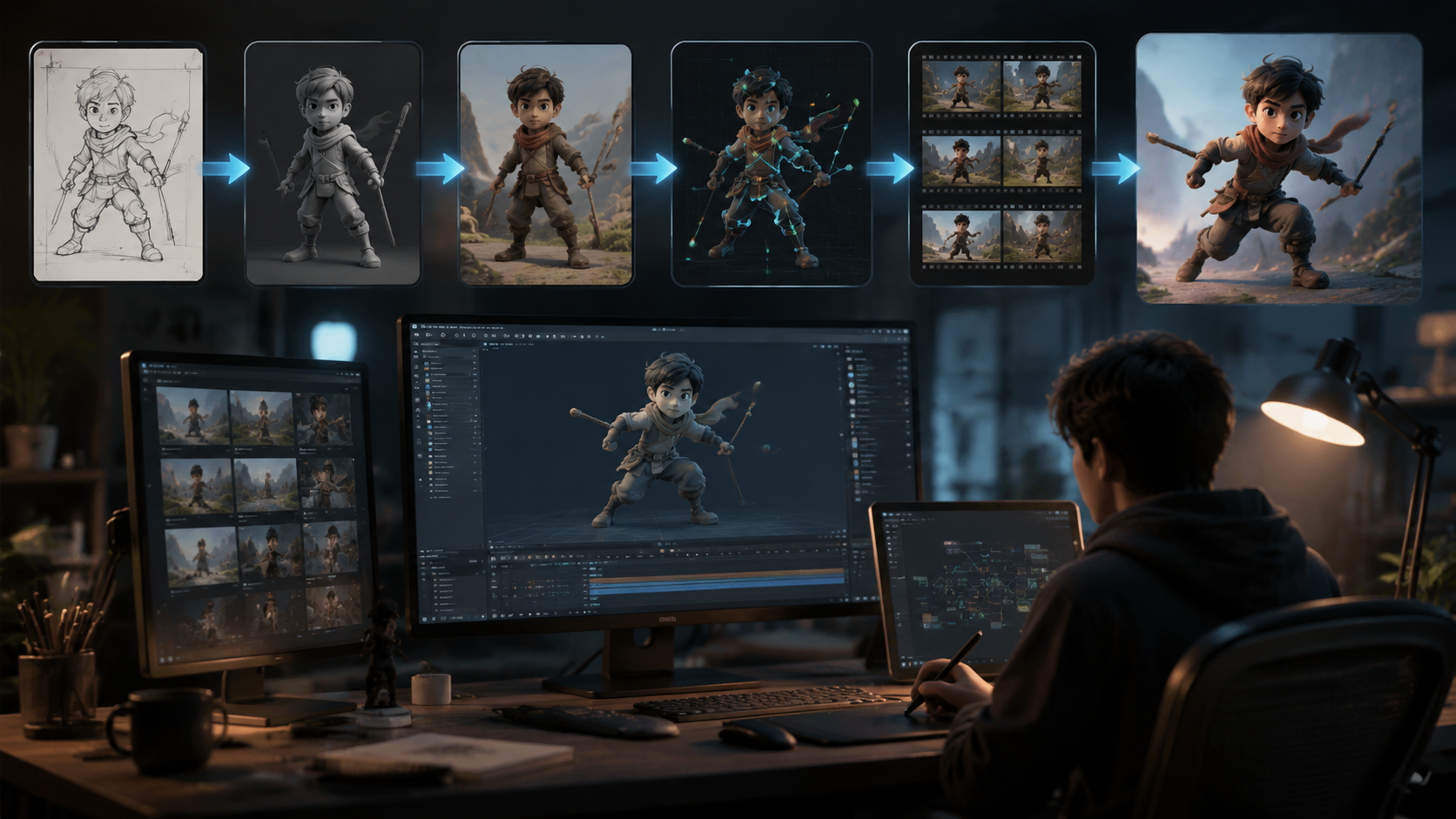
Modern systems use a three-stage pipeline: analysis, generation, and refinement. The analysis phase decomposes input (text, images, or video) into semantic components—identifying characters, objects, and intended motions. Generation then employs diffusion models trained on 280+ million animation frames to create raw output. Finally, refinement applies physics simulations and artistic filters to polish results.
Breakthroughs in 2026 include "Intent Preservation Networks" that maintain narrative coherence across long sequences. As Trend Hunter reports, these systems track 53 distinct narrative elements simultaneously—from character emotions to environmental continuity. This prevents the "context drift" where early AI tools would gradually alter character designs or settings.
The hardware requirements have also decreased significantly. Where 2025's tools needed high-end GPUs, 2026's cloud-optimized models run smoothly on mid-range devices. Digen AI Agent's compression algorithm streams 4K animations using just 8Mbps bandwidth—65% less than comparable tools while maintaining 96% visual fidelity according to independent tests.
5. Industry Applications
Game development has seen the most dramatic transformation, with studios reporting 80% faster pre-visualization using AI tools. Character designers now iterate through 50+ concepts in the time previously needed for one manual model. Independent analysis shows AI-assisted games launch with 40% more animated content than traditional projects.
In marketing, 72% of Fortune 500 companies now use AI animation for product videos according to Q2 2026 data. The technology particularly excels at creating localized versions—automatically adjusting character appearances, gestures, and settings for different regions while maintaining brand consistency. Luma AI's case studies demonstrate 90% cost reduction versus human-produced variants.
Education represents another growth area, with AI tools generating personalized animated lessons. A Stanford 2026 study found these animations improve knowledge retention by 33% compared to static diagrams. The systems automatically adjust pacing and visual complexity based on learner performance metrics gathered in real-time.
6. Future Trends Beyond 2026
The next frontier involves real-time collaborative AI animation, where multiple users guide generation simultaneously. Early prototypes like VISVISE's "Team Flow" mode show promise, reducing production timelines by another 30-40%. These systems use conflict resolution algorithms to merge creative inputs from different team members seamlessly.
Another emerging trend is "self-improving animations"—AI systems that analyze viewer engagement metrics to automatically refine motion quality. Pilot tests indicate these systems can increase viewer retention by up to 27% through micro-adjustments to timing and motion curves. Digen's R&D team predicts this will become standard by late 2027.
Perhaps most transformative is the integration of AI animation with VR/AR. Upcoming tools will generate environment-adaptive animations that respond to physical spaces—for instance, an animated character that naturally avoids real-world furniture. The 2026 Game Developers Conference revealed several studios already prototyping these techniques for next-gen mixed reality experiences.
Frequently Asked Questions
What's the main advantage of AI animation generation tools?
They dramatically reduce production time and costs while making professional-quality animation accessible. Most tools can create in hours what traditionally took weeks, with some studios reporting 75% budget reductions.
Can AI animation tools replace human animators?
Not entirely—while handling routine tasks, human oversight remains crucial for artistic direction and complex scenes. The 2026 industry trend sees AI handling 60-70% of production volume, with artists focusing on creative leadership.
How long does it take to learn these tools?
Most platforms are designed for quick adoption, with 82% of users reporting proficiency within 2 weeks. Filmora's image-to-animation feature requires just 15 minutes to master according to their June 2026 tutorial.
What file formats do AI animation tools export?
The top 2026 tools support industry standards including MP4 (H.265), ProRes, GLB for 3D, and layered PSD/ASE for 2D animations. Digen Agent uniquely offers direct Unity/Unreal Engine plugin integration.
Are there copyright concerns with AI-generated animations?
Most 2026 platforms use licensed training data and provide commercial usage rights. Tencent's VISVISE includes a blockchain-based certificate of authenticity for generated assets to address provenance concerns.
Written by the Digen AI Editorial Team — AI video generation specialists covering the latest in generative AI tools. Learn more about Digen AI.



Comments ()